Alternative Answers: How to Get Your Holistic Care Covered




Health insurance for alternative medicine remains one of the most confusing aspects of healthcare coverage in America. Most plans cover some complementary and alternative medicine (CAM) therapies - like chiropractic care - almost universally, while others like acupuncture and massage therapy receive only partial coverage or none at all. The key factors that determine coverage include:
The financial stakes are significant. CAM represents a $30 billion industry in America, yet coverage remains inconsistent. Research shows that between 2002 and 2012, the use of acupuncture, chiropractic, and massage increased far more among those without health insurance than those with it. When coverage exists, it's typically partial rather than full - and only about one-third of commercial and government-sponsored plans covered acupuncture at all in recent reviews.
This guide cuts through the confusion. You'll learn which therapies insurers typically cover, why they deny claims for holistic care, how to appeal denials with evidence, and practical strategies to reduce out-of-pocket costs when insurance won't pay. We'll also explore emerging integrated health plans that are changing how employers and employees access complementary medicine.
Note: Adaptify SEO is not a healthcare provider or insurer. We publish practical, search-driven explainers like this because agencies and brands in regulated categories (including healthcare and insurance) often need clear, well-structured content that answers real user questions. If you're an agency building SEO content for benefits platforms, employer wellness programs, clinics, or health publishers, this article shows the level of clarity and source-backed structure that performs in organic search.

Before we dive into the nitty-gritty of coverage, let's first clarify what we're talking about. Complementary and Alternative Medicine (CAM) refers to a group of diverse medical and healthcare systems, practices, and products that are not generally considered part of conventional medicine. "Complementary" means it's used together with conventional medicine, while "alternative" means it's used in place of conventional medicine. Often, you'll hear the term "integrative health," which implies coordinating conventional and CAM approaches in a holistic way.
The world of health insurance for alternative medicine operates on different principles than coverage for conventional treatments. For traditional medical procedures, the path to coverage is often clearer. However, when it comes to CAM, insurers weigh several factors carefully.
The primary criteria insurance companies use to decide whether to cover a CAM service often boil down to:
The implications of this limited coverage are profound. While the use of CAM therapies like acupuncture, chiropractic, and massage has risen, the increase has been "much more pronounced among those who did not have health insurance," according to a study analyzing 2012 NHIS data. This suggests that financial barriers significantly influence who can access these treatments. For those who do have health insurance, coverage for these therapies is "more likely to be partial than full."
Why this topic appears on Adaptify SEO: search demand for queries like "is acupuncture covered by insurance" or "massage therapy insurance coverage" is high, and the intent is informational. Agencies serving benefits companies, wellness brands, and clinics often need content that answers these questions clearly, cites reputable sources, and sets expectations - the kind of work Adaptify.ai helps automate and scale.
Navigating your health insurance plan can feel like solving a riddle, especially when it comes to alternative therapies. To avoid unwelcome surprises (like a bill for a service you thought was covered), I always recommend becoming a proactive advocate for your own care. Here are some key questions I suggest asking your insurance provider about CAM coverage:
Remember to keep meticulous records of all your interactions with your insurance company. Note down the date, time, representative's name, and a summary of the conversation. Keep copies of all bills, claims, and correspondence. This documentation can be invaluable if you encounter a claim dispute.
The gatekeeper to health insurance for alternative medicine coverage is often scientific evidence. Insurers, like Aetna, base their decisions on whether a treatment is "supported by adequate evidence of safety and effectiveness in the peer-reviewed published medical literature." This is where many CAM therapies face an uphill battle.
Many alternative medicine interventions are considered "experimental, investigational, or unproven" by major insurers. This doesn't necessarily mean they don't work for some individuals, but rather that there isn't enough robust, large-scale scientific research to meet the insurer's criteria. Aetna's Clinical Policy Bulletin on Complementary and Alternative Medicine lists hundreds of therapies they consider experimental or unproven, ranging from acoustic therapy for anxiety to crystal healing, aromatherapy, and even yoga and Pilates in some contexts.
The main reasons why CAM therapies are not covered by insurance often stem from this lack of what insurers deem "adequate evidence":
This reliance on scientific evidence means that even if a CAM treatment is popular or personally effective for you, it might not be covered. It highlights the significant difference in how health insurance for alternative medicine is evaluated compared to conventional treatments, which often have decades of clinical trials and established protocols backing them.
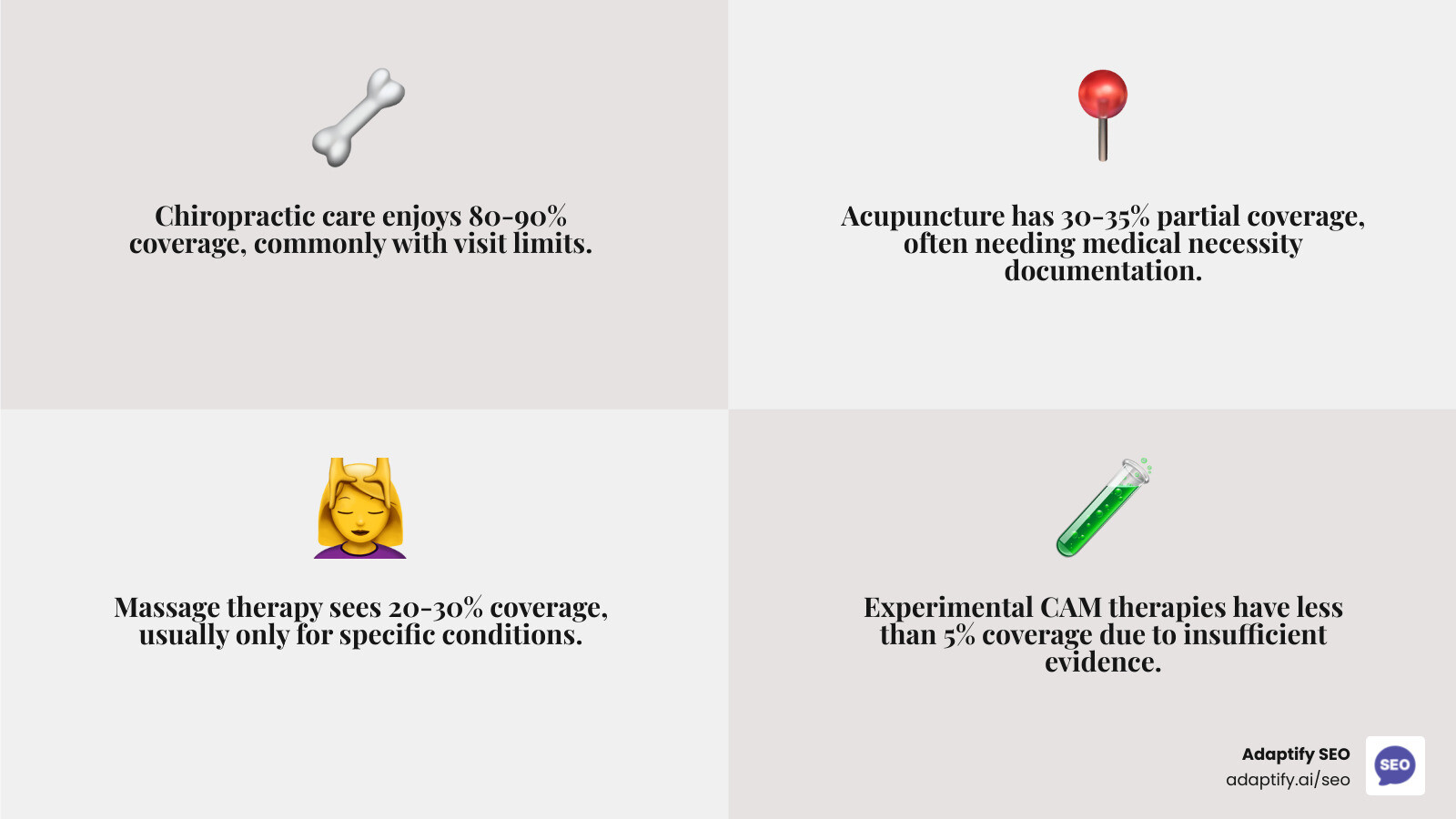
When we talk about specific CAM therapies and their insurance coverage, it's clear that not all alternatives are created equal in the eyes of insurers. Here's a general overview of some commonly discussed CAM therapies and their typical coverage status:
| CAM Therapy | Typical Coverage Status |
|---|---|
| Chiropractic Care | High (80-90%); widely covered for musculoskeletal conditions, often with visit caps. |
| Acupuncture | Partial (30-35%); often covered for chronic pain or nausea with medical necessity. |
| Massage Therapy | Low (20-30%); typically requires a prescription for specific medical conditions. |
| Biofeedback | Variable; may be covered for specific neuromuscular or behavioral health conditions. |
| Experimental (e.g., Crystal Healing) | Very Low (<5%); almost never covered due to lack of peer-reviewed evidence. |
For SEO teams and agencies, tables like the one above are useful because they match how people search (therapy-by-therapy) and can earn featured snippets when the page is well-structured. For more detailed information on navigating these costs, you can consult the Fair Health guide on alternative medicine coverage.

Get help with local SEO to rank higher in Google Maps and dominate neighborhood search results.

Compare health insurance for entrepreneurs with ACA plans, tax deductions, and subsidies to protect your business and budget.

Master search engine optimization and marketing with proven SEO and SEM strategies that boost visibility, drive organic traffic, and deliv...
Join 1,000+ agencies already delivering SEO and AI visibility from a single platform without increasing their headcount.Join 1,000+ agencies already delivering SEO and AI visibility from a single platform without increasing their headcount.