Beyond ChatGPT: Unlocking AI's Full Potential for Your Marketing Agency




AI for digital agencies is rapidly changing how marketing gets done, with widespread adoption to boost performance.
Here’s how AI is impacting digital agencies:
Marketing is always evolving. From print ads to digital campaigns, technology has always driven change, and AI is the latest leap.
As one industry expert noted, "The artificial intelligence wave that’s gripping the business world has an especially interesting hold on digital agencies." We’re moving past the hype into real-world applications as agencies find concrete ways AI can help them.
I'm Hansjan Kamerling. With a background leading design for SaaS platforms and working with AI startups, I've seen how AI for digital agencies can automate tasks and drive significant growth.
For digital agencies, AI is no longer science fiction; it's a present-day tool delivering solid results. The focus has shifted from exploration to implementation, with agencies seeing clear, measurable gains.
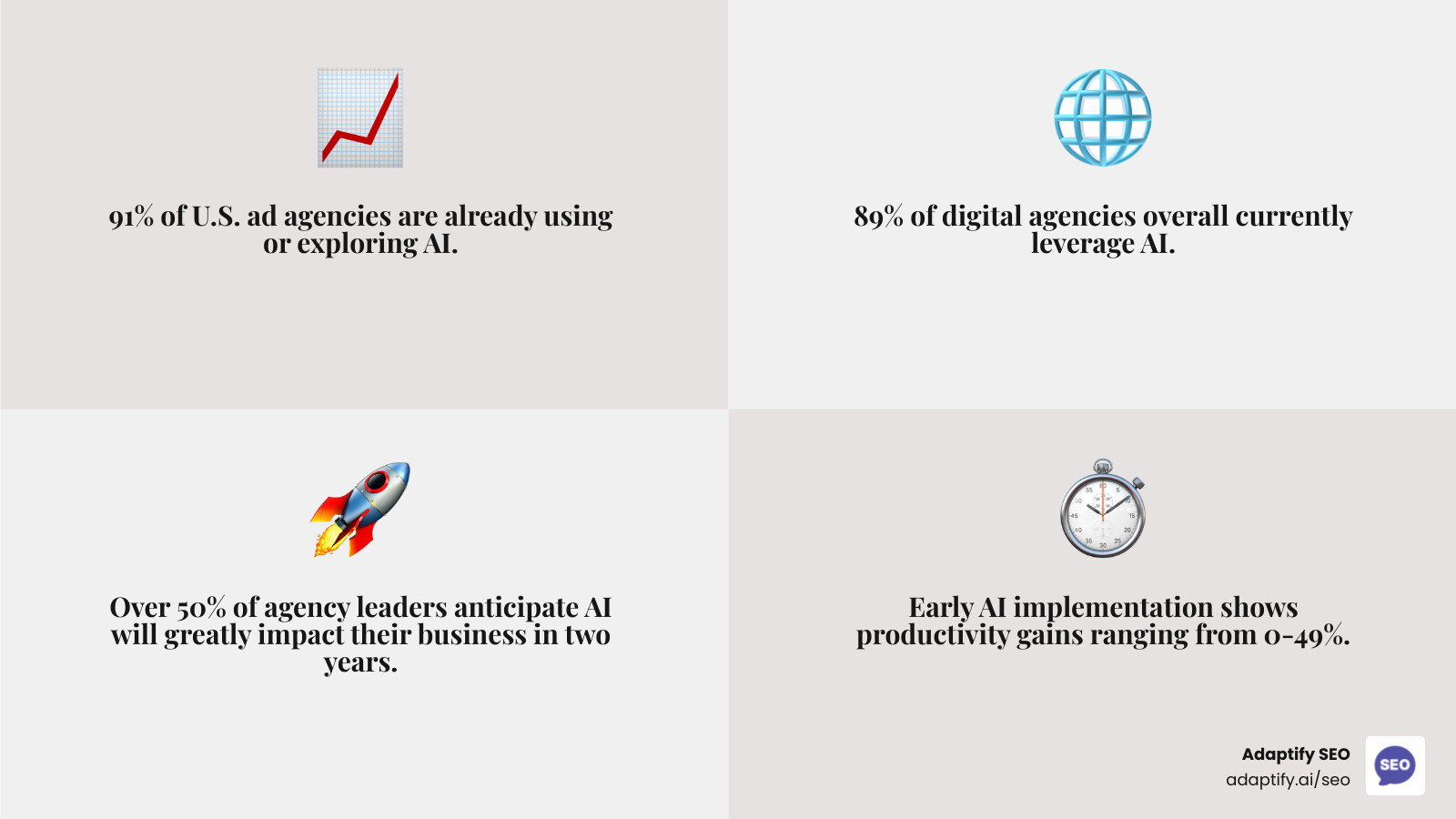
The numbers tell a powerful story. A huge 91% of U.S. advertising agencies are either using (61%) or exploring (30%) generative AI. This signifies a major operational shift, and 89% of digital agencies overall now use AI in some form. This wide adoption shows how vital AI has become.
Adoption rates vary. Larger agencies (over 201 employees) are leading with 78% using generative AI, while 53% of smaller agencies (fewer than 50 employees) are on board. While larger agencies currently lead in adoption, likely due to more resources, this gap is expected to close as AI tools become more accessible and affordable.
The main benefits for agencies are improved productivity, a better return on investment (ROI), and boosted margins. Research confirms this: "Realized productivity gains of 0-49% are common, even in these early stages of AI implementation." A 25-49% productivity gain from AI could push a typical agency's net margins to a remarkable 36%. This fundamentally improves financial health and competitive edge.
AI also revolutionizes personalization. Businesses using AI for personalization see an average 40% increase in revenue. This shows AI directly contributes to client success and agency growth.
A key benefit of AI for digital agencies is a massive reduction in time spent on repetitive tasks—often from hours to minutes. Generative AI can impact nearly half (47%) of all marketing activities. Imagine nearly half of all marketing tasks being automated or significantly accelerated. Companies could save 24% in marketing labor time with generative AI, which is roughly a 30% jump in overall marketing productivity.
This efficiency boost directly reduces operational costs. With automation, some experts predict a 20% drop in agency fees, allowing agencies to pass on savings, increase profits, or reallocate staff to strategic work.
The speed of AI's impact is also remarkable. Most organizations see positive returns within 3-6 months, stemming from better efficiency and marketing performance. This quick ROI makes AI an attractive investment for agencies looking to modernize.
At Adaptify SEO, we understand this need for speed. Our automated proposals, for instance, streamline the sales process, allowing agencies to create data-driven pitches in a fraction of the time. This lets agencies focus on strategy and client relationships while AI handles the rest.
AI is fundamentally changing how digital agencies operate and generate revenue, shifting them from labor-intensive businesses to highly efficient, data-driven models. This sets a new industry standard.
As mentioned, productivity gains of 25-49% from AI could mean a 36% net margin for the average agency. This level of margin increase positions AI as a key driver for profitability and higher agency valuations. AI-powered agencies are not just more efficient; they are more valuable.
This provides a direct competitive edge. AI-driven agencies can offer faster turnarounds, more personalized campaigns, and data-backed results. Competitors without AI struggle to keep up. AI-driven agencies can scale more easily, handling more clients and larger campaigns without proportional increases in staff.
Generative AI can affect 47% of marketing activities, fundamentally changing content creation, campaign management, and client relationships. Embracing AI is about future-proofing your agency, actively shaping its future to ensure it remains relevant and profitable in an AI-driven market.
AI for digital agencies involves practical, real-world applications that are changing daily operations. AI is integrating into every part of agency work, from ideation to client reporting.
One of the most impacted areas is content creation. Research shows 76% of respondents see generative AI significantly impacting content creation. This is unsurprising, as AI can draft copy, generate images, and even create video.
Beyond content, AI is revolutionizing media buying, SEO, and client reporting with greater precision, automation, and speed. Its ability to analyze vast data sets provides actionable insights that drive personalization and creativity.
Contrary to the belief that AI stifles creativity, it acts as a powerful co-pilot for AI for digital agencies, supercharging both the quantity and quality of creative output.
A critical application is creative ideation, which 74% of agencies using generative AI rate as a high or critical priority. AI can analyze successful campaigns, identify trends, and generate hundreds of concepts, freeing human creatives to focus on refinement and groundbreaking ideas instead of starting from scratch.
AI also excels at generating content at scale, from social media posts to full articles. This speed is crucial for personalization, enabling custom messages for audience micro-segments, which was previously impractical. For instance, 49% of respondents said generating assets for dynamic creative optimization is a high or critical priority, highlighting AI's role in creating variations for testing and improvement.
Adaptify SEO integrates powerful AI content tools to help agencies with SEO. Our features include:
This allows you to create optimized, engaging content faster. You can explore more about our AI content services to see the benefits for your strategy.
AI is changing the complex world of media buying and campaign management for AI for digital agencies, bringing new levels of automation, precision, and optimization.
AI improves data-driven programmatic advertising. Its algorithms analyze real-time bidding data to purchase ad space aligned with campaign goals, ensuring optimal budget spend through intelligent, real-time decisions.
AI excels at budget optimization by monitoring cross-channel performance, identifying opportunities, and adjusting budgets automatically. This reduces wasted ad spend. Performance tracking is also more sophisticated, with AI monitoring metrics, flagging anomalies, and predicting potential issues.
Predictive analytics is another powerful application. AI analyzes historical data and trends to forecast the best media mix, helping agencies make smarter investment decisions for their clients.
This automation extends to other marketing activities, like building a strong SEO backlink profile. At Adaptify SEO, our automated backlink strategies use AI to identify opportunities and streamline outreach, consistently building authority and visibility.
Demonstrating value through clear reporting is paramount for digital agencies but can be time-consuming. This is where AI for digital agencies excels.
AI tools process massive raw data sets into actionable audience insights. AI quickly identifies trends and behaviors, providing a deeper understanding of the target audience without manual data sifting. Research supports this, with 59% of respondents using generative AI to summarize audience insights.
AI also efficiently summarizes marketing performance results, with 49% of generative AI users leveraging it for this purpose. This allows agencies to generate performance summaries faster for more frequent client communication.
AI also enables predictive reporting, offering forecasts based on past trends to help clients make proactive decisions. It can also perform sentiment analysis on reviews and social media to gauge brand perception.
As an Adaptify SEO client noted, "Using the AI features in Adaptify SEO helps us summarize a client report much faster." This frees account managers to focus on strategy instead of data compilation. We also offer white-label reporting, allowing agencies to deliver branded, AI-powered reports to clients effortlessly.
Adopting AI for digital agencies is a major business change, not just a tool upgrade. It requires strategic planning, addressing challenges, and establishing clear ethical guidelines to ensure responsible and effective growth.
Your implementation plan should detail how new AI tools integrate into daily workflows. Selecting the right tools for your agency's specific needs is crucial. Preparing your team is also key, which involves addressing employee skills and fostering a culture of learning and adaptation.
Key considerations include legal concerns like IP ownership of AI-generated content and strong ethical guidelines for responsible data handling. How agencies steer these challenges will define their success and client trust in the AI era.
The biggest hurdle in AI adoption is often human, not technical. Skill gaps and employee resistance, typically stemming from job security concerns or perceived complexity, are common challenges. However, agencies can overcome this by taking proactive steps.
Training programs are vital. With only about one in five agencies offering them, there's a significant opportunity to close the knowledge gap. Training should focus on both tool usage and how AI augments human capabilities.
Workflow integration is essential. AI must integrate smoothly with existing systems like CRMs and content platforms via APIs, webhooks, native connectors, or middleware solutions to ensure seamless data flow.
Effective change management is also key. A phased AI rollout can manage costs and ease team adoption. Start with small, high-impact projects, showcase successes, and build momentum.
As Shopify's CEO mandated in a memo to employees, they must leverage AI. This is a near-necessity for agencies aiming for growth and relevance. Fostering a culture of experimentation with AI will open up new efficiencies and opportunities.
While AI offers exciting benefits, it also presents legal, ethical, and governance challenges for AI for digital agencies that require proactive management.
A pressing concern is legal liability regarding IP ownership, attribution, and copyright infringement, cited as a major issue by most agencies (94% of those exploring and 83% of those using AI). Questions around ownership of AI-generated content and potential infringement from training data are still evolving. Clear contracts with clients and vendors are essential.
Data privacy is another major concern. Agencies must ensure strong data security and comply with regulations like GDPR and CCPA. Bias in AI is a serious ethical issue; models trained on biased data can perpetuate unfairness. Regular audits and careful data selection are crucial to mitigate this.
To clarify the landscape, here’s a comparison of AI Agents and AI Marketing Agencies:
| Feature | AI Agents | AI Marketing Agencies |
|---|---|---|
| Nature | Software tools; autonomous programs | Service providers (human-led, AI-improved) |
| Function | Automate specific tasks | Deliver full-service marketing solutions |
| Autonomy | High (within defined parameters) | Human strategists make decisions, AI supports |
| Cost Model | Often subscription-based | Project-based, retainer, or value-based |
| Role | Augment human teams, handle repetitive work | Leverage AI tools to serve clients comprehensively |
| Key Benefit | Efficiency, speed, scalability for specific tasks | Strategic oversight, creativity, relationship building, integrated solutions |
| Example | Lead qualification agent, content generation tool | Adaptify SEO (a human-led agency providing AI-powered SEO solutions) |
Staying current with regulations like the EU AI Act is a legal necessity and a mark of leadership. Agencies prioritizing ethical AI and strong governance will build client trust and stand out.
The AI landscape for AI for digital agencies is shifting rapidly, leading to new business models and service offerings. The skills required for success are evolving, moving beyond simple tool adoption to a fundamental business change.
This is a revolution, not just an evolution. The traditional agency model is being replaced by more dynamic structures. We're seeing the rise of niche specialization in AI-powered solutions, more collaborative agency-client relationships based on real-time data, and changing roles that allow marketers to focus on high-value human tasks.
The global AI market is projected to reach approximately $826.7 billion by 2030, a market change that smart agencies are preparing to capitalize on.
Once futuristic, the "AI agency" is now a fast-growing segment in digital marketing. These are not traditional agencies using AI tools, but organizations built fundamentally around AI.
AI agencies are unique in their deep leverage of machine learning for automation, optimization, and customer behavior insights, making it their core competitive advantage, not just an add-on.
Many find success through niche specialization, such as Natural Language Processing for advanced content strategies or computer vision for ad targeting. This focus allows them to deliver superior results and charge premium rates.
The integration of autonomous agents is a game-changer. These intelligent programs make decisions, such as qualifying leads or adjusting campaign budgets in real-time. They are sophisticated, adaptive systems, not simple scripts.
This shift to AI-powered business models creates new revenue streams. Many AI agencies are adopting performance-based or subscription pricing instead of hourly billing, reflecting the value of their efficiency.
As noted in an analysis of the AI agency business model, these firms are becoming "highly efficient, data-driven machines" that adapt strategies in real-time.
AI isn't replacing marketing jobs; it's elevating the profession. It frees marketers from repetitive tasks to focus on uniquely human skills.
Strategic thinking is now the most valuable skill. With AI handling data analysis, marketers can focus on high-level strategy, identifying opportunities, and understanding client objectives to drive breakthrough insights.
Creativity remains a human domain. While AI can assist, true innovation that builds emotional connections requires a human touch. Creative teams can now focus more on concepts than production.
Emotional intelligence is increasingly valuable. Building client relationships, managing team dynamics, and understanding consumer psychology are key differentiators where human intuition excels.
A new key skill is prompt engineering: the art and science of communicating effectively with AI models. Mastering this open ups AI's full potential.
Data storytelling is another crucial skill. It involves translating AI-generated insights into compelling narratives that drive client decision-making.
The future belongs to marketers who master human-AI collaboration. Success lies in partnering with AI, leveraging its strengths while contributing human intuition, empathy, and creativity.
AI is making marketing more human, not less. By automating routine tasks, it allows us to focus on the strategic, creative, and relationship-building aspects of our work.
We've seen that AI for digital agencies is no longer a buzzword but a transformative force. It's reshaping our industry, moving beyond hype to deliver quantifiable benefits.
We've covered how AI boosts productivity and ROI, changes operational economics, and redefines client relationships. AI is here to stay, offering incredible advantages.
To recap, AI:
This shift demands new skills like strategic thinking, creativity, emotional intelligence, and human-AI collaboration. AI is also reshaping business models, paving the way for specialized AI agencies and autonomous agents.
For agencies to thrive, partnering with AI is essential for growth. This means moving beyond individual tools to integrate comprehensive platforms that streamline workflows and provide a strategic advantage.
This is where Adaptify SEO comes in. We are a comprehensive SEO automation partner for agencies, offering AI-powered solutions to reduce manual effort, boost efficiency, and drive client results. Our platform helps agencies in the US, the UK, and Australia harness AI for strategy, content creation, and PR link building.
The future of agency work is collaborative, intelligent, and exciting. Don't get left behind.
Book a Demo today and let's open up AI's full potential for your marketing agency.

Stop being invisible: discover what the best local SEO strategies for small businesses are to dominate Google Maps, reviews, and AI search...
Master localized SEO to rank your local business in Google Maps and drive more in-store visits.
Master local retail SEO to drive foot traffic from Google with proven strategies for GBP, reviews, and AI search optimization.
Join 1,000+ agencies already delivering SEO and AI visibility from a single platform without increasing their headcount.Join 1,000+ agencies already delivering SEO and AI visibility from a single platform without increasing their headcount.