Boost Your ROI: The Ultimate Guide to Evaluating Marketing Agencies




Growth marketing agency evaluation criteria are the make-or-break factors that determine whether your agency investment drives real revenue or just drains your budget. When you're choosing a partner to scale your business, you need a systematic way to compare options, verify claims, and avoid costly mistakes.
Here are the essential criteria to evaluate any growth marketing agency:
According to research, only 23 percent of marketers are confident in tracking the right KPIs—which means most businesses struggle to evaluate agencies effectively. The wrong choice leads to months of wasted spend, misaligned expectations, and revenue plateaus. The right choice open ups sustainable growth through data-driven strategies and full-funnel optimization.
As Hansjan Kamerling, I've worked with SaaS platforms, AI startups, and growth teams that scaled from zero to millions of users, and I've seen how proper growth marketing agency evaluation criteria separate winning partnerships from disappointing ones. In this guide, I'll walk you through the exact framework top agencies use to prove their value—and how you can use it to make smarter hiring decisions.
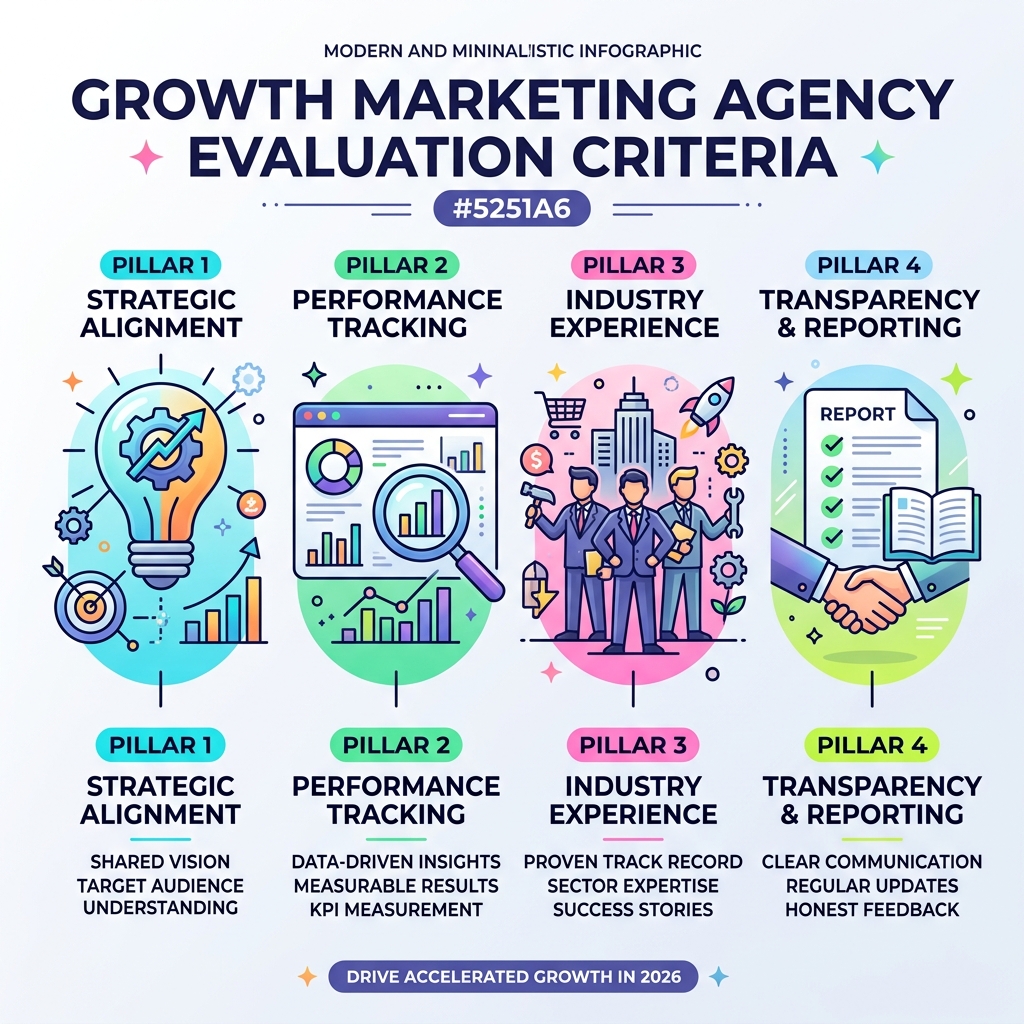
When I look at a potential agency partner, I don't just look at their flashy website. I look for a "growth system." Most traditional agencies focus on a single service—like just running ads or just writing blogs. But real growth is a system where SEO, ads, conversion, and retention are all talking to each other.
To evaluate an agency effectively, you should use a scorecard. I recommend a total score threshold of at least 80% to consider an agency reliable. If they score lower, you're likely entering a "trial and error" partnership rather than a data-driven one.
The core components of a successful strategy they should present to you include:
Before you even jump on a findy call, you need to know where you stand. I always suggest performing an analytics audit. Did you know there are over 2.6 billion online buyers worldwide? To reach your slice of that pie, you need S.M.A.R.T. (Specific, Measurable, Achievable, Relevant, Time-bound) goals.
Ask the agency how they set revenue targets. If they promise "to make you go viral" without mentioning your current conversion rate or customer acquisition cost (CAC), run the other way. A great agency will ask for your historical data to establish a baseline before they even send a proposal.
I’ve learned the hard way that a brilliant strategist who doesn't communicate well is a liability. You want an agency that integrates with your team like a "hybrid" department. Check their presence in places like the Exit Five Community or their LinkedIn updates. Are they thought leaders, or just task-takers?
Transparency is non-negotiable. If they hesitate to show you their internal project management tools or how they resolve conflicts when a campaign fails (and some will fail!), that's a red flag. Growth marketing is about learning from failure, not hiding it.
Experience in your specific sector is a massive shortcut to success. While a generalist agency can learn, a specialist already knows your buyer's pain points. I always check an agency's Clutch profile to see what real clients say about their industry expertise.
Look for a founder track record. Have they scaled a startup themselves? This "embedded" knowledge is rare and valuable. Also, verify their case studies with raw numbers. For instance, since search engines drive 68% of total search traffic, an agency claiming growth expertise must demonstrate a deep understanding of organic search and content scaling.
This is where we separate the "task suppliers" from the "strategic partners." A strategic agency builds a system. In my experience with the Adaptify SEO platform, the most successful agencies are those that automate the mundane tasks—like keyword research and technical audits—so they can focus on high-level strategy.
| Feature | Single-Service Agency | Full-Funnel Growth Agency |
|---|---|---|
| Focus | Channel specific (e.g., just Ads) | Unit economics (LTV/CAC) |
| Reporting | Monthly PDF reports | Real-time dashboards |
| Methodology | Set and forget | Rapid experimentation |
| Strategy | Tactical/Execution | Holistic/Growth Loops |
If you want to dive deeper into how modern agencies handle high-volume content, check out more info about SEO content strategies.
A growth agency is only as good as its tech stack. You should ask about their proprietary tech or how they use industry benchmarks. Some of the best teams use industry benchmarks to see how you stack up against competitors.
They should also be transparent about their internal operations, using time tracking software to ensure you’re getting the value you pay for. Most importantly, ensure they follow IAB, MRC Viewability Guidelines for their ads. If they don't know what these are, they might be wasting your budget on "invisible" ad impressions.
Does the agency actually get your brand? A deep understanding looks like identifying buyer pain points that your own team might have missed. They should be able to explain your helpful content strategy in a way that resonates with human readers, not just search bots.
If you’re feeling lost in the jargon, I recommend keeping a Marketing Terms Cheat Sheet handy during your meetings. An agency that can't explain their work in plain English probably doesn't understand it well enough themselves.
In growth, speed is a feature. Top agencies aim for "weekly shipping." This doesn't mean they change your whole strategy every seven days; it means they are constantly testing small variables—a headline here, a CTA button there.
They should follow the principles of Kohavi et al., Controlled Experiments to ensure their tests are statistically significant. This rigorous approach is how you achieve an incredible 2,000% traffic boost through superior content and iterative testing.
If you can't measure it, you can't grow it. An agency should provide a real-time data dashboard that tracks everything from top-of-funnel awareness to bottom-of-funnel revenue.
Essential growth metrics include:
Attribution is messy. Between privacy changes and multi-device journeys, knowing exactly which ad led to a sale is hard. That’s why I look for agencies that use "blended" measurement. They should use cohort analysis and geo holdouts to prove that their marketing is actually driving new revenue, not just claiming credit for people who would have bought anyway.
The MRC provides standards for this, and a good agency will follow them. Retaining an existing customer is much cheaper than finding a new one—loyal customers are five times more likely to repurchase. Your agency should have a plan for retention, not just acquisition.
Transparency in reporting is where most agencies fail. Only 23 percent of marketers feel they are tracking the right things. A trustworthy agency gives you full dashboard access—no "gatekeeping" your own data.
I often point my clients to the Harvard Business School YouTube channel to understand the financial side of marketing. If you want to see how we handle the technical side of reporting and link building, you can find more info about SEO backlinks on our site.
The proposal is the agency’s first "deliverable." If it’s sloppy, their work will be too. I’ve seen companies use pitch deck consulting services to make their proposals look pretty, but you need to look for substance.
Red flags to watch out for:
Before you sign anything, watch this YouTube video to arm yourself with the right questions.
Growth takes time. For SEO and content, you should expect to see results in 3-6 months. If an agency promises instant organic traffic, they are likely using "black hat" tactics that will eventually get you penalized by Google.
Check their SEO pricing models. I prefer monthly retainers with a 30-day exit clause—this keeps the agency hungry to deliver results every single month. For a look at how to structure these agreements, see more info about SEO proposals.
Should you hire an agency or build an entire growth team in-house?
Hiring an in-house team is expensive and slow. You need a developer, a designer, a copywriter, and a strategist. An agency gives you instant access to this "squad." Many businesses now opt for a “hybrid” growth team model, where the agency fills the strategic and technical gaps that the internal team can't cover.
If you do manage people internally, you might use employee monitoring tools, but with an agency, you monitor the outcomes, not the hours.
For SEO, it generally takes 3-6 months to see meaningful movement in rankings and organic leads. PPC (Paid Search) can show results in weeks, but it takes time to optimize for the best CPA. Always check the average website conversion rate for your industry to set a realistic baseline for what "success" looks like.
Startups should live and die by CAC (Customer Acquisition Cost) and LTV (Lifetime Value). I also apply the specifically 80% Pareto principle—80% of your future revenue will likely come from 20% of your current customers. Focus on retention, as the acquisition likelihood for a new prospect is only 5% to 20%, compared to 60-70% for an existing customer.
A task supplier asks, "What do you want me to do?" A strategic partner says, "Here is the data-driven path to your revenue goal." You can find out which one you're talking to by scheduling a strategy session. Ask them for creative ways to maximize ROI—if they only suggest "increasing the ad budget," they aren't being strategic.
Choosing the right partner is the most important growth decision you'll make this year. By using these growth marketing agency evaluation criteria, you move from guesswork to a system of predictable growth.
At Adaptify SEO, we believe in automated efficiency. We help agencies and businesses scale their organic presence without the manual grind of traditional SEO. If you're ready to see how a data-driven, automated approach can transform your results, explore our SEO Overview and see how we engineer growth from the ground up.

Compare automated SEO vs manual SEO to build a hybrid workflow that scales rankings with human oversight in 2026.

Master SEO service differentiation to stand out in a crowded market and prove your agency's unique business-first value.
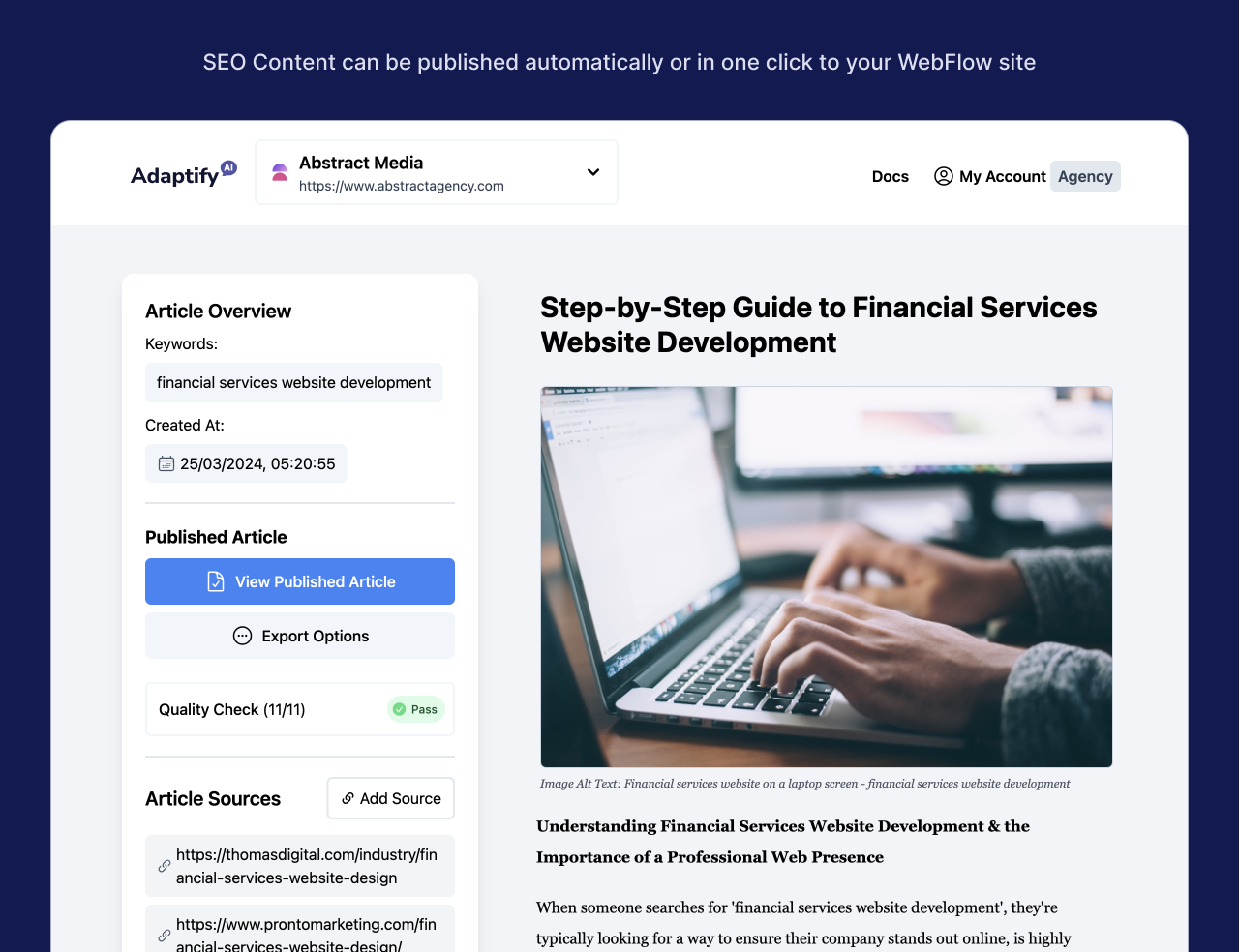
Stop wasting hours—automate your SEO reports to boost agency efficiency and client trust.
Join 1,000+ agencies already delivering SEO and AI visibility from a single platform without increasing their headcount.Join 1,000+ agencies already delivering SEO and AI visibility from a single platform without increasing their headcount.