Build Links That Last: The Power of Content-Driven Strategies




Content based link building is the process of creating valuable content that naturally attracts high-quality backlinks. This strategy focuses on earning links through merit, not manipulation.
Quick Answer for Content-Based Link Building:
Data shows that over 96% of websites in Google's top 10 have more than 1,000 backlinks from unique domains. However, it's not just about quantity. Google's algorithms prioritize relevance, authority, and user value.
Furthermore, content longer than 3,000 words gets 77.2% more referring domain links than shorter content because comprehensive pieces become go-to resources.
Smart SEOs build sustainable link profiles with helpful content, aligning with Google's E-E-A-T framework (Experience, Expertise, Authoritativeness, Trustworthiness) for lasting value.
The rise of generic AI articles makes this strategy even more powerful. Human-expert content with original insights stands out, creating opportunities for those who invest in quality.
I'm Hansjan Kamerling. I've scaled SEO for startups and agencies, using content based link building for organic growth in fintech, automotive, and SaaS, where it made the difference between growth and stagnation.
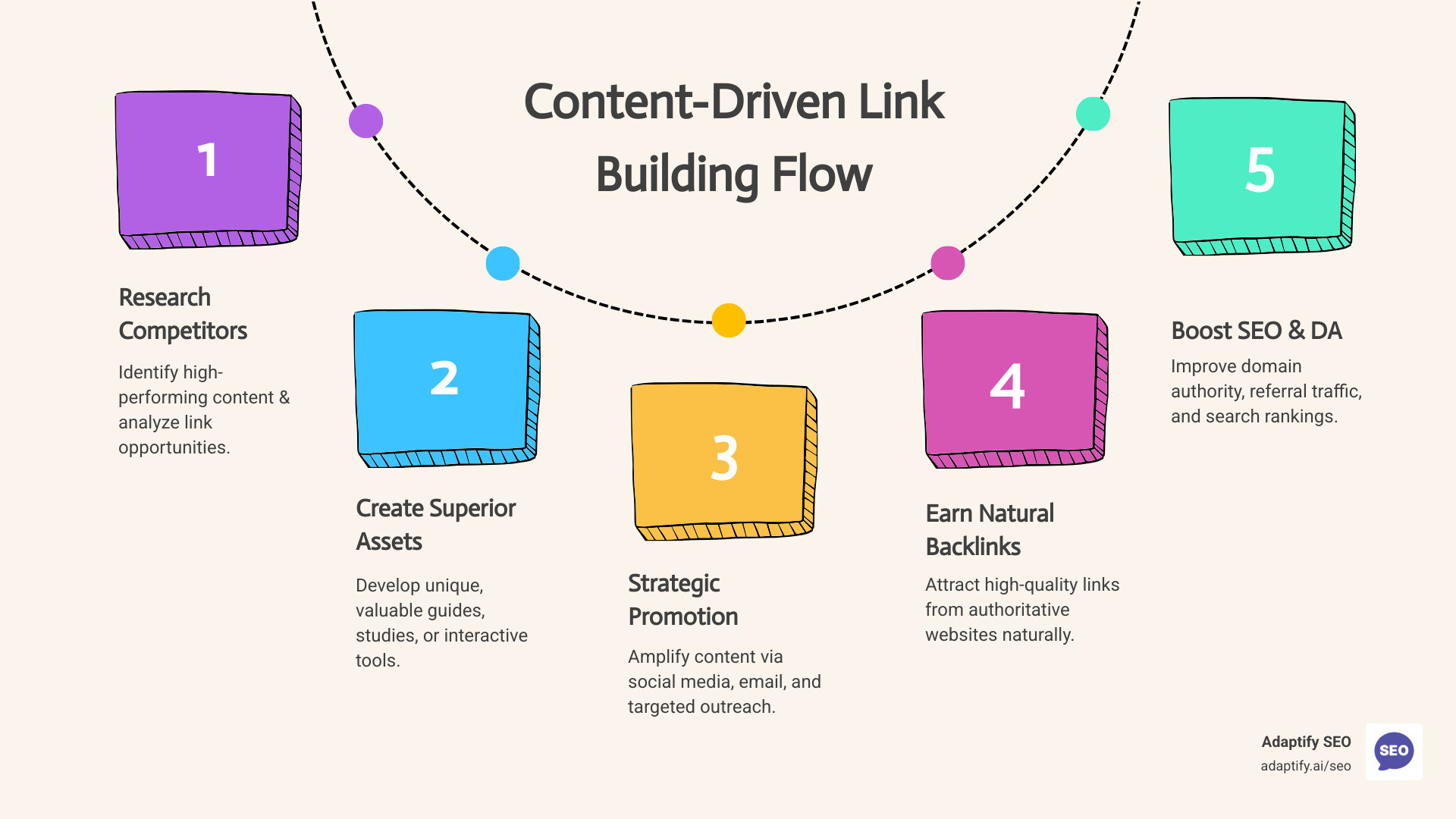
Truly effective content based link building means creating something so valuable that people feel compelled to reference it. The goal is to understand what makes content genuinely helpful and then execute it better than anyone else.
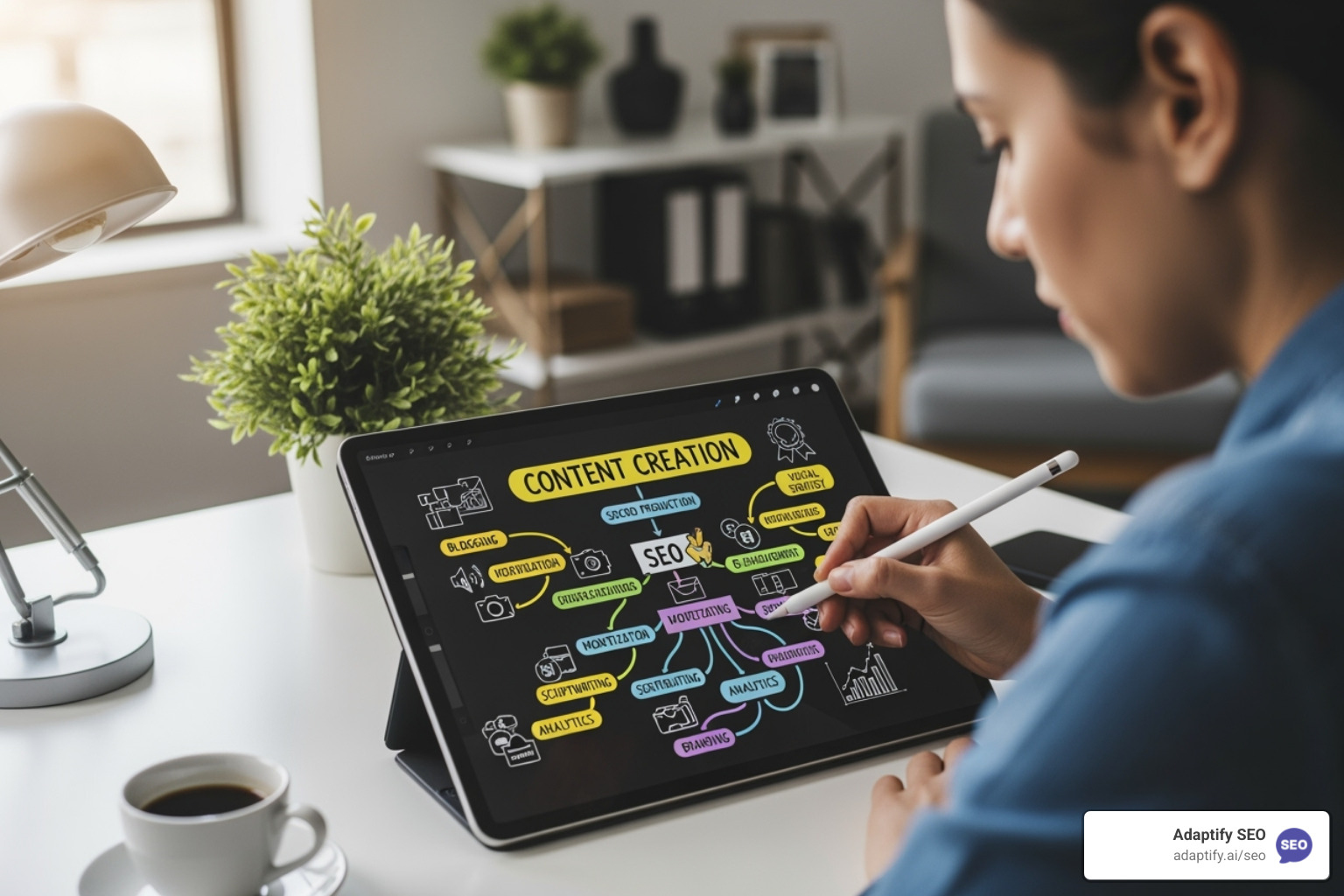
Link-worthy content has a few key ingredients that transform it from ordinary to exceptional.
Original research is paramount. When you publish your own studies, you become the source everyone quotes. Studies show that 74% of marketers see increased website traffic from original research, while 49% agree this content type excels at attracting backlinks.
Data-driven insights interpret what the numbers mean. Don't just present data; explain why it matters for your industry's future.
Provide actionable steps that readers can implement. Content that helps solve real problems gets bookmarked and shared.
Unique perspectives cut through the noise. Challenge conventional thinking or share personal experiences to make your content irreplaceable.
Above all, satisfy user intent. Your content must directly answer the questions your audience is asking. Use platforms like Quora or industry forums to understand their real problems.
Finally, aim for comprehensive coverage. Research analyzing 100 million articles found that long-form content gets more shares. More importantly for content based link building, a study on long-form content shows pieces over 3,000 words earn 77.2% more referring domain links. Cover a topic completely, without fluff.
Certain formats naturally attract more links. Focusing on these linkable assets improves results.
Long-form ultimate guides become definitive resources that earn links for years.
Case studies with "Hero Stats" combine storytelling with compelling data, giving creators an irresistible statistic to cite (e.g., "increased conversions by 785%").
Original surveys and industry studies establish you as a primary source, which is valuable for journalists and bloggers.
Infographics and visual assets make complex information digestible and shareable. Research shows visuals make content more credible, and they often get embedded with attribution links.
Free tools and calculators solve specific problems and create natural link magnets that other sites want to reference.
Great content fails if it's hard to read. Visual appeal signals professionalism. Custom graphics and consistent branding make content look impressive and more linkable. Even templates work well if improved with custom visuals and thoughtful formatting.
Use short paragraphs (1-2 sentences) to create breathing room. Subheadings and bullet points act as a roadmap for readers. Ensure font size and accessibility are prioritized, with at least 15px for body text. Finally, use flexible design platforms to ensure your content looks great on all devices, especially mobile.
The Skyscraper Technique, coined by Brian Dean of Backlinko, is a powerful framework for content based link building. Instead of starting from scratch, you find the best content in your niche and then build something even more impressive. You already know people value this type of content because they are linking to inferior versions.

This step is about reverse-engineering success to understand what makes content irresistible to linkers.
Start with competitor analysis. Use SEO tools to analyze your competitors' backlink profiles and find their most linked-to pages. When content has attracted hundreds of referring domains, it's a clear signal of what your audience wants.
Using SEO tools effectively means looking for content with many backlinks from diverse, authoritative sources. These are the true skyscrapers in your content landscape.
A pro tip is to find "Journalist Keywords." Journalists and bloggers constantly search for specific stats or expert insights. Analyzing why certain pages attract media attention reveals the exact angles that earn editorial links.
Researching popular content in your industry also involves browsing sites like Quora, industry forums, and Reddit communities. This grassroots research often reveals content gaps your competitors have missed.
"Better" doesn't just mean longer; it means creating something so obviously superior that linking to anything else feels like a compromise.
More comprehensive coverage is a strong advantage. If the top resource has 10 strategies, your guide should cover 25 with detailed examples. This aligns with research showing that thorough content attracts more links.
More up-to-date information is a secret weapon. Outdated guides from years ago present a massive opportunity. Update statistics, add current examples, and reflect new trends to outperform older content.
Better design and UX can make your content irresistible. A beautifully designed, easy-to-steer resource stands out against cluttered competitors. As the original Skyscraper Technique emphasizes, visual appeal increases your chances of earning links.
Added unique insights separate good content from great content. This could be original research, expert interviews, or a novel framework. When you contribute something new, you become a primary source.
Strategic outreach transforms your great content into a link magnet.
Identifying sites linking to inferior content gives you a pre-qualified prospect list. Use SEO tools to find every website linking to the content you've just surpassed. These sites have already shown they value this type of resource.
Personalized email outreach is crucial. Generic emails are ignored. Reference their specific content, explain why your resource benefits their readers, and show familiarity with their work. Response rates will soar.
Highlighting your content's unique value requires finesse. Don't just claim it's better—show them. Point to your original research, updated stats, or superior design. Make it obvious why their audience would prefer your resource.
Advanced outreach strategies can help you scale. The key is maintaining enough personalization that recipients feel valued, not spammed. You're not asking for a favor; you're offering genuine value.
Creating fantastic content is only half the battle. Strategic promotion is how you get your content in front of the right people who might link to it. Even the best content based link building strategy falls flat if you assume great content promotes itself.
Social media is a powerhouse for content distribution. Social signals create a snowball effect—the more people engage with your content, the more likely others are to find and link to it.
Building an authentic audience on relevant platforms like Twitter/X, LinkedIn, or Facebook/Meta is worth the effort. Share valuable content consistently, both yours and curated pieces.
Don't just share your content once. An experiment by CoSchedule found that sharing the same piece multiple times drove 192% more clicks. Vary your approach each time by highlighting different angles or stats.
Visuals make all the difference. Social posts with images get far more engagement. Create an eye-catching graphic for every post.
While traffic from Facebook is WAY down, boosted posts can still work well for targeted reach. A small budget can generate initial engagement that signals quality.
The psychology of social proof is powerful. When people see high engagement, they assume the content is valuable and are more likely to link to it.
Direct outreach allows for focused conversations with people most likely to link to your content.
Your email subscribers are pure gold. They already trust you. Sending them new content guarantees an initial wave of traffic and engagement, signaling to search engines that your content is valuable.
Finding the right influencers requires research. Use content research tools to identify people who share content similar to yours. These are often industry bloggers or thought leaders with an engaged following.
Don't lead with an ask. Build genuine relationships first by engaging with their content. When you eventually reach out, it will feel like a valuable recommendation, not spam.
Specialized tools can help you find contact information, but the best outreach emails are highly personalized and demonstrate clear value to the recipient.
Let's explore the practical strategies that earn valuable backlinks for content based link building campaigns. These methods focus on building genuine relationships and providing real value.
Effective manual outreach is about finding the right people who would genuinely value your content and contacting them in a human, helpful way.
Link roundups are gold mines for new content. These are curated lists of the best resources on a topic, and editors are always looking for fresh material. You can find them by searching for terms like "your keyword + link roundup" or "your keyword + weekly roundup." Timing is key, as most prefer content published recently.
Resource page link building is another effective tactic. Many sites maintain "resources" or "tools" pages. If you've created a comprehensive guide or a useful free tool, these pages are perfect homes for your link. Find them by searching for phrases like "your keyword + resources" or "your keyword + helpful links."
The secret to successful outreach is building genuine relationships before you ask. Engage with people's content on social media and leave thoughtful comments. When you eventually reach out, it's a warm conversation, not a cold pitch.
Personalized pitch emails are essential. Your email should mention something specific about their site and explain exactly why your content would help their readers.
Sometimes the best link opportunities come from simply being helpful.
Broken link building is a win-win strategy. You help website owners fix a problem (a dead link) and suggest your superior content as the solution. Use a browser extension like "Check My Links" to find broken links on relevant pages, then send a friendly email pointing it out and offering your content as a replacement.
Unlinked brand mentions are low-hanging fruit. People may discuss your brand or cite your research without linking. Monitoring tools can help you find these mentions. A polite email asking them to add the link usually works, as they often just forgot.
Answering questions on forums and Q&A sites like Quora, Reddit, and Yahoo Answers can drive traffic and links. Provide genuinely helpful answers first, then link to your content for more detailed information. Avoid spammy behavior.
Not all links are equal. Understanding the differences helps you prioritize your efforts.
Natural (earned) links are the ultimate goal. These happen when others link to your content without being asked because they find it valuable. Google sees these as the strongest endorsements.
Manual (built) links are those you actively pursue through outreach or guest posting. They are still earned on the merit of your content and relationships.
Self-created links (e.g., directory listings, forum signatures) carry much less SEO weight because you control them directly.
The most valuable links are contextual links from authoritative, relevant websites. They send the strongest quality signals to search engines.
Always prioritize avoiding Google's spam guidelines. Never pay for links or use link schemes. The goal of content based link building is to earn links because your content deserves them.
Tracking your content based link building efforts is like a regular health check-up—it tells you what's working and what needs attention. Without proper measurement, you're flying blind.
Here are the metrics that truly matter for measuring link building success:
Backlink Profile Growth: Use SEO tools to track new backlinks each month. Focus on steady, consistent growth rather than sudden spikes.
Referring Domains: This matters more than the raw backlink count. Getting one link each from 100 different sites is more valuable than 100 links from one site. Diversity signals broad appeal.
Domain Authority (DA) Changes: While not a direct Google ranking factor, DA is a useful proxy for your site's overall strength. Also, watch for emerging metrics like "Domain Power," which analyze performance data and traffic patterns.
Referral Traffic: This metric tells you if your backlinks are actually sending engaged visitors to your site. A quality link from a relevant site should drive traffic.
Keyword Ranking Improvements: This is the ultimate proof. As you earn quality backlinks, your target keywords should climb in the search results.
For a deeper dive, more info about backlink analytics can help you monitor your profile like a pro.
Avoiding common traps can save you months of wasted effort.
The "Spray and Pray" approach of sending hundreds of generic outreach emails is ineffective and can harm your brand's reputation.
Relevance trumps authority. A link from a highly authoritative but irrelevant site won't help you. Google understands context.
AI-generated content is flooding the web, creating an opportunity for genuine, human-expert content to stand out. Your unique insights are more valuable than ever.
Building trust isn't optional. Brand authority is a measure of how reliable your company is as an information source. It's built through consistency and quality.
Consistency beats intensity. One great piece of content promoted well each month is better than a short burst of activity followed by silence. Link building rewards persistence.
AI isn't replacing human link builders; it's making them more efficient. The key is knowing where to apply it.
Automating opportunity finding is where AI shines. It can analyze millions of sites, identify prospects, and spot broken links in minutes, freeing you up for strategy and relationship building.
For content creation, AI can help with research and outlining, but it often lacks the unique insights that make content link-worthy. Use it as an assistant, but ensure a human expert adds the experience and trust-building elements.
AI can assist with outreach personalization at scale, but the goal is efficiency, not replacing human connection. The most successful outreach still feels personal.
The human touch is your competitive advantage. Your real experiences and expert insights align with Google's E-E-A-T framework and are what ultimately earn valuable links.
At Adaptify.ai, our systems are designed to improve human expertise. Our automated tools handle time-consuming research, preserving the strategic elements that drive results. For more insights, explore our content strategy overview.
Here are answers to the most common questions about content based link building.
White hat link building is about earning links by creating amazing content that people genuinely want to share. You play by Google's rules, creating valuable resources and building real relationships. This includes publishing original research, writing comprehensive guides, and using strategies like broken link building.
Black hat link building involves manipulative tactics like buying links or using link farms. These methods might offer a quick boost but often lead to severe Google penalties that can take years to recover from. White hat strategies take longer but build a sustainable, penalty-proof foundation.
Content based link building is a long-term strategy. You likely won't see major results overnight. Most campaigns begin to show movement in backlink profiles and keyword rankings within 3-6 months.
Significant jumps in domain authority and organic traffic typically occur around the 6-12 month mark, though it can take longer in competitive industries. The benefit is that these links continue to provide value for years, making it a worthwhile investment. Consistency is more important than intensity.
Yes, absolutely. Data consistently shows that backlinks are one of the strongest ranking signals. Over 96% of websites in Google's top 10 have more than 1,000 backlinks from unique domains.
From Google's perspective, a link from a reputable site is a vote of confidence in your content's value and trustworthiness. However, the landscape has evolved. Google is now much smarter about which backlinks matter. Quality trumps quantity. A single, contextual link from a highly relevant, authoritative site is worth more than hundreds of low-quality links. That's why content based link building is so effective—it focuses on earning the high-quality links that Google values most.
Content based link building is more than an SEO tactic; it's a mindset that puts value first. When you focus on creating content that genuinely helps people, other websites will want to link to you, creating a virtuous cycle where everyone wins.
We've covered how to craft irresistible content, master the Skyscraper Technique, and use strategic promotion to build a powerful link-earning engine. The beauty of this approach is that content becomes a long-term asset. Unlike paid ads, great content attracts links and drives traffic for years.
The power of providing value cannot be overstated. When you solve problems for your audience, website owners see your content as a valuable resource to share with their own readers.
However, executing this strategy at scale is a significant challenge. The manual work of research, content creation, outreach, and tracking can be overwhelming. This is where smart automation makes all the difference.
At Adaptify SEO, our platform is built for agencies that want to deliver exceptional results efficiently. Our AI-powered tools handle the heavy lifting of strategy, content creation, and PR link building, freeing your team to focus on creative and relationship-building work.
The future of SEO belongs to those who combine the efficiency of automation with the authenticity of human expertise. Ready to transform your approach to link building? Find out how you can scale your SEO with our automated services and build sustainable, results-driven campaigns for your clients.

Discover how backlink automation software streamlines outreach, saves time, and scales your SEO strategy safely and effectively.
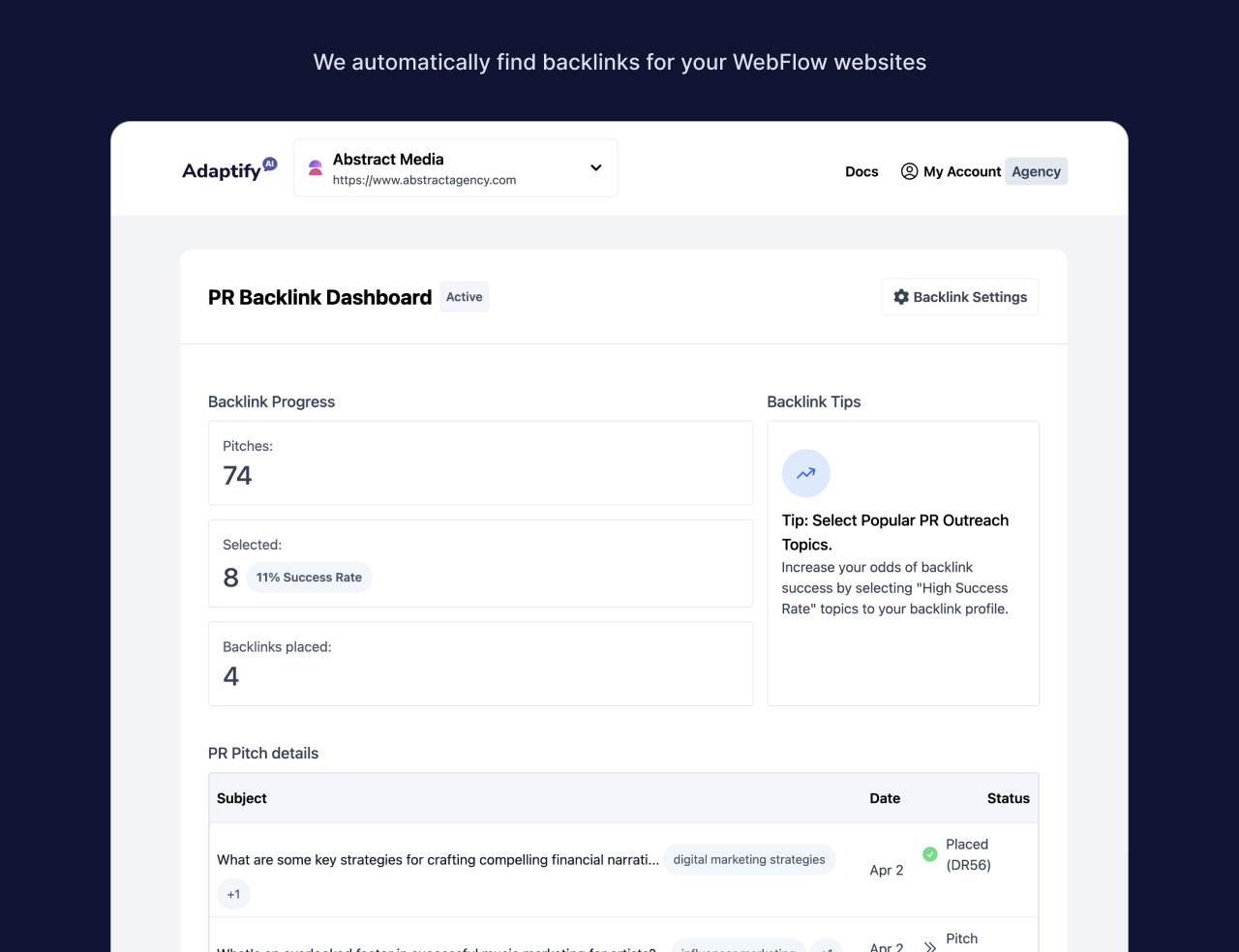
Track every backlink with an SEO backlink monitor—spot lost links fast, protect rankings, and boost ROI before competitors do.
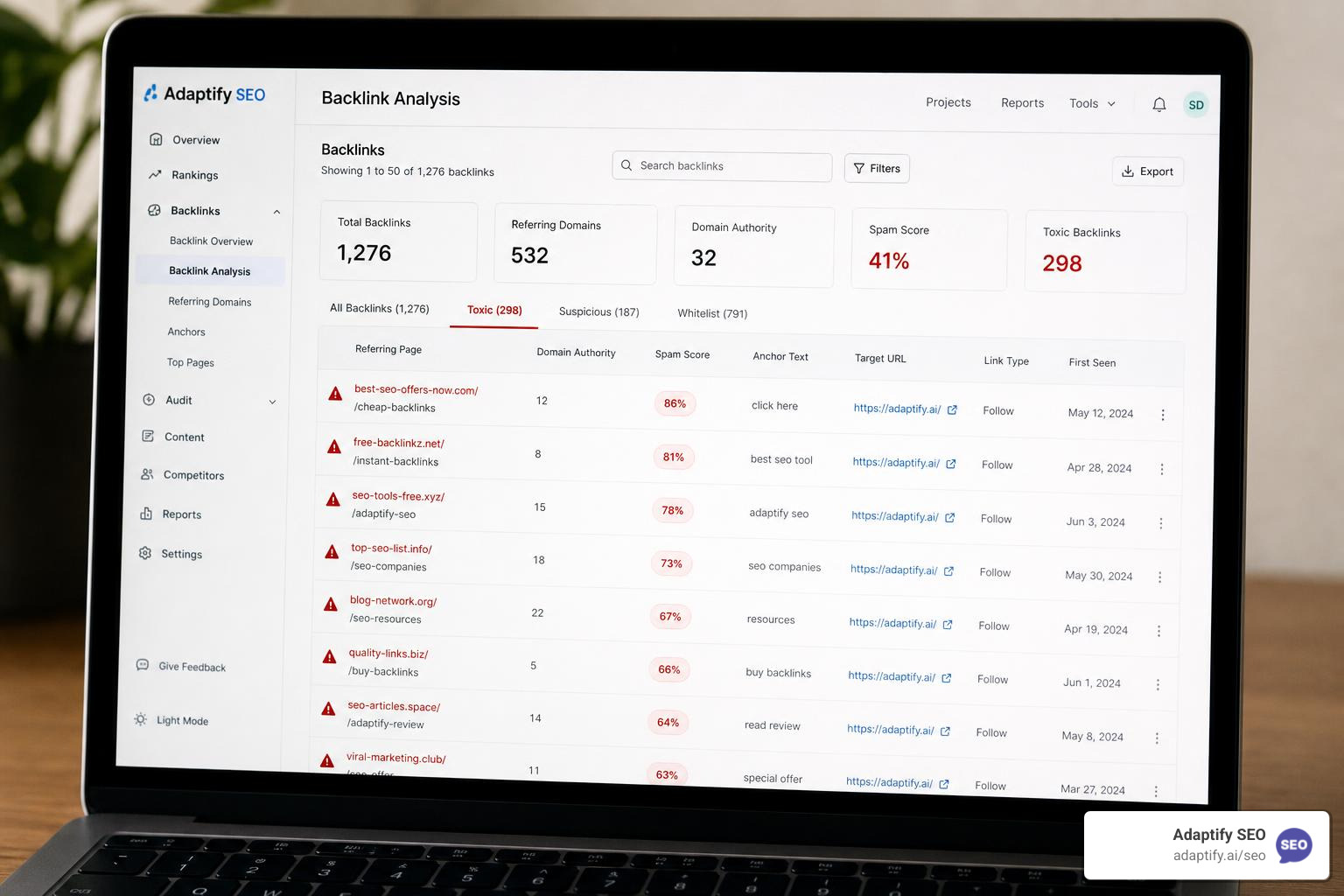
Learn how to disavow toxic backlinks, clean your profile, and recover rankings with this step-by-step guide.
Join 1,000+ agencies already delivering SEO and AI visibility from a single platform without increasing their headcount.Join 1,000+ agencies already delivering SEO and AI visibility from a single platform without increasing their headcount.