Cracking the Code of SEO What Every Beginner Needs to Know


Millions of searches every day ask the question, "What is SEO?" as businesses try to understand how to get found online. Simply put, SEO (Search Engine Optimization) is the practice of improving your website to increase its visibility when people search for products or services related to your business in search engines like Google.
Fundamentally, SEO involves optimizing your site's content and technical elements, building authority through quality backlinks, and enhancing user experience. The goal is to rank higher in organic (unpaid) search results, which is crucial because organic search delivers 53% of all website traffic. With over 8.5 billion searches happening on Google daily, the opportunity is massive.
However, many agency owners find themselves overwhelmed by the manual intensity of SEO, from content creation to complex keyword strategies. As someone who has helped scale businesses to over 40,000 users, I've seen that mastering SEO is the key to sustainable growth. Companies that crack this code don't just survive—they thrive by building predictable, scalable traffic that compounds over time.
Let's cut through the jargon. SEO is the practice of making your website irresistible to search engines and potential customers. It’s not just about getting more visitors; it's about attracting the right visitors—people actively searching for what you offer. When someone searches for a solution to their problem, they have genuine intent and are ready to act.
With billions of daily searches on Google alone, failing to appear in search results is like hiding your business from potential customers. The organic traffic generated by SEO is powerful because it's earned through quality and relevance, not paid ads. This increased visibility builds genuine credibility. When you consistently appear at the top of search results, users perceive you as an authority and a trustworthy leader in your field. This psychological effect is profound; users are far more likely to trust and click on an organic result than a paid ad, viewing it as a more authentic recommendation from the search engine itself.
The beauty of SEO is its potential for sustainable growth. Unlike paid ads that stop when you stop paying, good SEO work compounds over time, forming the digital marketing foundation for all your other efforts. An article you publish today can continue to generate leads for years, making it one of the most cost-effective marketing strategies in the long run. For agencies looking to scale, streamlining these processes is key. You can find more info about SEO services that help automate these complex tasks.
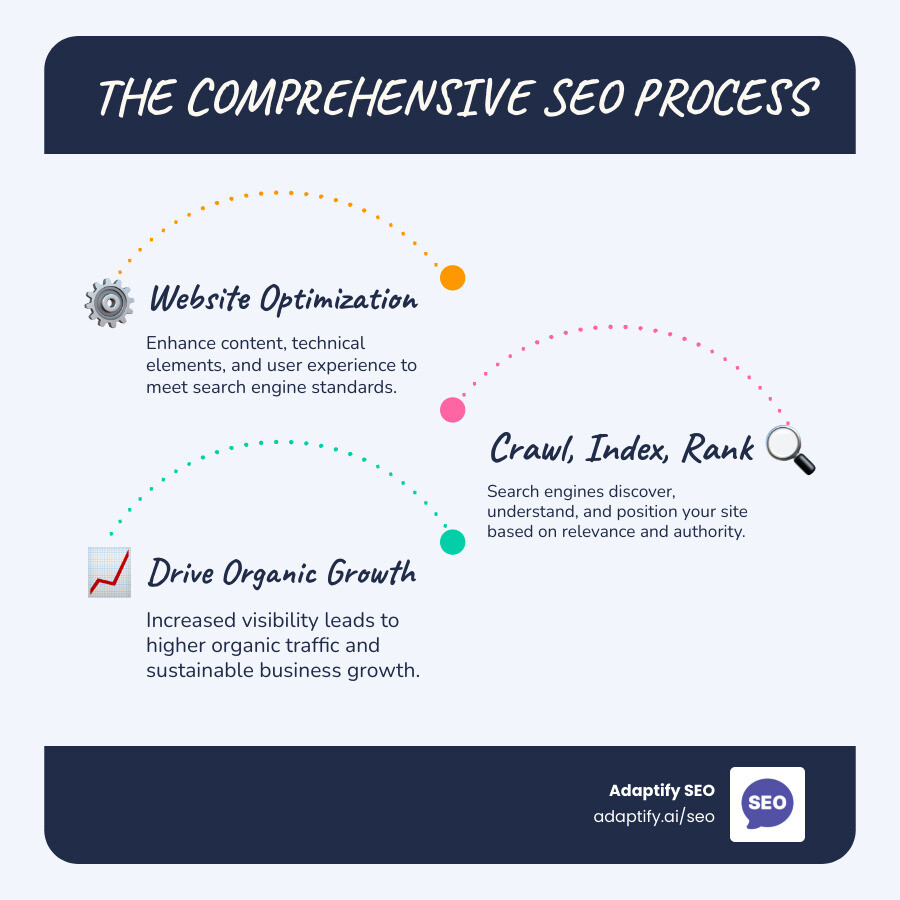
Understanding how search engines work is essential. The process has three key stages.
First is crawling, where digital spiders (like Googlebot) explore the internet, following links to find new and updated content. They have a limited "crawl budget," meaning they can only crawl a certain number of pages on your site at a time, so making your important pages easy to find is critical. As Google's Gary Illyes said, "MAKE THAT DAMN SITE CRAWLABLE." If search engines can't find your pages, nothing else matters.
Next, indexing begins. Search engines analyze your crawled pages, understand their content (text, images, videos, etc.), and store this information in a massive database called an index. Think of it as a global library cataloging billions of web pages. During this phase, the engine processes the content, renders the page to understand its layout, and stores it in a way that can be quickly retrieved. This is where concepts like canonicalization become important, telling the engine which version of a duplicate page to index.
Finally, ranking occurs. When a user performs a search, search algorithms sift through the index to find the most relevant and authoritative results. These algorithms weigh hundreds of ranking factors to deliver the best possible answer. Key factors include the relevance of your content to the query, the authority of your website (often measured by the quality and quantity of backlinks), the user experience your site provides (including page speed and mobile-friendliness), and signals of expertise and trustworthiness (E-E-A-T). The goal is to perfectly match user intent with the most helpful content available.

When we talk about SEO, we're primarily talking about Google. The reason is simple: Google's market share. With Google's global dominance at around 92%, optimizing for it means reaching the vast majority of searchers. While Bing, Yahoo, and DuckDuckGo exist and can provide valuable traffic, Google is where the action is for most businesses. Other search engines like Russia's Yandex or China's Baidu are dominant in their respective regions, but for a global or US-centric strategy, Google is king.
Google's relentless user experience focus and constant algorithm updates reward websites that provide high-quality content and genuine value. Their business model depends on user satisfaction, so they are incentivized to show the best results. By mastering Google's preferences for quality, relevance, and user experience, you'll likely see positive results across other search engines as well, as many of them follow similar principles for ranking content.
When you search on Google, the page you see is the Search Engine Results Page (SERP). It's a sophisticated, dynamic dashboard designed to answer your query as quickly and comprehensively as possible. Understanding its layout shows you where your SEO efforts can pay off.
The modern SERP is a mix of different elements. Paid ads often appear at the top and bottom, clearly marked with an "Ad" label. Below the top ads are the organic listings, which are earned through effective SEO and are the primary goal of your efforts.
Beyond these, you'll find a rich variety of SERP features that change based on your search query. Google's goal is to answer the query directly on the results page. These features include:
Google customizes the SERP based on user intent. A search for "running shoes" (a transactional query) will show shopping ads and product reviews. A search for "how to tie a tie" (an informational query) will yield videos and step-by-step guides. A search for "best restaurants near me" (a local query) will trigger the local pack.
Both paid search and organic search aim to get your website seen on the SERP, but they operate on fundamentally different models.
Paid search, using platforms like Google Ads, is like renting a billboard. You bid on keywords and pay for each click (PPC - Pay-Per-Click), gaining immediate visibility at the top of the page. It's highly effective for short-term campaigns, product launches, or testing market demand, but the traffic stops the moment you stop paying.
Organic search is about earning your spot through merit. You don't pay Google for clicks; you invest time and resources into creating high-quality content, ensuring technical excellence, and building your site's authority. It's a long-term strategy that builds a sustainable, valuable digital asset.
Organic traffic is the most valuable traffic source for several reasons. First, organic results get higher click-through rates (CTRs). Studies consistently show that the #1 organic result on Google gets around 28-30% of all clicks, with the CTR dropping off sharply for lower positions. Users inherently trust organic results more than paid ads, viewing them as more credible and relevant. This brand trust leads to higher engagement and better conversion rates.
The biggest advantage is that organic traffic compounds. A single, well-ranked page can generate consistent, targeted traffic for years without the incremental per-click cost of advertising. It's like owning a digital asset that appreciates in value over time, continuously delivering qualified leads.
Data shows that organic search drives 53% of all website traffic, making it the largest single source for most businesses. This traffic is often more qualified because it directly matches user intent. When someone finds you organically, they were actively searching for a solution you provide, meaning they are further down the buying funnel and more likely to become a customer. For agencies, building a strong organic presence is essential for delivering lasting value. To learn more about creating content that captures this traffic, you can explore more info about content strategy.
Successful SEO rests on three core pillars: technical health, on-page content, and off-page authority. For agencies wondering what SEO is in practical terms, these three pillars provide the answer. All three must work in harmony for sustainable success, as a weakness in one can undermine the strengths of the others.

Technical SEO ensures search engines can efficiently crawl, index, render, and understand your site. It's the non-negotiable foundation upon which all other SEO efforts are built.
robots.txt file and XML sitemaps are the primary tools to guide search engine bots. A sitemap provides a roadmap of your content, while robots.txt tells bots which areas to avoid. Proper use ensures your crawl budget is spent on your most important pages.yoursite.com/services/seo) helps users and search engines navigate and understand your content's context. Features like breadcrumbs can further enhance this.rel="canonical") and 301 redirects to consolidate signals for duplicate or similar pages, telling search engines which version is the primary one to rank.With a solid technical foundation, on-page SEO focuses on the content itself to make it valuable for users and clear for search engines.
Off-page SEO involves actions taken outside of your own website to build its reputation and authority across the internet.
For agencies, managing these three pillars is complex. Understanding how to build authority with strategies like those covered in More info about backlinks and using automated solutions can streamline these time-intensive processes.
SEO presents a choice between two paths: a sustainable, ethical one and a risky, manipulative one.
White Hat SEO involves following the rules and focusing on the user. This means creating valuable content, ensuring a great user experience, earning backlinks naturally, and adhering to the guidelines published in Google Search Essentials. This is the long-term approach that builds a sustainable digital asset that can withstand algorithm updates and grow in value over time.
Black Hat SEO, conversely, uses deceptive and manipulative tactics to try and trick search engine algorithms for quick ranking gains. This includes practices like:
These methods are extremely risky. Google is adept at detecting them, and getting caught can lead to severe penalties, including a manual action that can cause a massive drop in rankings or complete removal from the search results. The risk of destroying your online presence simply isn't worth the potential temporary reward.
SEO has evolved significantly from its early days.
In the late 1990s, ranking was often as simple as stuffing keywords into your page's meta tags. But Google's algorithm updates quickly changed the game. The Panda update (2011) targeted low-quality, thin content, while the Penguin update (2012) penalized manipulative link schemes and over-optimized anchor text. These updates shifted the industry's focus toward quality content and natural link building.
The rise of mobile led to mobile-first indexing, making a responsive design essential. The Hummingbird update (2013) and later BERT (2019) focused on understanding the context and intent behind search queries, moving SEO beyond exact-match keywords toward natural language and topical relevance. More recently, User Experience (UX) became a direct ranking factor through Core Web Vitals, and the Helpful Content Update further rewards content created for people, not just for search engines.
Today, we are in the age of AI in search. Features like Google's AI Overviews are changing how users get information, giving rise to Generative Engine Optimization (GEO)—the practice of optimizing content to be featured in AI-generated answers. This often involves providing clear, concise, factual answers and using structured data. This constant evolution consistently pushes SEO toward a greater focus on the user.
SEO is not a silo; it's most effective when integrated into a holistic digital marketing strategy.
Search Engine Marketing (SEM) is the umbrella term for all search-related marketing, encompassing both SEO and Pay-Per-Click (PPC) advertising. While SEO builds long-term trust and compounding returns through organic results, PPC (via Google Ads) offers immediate visibility and is excellent for testing. The two create a powerful feedback loop: PPC data on high-converting keywords can inform your SEO strategy, while strong SEO can reduce your long-term reliance on paid ad spend.
Content Marketing and SEO are deeply intertwined. You can't have one without the other. High-quality content is the fuel for SEO, attracting links, engaging users, and establishing E-E-A-T. Your SEO strategy dictates what content you should create to meet user demand.
Social Media Marketing amplifies your content's reach and builds brand awareness. While social signals aren't a direct ranking factor, a strong social presence can lead to increased brand searches and the natural discovery of your content, which can result in backlinks.
A successful strategy integrates these channels. SEO provides a sustainable foundation of traffic, PPC captures immediate demand, content marketing builds authority and assets, and social media spreads the word. For agencies, managing this integrated approach across multiple clients is where automated solutions can provide a significant advantage.
Here are answers to the most common questions agency owners ask about how SEO works in the real world.
This is the most common question, and the honest answer is: it depends, but it's a long-term strategy. You can typically expect to see meaningful, needle-moving results in 4 to 12 months.
Several factors influence this timeline:
The good news is that SEO results compound. The effort you put in during the first six months can continue to drive traffic and leads for years to come, making it a powerful investment with an incredible long-term ROI.
Yes, you can certainly learn and implement the basics of SEO. Free tools like Google Search Console and Google Analytics provide invaluable data, and there are countless high-quality blogs and resources available to help you get started with keyword research, on-page optimization, and content creation.
However, the learning curve for advanced SEO is steep, and the field is constantly changing. SEO combines technical analysis, creative content strategy, and data science. As a business grows, advanced tasks like performing in-depth technical audits with tools like Screaming Frog, conducting large-scale competitor analysis with platforms like Ahrefs or SEMrush, and executing a strategic digital PR campaign for backlinks can become a full-time job requiring deep expertise.
This is a common challenge for SEO agencies. Servicing clients effectively requires a team with deep expertise across multiple disciplines. Many agencies turn to automated solutions to handle the heavy lifting of data analysis, content planning, and reporting, allowing their human experts to focus on high-level strategy and client relationships while scaling their operations.
No, SEO is definitively not a "set it and forget it" task. It's an ongoing process of maintenance, improvement, and adaptation, much like tending a garden. If you stop, your results will eventually wither.
Here's why SEO requires continuous effort:
This need for continuous improvement is why automated SEO solutions are so valuable for agencies, as they provide the consistent monitoring and effort required to stay competitive without overwhelming internal resources.
So, what is SEO? At its core, it's the strategic, multi-faceted process of making your website the best possible answer for search engines and, more importantly, for the people using them. It's about building a robust technical foundation so your site is fast, secure, and easy to crawl. It's about creating compelling, expert-level content that satisfies user intent and solves real problems. And it's about earning authority-building backlinks that act as powerful votes of confidence from across the web.
Great SEO is ultimately about creating genuine value for people. You're not just optimizing for a complex algorithm; you're making it easier for a person to find the solution, product, or information they need, right at the moment they need it most. This user-centric approach is the key to sustainable success.
The landscape is also evolving at a breakneck pace, with AI changing the very fabric of how we search. The rise of generative search and AI Overviews means we must adapt our strategies for a new kind of answer engine, focusing on clarity, factuality, and structured data.
For agencies, this increasing complexity presents both a challenge and an opportunity. Your clients need sustainable, long-term growth more than ever, but the manual work involved in traditional, high-level SEO can hinder your ability to scale effectively. This is where automated SEO solutions become a game-changer.
At Adaptify.ai, we've built our platform for agencies that want to deliver exceptional SEO results efficiently. Our AI handles the heavy lifting of strategy, content creation, and PR link building, freeing you to focus on what you do best: fostering client relationships and driving business growth.
The future of search is here. Ready to transform how your agency delivers SEO success?

Master SEO monitoring with key metrics and tools to track rankings, technical health, and organic growth for continuous performance optimi...

The Best Online Keyword Monitoring Tools for Real-Time Alerts - Learn about online keyword monitoring tool

Stop Flying Blind with These Top SEO Monitor Tools - Learn about seo monitor tools
Join 1,000+ agencies already delivering SEO and AI visibility from a single platform without increasing their headcount.Join 1,000+ agencies already delivering SEO and AI visibility from a single platform without increasing their headcount.