From Idea to Article:Exploring Free and Paid AI Blog Content Creators
Hansjan Kamerling
Feb 20, 202618 min read
Why AI Blog Content Generators Matter for Modern Content Teams
ai blog content generator
An ai blog content generator is a software tool powered by artificial intelligence that creates written content—like blog posts, articles, and marketing copy—based on prompts or topics you provide. These tools use Natural Language Processing (NLP) and large language models (like GPT-4) to analyze existing content across the web and generate new text that sounds human-written.
Quick Answer: What You Need to Know
What it does: Transforms keywords, topics, or outlines into full blog posts in minutes
How it works: Uses AI models trained on millions of documents to synthesize new content
Key benefits: Saves 50-75% of writing time, helps overcome writer's block, scales content production
Main limitation: Requires human editing for accuracy, brand voice, and unique insights
Best for: First drafts, content briefs, idea generation, and repurposing existing content
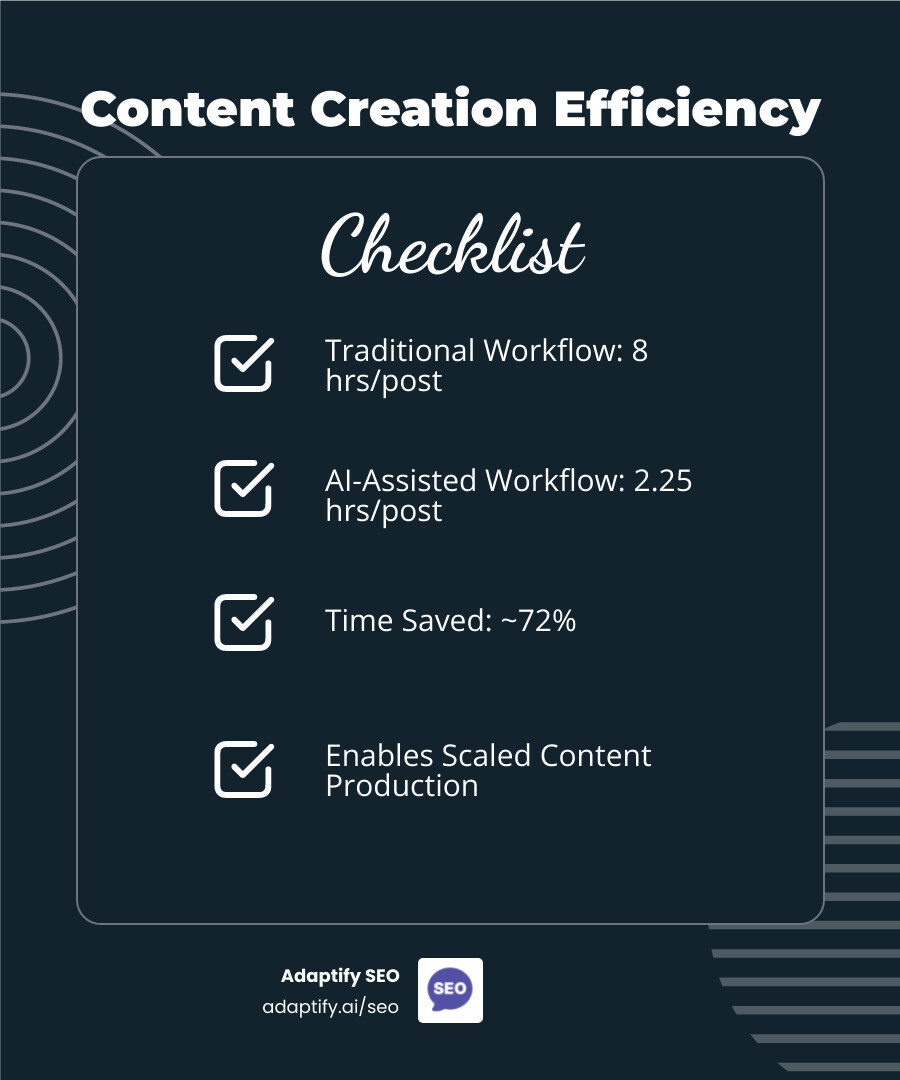
The reality is simple: content creation takes too long. According to the research, writers spend around 8 hours crafting a single blog post. With AI assistance, that drops to about 2.25 hours. For agency owners managing multiple clients, this isn't just convenient—it's transformative.
But here's what matters most: these tools don't replace writers. They change the workflow. Instead of staring at a blank page, you start with a draft. Instead of researching for hours, you edit and refine. The creative heavy lifting shifts from creation to curation.
Over 40 million people now use AI writing tools daily. Free options from platforms like HubSpot and SEOptimer offer basic generation capabilities, while paid tools like Copy.ai, Jasper, and RightBlogger provide advanced features like SEO optimization, brand voice training, and content workflow automation.
Here at Adaptify.ai, we've spent years working with AI-powered SaaS platforms, including data analytics tools with custom-trained models used by 40,000+ users. Throughout our experience designing content systems and marketing platforms, we've seen how ai blog content generators fundamentally reshape content workflows when used strategically.
Infographic showing traditional content workflow (research, outline, first draft, editing, SEO optimization, publishing - 8 hours total) compared to AI-assisted workflow (AI prompt, AI draft generation, human editing and fact-checking, SEO refinement, publishing - 2.25 hours total) - ai blog content generator infographic checklist-dark-blue
What is an AI Blog Content Generator and How Does It Work?
At its heart, an ai blog content generator is a sophisticated piece of software designed to mimic human writing. It takes your input—a topic, a few keywords, or even a full outline—and, like magic, produces a coherent, contextually relevant piece of text. But how does this digital wizardry actually happen?
visualizing the process of a prompt turning into a blog post - ai blog content generator
It all starts with advanced artificial intelligence, specifically Natural Language Processing (NLP). NLP is a field of AI that gives computers the ability to understand, interpret, and generate human language. The most common engines behind these generators are large language models (LLMs), such as OpenAI's GPT series (like GPT-3 or the more recent GPT-4o). These models are trained on colossal datasets of text and code—think billions of web pages, books, and articles. This extensive training allows them to learn patterns, grammar, facts, and even different writing styles. You can dig deeper into the technology behind these tools to understand the nuances of these models.
When you provide an AI blog content generator with a prompt, it doesn't just copy and paste from its training data. Instead, it uses its learned knowledge to predict the most probable sequence of words that would logically follow your input. This process is called content synthesis. It can paraphrase existing information, reword sentences, and generate new text that is unique yet informed by its vast understanding of language and topics. The more specific and detailed your prompt, the better the AI can tailor its output to your needs. It's like having a super-fast, incredibly well-read research assistant who can also write a first draft in seconds!
The Core Benefits for Bloggers and Marketers
From my experience, the benefits of incorporating an ai blog content generator into your workflow are truly game-changing:
Time-saving: This is perhaps the most obvious and impactful benefit. As the research shows, AI can slash content creation time from roughly 8 hours to just over 2 hours per article. Imagine the sheer volume of content you could produce or the extra time you'd have for strategic planning!
Overcoming writer's block: We've all been there—staring at a blank screen, the cursor blinking mockingly. An AI blog content generator can be your best friend in these moments. It can generate ideas, outlines, or even initial drafts, giving you a springboard to jump from. CoSchedule aptly puts it: "Overcome writer’s block and generate first-draft copy faster."
Idea generation: Need fresh angles or new topics? Tools like Surfer's Blog Post Ideas Generator can provide instant, relevant suggestions based on your niche or keywords, preventing creative burnout and keeping your content calendar full.
Scaling content output: For businesses and agencies, the ability to produce high-quality content at scale without significantly increasing headcount is invaluable. HubSpot highlights that AI allows you to "create content at scale without scaling headcount." This means more blog posts, more social media updates, and more marketing copy, all driving greater reach and engagement.
Consistency: AI can help maintain a consistent tone, style, and quality across your content, especially when multiple writers or contributors are involved. While human oversight is still needed, AI provides a solid foundation.
Cost-effectiveness: In many cases, using an AI blog content generator can be a low-cost form of outsourcing the initial drafting process. This frees up your human writers to focus on more complex, strategic, and creative tasks, ultimately optimizing your content budget.
Potential Drawbacks and Limitations
While the upsides are compelling, it's crucial to approach an ai blog content generator with a clear understanding of its limitations. As with any powerful tool, there's a responsibility to use it wisely:
Inaccuracy and "hallucinations": AI models, despite their vast training, can sometimes generate information that is factually incorrect or completely fabricated—what we in the industry call "hallucinations." This is why I always emphasize the need for rigorous fact-checking. As RightBlogger states, you must "take extra care with SEO-optimizing & fact-checking your AI content."
Lack of personal voice: AI is excellent at mimicking styles, but it struggles to inject genuine personal experiences, unique anecdotes, or a truly distinct brand voice. It's a generalist, not a specialist in your story. To truly stand out, you'll need to "add your own voice, tone, and style to AI-generated content."
No unique insights: AI synthesizes existing information. It doesn't conduct original research, invent new theories, or provide groundbreaking perspectives that haven't been discussed before. For deep dives into novel topics or highly specialized fields, human expertise remains irreplaceable. RightBlogger notes that AI "writes best" for "well-established topics that don't require personal stories or unique insights."
Ethical concerns: The use of AI in content creation raises questions about transparency, authenticity, and potential misuse. It's important to be transparent with your audience if you're using AI and to ensure the content remains helpful and valuable.
Over-reliance risk: The biggest danger, in my opinion, is treating AI as a "set it and forget it" solution. It's a tool, an assistant, not a replacement for human intellect and creativity. As RightBlogger wisely warns, "AI Article Writers are Tools (Not a Replacement for You)."
A Practical Guide to Using an AI Blog Content Generator
Integrating an ai blog content generator into your daily tasks can feel daunting at first, but with a structured approach, it quickly becomes second nature. Think of it as having a highly efficient co-pilot for your content journey.
user interface for an AI writing tool - ai blog content generator
These tools are incredibly versatile. They aren't just for full blog posts; they can assist with various content needs:
First drafts: This is where AI truly shines, providing a solid starting point for almost any topic.
Content repurposing: Transform a blog post into social media snippets, email newsletters, or even video scripts. Copy.ai, for example, can "transform a blog post into content for all of your channels."
Social media posts: Quickly generate engaging captions for LinkedIn, Facebook, or Instagram, custom to specific personas.
Ad copy: Craft multiple variations of ad copy for platforms like Google Ads or Facebook, allowing for easy A/B testing.
Listicles: Need a quick "Top 10" article? AI can generate these with ease.
SEO content briefs: Generate comprehensive briefs from keywords by scraping top-ranking SERP results, as Copy.ai demonstrates.
To truly scale your content strategy and make the most of these capabilities, you might want to explore how Adaptify.ai combines AI-driven content creation with technical SEO, internal linking, and PR link building. Learn more on scaling your content strategy with integrated SEO solutions custom for agencies.
Step-by-Step: From Prompt to Polished Post
Here's how we typically guide users through the process of taking an idea from a simple prompt to a publish-ready article using an ai blog content generator:
Topic input: Start by clearly defining your topic and target keywords. Most tools will have a dedicated field for this. The more specific you are, the better the output. For example, instead of "AI," try "Benefits of using an AI blog content generator for small businesses."
Outline generation: Many advanced tools, and even some free ones, can generate a blog post outline based on your topic. This is a fantastic feature for structuring your thoughts and ensuring comprehensive coverage. Surfer's AI outline generator, for instance, helps "transform unorganized ideas into clear, logical content frameworks." You can then customize this outline by adding, removing, or rearranging sections.
Tone and style selection: Want your content to sound formal, casual, creative, or authoritative? Most generators offer options to adjust the tone and writing style. RightBlogger, for example, offers various tones like "Creative", "Professional", or "Fun & Quirky".
Point of view: Some tools allow you to specify the point of view (e.g., first-person, third-person), which is crucial for maintaining consistency with your brand voice.
Generating the draft: Once your inputs are set, hit "Generate." In mere seconds, the ai blog content generator will produce a full first draft. It's often astonishingly good, given the speed.
Editing and refining: This is where the human touch becomes indispensable. Review the content for accuracy, flow, grammar, and adherence to your brand voice. Inject your unique insights and personal anecdotes. The AI provides a canvas; you're the artist adding the final brushstrokes.
Comparing the Tools: Free vs. Paid Solutions
The landscape of ai blog content generator tools is vast and ever-growing, with options ranging from completely free to premium, feature-rich platforms. Here's a quick comparison to help you steer:
Comprehensive content strategy, full blog posts, ad copy, sales emails, entire content lifecycle automation
List of Popular AI Content Tools:
HubSpot's Free AI Writer
Copy.ai's Marketing OS
RightBlogger's Full Suite
Grammarly (for improving writing with AI)
CoSchedule (for blog post generation and headlines)
Surfer (for idea and outline generation)
SEOptimer (for SEO-optimized blog posts)
While free tools are fantastic for getting your feet wet and handling basic needs, paid solutions often provide a more comprehensive, integrated experience. For instance, Copy.ai's Marketing OS aims to be an all-in-one platform for content creation, optimization, and auditing, streamlining entire marketing workflows. They offer features like generating content briefs from keywords by scraping SERPs or repurposing content across channels.
If you're serious about scaling your content efforts across multiple clients, pairing one of these generators with Adaptify.ai's automated SEO platform gives you an end-to-end system: from keyword research and content briefs to AI-assisted drafts, optimization, and automated PR link building. For agencies, this combination turns content production and SEO into a repeatable, efficient process rather than a series of manual one-offs.
The Human Touch: Why Editing and Oversight are Crucial
No matter how advanced an ai blog content generator becomes, the human element remains irreplaceable. Think of AI as a highly skilled apprentice, capable of doing much of the heavy lifting, but still needing the master craftsman's eye for detail, nuance, and true artistry.
Our core advice is always this: AI-generated content is a first draft, not a final product. Here's why human editing and oversight are absolutely crucial:
Fact-checking: As we mentioned, AI can "hallucinate." Always, always fact-check any statistics, claims, or data points generated by the AI. Your credibility depends on it.
Brand voice: While AI can mimic tones, it can't fully grasp the subtle nuances of your unique brand voice. You need to infuse the content with your brand's personality, values, and specific terminology. HubSpot advises you to "customize AI-generated content with your unique voice and expertise."
E-E-A-T (Experience, Expertise, Authoritativeness, Trustworthiness): Google prioritizes content that demonstrates these qualities. AI can't have experience or expertise in the way a human does. It's up to you to add your unique insights, back claims with data, and showcase your (or your client's) certifications to build trust and authority. This is how you differentiate your content.
Adding personal stories: AI is generally poor at weaving in authentic personal anecdotes or unique case studies that resonate deeply with readers. These human touches make content memorable and relatable.
Crafting the perfect headline: While AI can suggest headlines, a truly compelling, click-worthy headline often requires a human's creative spark and understanding of audience psychology. Tools like Headline Studio can help, but the final decision should be yours.
Can an ai blog content generator produce SEO-optimized content?
Yes, absolutely! An ai blog content generator can be a powerful ally in your SEO efforts, but it's most effective when guided by a human SEO strategy. Here's how:
Keyword integration: AI tools excel at integrating target keywords naturally throughout the text, including headings and body paragraphs. You provide the keywords, and the AI weaves them in.
Meta descriptions: Many generators can craft compelling meta descriptions that include your keywords, enticing users to click from search results.
Internal linking: Some advanced platforms, like Copy.ai, can even suggest or automate internal linking, helping to distribute link equity and guide users through your site.
SERP analysis: Tools can generate content briefs by analyzing the top-ranking articles for your target keywords. Copy.ai, for instance, can "generate content briefs from keywords by scraping the top 3 urls from the SERP." This gives the AI a blueprint for what kind of content ranks well.
Content structure (H1, H2, H3): AI can generate well-structured outlines with appropriate heading tags, improving readability and helping search engines understand your content's hierarchy. Surfer's outline generator, for example, creates "well structured outlines with full H1, H2, and H3-style suggestions."
AI helps automate the tactical aspects of SEO content creation. However, the strategic SEO decisions—which keywords to target, what audience pain points to address, how to build topical authority—still require human intelligence and market understanding.
The Future of AI in Blog Content Creation
The rapid evolution of AI, epitomized by models like GPT-4o, suggests a future where the ai blog content generator becomes an even more integrated and indispensable part of the content creation ecosystem.
Evolving AI capabilities: We can expect AI to become even more sophisticated, capable of understanding nuanced instructions, generating more creative and unique content, and reducing factual errors. The "hallucination" problem will likely diminish over time.
AI as a creative partner: The relationship will shift further from AI being a mere tool to a true creative partner. It will handle the mundane, repetitive tasks, freeing up human creators to focus on strategy, innovation, and injecting that unique spark that only a human can provide.
Shift in content creator roles: Content creators will become more "editor-first," as RightBlogger suggests. Their skills in prompt engineering, editing, fact-checking, and infusing brand voice will be paramount. This isn't about replacing writers, but evolving their role.
Hyper-personalization: AI will enable unprecedented levels of content personalization, tailoring messages to individual audience segments or even single users based on their data and preferences. Imagine blog posts that dynamically adapt to the reader's interests!
Real-time data integration: Future ai blog content generator tools will likely integrate even more deeply with real-time data from analytics platforms, CRMs, and market trends, allowing for immediate content adjustments and hyper-relevant messaging.
We believe this future is exciting. It's a world where we can produce more impactful, higher-quality content faster than ever before, all while focusing our human creativity where it matters most.
Frequently Asked Questions about AI Content Generation
As an expert in this space, I often hear similar questions from those curious about or new to using an ai blog content generator. Let's tackle some of the most common ones.
Are AI-generated articles considered plagiarism?
This is a big one, and it's a valid concern. The short answer, based on current understanding, is generally no, AI-generated articles are not considered plagiarism in the traditional sense. Here's why:
Content synthesis vs. copying: Plagiarism involves taking someone else's work and presenting it as your own. An ai blog content generator doesn't copy existing articles word-for-word. Instead, it synthesizes information and ideas from its vast training data to create new text. It's like a human who has read many books on a topic and then writes an original summary or article based on that knowledge. As RightBlogger explains, AI "synthesizes information rather than copying specific sources."
Originality: While the ideas might not be entirely novel (as AI generates based on existing patterns), the specific phrasing and structure of the output are generally unique. Most AI tools are designed to produce original content.
Role of plagiarism checkers: While free AI tools might not have built-in plagiarism checkers, many paid versions do. These checkers typically confirm that the generated text doesn't match existing published content. It's still a best practice to run your AI-generated content through a plagiarism checker if you have any doubts.
Google's stance on AI content: Google's primary concern is content quality and helpfulness, not how it was generated. If AI content is high-quality, accurate, and provides value to users, Google generally doesn't penalize it. However, if it's low-quality, spammy, or inaccurate, it will likely struggle to rank, regardless of authorship. My advice is always to use AI responsibly and transparently, ensuring the content is truly helpful.
How can AI blog content generators help overcome writer's block?
Writer's block is the bane of any content creator's existence. Thankfully, an ai blog content generator is a fantastic antidote:
Idea generation: When your mind is blank, AI can brainstorm a multitude of topics, angles, and sub-points based on your keywords or niche. Surfer's generator, for instance, can give you "fresh blog post ideas instantly."
Outline creation: Even if you have a topic, structuring an article can be daunting. AI can instantly generate a detailed outline with headings and subheadings, providing a clear roadmap for your writing. CoSchedule notes that it helps "create a blog post outline before writing."
First draft automation: The hardest part is often just getting started. AI can produce a full first draft in minutes, giving you something tangible to work with. It transforms that intimidating blank page into a document ready for your human refinement.
Inspiration source: Sometimes, seeing a machine-generated paragraph or sentence can spark your own creativity, leading you down new and exciting paths you hadn't considered. It acts as a creative muse, always ready to churn out ideas.
What are the best use cases for an ai blog content generator?
The versatility of an ai blog content generator means it can be applied to a wide array of content needs, making it a valuable asset for almost any marketing team or blogger:
First drafts: This is the most common and powerful use case. Get a solid foundation for any blog post, article, or long-form content piece in minutes.
SEO content briefs: Generate comprehensive briefs that include keywords, competitor analysis, and suggested outlines, streamlining your SEO strategy.
Social media copy: Quickly create engaging captions for various platforms, custom to specific audiences and tones.
Email newsletters: Draft compelling email subject lines, body copy, and calls to action for your marketing campaigns.
Product descriptions: Generate persuasive and detailed descriptions for e-commerce products at scale.
Repurposing content: Transform existing blog posts into new formats like social media updates, FAQs, or snippets for other platforms. Copy.ai can "transform a blog post into content for all of your channels."
Listicles and how-to guides: These structured content formats are perfect for AI generation, providing clear, concise information quickly.
Ad copy: Create multiple variations of headlines and body copy for online advertisements, enabling more effective A/B testing.
Essentially, any content task that requires speed, scale, and a good first draft is an ideal candidate for an ai blog content generator.
Conclusion: Your New Partner in Content Creation
The rise of the ai blog content generator isn't just a trend; it's a fundamental shift in how we approach content creation. I've seen how these tools can dramatically reduce time spent on writing, conquer writer's block, and scale content output to levels previously unimaginable. They are, without a doubt, powerful allies in the demanding world of digital marketing.
However, it's crucial to remember the core message: AI is a tool, not a replacement. The most successful content strategies will always be those that accept human-AI collaboration. Leverage AI for its speed and efficiency in generating first drafts, ideas, and structured content. Then, bring in your unique human expertise for fact-checking, infusing brand voice, adding personal insights, and refining for true E-E-A-T.
This strategic approach gives you a significant advantage, allowing you to produce higher quality, more impactful content faster than ever before. If you're looking to build a powerful, scalable SEO strategy that leverages AI for content and beyond, I encourage you to explore our automated SEO services. Let's work smarter, not harder, to achieve your content goals.
Join 1,000+ agencies already delivering SEO and AI visibility from a single platform without increasing their headcount.Join 1,000+ agencies already delivering SEO and AI visibility from a single platform without increasing their headcount.