From Zero to Hero:Crafting SEO-Friendly Articles with AI
Hansjan Kamerling
Feb 5, 202618 min read
Why AI Writing for SEO Is Reshaping Content Creation
AI writing for SEO
AI writing for SEO has become one of the most discussed topics in digital marketing—and for good reason. Here's what you need to know:
Google doesn't penalize AI content as long as it's high-quality, helpful, and meets E-E-A-T guidelines
AI tools can generate content 10x faster than traditional methods, helping agencies scale efficiently
Human oversight remains essential for fact-checking, brand voice, and strategic optimization
The best approach combines AI efficiency with human expertise through structured workflows
Success depends on proper prompt engineering and understanding how to guide AI tools effectively
If you're an agency owner drowning in content creation tasks, you're not alone. The manual work of researching keywords, analyzing SERPs, drafting articles, and optimizing every element takes hours—time you could spend growing your business or serving more clients.
The good news? AI writing tools have evolved dramatically. As one content manager put it, "Grammarly's AI is like my right-hand partner at the moment. It's the fastest way for me to generate initial drafts." But here's the catch: nearly half of content professionals now use AI daily, yet only 18% of AI-generated articles reach Google's first page without additional optimization.
The difference between success and failure isn't the AI tool itself—it's how you use it.
This isn't about replacing writers or gaming search engines. It's about building a smart workflow that combines AI's speed with human strategy. Think of AI as your research assistant, your first-draft writer, and your optimization helper—but you're still the editor, fact-checker, and brand voice guardian.
The challenge facing most agencies is clear: clients want more content, Google wants better content, and your team only has so many hours in the day. Traditional SEO content creation doesn't scale without hiring an army of writers. AI writing for SEO offers a solution—but only when implemented thoughtfully.
I'm Hansjan Kamerling, and I've spent years helping AI startups and SaaS platforms grow, including working with a data analytics platform serving 40,000 users with custom-trained AI models. Throughout my career in product design and marketing for AI-driven companies, I've seen how AI writing for SEO can transform agency operations when done right.
In this guide, we'll walk through the exact workflow that turns AI from a liability into your competitive advantage—covering everything from keyword research to publication, with specific strategies for maintaining quality, avoiding common pitfalls, and ensuring your content actually ranks.
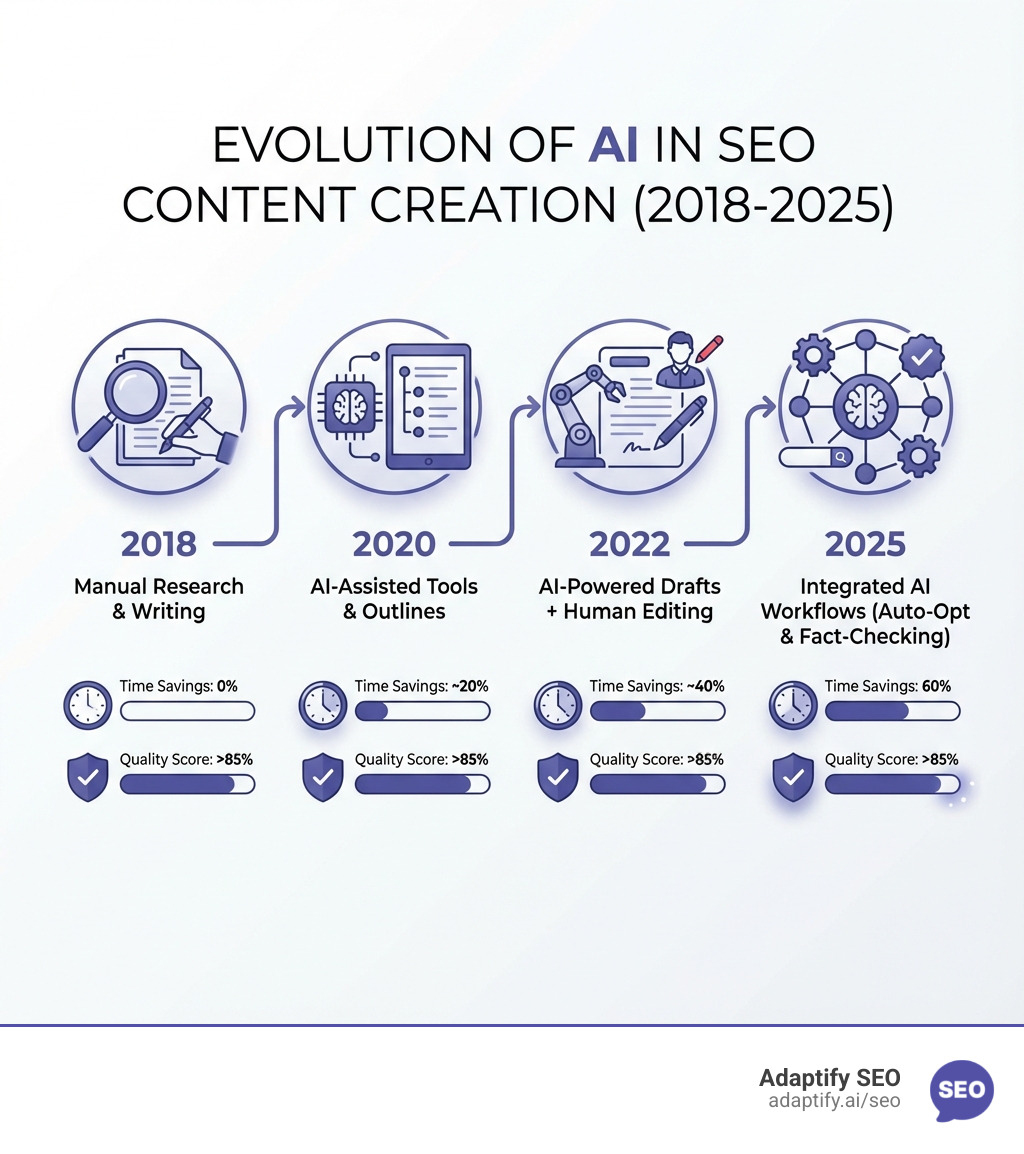
Infographic showing the evolution of AI in SEO content creation: starting with manual keyword research and writing (2018), moving to AI-assisted keyword tools and outline generation (2020), then AI-powered first drafts with human editing (2022), and finally integrated AI workflows with automated optimization and fact-checking (2025). Each stage shows time savings increasing from 0% to 60%, while maintaining quality scores above 85%. - AI writing for SEO infographic
AI & SEO: What Google Really Thinks About Your Content
There's a common misconception that Google automatically penalizes AI-generated content. Let me clear this up: Google does not ban or punish your website for having AI-generated content. As of early February, Google stated that they don’t care about how content is produced, so long as it’s high-quality. They accept the use of AI-generated content, as long as it’s done ethically.
However, if your AI-generated content isn’t optimized for SEO or you try to use it for spam, it will still perform poorly. This means the focus isn't on who writes it, but what is written. Google's Helpful Content System rewards pages that fully answer specific user intent, providing usefulness, accuracy, and strong E-E-A-T signals.
The landscape is also shifting with the rise of AI-powered search. New paradigms like Google's Search Generative Experience (SGE) and AI Overviews (AIO) are changing how users find information. AI Overviews, for instance, use generative AI to crawl and summarize webpages, directly impacting your content's visibility. Content that ranks in the top three positions on Google has approximately a 45% chance of being cited by ChatGPT, and for Perplexity, that likelihood increases to around 60%. This makes optimizing for AI search engines a crucial new frontier, alongside traditional SEO.
Google's E-E-A-T guidelines logo - AI writing for SEO
The E-E-A-T Conundrum
Google's E-E-A-T guidelines (Experience, Expertise, Authoritativeness, Trustworthiness) are paramount. They represent Google's desire to deliver the most relevant and trustworthy information to its audience. If your content, regardless of its origin, doesn't meet these standards, it will struggle to rank.
Experience: Does the content demonstrate experience with the topic?
Expertise: Is the creator knowledgeable about the subject?
Authoritativeness: Is the creator or website a recognized authority in the field?
Trustworthiness: Is the content accurate, honest, and safe?
This is where AI-generated content can hit a snag. AI tools may "hallucinate" and make up information, including statistics or sources, which directly undermines factual accuracy and trustworthiness. Without human oversight, AI content often lacks the unique insights, personal anecdotes, or real-world experience that signal strong E-E-A-T. Relying solely on AI for entire articles is risky because factual errors can destroy E-E-A-T, and Google's algorithms are designed to detect unhelpful content.
Pros vs. Cons of AI-Generated Content
Let's weigh the benefits and drawbacks of integrating AI into your SEO content strategy.
Pros of AI for SEO:
Efficiency Boost: AI tools can generate content 10x faster, cutting content research time from hours to minutes. This speed allows agencies to scale content creation significantly, producing everything from blog posts to social media updates rapidly.
Scalability: AI enables you to produce a high volume of content to meet client demands without hiring an army of writers. You can generate 1000+ articles in hours with tools that support bulk content creation.
Data-Driven Insights: AI tools are built to detect patterns, analyze data, and even mimic how search engines "think." They can provide data-driven insights for keyword research, competitor analysis, and content optimization, enhancing your content's effectiveness.
Cons of AI-Generated Content:
Lack of Originality: AI content can often sound generic, lacking the unique voice, creativity, and fresh perspectives that differentiate human-written pieces. This can lead to content that struggles to engage readers and stand out in the SERPs.
Emotional Disconnect: AI often struggles to infuse content with human emotion, empathy, or humor. This can result in dry, robotic copy that fails to connect with an audience on a deeper level, impacting dwell time and user engagement.
Potential for Misinformation: As mentioned, AI can "hallucinate" and generate inaccurate information. Publishing unverified AI content can harm your brand's reputation and lead to penalties from search engines for low-quality or misleading information.
Repetitiveness: Some AI tools, like Jasper AI, have been noted for creating repetitive content, which can bore readers and signal low quality to search engines.
Need for Human Oversight: AI is only as effective as the person using it. It requires significant human review, editing, and strategic guidance to ensure accuracy, quality, and alignment with your brand's voice and SEO goals.
Your 8-Step Workflow for Effective AI Writing for SEO
The key to successful AI writing for SEO lies in a structured, human-led workflow. This isn't about letting AI take the wheel; it's about making AI your co-pilot. I've seen this approach transform content creation from a bottleneck into a streamlined, high-impact process.
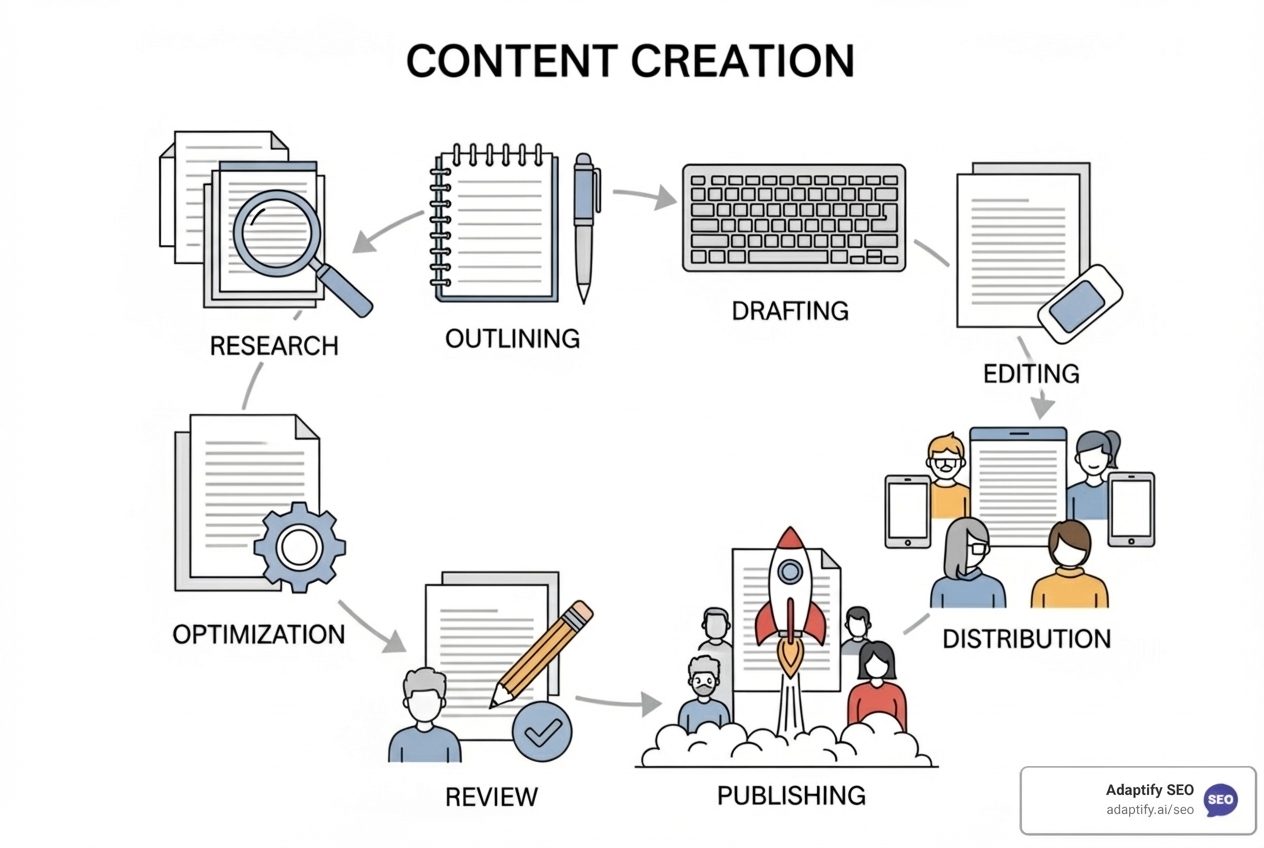
A detailed workflow diagram showing the 8 steps of AI-assisted SEO content creation, from research and outlining to drafting, optimizing, editing, and publishing. - AI writing for SEO
My 8-step workflow emphasizes human-AI collaboration, leveraging AI for efficiency while maintaining human strategic oversight, creativity, and quality control. This includes mastering prompt engineering, where the quality of your AI output is directly proportional to the quality of your input. For agencies looking to improve their content creation capabilities, you can find More info about content services that integrate these AI-powered processes.
Step 1: Keyword Research and Intent Analysis
This is where it all begins. AI tools can significantly accelerate this foundational step.
Pinpoint Search Intent: Before writing, I map the query to the user's intent (Top-of-Funnel (TOFU), Middle-of-Funnel (MOFU), Bottom-of-Funnel (BOFU)) and define a clear call-to-action (CTA). AI doesn't inherently understand search intent, so human guidance here is crucial.
Long-Tail Keywords and Semantic Terms: AI tools can quickly generate supplemental keywords when I input my core keyword, providing variations and related entities. I can prompt AI for "What long-tail keywords are related to X?" or "What SEO keywords are trending in [industry]?" This helps me identify conversational language and specific questions my audience is asking.
AI Keyword Tools: Platforms like Semrush, Copymatic, and Surfer offer AI-powered features for keyword brainstorming and analysis. They can help detect emerging trends by analyzing changes in language and user behavior.
Competitor Analysis: AI can analyze top-ranking competitors to identify their keyword strategies and content gaps. Tools like MarketMuse or Rankability can help me understand what's already performing well in the SERPs.
Step 2: Crafting the Perfect Outline
A well-structured outline is the blueprint for a high-ranking article. AI is excellent at this.
SERP Analysis: I reverse-engineer the top 10 SERP results. AI can analyze heading patterns, FAQ blocks, and schema types used by competitors, helping me understand what the SERP "loves."
Structuring for Featured Snippets: AI can identify common structures that lead to featured snippets (e.g., clear definitions, bulleted lists, direct answers).
Using AI for Outline Generation: Instead of spending hours brainstorming, I use AI to create a comprehensive outline. I feed the AI my primary keyword and intent, and it can generate a structured framework with headings and subheadings. This is one of the most effective uses of AI, saving me immense time. Copymatic, for example, can generate detailed outlines quickly.
Step 3: Generating a Quality First Draft
With a solid outline, AI can now assist in drafting the content. This is where prompt engineering truly shines.
Prompt Chaining: I break down the content creation into smaller, manageable tasks for the AI. Instead of asking for a full article, I'll first ask for an outline, then for content for each subheading, then to rewrite sections in a specific brand voice, and finally to format. This iterative process, often using frameworks like CRAFT (Context, Role, Audience, Format, Task), leads to much better results.
Providing Context: The more specific I am, the better the output. I give the AI details about the topic, target audience, desired tone, and specific instructions. For instance, "Write a 600-word blog post on time management tips for remote teams using the keyword 'remote productivity hacks.'"
Brand Voice: Maintaining a consistent brand voice is crucial. I train the AI by providing it with examples of my existing content and a style guide. This helps it generate content that aligns with the brand's identity, ensuring a cohesive message across all platforms.
Generating Sections: AI can generate intros, body paragraphs, and conclusions. I often use it to generate multiple variations of intros or product descriptions, allowing me to choose the most compelling one.
Step 4: Optimizing for On-Page SEO
Once I have a draft, I use AI to fine-tune it for on-page SEO.
Meta Titles & Descriptions: AI can generate optimized meta titles (<= 60 characters) and meta descriptions (<= 155 characters) that include relevant keywords and compelling language, encouraging clicks in the SERPs.
URL Slugs: I use AI to suggest clean, keyword-rich URL slugs that are easy for both users and search engines to understand.
Internal Linking: AI can identify relevant internal pages within my site and suggest contextual links, strengthening topical authority and improving site navigation. I aim for 3-5 contextual links to related pages plus one pillar link per article.
Image Alt Text: AI can generate descriptive alt text for images, improving accessibility and providing additional context for search engines.
Keyword Density & Entity Inclusion: While avoiding keyword stuffing, AI helps me naturally sprinkle primary keywords, synonyms, and related entities throughout the content, ensuring comprehensive coverage of the topic.
For agencies, optimizing every element for on-page SEO is part of delivering a comprehensive service. To learn more about how we streamline these processes, you can find More info about white-label SEO solutions.
Step 5: Fact-Checking and Human Editing
This is arguably the most critical step. AI is a tool, not a truth machine.
Verifying Statistics & Information: I never blindly trust AI-generated facts. I verify every statistic, quote, and piece of information, adding citations from reputable sources. AI hallucinations are real, and factual errors can severely damage E-E-A-T.
Adding Citations: Where AI suggests information, I manually find and add credible sources.
Plagiarism Scans: I always run a plagiarism scan before publishing. While AI aims for originality, accidental overlap can occur. Tools like Copymatic offer built-in plagiarism checkers.
Improving Readability & Flow: I refine the AI-generated text to ensure it sounds natural, engaging, and aligns with human communication patterns. This involves tightening wording, breaking up long paragraphs, improving transitions, and ensuring a smooth flow. Tools like Grammarly, Wordtune, and Hemingway App are invaluable here.
Injecting Brand Voice & Personality: I adapt the content to my unique brand voice, adding personal anecdotes, unique insights, and storytelling elements that AI often misses. This human touch makes the content relatable and memorable.
Step 6: Publishing and Technical Hygiene
The final step ensures your perfectly crafted content is ready for prime time.
Clean Slugs: I ensure the URL slug is concise, keyword-rich, and accurately reflects the content.
Schema Markup: I implement relevant schema markup, such as FAQPage and Article schema, using JSON-LD. AI can assist in generating the basic structure for these, helping search engines better understand and display your content in rich results.
Canonical Tags: For content that might appear similar across different URLs, I set canonical tags to prevent duplicate content issues.
Indexing: After publishing, I ping IndexNow to accelerate crawling and ensure Google finds the new content quickly.
Internal Linking (Post-Publication): I also leverage AI to identify opportunities for new internal links from older, relevant articles to the freshly published content, further boosting its authority and findability.
For agencies, technical hygiene is part of a robust SEO strategy. If you're interested in how we manage and automate critical SEO elements like link building, which can significantly boost your content's authority, explore More info about backlink services.
The Modern SEO's Toolkit: Best Practices and Prompting Secrets
Integrating AI writing for SEO effectively means having the right tools and knowing how to use them.
Here's a look at essential features and how they compare, including how Adaptify.ai approaches these challenges for its agency partners.
Feature Area
Industry Standard AI Tools (e.g., Surfer, Jasper, Copymatic)
Adaptify.ai AI Content Features
Best Use Case
Content Optimization
Real-time SEO scores, keyword density checks, competitor analysis.
Automated content analysis against SERP, real-time optimization suggestions, E-E-A-T alignment.
Ensuring content meets Google's ranking factors.
Keyword Integration
Suggestions for primary and secondary keywords, entity recognition.
When I evaluate AI writing tools for SEO, I look for capabilities that go beyond simple text generation:
Content Optimization: Tools like Surfer and Semrush's SEO Writing Assistant provide real-time feedback on how well my content is optimized for target keywords, suggesting missing terms and ideal word counts. Copymatic's Content Analysis also offers an SEO score generator.
Keyword Integration: The best tools help me naturally weave in keywords and semantic terms, preventing unnatural phrasing. They can identify content gaps by analyzing keyword frequency within top-ranking articles.
Readability Analysis: Features that check for grammar, spelling, sentence structure, and overall readability (like Grammarly, Wordtune, and Hemingway App) are crucial for user experience and engagement.
Plagiarism Checking: It's non-negotiable. I always ensure the tool either has a built-in plagiarism checker or integrates with one.
Tone and Style Adjustment: The ability to tweak content to match a specific tone (e.g., formal, conversational, humorous) and brand style is vital for humanizing AI output. Jasper AI and Wordtune excel here.
Collaboration Tools: For agency environments, features that facilitate team collaboration, like Notion's AI capabilities or Jasper's shared workspaces, are a huge plus.
Mastering Prompt Engineering
The secret sauce to effective AI writing for SEO is mastering prompt engineering. It’s the difference between generic, unusable content and highly relevant, SEO-friendly articles.
Specificity is Key: I've learned that vague prompts yield vague results. Instead of "Write an article about SEO," I'd request "Write a detailed guide on using structured data to improve search rankings for e-commerce sites, targeting intermediate SEO professionals. Include an introduction, 3 main benefits, 2 common schema types with examples, and a conclusion. Use a helpful, authoritative tone."
Providing Context: I give the AI as much background as possible: the topic, target audience, desired outcome, and even competitor examples. This helps the AI understand the nuances.
Using Frameworks: Frameworks like the 5Ws and H (Who, What, When, Where, Why, How) help me structure my prompts for clarity and comprehensiveness. This ensures I cover all necessary angles.
Reusable Prompts: I create a library of reusable prompts for recurring tasks, such as generating title tags, meta descriptions, content outlines, or FAQ sections. Storing these in tools like Notion or Google Sheets ensures consistency across projects and team members.
Custom Prompt Templates for SEO Content: I design templates for various content types—e.g., a template for "Product Review Article" that includes placeholders for product features, pros/cons, target audience, and a CTA. Copy.ai's Prompt Improve feature is excellent for refining prompts.
Humanizing AI Content
Even with the best prompts, AI content often needs a human touch to truly shine and meet E-E-A-T standards.
Injecting Personal Experience: AI cannot replicate genuine experience. I add my own insights, case studies, and practical examples to make the content relatable and authoritative.
Adding Unique Insights: I bring in perspectives or interpretations that AI, limited to existing data, cannot generate. This often comes from industry knowledge, client experiences, or forward-thinking analysis.
Storytelling: Humans connect with stories. I use AI to draft facts, but I weave them into a compelling narrative, adding anecdotes or scenarios that resonate with the reader.
Refining Tone and Style: While AI can mimic tones, I refine the language to ensure it sounds authentically human, engaging, and aligned with the brand's personality. Wordtune can help tweak copy into a more desirable tone, and QuillBot can paraphrase to avoid robotic phrasing.
Using Adaptify's Rephrasing and Editing Features: Platforms like Adaptify.ai often integrate advanced rephrasing and editing capabilities that allow me to quickly transform AI-generated drafts into polished, human-like content, ensuring every piece reflects genuine experience and expertise.
Frequently Asked Questions about AI Writing for SEO
Is AI-generated content bad for SEO?
No, Google does not penalize content simply for being AI-generated. The focus is on quality, helpfulness, and adherence to E-E-A-T guidelines. Low-quality, spammy content, whether written by a human or AI, will perform poorly. Google has explicitly stated that they accept the use of AI-generated content, provided it's done ethically and optimized for SEO. The risk lies in creating unhelpful or inaccurate content, not in the method of its creation.
Should AI be used to write entire articles?
It's risky. While AI can crank out 1,000 words in seconds, relying on it to write entire articles without significant human editing and fact-checking can lead to inaccuracies, a lack of originality, and poor E-E-A-T signals. AI is best used as an assistant for tasks like research, outlining, generating first drafts, and optimizing specific elements. The human touch is essential for verifying facts, injecting unique insights, maintaining brand voice, and ensuring the content truly resonates with readers.
How can I prevent plagiarism when using AI?
Always use a plagiarism checker as a final safeguard. More importantly, infuse the content with your own unique data, brand-specific insights, expert quotes, and personal anecdotes. The human element is the best defense against unoriginal content. When guiding the AI, provide specific instructions that encourage it to synthesize information in new ways or focus on unique angles you've researched. AI often pulls from existing web content, so your unique input is crucial to make the output truly original and valuable.
Conclusion
The future of SEO isn't about choosing between AI and humans; it's about intelligent collaboration. As I've explored throughout this guide, AI writing for SEO is not a replacement for human creativity and strategic thinking, but a powerful accelerator. It allows us to scale content creation, gather data-driven insights, and optimize for both traditional search engines and emerging AI Overviews with unprecedented efficiency.
The balancing act between automation and strategy is delicate but immensely rewarding. AI handles the heavy lifting—the research, the drafting, the optimization checks—while human expertise provides the critical oversight, fact-checking, brand voice, and unique insights that truly make content shine and rank.
For agencies looking to scale their content operations, reduce manual effort, and improve efficiency without compromising quality, automated platforms that integrate these AI-powered workflows are the answer. Such solutions streamline the entire SEO process, allowing you to deliver exceptional results for your clients.
I believe that by embracing this human-AI synergy, we can transform content creation from a daunting task into a strategic competitive advantage, turning agencies from zero to hero in the changing world of SEO.
Join 1,000+ agencies already delivering SEO and AI visibility from a single platform without increasing their headcount.Join 1,000+ agencies already delivering SEO and AI visibility from a single platform without increasing their headcount.