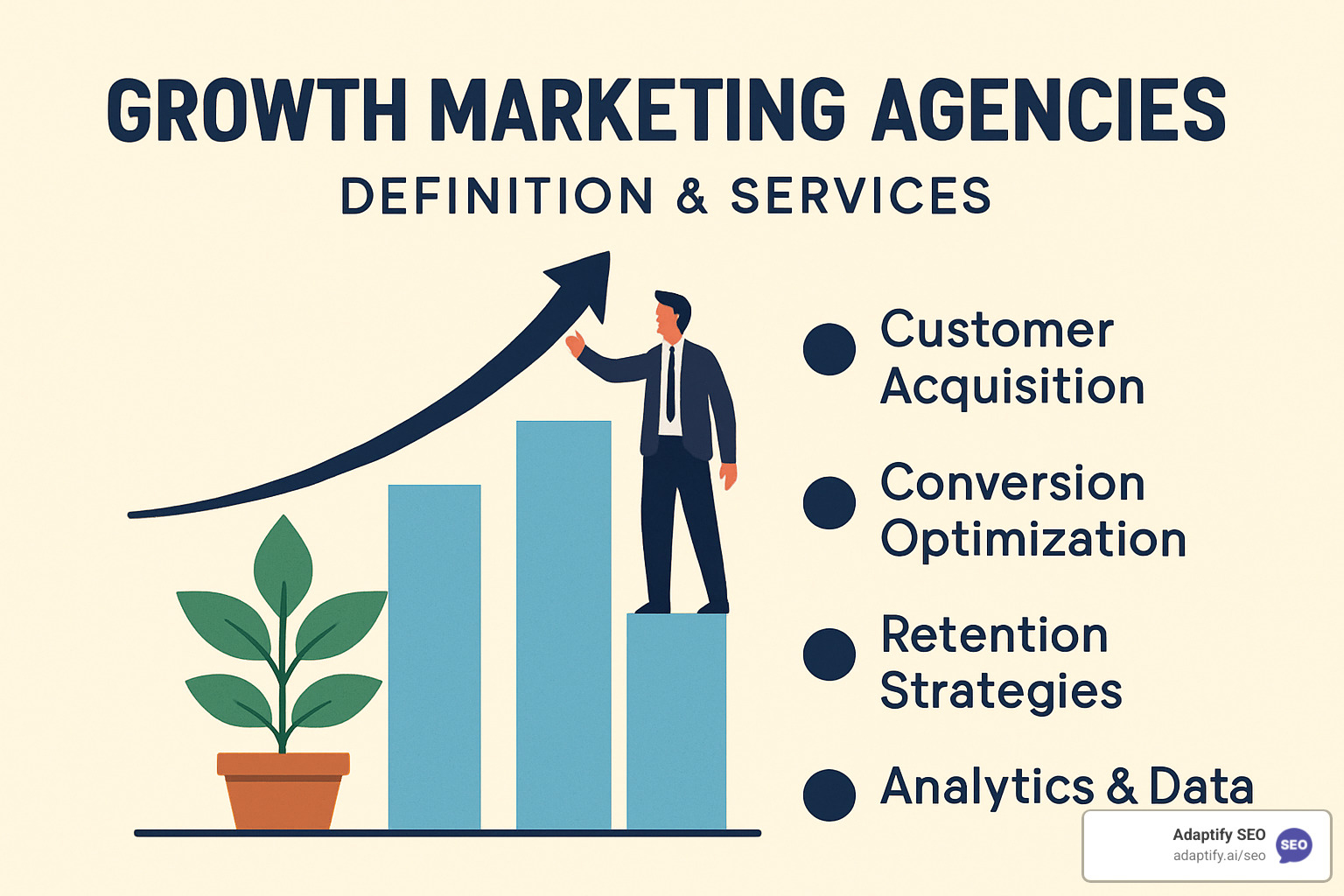
Growth marketing agencies definition services describe partners that run data-driven experiments across the entire customer journey instead of running one-off ads or isolated brand campaigns. They treat marketing not as a cost centre, but as a scientific, revenue-driving function of the business.
Quick Answer
Definition – Scientific, test-and-learn teams that optimise acquisition and retention to drive sustainable growth.
Why It’s Different – Continuous experimentation and full-funnel ownership are prioritised over single, top-of-funnel campaigns.
Expected Impact – 8 % average revenue lift, healthier LTV/CAC ratios, and a clear, measurable ROI on marketing spend.
Companies that adopt a growth mindset compound their results over time. For instance, a landmark study by Bain & Company found that increasing customer retention by just 5 % can raise profits by a staggering 25 % to 95 %. Growth agencies achieve this by treating marketing as a loop, not a linear funnel. In a traditional funnel, the customer journey ends with a purchase. In a growth loop, each touchpoint feeds data back into the next sprint, and satisfied customers become a source of new acquisition through referrals, creating a self-sustaining cycle.
If you’ve heard of the AARRR pirate metrics framework (Acquisition → Activation → Retention → Referral → Revenue), you already know the playbook. This model forces a holistic view of the customer journey, from the very first impression to long-term loyalty. A modern growth agency simply operationalises that model with rigorous testing, real-time analytics, and a relentless focus on the metrics that matter.
I’m Hansjan Kamerling. After years inside high-growth start-ups and scale-ups, I’ve seen exactly how the right agency partnership turns scattered tactics into a predictable growth engine.
What Is a Growth Marketing Agency?
Picture a marketing lab combined with a business strategy unit. Every headline, landing page, email sequence, and onboarding flow is a running experiment, carefully tracked down to its impact on revenue. That’s the day-to-day reality of a growth marketing agency.
Traditional shops celebrate brand awareness and impressions. Performance agencies obsess over paid ad metrics like CPA and ROAS. Growth teams merge creativity and maths, but add something bigger: lifecycle ownership. This means they’re accountable not just for getting strangers to visit your website, but also for ensuring those visitors become happy, activated users and loyal customers six months later. They focus on the entire journey, from first click to final referral.
Key characteristics
Holistic, full-funnel view – They work across acquisition, activation, retention, referral, and revenue, understanding that a 10% improvement in retention can be more valuable than a 10% increase in traffic.
Iterative testing – They run dozens of A/B tests monthly, not just a few per year. This high tempo of experimentation accelerates learning and drives compounding gains.
Channel agnostic – They aren't married to a single channel. They use whatever works—SEO, paid media, email marketing, product-led growth tactics, partnerships—to move the core business metrics.
Numbers first – Success isn't measured in vanity metrics like likes or followers. It's defined by tangible business outcomes: LTV growth, churn reduction, shorter payback periods, and profitable scaling.
How Growth Agencies Differ
Traditional
Performance
Growth
Goal
Brand recall
Cheap conversions
Sustainable scale
Focus
Top-of-funnel
Single channel
Full funnel
Metric
Reach
CPA / ROAS
LTV / CAC, churn
Cadence
Campaigns
Continuous
Weekly sprints
4-Stage Evolution
This is the typical journey a company takes with growth marketing, often guided by an agency partner.
Growth Hacking – In the early days, the focus is on rapid, often low-cost, tests to find initial traction and confirm product-market fit.
Growth Marketing – Once winning tactics are identified, this stage is about systematising them, building scalable channels, and diversifying efforts.
Growth Engine – Here, the focus shifts to building the infrastructure for predictability. This includes creating robust dashboards, implementing sophisticated attribution models, and understanding unit economics.
Growth Flywheel – The ultimate goal. The growth engine becomes self-propelling as satisfied customers drive referrals and user-generated content, creating compounding loops that reduce reliance on paid acquisition.
Most agencies enter at stage 2 or 3, helping a company build the systems and processes needed to graduate to a self-propelling flywheel.
Working with a growth agency replaces a collection of siloed vendors (an SEO agency, a PPC freelancer, an email consultant) with one integrated, cross-functional squad focused on a single goal: your company's growth.
Essentials
Cross-channel acquisition – This isn't just running ads. It's building an integrated strategy where channels complement each other, like using paid social to amplify top-performing SEO content or using PR to build authority that boosts all channels.
Conversion rate optimisation (CRO) – A continuous process of forming hypotheses and A/B testing everything from landing page headlines and calls-to-action to user flows and pricing pages to systematically increase the percentage of visitors who take a desired action.
Lifecycle marketing – This involves using marketing automation (email, SMS, in-app messages) to deliver personalised communications based on user behaviour. This includes onboarding new users, re-engaging dormant ones, and reducing churn.
Analytics & attribution – Setting up the infrastructure to track the entire customer journey, moving beyond simplistic last-click attribution to understand how different touchpoints contribute to a conversion. This is the foundation for all data-driven decisions.
Growth sprints – Applying agile methodology to marketing. The agency works in short, 1–2-week cycles, each focused on a specific hypothesis. They build, test, measure, and log learnings, ensuring a constant tempo of experimentation and progress.
Fractional growth leads – Gaining access to senior, strategic talent (a Head of Growth or CMO-level expert) for a fraction of the cost of a full-time executive hire.
Primary Services Map
Strategy road-mapping – The engagement typically starts with a deep-dive audit of your current marketing efforts, which leads to an opportunity matrix highlighting the highest-impact areas. This culminates in a clear 90-day plan.
Channel prioritisation – Instead of trying to be everywhere, the agency uses data to identify and double-down on the top 2–3 highest-return acquisition sources for your business.
A/B testing infrastructure – Setting up and managing the tools required for rigorous testing, such as Optimizely, VWO, Google Analytics 4, and data visualisation platforms like Looker Studio.
Funnel audits & LTV/CAC modelling – A quantitative analysis to find the biggest leaks in your customer funnel and build a financial model to predict customer lifetime value (LTV) and payback periods.
B2B vs. B2C Nuances
B2B – Focus is on longer sales cycles. Key services include demand generation through content, account-based marketing (ABM) targeting high-value accounts, and creating sales enablement materials to help the sales team close deals.
B2C / E-commerce – The sales cycle is shorter and more transactional. Focus is on product-page CRO, reducing cart abandonment with automated email flows, and optimising influencer marketing for a clear ROAS.
SaaS – A hybrid model with a focus on user behaviour. Key services include optimising freemium-to-paid conversion rates, testing different pricing models (like usage-based pricing), and developing churn forecasting models to proactively save at-risk accounts.
Pricing Snapshot
Monthly retainer: $2.5k–$12.5k
Hybrid retainer + performance bonus: Common for aligning incentives, where the agency gets a bonus for hitting specific revenue or user growth targets.
Project work (audits, stack set-up): A fixed fee for a clearly defined, one-off project.
The sweet spot is a modest retainer plus a dedicated media budget. This gives the agency the flexibility to test rapidly across channels without needing to renegotiate the contract for every new experiment.
Benefits, KPIs & Data Frameworks
Growth agencies aren’t about prettier ads or more social media followers – they’re about building a more resilient and profitable business through better economics.
A mere 5 % lift in customer retention can raise profits by 25 % to 95 %, as repeat customers are cheaper to serve and tend to spend more over time.
While the industry average Return On Ad Spend (ROAS) hovers around 2.9:1, strong growth teams routinely beat this by optimising the entire funnel, not just the initial ad click.
Must-Track KPIs
These are the metrics that define success for a growth-focused team.
CAC & LTV (and the LTV/CAC ratio) – Customer Acquisition Cost and Lifetime Value. The ratio is the ultimate measure of marketing profitability. A healthy SaaS or e-commerce business aims for a ratio of at least 3:1.
Activation rate & monthly churn – Activation is the percentage of new users who experience the core value of your product. Churn is the percentage of customers who leave each month. These metrics measure product stickiness.
Net Promoter Score (NPS) – A measure of customer satisfaction that asks how likely users are to recommend your product. It's a leading indicator of word-of-mouth growth and referral potential.
Payback period – The number of months it takes to earn back the cost of acquiring a customer (CAC). A shorter payback period means faster, more capital-efficient growth.
MRR growth – For subscription models, Monthly Recurring Revenue is the North Star metric. Growth is often broken down into new MRR, expansion MRR (from upgrades), and churned MRR.
Tool Stack Essentials
To track and act on these KPIs, a modern growth stack is essential.
Analytics – GA4, Mixpanel/Amplitude. These tools track user behaviour on your website and inside your product, answering questions like "What features do our best customers use?"
Testing – Optimizely / Google Optimize / VWO. These A/B testing platforms allow you to rigorously test changes to your website and measure their impact on conversion rates.
CDP – Segment, mParticle. A Customer Data Platform unifies data from all sources (website, app, CRM) into a single customer view, enabling highly personalised marketing.
Automation – HubSpot, Klaviyo. These platforms automate communication across channels like email and SMS, allowing you to nurture leads and customers at scale.
BI Dashboards – Looker, Power BI, Looker Studio. Business Intelligence tools pull data from all other sources into a single dashboard to visualise KPIs and track progress against goals.
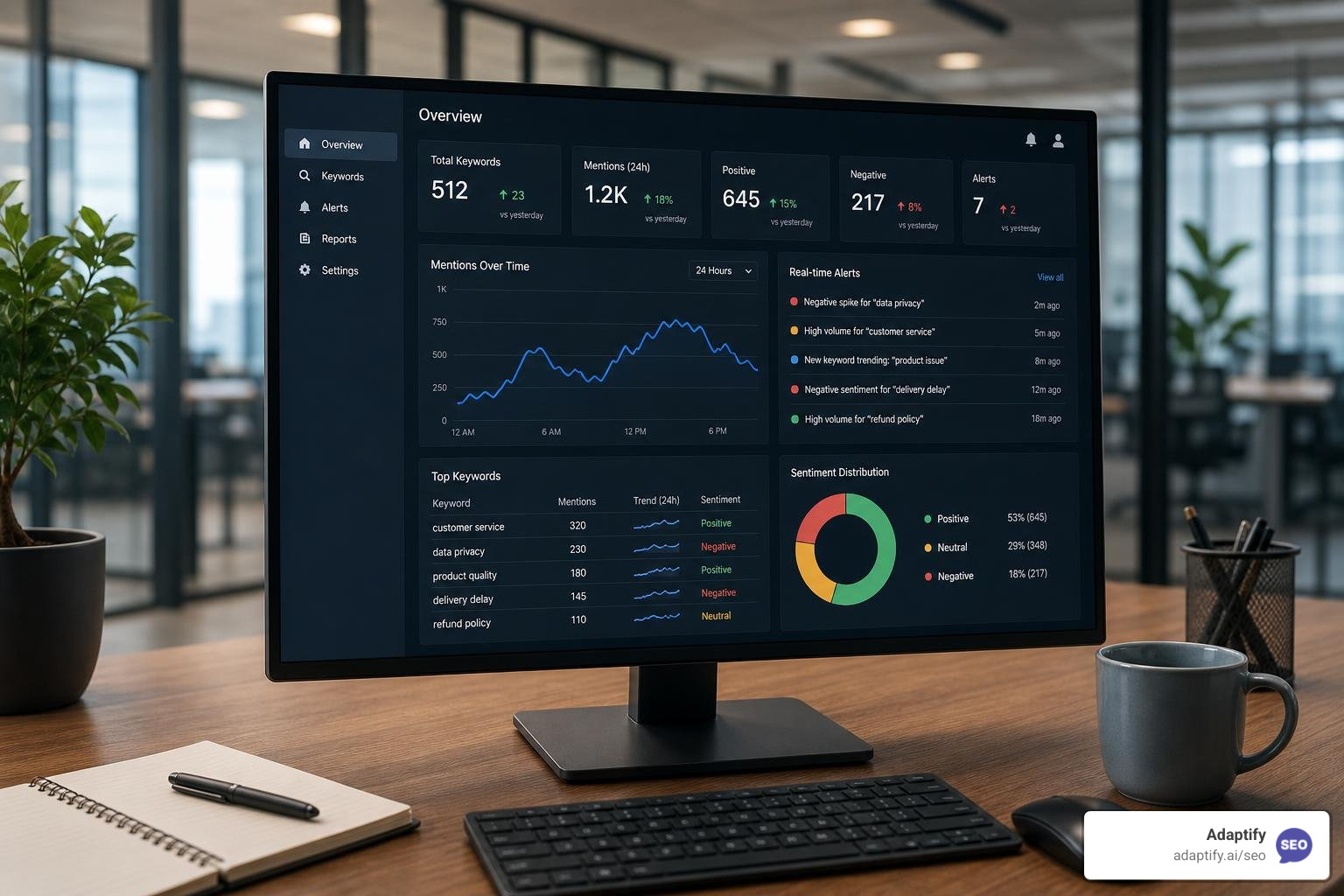
Modern growth marketing dashboard showing key metrics like CAC, LTV, conversion rates, and funnel performance with real-time data visualization - growth marketing agencies definition services
How to Choose & Work With a Growth Marketing Agency
Selecting a growth partner is less like a Tinder swipe and more like entering a long-term marriage. Success depends on alignment, communication, and shared goals. Here’s how to get it right.
Self-audit first – Before you even talk to an agency, diagnose your own business. What’s the biggest bottleneck: traffic (not enough visitors), conversions (visitors don't take action), or retention (customers don't stick around)? Knowing your primary problem helps you find an agency with the right specialisation.
Shortlist by industry and business model fit – Don't be swayed by a big-name agency that only works with Fortune 500s if you're a seed-stage startup. Ask for specific case studies from companies similar to yours (e.g., B2B SaaS, D2C e-commerce) and check their references.
Culture check for curiosity and transparency – During the pitch process, pay attention to the questions they ask. A great partner will challenge your assumptions and be deeply curious about your business model. A red flag is an agency that promises guaranteed results or isn't transparent about their process and past failures.
Set SMART goals together – A vague goal like “we want more growth” is a recipe for failure. Work with the agency to set a specific, measurable, achievable, relevant, and time-bound (SMART) goal. For example: “Increase qualified marketing leads (MQLs) by 25% in the next 6 months, while keeping the cost per MQL below $200.”
Clarify roles and responsibilities (RACI) – Define who is Responsible, Accountable, Consulted, and Informed for key tasks. Who owns the creative development? Who implements technical fixes on the website? Who has final sign-off on budget changes? Clear boundaries prevent friction later.
First 90 Days Snapshot
0-30 days: Audit & Foundation – This phase is all about findy and setup. The agency will conduct a deep-dive audit of your analytics, tech stack, and past performance. They'll clean up tracking, build initial dashboards, and create a backlog of experiment hypotheses.
31-60 days: Experimentation & Quick Wins – The agency will start running its first experiments, often focusing on “quick win” opportunities identified in the audit (e.g., CRO tests on high-traffic pages, optimising email onboarding). Weekly reports on progress and learnings begin.
61-90 days: Scaling & Road-mapping – Based on the initial data, the agency will start to scale the winning experiments and kill the losing ones. They will present a comprehensive analysis of the first 90 days and a strategic 12-month roadmap.
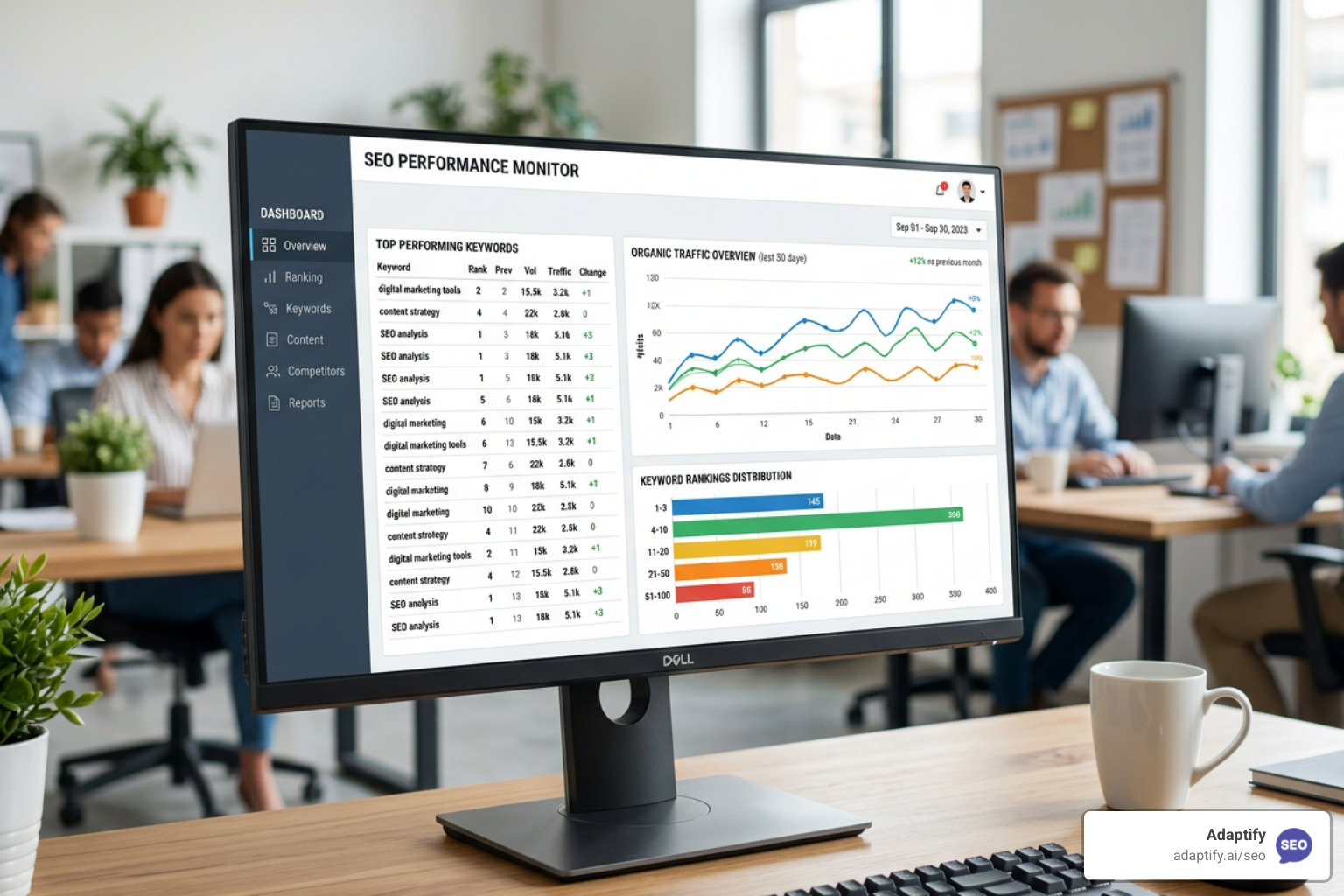
Growth marketing sprint board showing experiment pipeline with hypothesis, test design, success metrics, and results tracking across multiple channels - growth marketing agencies definition services
Agency vs. In-House – Quick Pros & Cons
Agency
In-House
Speed to expertise
Immediate access to a specialised team
3–6 month hiring and onboarding cycle
Cost
Flexible retainer, scales up or down
Fixed salaries, benefits, and overhead
Perspective
Broad, cross-industry knowledge of what works
Deep, nuanced product and company knowledge
Control
Shared ownership and decision-making
Full control over priorities and execution
Many firms find success with a hybrid model: using an agency for high-level strategy, specialised channel management (like technical SEO or complex paid media), and running experiments, while an in-house marketer handles daily execution, content creation, and brand voice.
Frequently Asked Questions
What budget do I need to work with a growth agency?
Meaningful traction usually starts around US$5k–10k/month in total marketing spend. This typically breaks down into 60–70% for media/tools and 30–40% for agency fees. This budget allows for enough testing velocity to generate learnings quickly. Scale-ups with proven product-market fit often invest $15k+ per month as the ROI becomes clear and they want to scale faster.
How long does it take to see ROI?
ROI is not a single event but a phased process. You should expect to see different types of results on different timelines:
30-60 days – Early wins often come from CRO on existing traffic or optimising lifecycle email flows. These are "low-hanging fruit."
60-90 days – You should start seeing efficiency gains in paid channels as the agency optimises campaigns and creative.
90-180+ days – More strategic, long-term channels like SEO and content marketing begin to show compounding effects, driving sustainable organic growth.
What's the difference between a growth agency and a digital marketing agency?
A digital marketing agency typically focuses on executing services within specific channels (like SEO, PPC, or social media), often with a top-of-funnel goal like driving traffic or leads. A growth agency takes a more holistic, strategic, and data-driven approach. They own the entire customer funnel—from acquisition to retention—and are measured on business outcomes like revenue growth, LTV/CAC ratio, and churn, not just channel-specific metrics.
Can a growth agency replace my internal marketing team?
Rarely 100%. The most effective model is a true partnership. The agency brings an outside perspective, a rigorous testing framework, and specialised expertise that's hard to hire for. The internal team provides deep product context, customer knowledge, and the ability to implement changes quickly. The agency provides the 'what' and 'why,' while the internal team often helps with the 'how.'
Conclusion
The era of siloed, gut-feel marketing is over. To win in today's competitive landscape, businesses must be more scientific, more data-driven, and more holistic in their approach. Growth marketing agencies definition services provide companies with the strategic framework, experimental process, and analytical rigour needed to scale efficiently, improve the fundamental economics of their business (LTV/CAC), and ultimately out-learn their competitors.
This systematic approach requires a robust tech stack and expertise across multiple disciplines. For agencies looking to add world-class SEO to that toolkit without the overhead of a large in-house team, Adaptify.ai delivers an automated solution. Our platform covers strategy, content creation, and PR link building in one streamlined, AI-powered engine.
Ready to see how you can plug a high-impact SEO engine straight into your growth stack? Book a Demo and find how Adaptify can become a core part of your growth services.
Join 1,000+ agencies already delivering SEO and AI visibility from a single platform without increasing their headcount.Join 1,000+ agencies already delivering SEO and AI visibility from a single platform without increasing their headcount.