Mastering SEO: How to Do Effective Keyword Research




How to do keyword research is the foundation of any successful SEO strategy. It’s the process of finding and analyzing the exact words and phrases your target audience types into search engines when looking for information, products, or services like yours. With over 8.5 billion daily Google searches, understanding this behavior is essential for business growth.
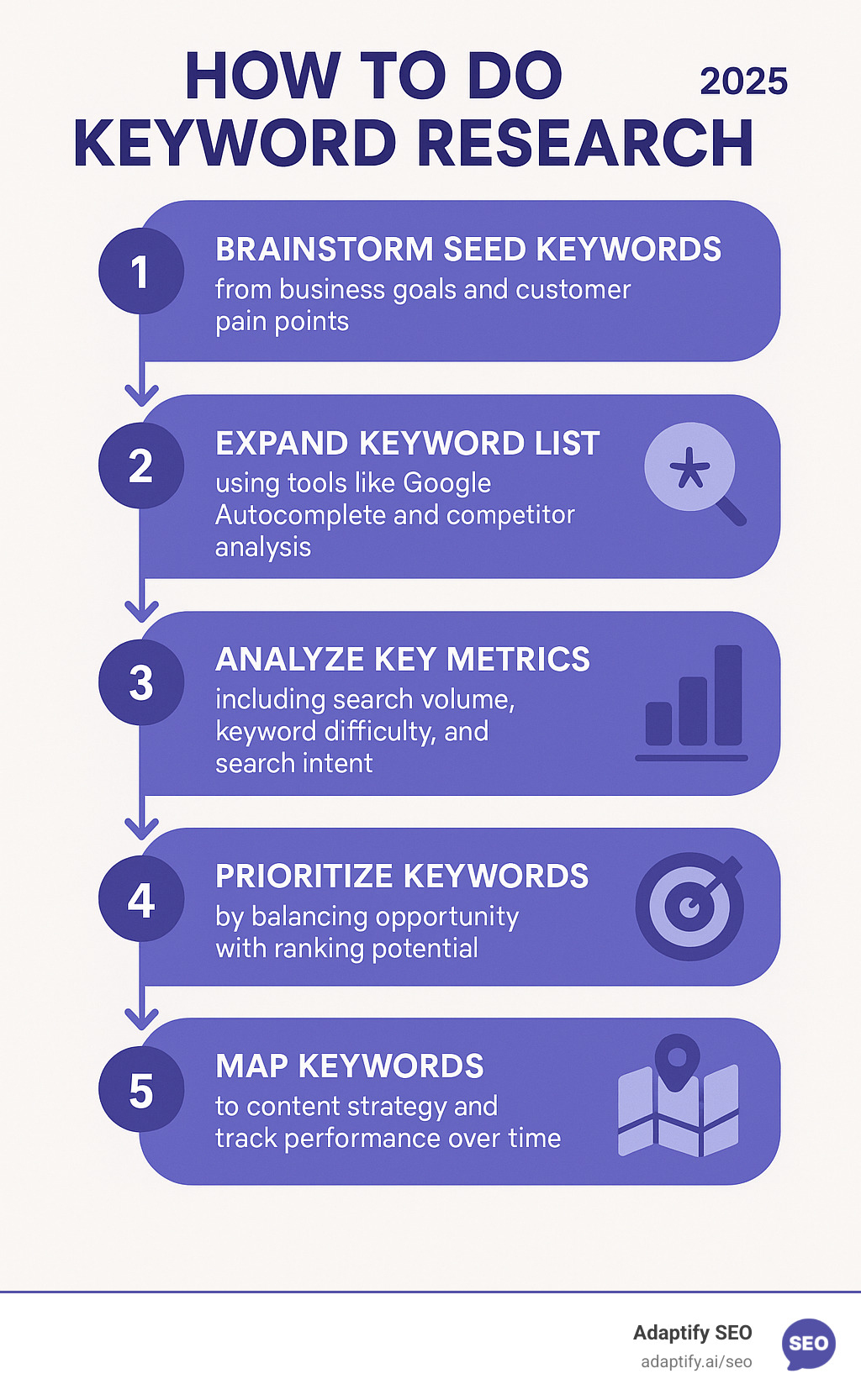
Here's how to do keyword research in 5 essential steps:
Effective keyword research helps you create content that matches user intent, drives qualified traffic, and converts visitors into customers.
Why keyword research matters for your SEO success:
Many agencies struggle with the manual intensity of keyword research, spending hours on repetitive tasks. The process becomes even more complex when managing multiple client accounts and needing consistent, high-quality results at scale.
I'm Hansjan Kamerling, and through my work with AI startups and data analytics platforms, I've learned how to do keyword research efficiently using both traditional methods and emerging AI tools. My experience has shown me the importance of systematic processes that deliver results without the grunt work.
Before you can master how to do keyword research, you need to understand its building blocks. Without these foundations, even the best tools won't help you succeed.
Search intent is the reason behind a search. If you don't understand what people actually want, you're setting yourself up for failure. As SEO expert Greg Gifford puts it, if you don't match the search intent, you're not going to rank. Google has made this clear in their explanation of content relevance, stating that matching keywords to queries is a critical ranking factor.
There are four main types of search intent:
To understand intent, look at what's already ranking. If the top results are blog posts, Google thinks users want information. If they're product pages, users are ready to buy.
Not all keywords are created equal. Understanding the differences is key to a successful SEO strategy.
| Keyword Type | Volume | Competition | Conversion Rate | Description |
|---|---|---|---|---|
| Head Terms (Fat-head) | High | High | Low | Short, generic terms (1-2 words). Very broad intent, hard to rank for. Example: "shoes", "coffee" |
| Chunky Middle | Medium | Medium | Medium | Slightly more specific terms (2-3 words). Better intent, more manageable competition. Example: "running shoes", "coffee maker" |
| Long-Tail Keywords | Low | Low | High | Longer, very specific phrases (3+ words). Clear intent, easier to rank for, highly convertible. Example: "best women's size 7 running shoes for plantar fasciitis", "aeropress coffee to water ratio" |
While head terms like "SEO" have massive search volume, they are incredibly competitive. Long-tail keywords are where most businesses find success. A term like "content marketing for dentists" has much lower volume but attracts a highly qualified audience that is more likely to convert.
Once you have a list of potential keywords, you need to analyze them with these key metrics:
Successful keyword research involves balancing these metrics. A low-volume, low-competition keyword with perfect intent is often better than a high-volume keyword you'll never rank for.
Now that we've covered the foundations, let's walk through the practical steps of how to do keyword research effectively. This is your roadmap to uncovering the phrases that will drive qualified traffic to your website.
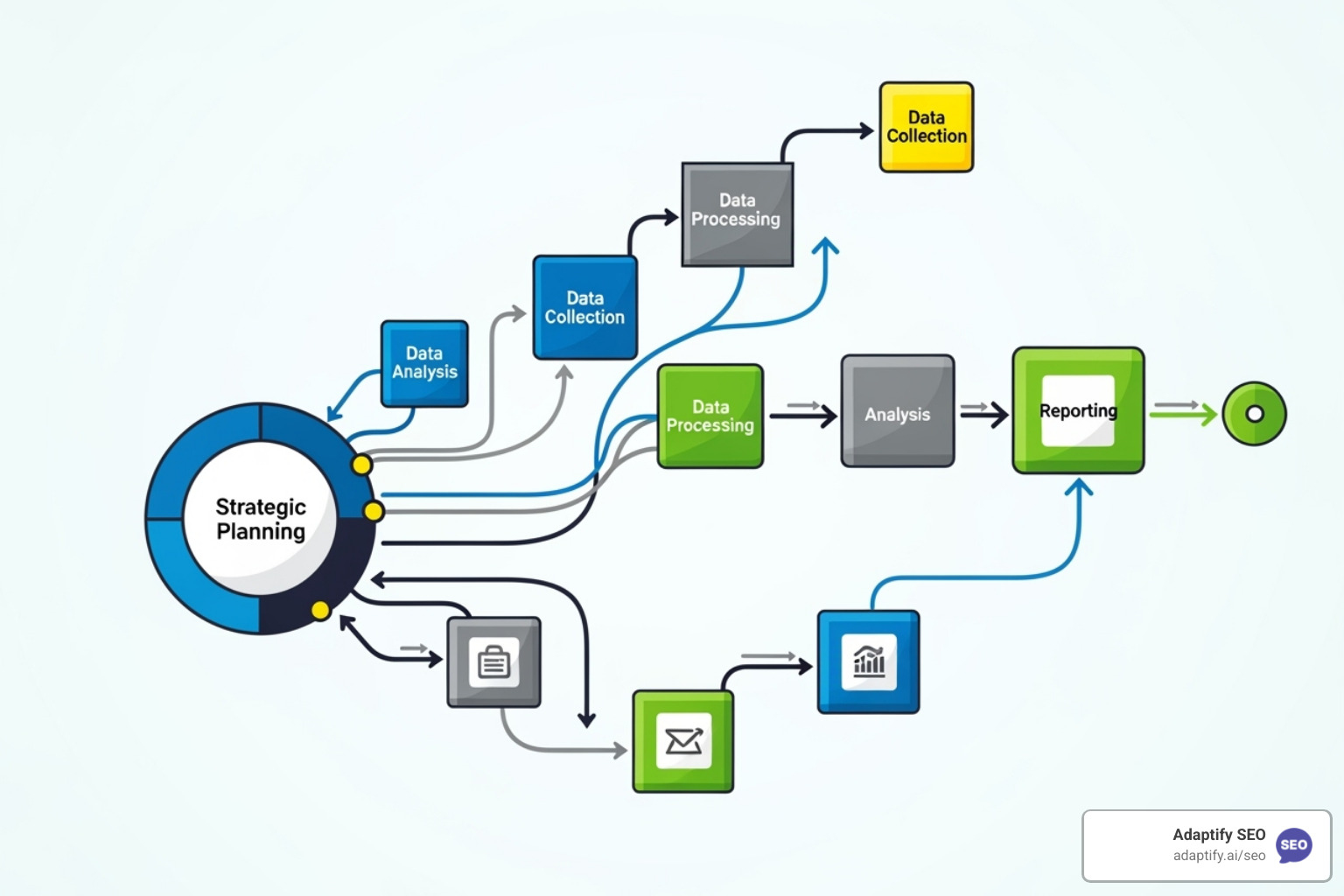
Effective how to do keyword research starts with understanding your customers. Think about the problems you solve and the language your customers use. A restaurant owner might search "how to get more customers," while a tech founder looks for "growth hacking strategies."
Your sales and customer service teams are invaluable here. They hear the exact questions customers ask daily, like "why did my rankings drop" or "how long does SEO take." These are powerful keyword ideas. Also, consider what you want to be known for. At Adaptify, we target terms like "AI SEO tools" and "automated content optimization." These initial ideas are your seed keywords—the foundation for your research.
This is where you find the treasure. Long-tail keywords are more specific, less competitive, and convert better. Here's how to find them:
Question-based keywords often signal high intent, meaning the searcher is more likely to engage with your content.
Learn from what's already working for your competitors. Start by identifying your true SEO competitors—these might be blogs or resource sites, not just direct business rivals.
Use a content gap analysis to find keywords where multiple competitors rank but you don't. SEO tools can automate this process, revealing proven opportunities. It's like finding a busy restaurant district where you don't have a location yet.
Analyze the content that's ranking. Can you create something more comprehensive, up-to-date, or helpful? Sometimes competitors rank with weak content, presenting a clear opportunity for you to create something superior and outrank them. This isn't about copying; it's about finding gaps you can fill better than anyone else.
With a large list of ideas, you need a system to pick the winners. Focus on low-hanging fruit—keywords with decent search volume but manageable competition. This is especially important for newer websites.
Think about business potential. A keyword that brings 100 highly qualified prospects is more valuable than one that brings 1,000 uninterested visitors. Ask yourself: "If I rank #1 for this, will it bring the right customers?"
Also, perform a SERP feature analysis. Look for featured snippets, image packs, or People Also Ask boxes in the search results for your target keywords. Earning a spot in these features can provide extra visibility and traffic.

Don't dismiss low-volume keywords. A keyword with only 50 monthly searches can be incredibly valuable if it perfectly matches your ideal customer's specific need.
The final step is turning your research into an actionable plan. Keyword mapping involves assigning a primary keyword and related secondary keywords to each page on your site. This ensures every piece of content has a clear purpose.
Organize your content into topic clusters. A broad topic becomes a comprehensive pillar page (like this guide), while related subtopics become spoke content that links back to the pillar. This structure builds topical authority and helps search engines understand your expertise.
This process helps you avoid keyword cannibalization, where multiple pages on your site compete for the same keyword. If you find cannibalization, you can consolidate the content, use a 301 redirect to point the weaker page to the stronger one, or differentiate the content to target different user intents. A logical content architecture is key to maximizing your SEO impact.
The right tools can make or break your keyword research. While you can start with manual methods, dedicated tools help you master how to do keyword research efficiently.
Free tools are a great starting point, especially on a tight budget. They have limitations but provide a solid foundation.
Free tools are useful, but they often cap daily searches and lack the deep competitive insights needed for serious SEO.
When you're serious about how to do keyword research, paid tools are a game-changer. They offer speed, precision, and data that free tools can't match.
These tools transform keyword research from guesswork into a data-driven strategy with advanced filtering, competitor analysis, and rank tracking.
You'll know it's time to upgrade when you're constantly hitting search limits on free tools, or when you need advanced features like detailed competitor analysis and automated rank tracking. As your content investment grows, data accuracy becomes critical. For agencies managing multiple clients, the efficiency and depth of paid tools are not luxuries—they're necessities. This is why platforms like Adaptify SEO exist: to streamline these critical but repetitive tasks at scale.
AI is reshaping keyword research, but it's important to understand its role. AI chatbots like ChatGPT and Gemini are excellent for brainstorming and generating keyword ideas. They can suggest semantically related terms and long-tail variations you might not have considered.
However, current AI chatbots cannot provide accurate SEO metrics like search volume or keyword difficulty because they lack access to real-time search data. Their suggestions are based on past training data, not current search behavior.
The real innovation is happening as specialized SEO tools integrate AI features. For example, some platforms use AI to automate tasks and generate content briefs based on keyword clusters. This is the future: AI enhancing the tools we already use. At Adaptify SEO, we leverage this principle to streamline the entire SEO workflow, from keyword research to content creation, freeing you to focus on strategy.
Let's address some common questions about how to do keyword research.
There's no single magic number. While a guideline of 100+ monthly searches is a decent starting point, it's not a strict rule. In specialized niches, a keyword with just 20-30 monthly searches can be incredibly valuable.
Relevance beats volume every time. A low-volume keyword that perfectly matches your ideal customer's intent is worth more than a high-volume keyword that brings unqualified traffic. The real question isn't about volume, but about the business potential of the keyword. If ranking for a term can lead directly to customers, it's valuable regardless of its search volume.
Keyword research is an ongoing process, not a one-time task. Search trends shift, and new competitors emerge.
Yes, but it's a long-term goal that requires a strategic approach, especially for newer websites. High-difficulty keywords are dominated by sites with strong domain authority and extensive backlink profiles.
To compete, you'll need exceptional content that is significantly better than what's currently ranking, along with a solid backlink strategy to build your site's authority. The best approach is to build topical authority first. Start by targeting easier, long-tail keywords in your niche. As you create excellent content and earn backlinks, your site's reputation will grow, making those high-difficulty keywords more achievable over time.
Learning how to do keyword research is a foundational SEO skill. The goal isn't just to find popular terms, but to understand what your audience truly needs and position your content as the best solution.
When you focus on user intent over raw search volume, you create content that genuinely helps people. This leads to better engagement, higher conversions, and stronger search rankings. Keyword research is a continuous journey. The most successful SEO strategies adapt to shifting trends while maintaining a solid foundation of well-researched, intent-focused keywords.
As search engines evolve, the core principle remains: connect users with the answers they seek. For agencies, managing this process across multiple clients can be overwhelming. The manual work of research, strategy, and content creation drains resources and limits scalability.
Adaptify.ai transforms this challenge into an opportunity. Our automated SEO platform handles the heavy lifting of keyword research, strategy formulation, and content creation. We help agencies reduce their SEO workload by up to 80%, allowing them to focus on delivering exceptional results for their clients.
Ready to turn your keyword research into consistent ranking wins without the manual grind? Leverage AI to scale your SEO operations efficiently.

Stop Flying Blind with These Top SEO Monitor Tools - Learn about seo monitor tools

Learn what is local SEO and how to dominate Google Maps, drive foot traffic, and grow your business with this complete optimization guide.

Going Local and Winning Big with the Best SEO Keywords - Learn about local keywords
Join 1,000+ agencies already delivering SEO and AI visibility from a single platform without increasing their headcount.Join 1,000+ agencies already delivering SEO and AI visibility from a single platform without increasing their headcount.