Monitor Backlinks Like a Prowith Free and Paid Tools
Hansjan Kamerling
Jan 23, 202618 min read
Why SEO Backlink Monitoring Keeps Your Rankings Safe
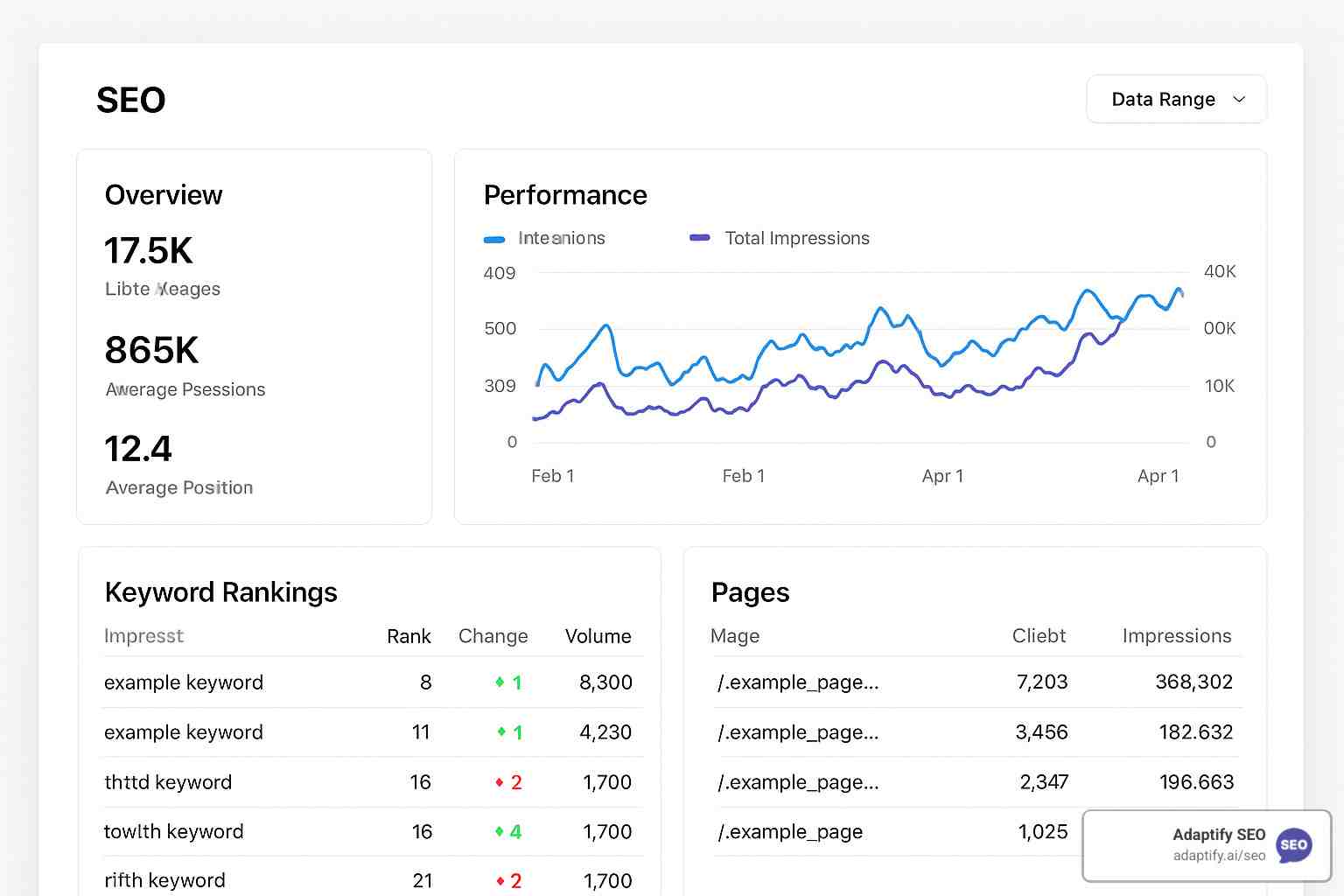
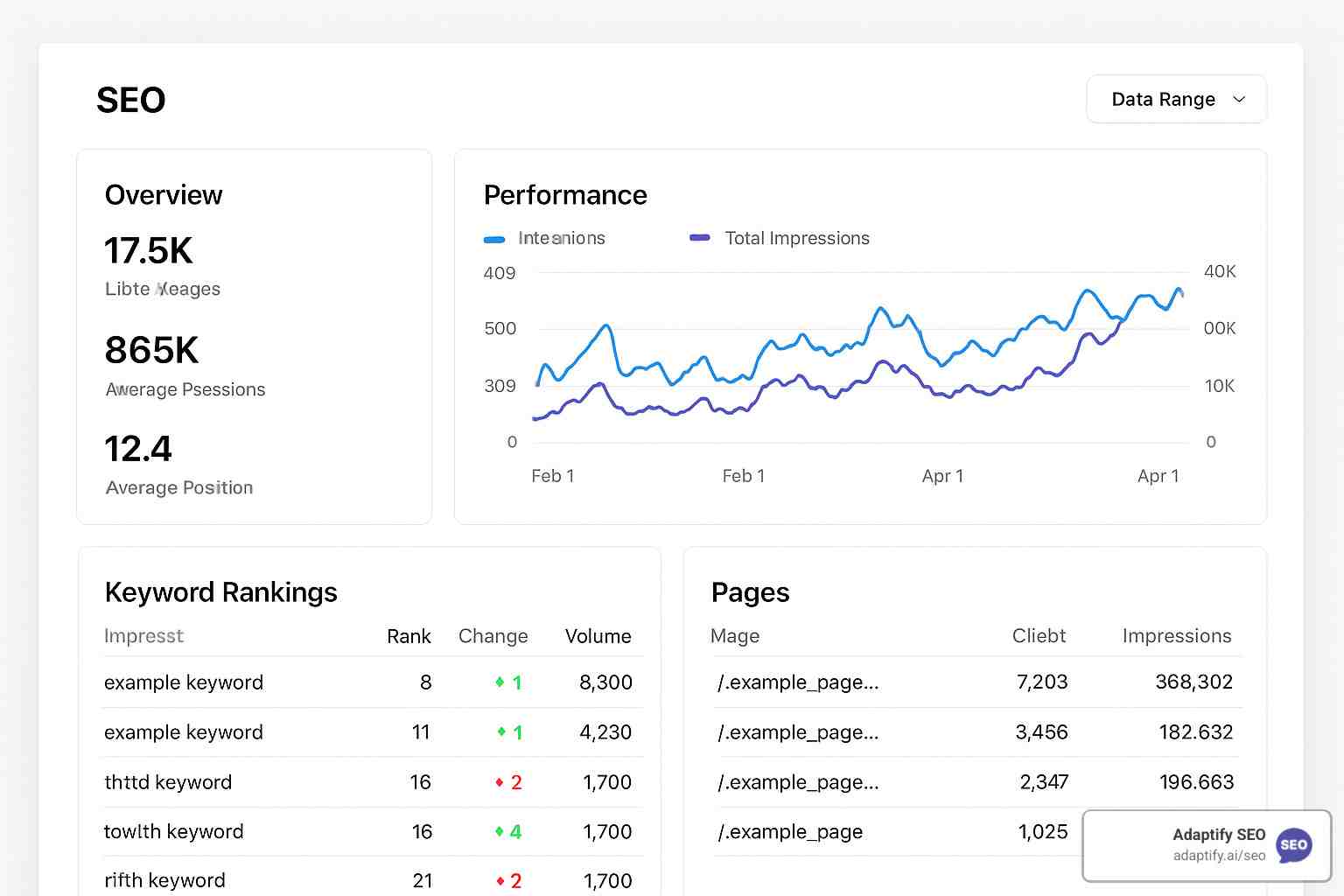
backlink monitoring dashboard - seo backlink monitoring
SEO backlink monitoring is the process of regularly tracking the links pointing to your website to ensure they remain active, valuable, and free from harmful spam. Here's what you need to know:
Essential Tools for Backlink Monitoring:
Free Options: Google Search Console (basic link data), Open Link Profiler (live backlink data)
Mid-Range: Monitor Backlinks ($29/month), Linkody ($13.90/month), SE Ranking ($65/month)
Premium: Ahrefs ($129/month), Semrush ($139.95/month), Moz Pro ($49/month)
Key Features to Look For:
Real-time alerts for new and lost links
Link quality metrics (Domain Authority, Trust Flow)
Broken link detection
Competitor backlink analysis
Disavow file generation
Backlinks remain one of the top two ranking factors according to Google, alongside content. But here's the challenge: backlinks don't last forever. Links disappear, pages get deleted, and sometimes competitors attack your site with spammy links. According to John Mueller, Google's trends analyst, "There are still algorithms that look at link quality." This means monitoring isn't optional - it's essential for protecting your hard-earned rankings.
The problem most agencies face is simple: manual backlink tracking eats up valuable time. Checking links in spreadsheets, manually verifying if they're still live, and trying to spot toxic links before they cause damage is exhausting work that pulls you away from growing your business.
I'm Hansjan Kamerling, an SEO expert who helps businesses scale. In this guide, I'll show you which tools can automate SEO backlink monitoring and free up your team to focus on strategy, not spreadsheets.
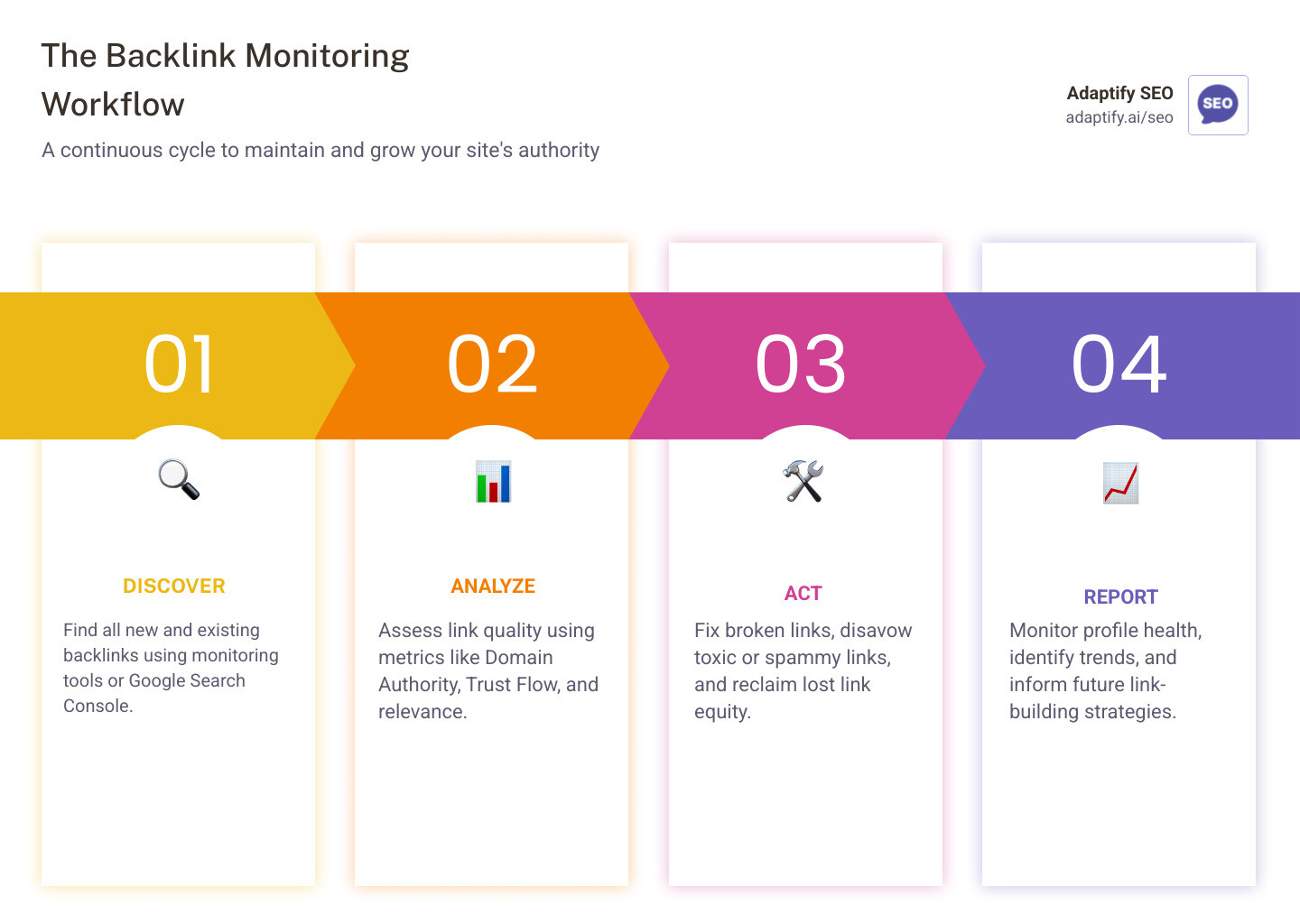
Infographic showing the backlink monitoring workflow: Step 1 - Discover backlinks through tools or Google Search Console, Step 2 - Analyze link quality using metrics like Domain Authority and Trust Flow, Step 3 - Take action by fixing broken links and disavowing spam, Step 4 - Report on backlink profile health and growth trends - seo backlink monitoring infographic pillar-4-steps
What is Backlink Monitoring and Why is it Crucial for SEO?
At its core, backlink monitoring is about tracking the digital "votes" (links) your website receives from other sites. Think of them as endorsements; more high-quality endorsements mean more authority in Google's eyes. As Google's Andrey Lipattsev stated, "Content and Links going into your site, are the two most important ranking factors followed by RankBrain." Neglecting your backlink profile is a major risk.
Backlinks are the lifeblood of your site's authority, passing what SEOs affectionately call "link equity" or "link juice" from one domain to another. This "juice" is what helps your pages climb higher in search results. Google explicitly states that they look at quality links pointing to your site. This isn't just about quantity; it's about the relevance, authority, and trustworthiness of the linking source.
Maintaining a healthy backlink profile is like tending a garden: nourish good links and prune spammy ones. Proactive SEO backlink monitoring helps you react swiftly to issues like negative SEO attacks before your rankings plummet. It's preventative maintenance versus emergency repairs.
Beyond search engines, your backlink profile also impacts user experience. Broken links, for instance, don't just drain link equity; they lead users to frustrating 404 pages, diminishing their trust and potentially driving them away. A well-maintained backlink profile ensures a smoother journey for both search engine crawlers and human visitors.
Protecting Your Site from Negative SEO
Negative SEO is a real threat where competitors try to sabotage your rankings with spammy backlinks. Research shows that "negative SEO can get companies penalized or entirely banned from Google. It can affect share price. It can even put companies out of business."
This is where proactive SEO backlink monitoring transforms from a best practice into an essential defense mechanism. Tools that offer real-time alerts for new backlinks allow you to spot suspicious activity almost immediately. If I see a sudden influx of links from irrelevant, foreign, or clearly spammy websites, my alarm bells start ringing. These low quality backlinks can actually do more harm than good, potentially triggering Google penalties.
Once identified, the solution often involves using Google's Disavow tool. This tells Google to ignore those specific links, protecting your site from their harmful influence. Semrush, for example, offers an automated export of spammy links directly to Google's disavow tool, streamlining a process that could otherwise be incredibly tedious. Without diligent monitoring, these attacks can go unnoticed until significant damage is done to your search visibility.
Identifying and Fixing Broken Links
Imagine working tirelessly to build a strong network of backlinks, only for them to vanish into thin air. That's the reality of "link rot" - the natural decay of links over time. Pages get deleted, URLs change, and websites shut down. When this happens, you end up with broken links pointing to your site, leading to 404 errors. These aren't just minor inconveniences; broken links are more than just minor nuisances; they are leaks in your website's SEO vessel, draining away valuable link equity and diminishing user experience.
SEO backlink monitoring helps you identify these broken links quickly. Tools automatically check if your link is still where it should be, notifying you if it's been removed, changed, or if the linking page itself is now a 404. This allows you to recover valuable lost links.
My strategy for fixing broken links typically involves two steps:
Reclaiming Lost Value: If the broken link points to a page on your site that no longer exists, I'll implement a 301 redirect from the old URL to the most relevant new page. This recovers the link juice and ensures a good user experience.
Outreach for Link Recovery: If the link on another site is broken (for example, they changed their page or removed your link), I'll reach out to the website owner. A polite email explaining the broken link and offering a correct (or even better, updated) URL can often get the link reinstated. As the research suggests, "If a key link disappears... reach out to find out what went wrong and why the link disappeared." Tools like SE Ranking even alert you when a backlink changes to a 404, prompting you to contact the website owner for a fix.
Key Metrics for Analyzing Backlink Quality
Not all backlinks are created equal. A link from a local pizza shop's blog is unlikely to carry the same weight as one from a globally recognized industry leader. Understanding the quality of your backlinks is paramount, and thankfully, various metrics help us quantify this.
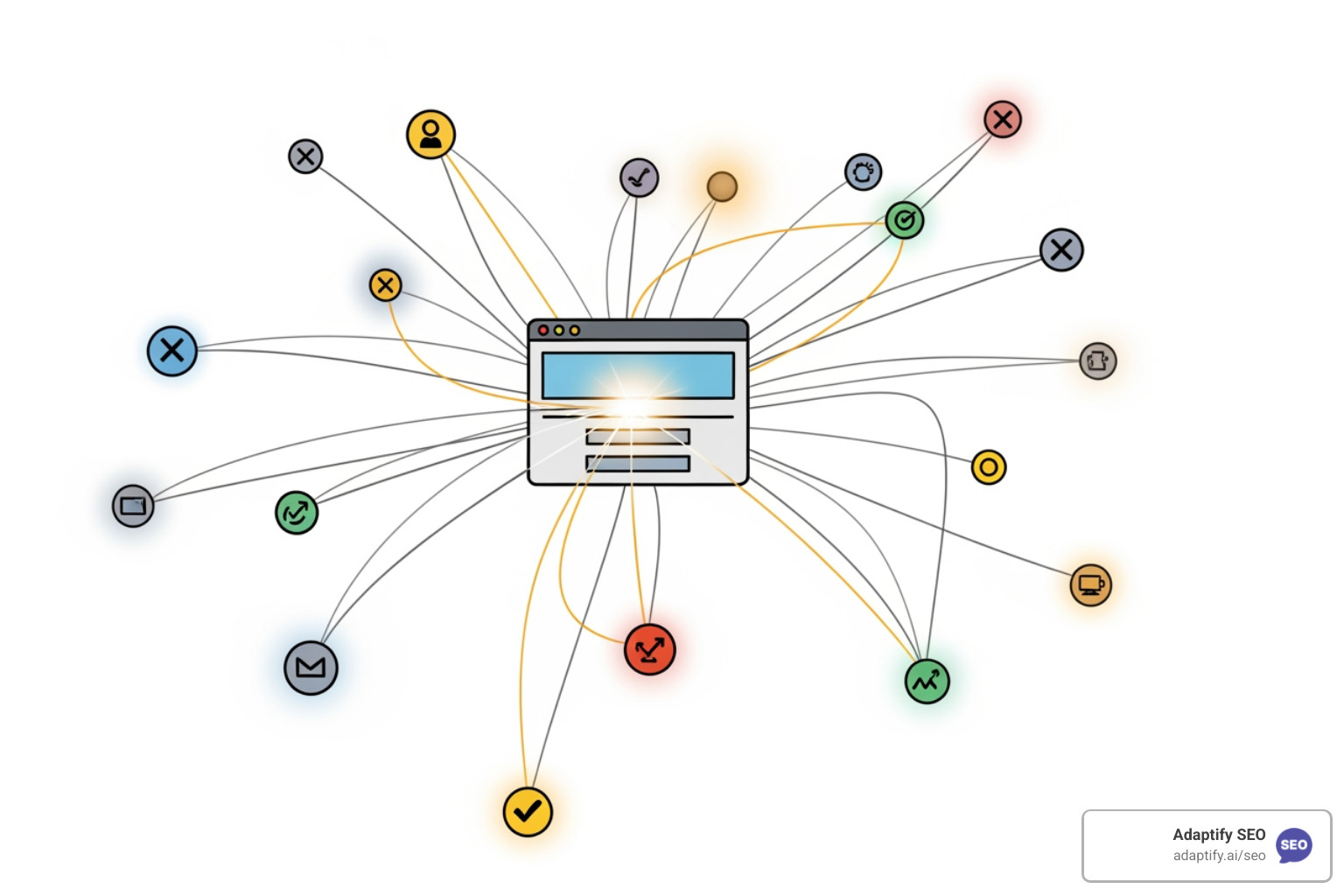
Diagram illustrating various backlink quality metrics such as Domain Authority, Trust Flow, Referring Domains, and Anchor Text variation. - seo backlink monitoring
When analyzing a backlink profile, I focus on these key metrics:
Domain Authority (DA) & Page Authority (PA): Developed by Moz, Domain Authority is a metric that "measures how high a website is likely to rank in Google." It's a predictive score (on a 1-100 scale) of how well a website will rank in search engine results. Page Authority does the same for individual pages. While not a Google metric, it's widely used as an indicator of a site's overall SEO strength and backlink profile quality.
Domain Rating (DR) & Ahrefs Rank (AR): These are Ahrefs' equivalents. Domain Rating "is a metric developed by Ahrefs to estimate a website's backlink authority" (on a 0-100 scale), while Ahrefs Rank is a ranking of websites based on the size and quality of their backlink profiles. The lower the AR number, the stronger the site.
Trust Flow & Citation Flow: Majestic SEO's proprietary metrics. Citation Flow predicts how influential a URL might be based on the number of linking sites. Trust Flow predicts how trustworthy a URL is based on the trustworthiness of sites linking to it. A healthy profile typically has a higher Trust Flow than Citation Flow, indicating quality over sheer quantity.
Referring Domains vs. Total Backlinks: This is a crucial distinction. "Total followed referring domains" tells you the number of unique websites linking to you, while "total followed linked domains" might count multiple links from the same domain. Unique referring domains are generally more valuable, as they signal a broader vote of confidence.
Anchor Text Distribution: This refers to the visible, clickable text in a hyperlink. A natural backlink profile has a diverse range of anchor texts – branded, naked URLs, generic terms, and keyword-rich phrases. Over-optimization with too many exact-match keyword anchors can appear manipulative to Google.
Dofollow vs. Nofollow Links: "Followed links pass link equity, while nofollow links typically do not." Dofollow links are the ones that directly contribute to your SEO authority. Nofollow links (and now UGC/Sponsored attributes) still have value in terms of referral traffic and brand visibility but generally don't pass "link juice." A healthy profile has a mix, but a strong bias towards dofollow from relevant sites is ideal.
Spam Score: Many tools provide their own version of a "Spam Score" (Moz is well-known for this), which estimates the likelihood of a website being penalized by Google. A high spam score on a linking domain is a red flag. Inbound Link, for instance, includes Spam Score in its quality analysis, alongside DA, PA, Trust Flow, and Citation Flow.
Combining these metrics provides a holistic view of backlink health, informing decisions on disavowing links, pursuing opportunities, and refining SEO strategy.
The Best Tools for SEO Backlink Monitoring
Choosing the right SEO backlink monitoring tool is like choosing the right car for a road trip: you need something reliable, efficient, and suited to your journey. From comprehensive all-in-one suites to specialized, affordable options and even free solutions, there's a tool for every need and budget.
Here's a quick comparison of the top-tier tools:
Tool
Key Features
Starting Monthly Price
Ahrefs
Real-time new/lost link alerts, largest link database (43 trillion links), DR/AR metrics, comprehensive competitor analysis, Site Explorer, Content Explorer. Often hailed as the go-to tool.
$129
Semrush
Backlink Audit Tool (identifies spammy links, automated disavow export), comprehensive SEO suite (keyword research, site audit, content marketing), detailed new/lost link analysis. Ideal for holistic approach.
$139.95
SE Ranking
User-friendly interface, detailed backlink analysis (Trust/Citation Flow, Dofollow/Nofollow ratios), budget/manager assignment for link building, disavow file generation, integrates keyword rankings. Versatile and user-friendly.
$65
All-in-One SEO Suites
These are the heavy-hitters, offering a full arsenal of SEO tools, with backlink monitoring being just one (albeit crucial) component.
Ahrefs: Ahrefs boasts the industry's largest link database, with "43 trillion links from 390 million domains" and a "real-time alert system, which notifies users about new and lost backlinks." It's exceptional for competitive analysis, allowing deep dives into competitor backlink profiles. Its Domain Rating (DR) and Ahrefs Rank (AR) metrics are industry standards for assessing authority.
Semrush: Semrush offers a robust Backlink Audit Tool, great for identifying spammy links and can "export spammy links to Google's disavow tool" automatically. Semrush is "perfect for businesses and SEO professionals seeking a holistic approach," integrating backlink data with keyword research, site audits, and content planning. Pricing starts at $139.95 per month.
SE Ranking: A strong contender at $65 per month, SE Ranking is praised for being "versatile and user-friendly." It provides detailed insights into backlink parameters like Trust Flow, Citation Flow, and Dofollow/Nofollow ratios. It also includes features for managing link-building budgets, which is useful for agencies.
Moz Pro: Known for its proprietary Domain Authority (DA) and Page Authority (PA) metrics, Moz Pro offers a robust Link Explorer. "Moz offers various tools to optimize every aspect of your online presence, including a robust backlink analysis feature." Starting at $49 per month, it's a competitive option for those prioritizing DA/PA metrics.
Specialized and Affordable Backlink Monitoring Tools
Sometimes, you don't need the whole kitchen sink; you just need a really good backlink wrench. These tools focus specifically on backlink monitoring and often come at a more accessible price point.
Monitor Backlinks: This tool "specializes as a dedicated guide in the vast sea of backlink analysis." Acquired by SEOptimer in 2023, it's an "affordable option with features like SERP influence tracking and competitor backlink alerts" starting at around $29 per month. It's great for tracking new/lost links and integrates keyword rankings.
Linkody: At $13.90 per month, Linkody is a cost-effective solution that "specializes in backlink tracking, making it easier for marketers and SEO professionals to effectively manage and analyze their link-building efforts." It offers continuous monitoring with notifications for gained/lost links and competitor analysis.
Seobility: Seobility offers "user-friendly Backlink Monitoring," allowing you to "easily track and maintain your website’s backlinks" and see "new and lost backlinks at a glance." It assigns a unique "link rating" to evaluate link quality and "generates custom link-building ideas based on your target keywords and competitors’ backlink profiles." A 14-day free trial is available.
BackMetric: This tool focuses on automated, real-time monitoring. Their "Starter plan is perfect for freelancers and small projects and includes 100 backlinks" for $14.99/month. They automatically crawl your backlinks and send instant alerts for changes.
Inbound Link: This tool aims to revolutionize backlink management, offering 24/7 monitoring with "omni-channel notifications" (email, Slack, etc.). It integrates GSC data and provides quality analysis (DA, PA, Trust Flow, Spam Score). Basic plans monitor up to 500 backlinks.
Free Backlink Monitoring Options
If you're just starting out or have a limited budget, there are still ways to keep an eye on your backlinks.
Google Search Console: This is your absolute first stop, and it's completely free! Google Search Console is "invaluable for basic website backlinks monitoring," showing you a list of links Google has finded pointing to your site. However, as the research notes, "it falls short in offering the granular insights and comprehensive analysis that dedicated SEO professionals often require." It won't give you real-time alerts or detailed quality metrics, but it's essential for any webmaster.
Open Link Profiler: This is a "free and cost-effective solution" that offers "live backlink data." It provides more functionality than GSC, allowing for CSV export and offering a unique "Link Influence Score." While it has limitations compared to paid tools, it's a great option for exploring backlink analysis without financial commitment.
How to Leverage Backlink Monitoring Data for Growth
Simply collecting data isn't enough; the real magic happens when you turn that data into actionable insights that fuel your growth. This is where SEO backlink monitoring moves from being a defensive measure to a powerful offensive strategy.
Advanced SEO Backlink Monitoring for Competitor Analysis
One of the most potent uses of backlink data is competitive intelligence. "Monitoring your competitors’ backlink strategies offers invaluable insights into industry trends, effective linking opportunities, and potential gaps in your own strategy." Backlink analysis is an effective way to see what's working for others.
Here's how I approach it:
Identifying Competitor Strategies: By analyzing where competitors are getting their links, I can often uncover their link-building tactics. Are they guest posting? Are they getting mentions from industry news sites? Are they leveraging broken link opportunities?
Finding New Link Opportunities: If a high-authority site links to three of my competitors but not to me, that's a prime target! I can then create content that's even better than my competitors' and pitch it to that linking domain. As Seobility points out, they can "generate custom link-building ideas based on your target keywords and competitors’ backlink profiles."
Skyscraper Technique: This classic tactic involves finding content with many backlinks, creating a superior version, and then asking sites linking to the original to link to your improved content instead. It's a fantastic way to acquire high-quality links.
Content Gap Analysis: Backlink data can show which topics or content formats are attracting the most links in your niche. This helps inform your content strategy, ensuring you create content that not only ranks but also earns those valuable endorsements.
Benchmarking your backlink profile against competitors helps you understand your position in the market and identify areas where you need to catch up or can pull ahead.
Using Data to Refine Your Overall SEO Strategy
Beyond direct link acquisition, backlink monitoring data feeds into every aspect of your SEO strategy. It’s a continuous feedback loop that helps you make smarter decisions.
Informing Content Creation: Which of your pages attract the most links? What type of content resonates with authoritative sites in your industry? This data guides your content team to create more of what works, improving your chances of earning natural backlinks.
Improving Link-Building Outreach: By understanding which types of sites link to you (and your competitors), you can refine your outreach lists and personalize your pitches. This makes your link-building efforts far more efficient and effective.
Measuring Campaign ROI: For agencies, being able to show clients how backlink efforts translate into improved metrics is critical. By monitoring new links, their quality, and their impact on rankings and organic traffic, you can clearly demonstrate the return on investment. If you're curious about how we tie these efforts together, you can find more info about our backlink services.
Aligning with High-Performing Pages: Backlink analysis helps you identify your "pillar" content – pages that naturally attract and retain links. You can then focus on strengthening these pages, ensuring they remain updated and continue to serve as strong authority hubs for your site.
At Adaptify.ai, we understand that for agencies, reducing manual effort and enhancing efficiency is key. Our automated SEO services, including sophisticated SEO backlink monitoring, streamline these processes, allowing you to focus on strategy formulation, content creation, and PR link building, all powered by AI. We turn raw backlink data into actionable intelligence, freeing your team to drive real growth for your clients.
Frequently Asked Questions about SEO Backlink Monitoring
How frequently should backlinks be monitored?
This is a common question, and the answer, like many things in SEO, is "it depends!" However, I generally recommend a tiered approach:
Daily for Critical Links: For your most important, high-value backlinks or if you suspect a negative SEO attack, daily checks are prudent. Many tools offer 6-hour or 12-hour monitoring for their higher-tier plans (e.g., BackMetric's Agency plan offers 6-hour monitoring).
Weekly for General Profile Health: For the bulk of your backlink profile, weekly checks are usually sufficient. Tools like SEOPress Insights and Seobility automatically collect backlink data every week. This allows you to spot new and lost links, identify trends, and address issues before they escalate.
Monthly for Reporting and Strategic Review: On a monthly basis, I recommend a more comprehensive review of your backlink profile. This is when you'd analyze overall growth, quality shifts, and prepare reports for clients or internal stakeholders. Many tools offer weekly or monthly summaries of changes.
The frequency can also depend on your site's size, industry, and the pace of your link-building efforts. A rapidly growing site engaging in aggressive link building will need more frequent monitoring than a static, established site.
What's the difference between basic and advanced backlink monitoring?
The distinction between basic and advanced SEO backlink monitoring boils down to depth, automation, and analytical capabilities:
Basic Features (Think Google Search Console):
Limited Link Data: Provides a list of links Google knows about.
No Real-Time Alerts: You have to manually check for updates.
Minimal Quality Metrics: Lacks proprietary metrics like DA, DR, Trust Flow, or Spam Score.
Manual Analysis: Requires significant manual effort to understand context or quality.
No Competitor Data: Focuses only on your own site.
Advanced Features (Think Ahrefs, Semrush, SE Ranking):
Comprehensive Database: Access to vast databases of finded links, not just those Google reports.
Real-Time Alerts: Instant notifications for new, lost, or changed links (e.g., Dofollow to Nofollow).
Automated Audits & Disavow: Tools can identify spammy links and help generate disavow files automatically.
Competitor Analysis: Allows you to analyze competitor backlink profiles in detail, identifying gaps and opportunities.
Historical Data: Tracks changes over time, showing trends in your backlink profile.
Granular Filtering: Ability to filter links by type, anchor text, index status, and more.
Reporting & Management: Offers customizable reports, team collaboration, and sometimes even link-building management features.
Basic monitoring tells you what links you have, while advanced monitoring tells you how good those links are, what changed, what your competitors are doing, and what you should do next.
Can bad backlinks really hurt my site?
Absolutely, yes. This isn't just SEO folklore; it's a critical reality. "Not all backlinks are good - low quality backlinks can actually do more harm than good."
Here's why:
Google's Stance: As John Mueller confirmed, Google's algorithms still "look at link quality." If Google perceives that you're intentionally trying to manipulate rankings with spammy or irrelevant links (e.g., from link farms, irrelevant foreign sites, or automated spam), it can trigger penalties.
Algorithmic vs. Manual Penalties: Most of the time, Google's algorithms will simply devalue or ignore low-quality links, meaning they won't help you rank. However, in more severe cases, especially with persistent or clear attempts at manipulation, you could face a manual penalty, which can drastically drop your rankings or even de-index your site entirely. "Negative SEO can get companies penalized or entirely banned from Google."
Importance of Disavowing Toxic Links: This is why the Disavow tool exists. It's a way to tell Google, "Hey, I don't endorse these links, please ignore them." While some low-value links might just be ignored by Google (as Seobility suggests, "a low-value backlink is generally better than no backlink, unless you have a good reason to believe that you have been the victim of malicious spam"), truly toxic links must be disavowed to protect your site.
So, while a single bad link might not sink your ship, a pattern of low-quality or spammy links definitely can. Proactive SEO backlink monitoring is your best defense against this kind of harm.
Conclusion: Take Control of Your Backlink Profile
In the changing world of SEO, backlinks remain a foundational element for ranking success. However, their dynamic nature demands constant vigilance. SEO backlink monitoring isn't just an optional add-on; it's an indispensable practice for protecting your digital assets, capitalizing on new opportunities, and maintaining search engine trust.
From identifying and fixing broken links that drain valuable link equity to fending off malicious negative SEO attacks, a proactive approach ensures your link profile remains healthy and robust. Leveraging key metrics like Domain Authority, Trust Flow, and anchor text distribution allows us to dissect the quality of every incoming link, making informed decisions that bolster our SEO strategy.
Whether you opt for the comprehensive power of all-in-one suites like Ahrefs and Semrush, the focused efficiency of specialized tools like Monitor Backlinks and Seobility, or the essential insights from free options like Google Search Console, the goal is the same: to gain control over your backlink narrative.
For agencies especially, the ability to automate this intricate process, freeing up valuable time for strategic thinking and client growth, is a game-changer. That's precisely the vision behind Adaptify.ai - providing automated SEO solutions that empower agencies to streamline operations and deliver exceptional results.
By integrating robust SEO backlink monitoring into your routine, you're not just tracking numbers; you're safeguarding your rankings, opening up growth opportunities, and building a resilient online presence.
Ready to see how a proactive approach to SEO backlink monitoring can transform your client's performance? View our SEO case studies to learn more.
Join 1,000+ agencies already delivering SEO and AI visibility from a single platform without increasing their headcount.Join 1,000+ agencies already delivering SEO and AI visibility from a single platform without increasing their headcount.