SEO Content on Autopilot – Your Guide to Automated Creation


Automated seo content creation uses AI-powered tools to generate, optimize, and publish SEO content without manual intervention. Here's what you need to know:
Key Components:
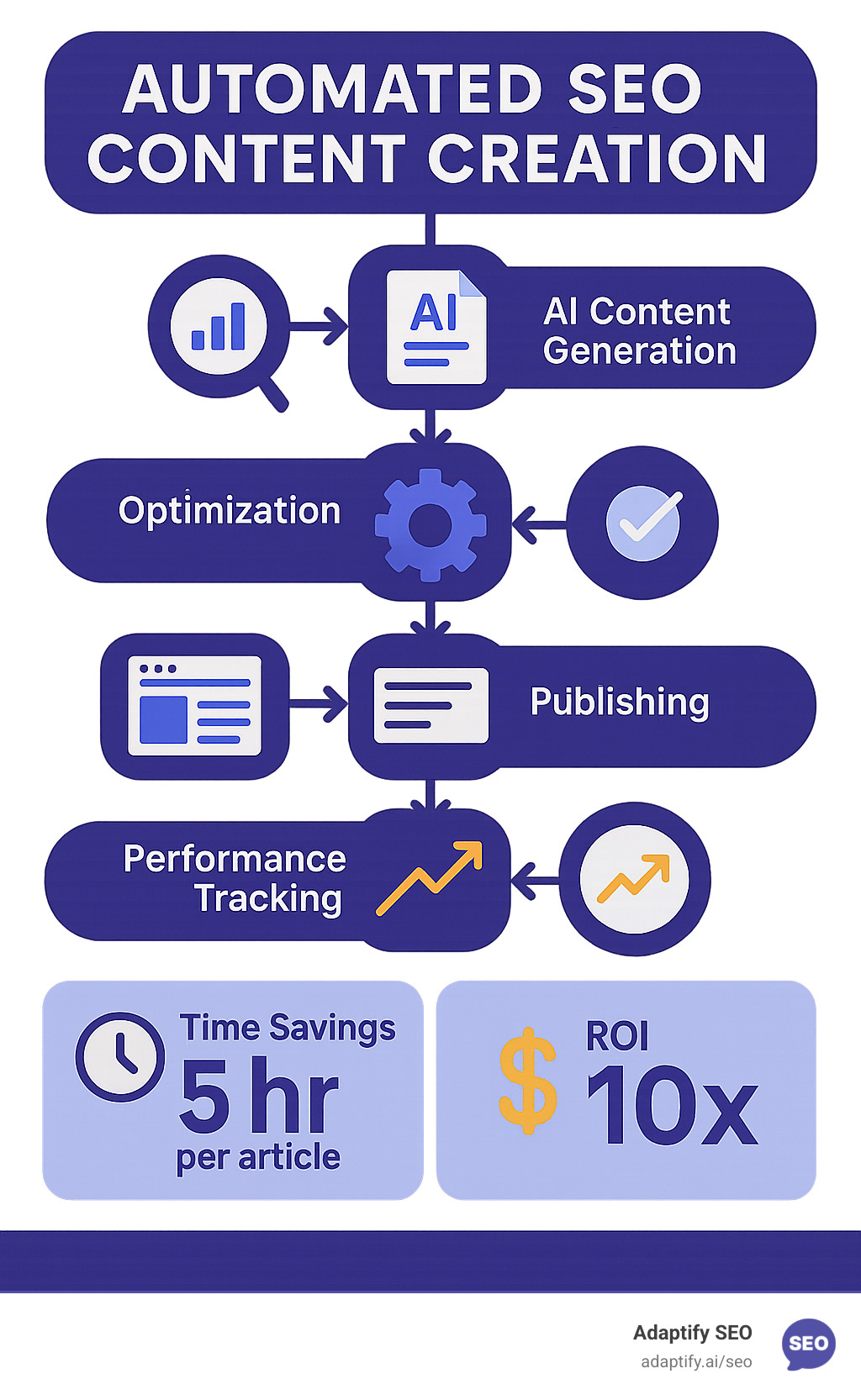
Time Savings: Production time drops from 8 hours to 3 hours per article, with some platforms generating 2,500-word pieces in under 60 seconds.
Scale Potential: Agencies report 10x revenue growth using white-label automated solutions, while platforms like BlogSEO AI have generated over 10 million SEO-optimized articles.
If you're an agency owner drowning in manual SEO tasks, you're not alone. Research shows that 90% of content creation time gets spent on repetitive work - keyword research, outline creation, optimization tweaks, and publishing workflows.
The numbers tell the story. Over 150,000 content creators now use tools like Surfer SEO for automated optimization. Agencies using Search Atlas report seeing results in days instead of the typical 3-month SEO timeline.
Automated seo content creation isn't about replacing human creativity. It's about eliminating the grunt work so you can focus on strategy and client relationships.
I'm Hansjan Kamerling, and I've spent years helping SaaS platforms scale from startup to millions of users, including AI-powered tools that now serve over 40,000 users with custom-trained models.
Think of automated seo content creation as having a really smart writing assistant that never sleeps. It combines artificial intelligence, natural language processing (NLP), and Retrieval-Augmented Generation (RAG) to create content that meets Google's E-E-A-T guidelines - Experience, Expertise, Authoritativeness, and Trustworthiness.
The technology has evolved significantly since ChatGPT's debut. Today's specialized SEO platforms generate content that passes AI detection tools and ranks competitively in search results.
Modern automated systems analyze top-ranking pages, understand what makes them successful, and generate original content with fresh perspectives. According to Google's guidance on AI-generated content, the search giant cares more about helpful, high-quality content than whether a human or AI wrote it.
The process works through RAG Technology that accesses real-time information from trusted sources. NLP Analysis examines competitor strategies to identify content gaps. Entity Recognition helps AI understand concept relationships. Automated Optimization handles technical SEO elements like keyword placement and meta tags.
The SEO landscape has transformed dramatically. We're dealing with AI search features like Google's Search Generative Experience (SGE) and natural language queries instead of keyword phrases.
Your content now needs to work for both traditional Google searches and AI chat interfaces. Surfer SEO alone has over 150,000 users optimizing content for both Google and ChatGPT visibility.
Multi-language automation has become a game-changer for global expansion. Platforms like SEO.ai support over 50 languages, while AISEO handles 26+ languages.
Traditional content creation is time-intensive: 2-3 hours on research, 1 hour creating outlines, 3-4 hours writing, and 1-2 hours on optimization. That's 7-10 hours per article.
Automated seo content creation changes this completely. AI handles research and outlines in 5 minutes. Content generation takes 1-2 minutes. You still need 2-3 hours for human review, but total time drops to 3-4 hours per article.
Consistency might be even more valuable than time savings. AI maintains your brand voice across hundreds of articles, while human writers naturally introduce variations.
According to Writesonic's data, agencies see cost reductions of 70%+ with proper automation implementation.
The duplicate content fear is the biggest myth. Modern AI systems generate completely unique text that passes plagiarism checks every time.
Google doesn't penalize AI-generated content - this is from their official guidelines. AI content doesn't go against their guidelines when it provides real value to users.
AI detection tools making automation risky is another myth. Advanced platforms include AI humanizers that rewrite content to pass detection tools like Turnitin and Originality.ai.
The beauty of automated seo content creation lies in its seamless workflow that transforms a simple keyword into fully indexed, ranking content. This end-to-end process eliminates frustrating manual handoffs, reducing production time by 60-80%.
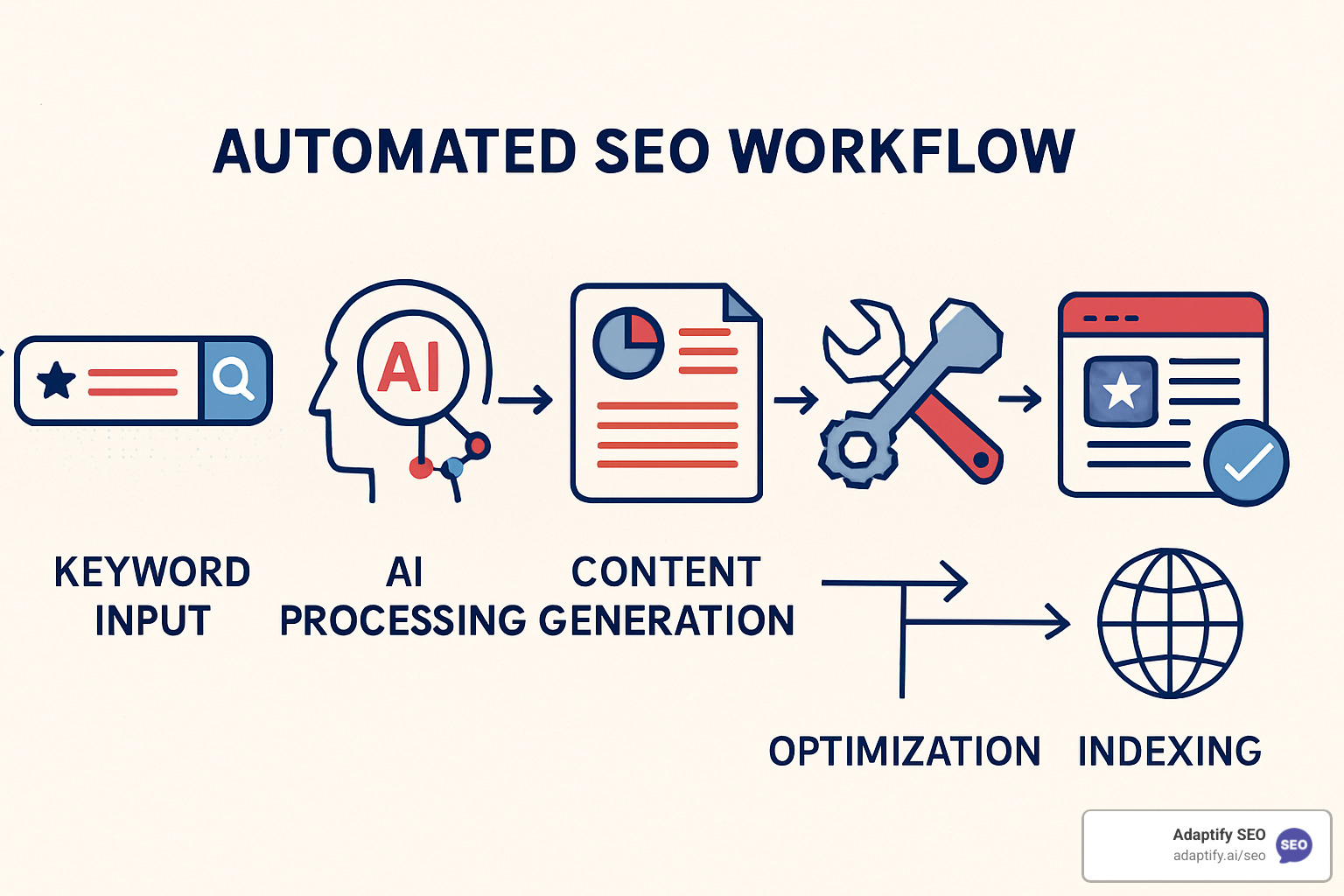
Automated seo content creation platforms have transformed painful keyword research into a coffee break activity. You input your seed keyword, and AI-powered tools like LowFruits analyze the top 10 results, extracting semantic patterns and identifying content gaps.
The system automatically sorts keywords into intent buckets - separating commercial terms from informational ones. Google Keyword Planner integration pulls real search volume data, while automated SERP scraping reveals exactly what's ranking.
| Manual Research | AI-Automated Research |
|---|---|
| 2-3 hours per topic | 5-10 minutes per topic |
| 50-100 keywords found | 500+ keywords with intent data |
| Subjective difficulty assessment | Algorithmic scoring with accuracy metrics |
| Manual SERP analysis | Automated competitor content gaps |
Tools like Gumloop automatically export this data to Google Sheets, creating organized keyword clusters ready for content briefs.
Platforms like Surfer AI, SEO.ai, and ChatGPT don't just write content - they craft SEO-optimized pieces that understand search intent better than most human writers.
The process starts with entity coverage analysis. AI examines what topics, people, and concepts appear in top-ranking content, then weaves them naturally into your article. Readability optimization happens in real-time, adjusting sentence length and vocabulary complexity.
Surfer users consistently report 15% organic traffic growth within the first month. SEO.ai focuses on competitor question analysis, automatically incorporating People Also Ask data that human writers typically overlook.
Modern platforms have automated most quality refinement processes. Grammarly integration catches grammar errors, while AI Humanizer tools rewrite sections that might trigger AI detection software.
Plagiarism scanning happens automatically, cross-referencing content against billions of web pages. The real game-changer is brand voice consistency - you can train AI models on your best-performing content, ensuring every piece reflects your unique perspective.
One click, and your content appears across multiple platforms, properly formatted, internally linked, and submitted to Google for indexing.
WordPress API and Webflow integrations handle technical publishing details. Auto-internal linking analyzes existing content and creates contextual connections. Zapier workflows syndicate content across multiple platforms simultaneously.
The Google Index API integration submits content for indexing immediately, often appearing in search results within hours. Platforms like Machined showcase this automation at scale, publishing 30 articles simultaneously while handling featured images, internal links, and indexing submission.
Choosing the right automated seo content creation platform can make or break your agency's scaling efforts. Success comes down to picking platforms that integrate with your existing workflow rather than forcing complete rebuilds.
Surfer SEO leads with over 150,000 users who rely on its optimization capabilities. The platform's strength lies in AI humanization features – content passes detection tools while maintaining perfect optimization scores.
SEO.ai has captured 30,000+ teams with its competitor analysis approach. The platform analyzes what's already ranking and creates something better. Their multilingual support enables global scaling without hiring native speakers.
Writesonic serves 10 million marketers with extensive tool integrations. Search Atlas and OTTO SEO have become agency game-changers with white-label approaches that let your SEO work smarter, not harder with AI while maintaining your brand.
Specialized tools deserve attention too. Gumloop eliminates coding requirements for complex workflows, while Machined takes a cluster approach, generating entire content hubs with automatic internal linking.
The best results come from combining 2-3 specialized tools rather than forcing one platform to do everything.
Integration depth tops the list because switching between platforms kills productivity gains. You need native integrations with Google Search Console, WordPress, and your analytics stack.
Accuracy and hallucination control separate professional platforms from consumer tools. Platforms using RAG technology pull information from verified sources rather than generating potentially false information.
Scalability becomes critical as your client base grows. BlogSEO AI's track record of generating 10 million articles proves infrastructure can handle enterprise demands.
Security and data privacy require SOC 2 compliance and GDPR adherence. Pricing models should reflect genuine value creation.
For content drafting, Article Forge generates 1,500-word articles in under 60 seconds. On-page optimization belongs to Surfer SEO with real-time editing suggestions that correlate strongly with ranking improvements.
Workflow automation gets interesting with Gumloop and AirOps, both letting you build custom automation without coding. AI detection and humanization have become essential – AISEO's Humanizer targets bypass capabilities while Surfer's built-in humanizer maintains optimization during rewriting.
White-label capabilities determine whether you can maintain brand consistency across client touchpoints. The 10x revenue potential from Search Atlas works mathematically – if automation lets you handle 10 clients with the same effort previously required for one, revenue scaling becomes inevitable.
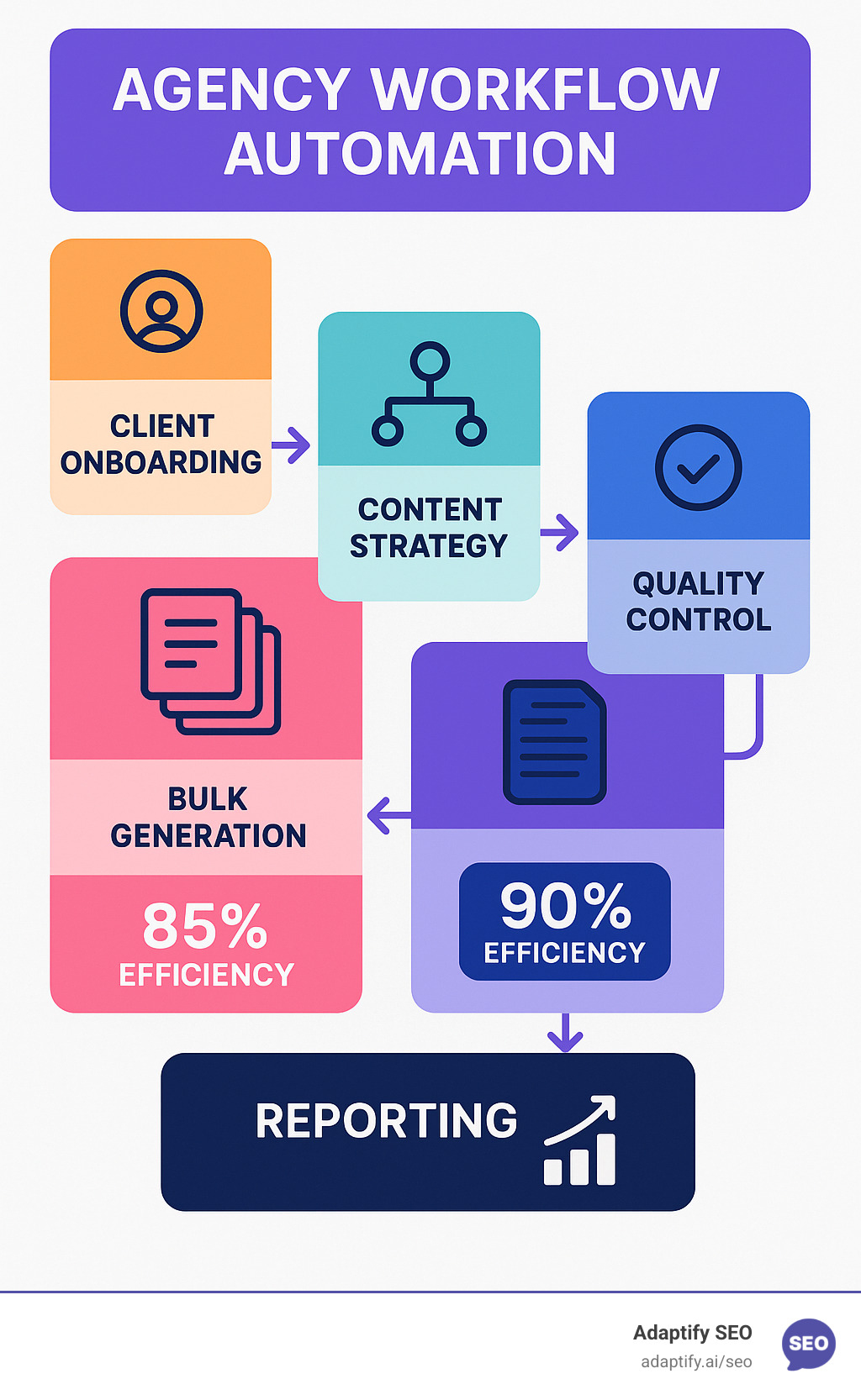
Bulk workflow management separates agency-ready platforms from individual tools. Managing 50+ client accounts requires systems designed for scale. The most successful agencies integrate automated seo content creation into existing client communication workflows.
Automated seo content creation requires addressing AI limitations and ethical considerations. The biggest concern? Hallucinations - AI models sometimes generate false information with absolute confidence.
Modern platforms like Surfer have tackled this with citation systems that cross-reference claims against authoritative sources. But responsibility ultimately falls on you to maintain fact-checking workflows, especially for YMYL (Your Money or Your Life) content.
Copyright considerations add complexity. Current U.S. law states that AI-generated content cannot be copyrighted due to lack of human authorship. Smart agencies address this by ensuring substantial human editing and oversight.
Transparency requirements have become increasingly important as Google doubles down on E-E-A-T guidelines. The winning approach? Disclose AI assistance while emphasizing human oversight and subject matter expertise.
The ROI data from automated seo content creation is remarkable when tracking the right metrics.
Efficiency gains show immediate impact. Most agencies see 50-70% time reduction per article. One agency went from 8 hours per piece to 3 hours, tripling content output without hiring additional writers.
The cost mathematics are compelling. If you're paying a writer $50/hour for 8 hours of work ($400 per article), and automation reduces that to 3 hours ($150), you're saving $250 per piece.
Performance metrics reveal whether automated content actually works for SEO. Google Analytics 4 and Search Console data from Surfer users shows an average 15% monthly organic traffic increase after implementing NLP-optimized content.
One agency saved $2,835.75 monthly by replacing paid advertising with evergreen automated content, building long-term organic assets that continue generating traffic months later.
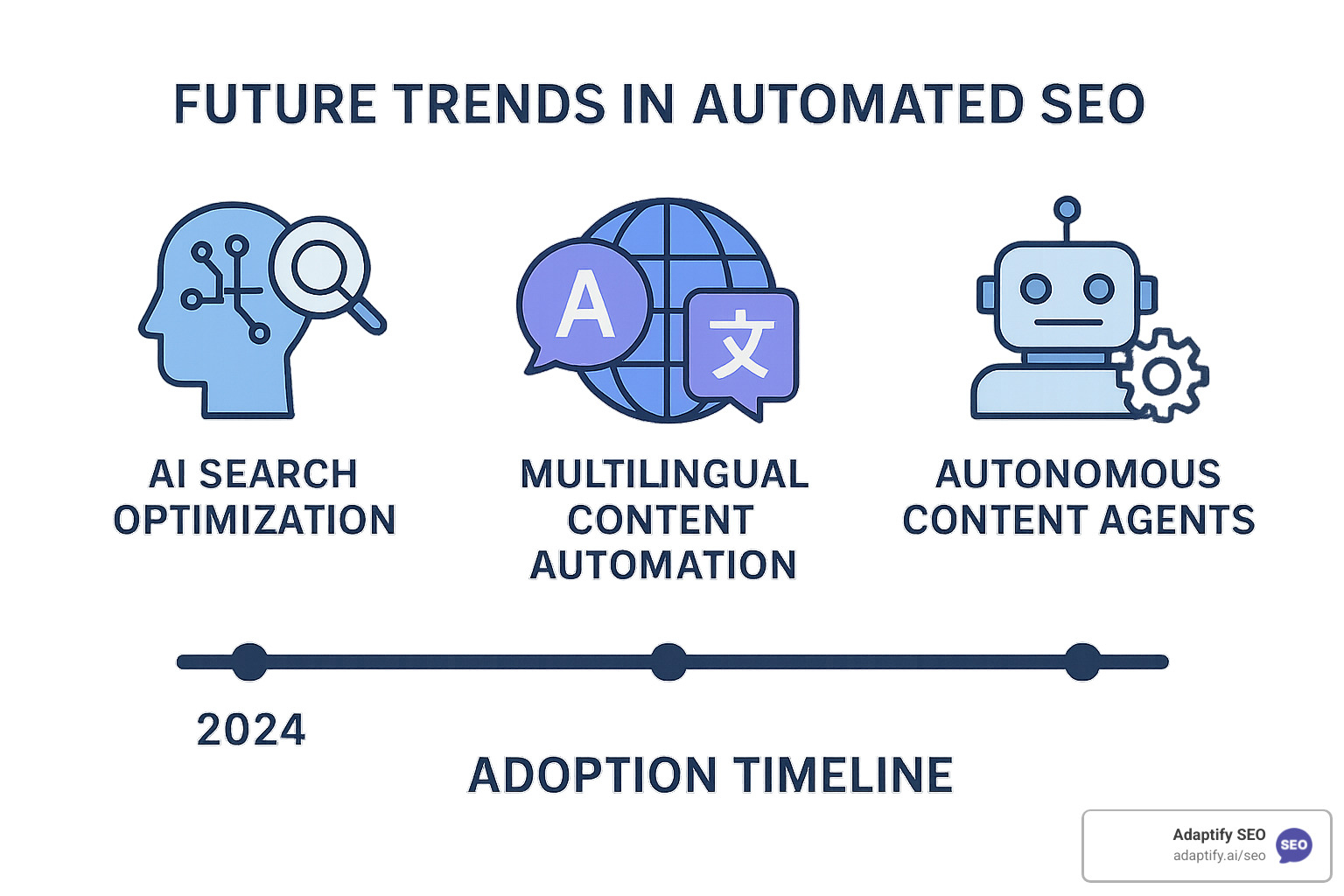
The future of automated seo content creation is moving toward three game-changing developments:
Multi-language automation is getting smarter. Current platforms like AISEO support 26+ languages, but the next generation will understand cultural context adaptation rather than simple translation.
Programmatic SEO pages represent the next frontier. Tools like SEOBrrr can generate thousands of unique pages from data templates - imagine automatically creating location-specific service pages for every city in your client's service area.
Autonomous agents are the holy grail. Instead of manually triggering each workflow step, these systems will handle entire strategies independently. Early examples like Machined's content cluster automation hint at what's coming.
Agencies succeeding with these approaches share one trait: they start small and scale systematically. Rather than attempting full automation immediately, they prove ROI with one workflow, then expand gradually.
The sweet spot for automation lies in repetitive, data-driven tasks. Keyword research and clustering automate beautifully - tools process thousands of keywords in minutes versus hours of manual work. Content brief creation follows naturally, with AI analyzing top competitors to build comprehensive outlines.
Meta tag optimization and internal linking suggestions are perfect automation candidates because they follow clear rules. Performance reporting practically runs itself once you set up dashboards.
Where automation gets tricky is with strategic thinking tasks. Content writing works well with AI, but you'll want human editors polishing the final output. Start with keyword research and reporting for immediate time savings with minimal risk.
The secret is treating AI like a junior writer who needs training. Upload your best-performing content to platforms like Writesonic or SEO.ai - at least 10-15 pieces that capture your voice. The AI learns your vocabulary, tone, and style patterns.
Brand voice isn't just about how you write, it's about what unique perspective you bring. Feed the AI your case studies, proprietary methodologies, and industry insights.
Human editing workflows remain essential. Have team members who know your brand review AI outputs before they go live. Tools like Surfer's AI Humanizer help maintain that natural feel while keeping SEO optimization intact.
Absolutely. Success comes down to execution, not who wrote the content.
Google's algorithms don't care whether a human or AI created your content - they care about quality signals like comprehensive topic coverage, factual accuracy, and user engagement. Well-optimized AI content often performs better because it covers keywords more thoroughly and maintains consistent readability.
One case study involved an agency replacing 85% of their existing content with AI-optimized pieces. They saw immediate ranking improvements because the new content better matched search intent and covered topics more completely.
Focus on creating genuinely helpful content that serves your audience, regardless of how it's created. Automated seo content creation just makes it easier to do this at scale.
The change is already happening. While you're reading this, thousands of agencies are using automated seo content creation to scale their operations and deliver faster results to clients. The question isn't whether automation will reshape SEO - it's whether you'll lead or follow.
The numbers speak for themselves: agencies report 10x revenue growth potential, 70% cost reductions, and dramatically happier clients who see results in days instead of months. But the real benefit is having time to think strategically instead of drowning in keyword research and content briefs.
The most successful agencies don't try to replace human expertise with robots. Instead, they use automated seo content creation to eliminate tedious tasks so their teams can focus on what humans do best: understanding client needs, crafting winning strategies, and building relationships.
Starting feels overwhelming, but it doesn't have to be. Pick one workflow that's eating up your team's time - maybe keyword research or content optimization. Automate that first. Prove the ROI. Then expand systematically.
The agencies thriving in 2025 will be the ones that figured out this balance: AI handles the grunt work while humans provide the insight, creativity, and strategic thinking that clients actually pay for.
At Adaptify SEO, we've built our entire approach around this philosophy. Our automated solutions don't replace your expertise - they amplify it. We handle the time-consuming SEO tasks so you can focus on growing your agency and delivering exceptional results.
Ready to see how automated seo content creation can transform your agency's efficiency without sacrificing quality?
Book a Demo to find how Adaptify SEO can help you scale smarter, not harder.

Learn how an SEO automation system streamlines keyword research, content workflows, and reporting to scale your search operations efficien...

Discover what SEO tasks seo automation services can realistically automate for faster audits, keyword research, and content optimization.

Stop staring at blank pages. Use the best SEO article writing software to create optimized content that ranks in 2026.
Join 1,000+ agencies already delivering SEO and AI visibility from a single platform without increasing their headcount.Join 1,000+ agencies already delivering SEO and AI visibility from a single platform without increasing their headcount.