The Backlink Quality Score: Your Key to a Bulletproof SEO Profile



Backlink quality score is a metric used by SEO tools to evaluate the health and authority of the links pointing to your website. It helps distinguish valuable links from harmful ones.
Since Google's rise, backlinks have been a top ranking factor. However, not all backlinks are created equal. A link from a spammy site can hurt your rankings, while one from an authoritative publication can provide a major boost.
Google's Penguin algorithm, introduced in 2012, targeted websites using manipulative link schemes. This shifted the focus from the quantity of backlinks to their quality. For agency owners managing multiple clients, manually evaluating backlink quality is complex and time-consuming. You must assess domain authority, check for spam, verify relevance, and monitor anchor text.
Modern SEO tools provide backlink quality scores to simplify this, but understanding and using them strategically is the real challenge. This guide will show you how.
I'm Hansjan Kamerling, and I've spent years helping SaaS platforms and startups scale their SEO with data-driven strategies. My work focuses on turning complex SEO challenges, like evaluating backlink quality score, into systematic processes that drive real results.
Think of backlinks as recommendations. When another site links to yours, it’s vouching for your content. The more credible the source, the more Google trusts your site. But not all recommendations carry the same weight.
A link from a respected industry leader means more than one from a sketchy, spam-filled site. The latter can actually make you look worse. This is why backlink quality score exists: to help SEO tools measure the real value of your backlinks.
Google's Penguin algorithm made this clear in 2012. Before Penguin, SEO was often a numbers game of acquiring as many links as possible. Penguin changed everything by penalizing sites with manipulative link profiles. Suddenly, ten high-quality links became far more valuable than a thousand spammy ones.
The idea that links signal authority isn't new. A 1999 research paper explored this concept even before Google's dominance. Google then built its empire on the PageRank algorithm, which evaluated link quality, not just quantity.
Matt Cutts, former head of Google's webspam team, described PageRank as a "flow that happens between documents across outlinks" in a 2009 blog post. Authority passes from one page to another through links, so strong sources create strong flows.
Google no longer shares PageRank scores publicly, but the principle remains: quality links still matter—a lot. In response, the SEO industry created its own metrics to estimate authority, such as Domain Authority (DA), Domain Rating (DR), and Authority Score (AS). These are educated guesses at how Google might view a site, not what Google actually uses. As Google representatives like John Mueller often state, Google focuses on overall site quality from a user's perspective, not third-party scores. Still, these metrics provide a practical way to evaluate backlinks at scale.
High-quality backlinks are powerful credibility signals. When authoritative, relevant sites link to you, search engines see it as proof that you're a valuable resource. This link equity (or "link juice") flows to your site, boosting your pages' authority and helping them rank higher.
Low-quality links do the opposite. Google views spammy backlinks as attempts at manipulation, and the consequences can be severe. Engaging in link schemes—like buying links or using private blog networks—risks serious penalties.
You could face a manual action, where a human reviewer at Google penalizes your site, causing rankings to plummet. Or, you might suffer algorithmic devaluation, where Google's systems simply ignore your suspicious links, rendering your efforts worthless or even harmful. Proactively monitoring your backlink quality score and cleaning up toxic links is the best way to stay safe and avoid scrambling to recover from a penalty.
If you've ever felt overwhelmed by the alphabet soup of SEO metrics—DA, DR, AS, TF, CF—you're not alone. Each major SEO tool has its own proprietary method for measuring backlink quality score. Understanding what these metrics represent is key to managing your link profile effectively.
Think of these tools as different specialists examining your website's health. Each uses a different diagnostic approach, but by combining their insights, you can get a complete picture. Most tools offer free and paid versions, with paid tiers providing more comprehensive data and API access, which is invaluable for agencies managing multiple clients at scale.
Let's break down how the major players calculate their authority metrics.
Semrush's Authority Score (AS) grades websites from 1 to 100, measuring overall quality and SEO authority. The metric was updated in 2023 to be more resistant to manipulation, providing a more authentic picture of a site's influence. The score is calculated using AI that analyzes a backlink profile through three main lenses: Link Power (quantity and quality of backlinks), Organic Traffic (estimated monthly visitors), and Spam Factors (signs of manipulation or low-quality tactics).
Ahrefs runs one of the most active web crawlers after Google, providing an incredibly fresh backlink database. Its Domain Rating (DR) measures the strength of a site's entire backlink profile on a logarithmic 0-100 scale. This means moving from DR 70 to 80 is exponentially harder than going from DR 20 to 30. URL Rating (UR) works the same way but applies to individual pages. Ahrefs also provides valuable estimated organic traffic data, which helps you gauge the real-world value of a link beyond its authority score.
Moz pioneered the concept of "Domain Authority." Its DA score (1-100) uses a machine learning model to predict how well a website will rank in search results, based heavily on the number of inbound links and unique linking domains. Equally important is Moz's Spam Score, which identifies how "spammy" a site appears based on 27 common features found in penalized sites. A score of 1-30% is low, 31-60% is medium, and 61-100% is high. A high score warrants a closer manual review before pursuing a link. If you're looking to streamline how you assess these metrics, our SEO services at Adaptify.ai can help automate these quality checks.
Majestic separates link quality from quantity with its Flow Metrics. Trust Flow (TF) measures quality by calculating how close a site is to a seed set of highly trusted websites. The closer you are, the higher your TF. Citation Flow (CF) simply measures link quantity. The key is the ratio: a site with a higher TF than CF typically has high-quality links. A much higher CF than TF suggests a large volume of low-quality links. Majestic also offers Topical Trust Flow to assess relevance within specific categories.
Here's how these different metrics stack up:
| Metric (Tool) | Focus | Range | What a Good Score Means |
|---|---|---|---|
| Domain Authority (Moz) | Predictive ranking | 1-100 | Higher score indicates better ranking potential, influenced by total links & root domains |
| Domain Rating (Ahrefs) | Backlink strength | 0-100 | Higher score means stronger backlink profile, harder to achieve at higher levels |
| Authority Score (Semrush) | Overall quality | 1-100 | Higher score indicates more trusted, less manipulative link profile |
| Trust Flow (Majestic) | Link quality | 0-100 | Higher TF, especially relative to CF, indicates links from trustworthy sources |
| Citation Flow (Majestic) | Link quantity | 0-100 | Higher score means more links, but not necessarily quality |
I rarely rely on just one metric. Using these tools together helps you spot inconsistencies and make smarter decisions about which links to pursue and which to avoid.
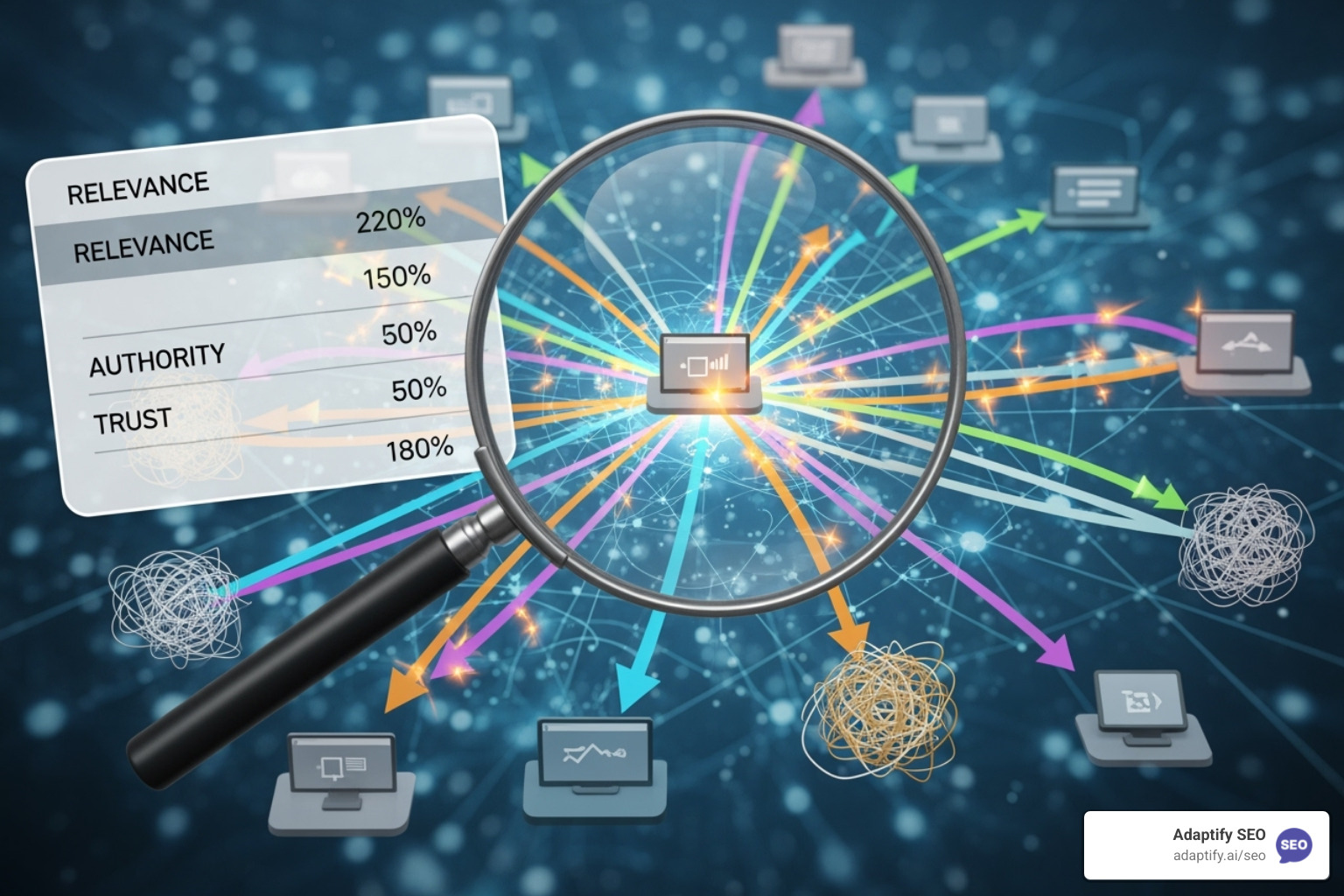
An audit is where you evaluate every external link pointing to your website to improve your backlink quality score. The most effective audits combine automated tools with human judgment.
Numbers can be deceiving. A site might have a high authority score but be a spam-filled mess. That's why you must visit the linking websites. When evaluating a site, ask these critical questions:
This manual process is the only way to truly understand your backlink quality beyond the numbers.
Anchor text—the clickable words in a link—tells search engines what the linked page is about. A healthy profile has a natural balance of anchor text types:
A profile dominated by keyword-rich anchors looks manipulative to Google. Most of your anchors should be branded and generic, with keyword-rich anchors used sparingly and naturally.
Toxic links are low-quality, spammy, or manipulative links that can damage your rankings. Look for these red flags:
Once you've identified toxic links, you have two options:
An audit sets the stage for strategic link building. Once you understand your current backlink quality score, you can proactively build a robust, high-quality backlink profile.

Think of link building as constructing a reputation. Every high-quality backlink is a strong brick in your foundation.
Analyzing your competitors' backlink profiles with tools like Semrush and Ahrefs can uncover valuable opportunities. Look for link gaps—authoritative sites linking to competitors but not to you. Also, identify their most-linked-to pages and create a better, more comprehensive version (the "skyscraper technique"). This helps you target sites already interested in your niche. At Adaptify.ai, we integrate competitor analysis into our automated SEO services to quickly identify these opportunities. You can see how this works by exploring our case studies.
Earning links is about providing value. The days of quick-fix schemes are over.
Your backlink profile is always changing. Continuous monitoring is essential for maintaining a healthy backlink quality score. Track your link velocity (the rate of new links) to ensure natural growth. Use your SEO tools to identify lost backlinks from valuable sites. When you spot a lost link, reach out to the webmaster to try and recover it. This proactive approach is a quick win for your SEO. At Adaptify.ai, we help agencies automate this monitoring process, freeing up time for strategy. More about our SEO services can show you how we streamline these tasks.
Here are answers to some of the most common questions about backlink quality score.
No. While there's a strong correlation, a high Domain Authority (DA) or Domain Rating (DR) doesn't guarantee top rankings. It's an indicator of potential, not a magic bullet. Google uses many other factors, including:
Google doesn't use DA/DR. As explained in their ranking systems guide, their algorithms are far more complex. A high backlink quality score must be part of a holistic SEO strategy.
Follow this two-step process:
.txt file of the domains or URLs you want Google to ignore. Use this tool with extreme caution, as disavowing good links can harm your rankings. Only disavow links that are clearly toxic or part of a manipulative scheme.Not necessarily. A low score can mean several things:
A low score is a signal to investigate further with a manual review, not an automatic sign of a spammy site.

Discover how backlink automation software streamlines outreach, saves time, and scales your SEO strategy safely and effectively.
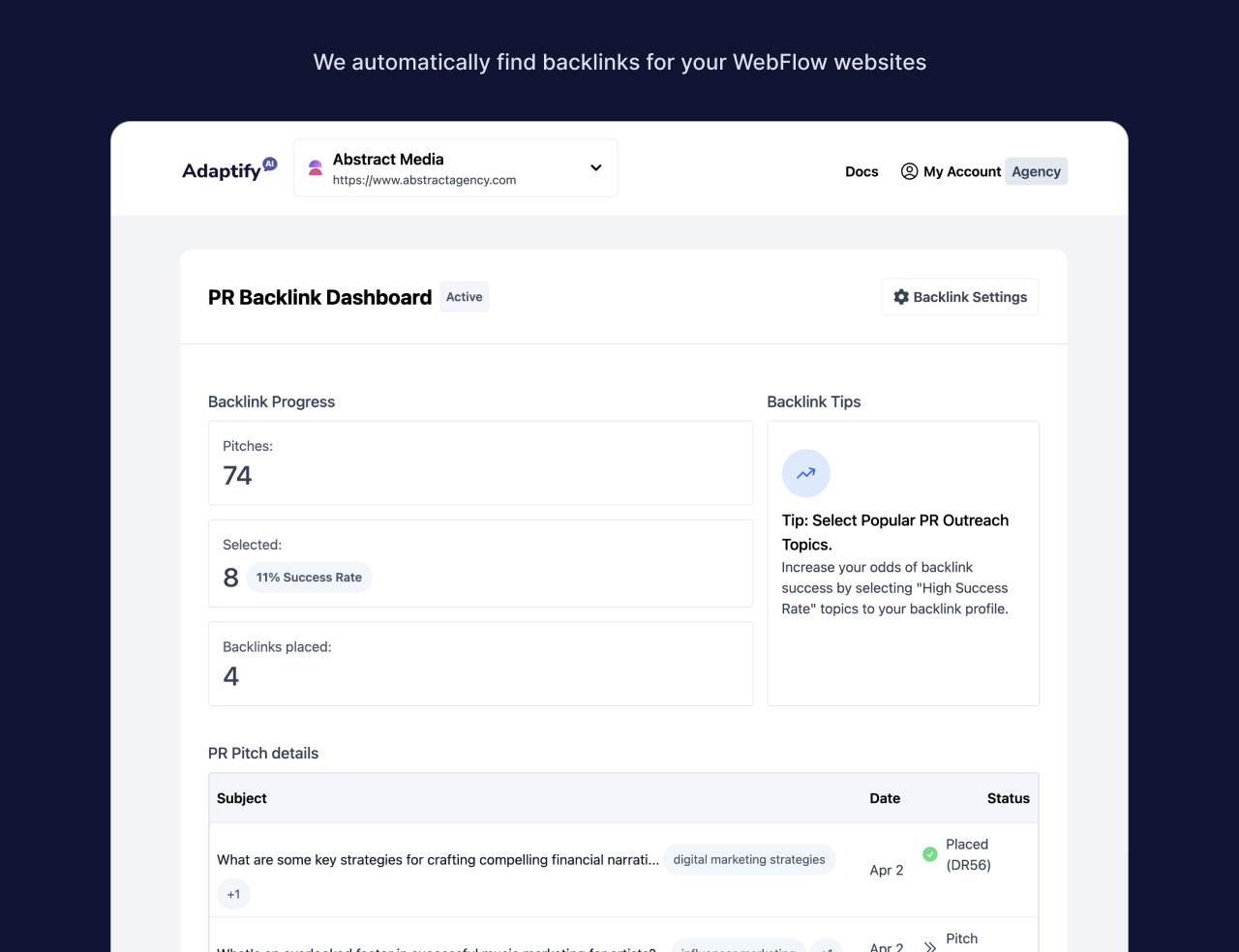
Track every backlink with an SEO backlink monitor—spot lost links fast, protect rankings, and boost ROI before competitors do.
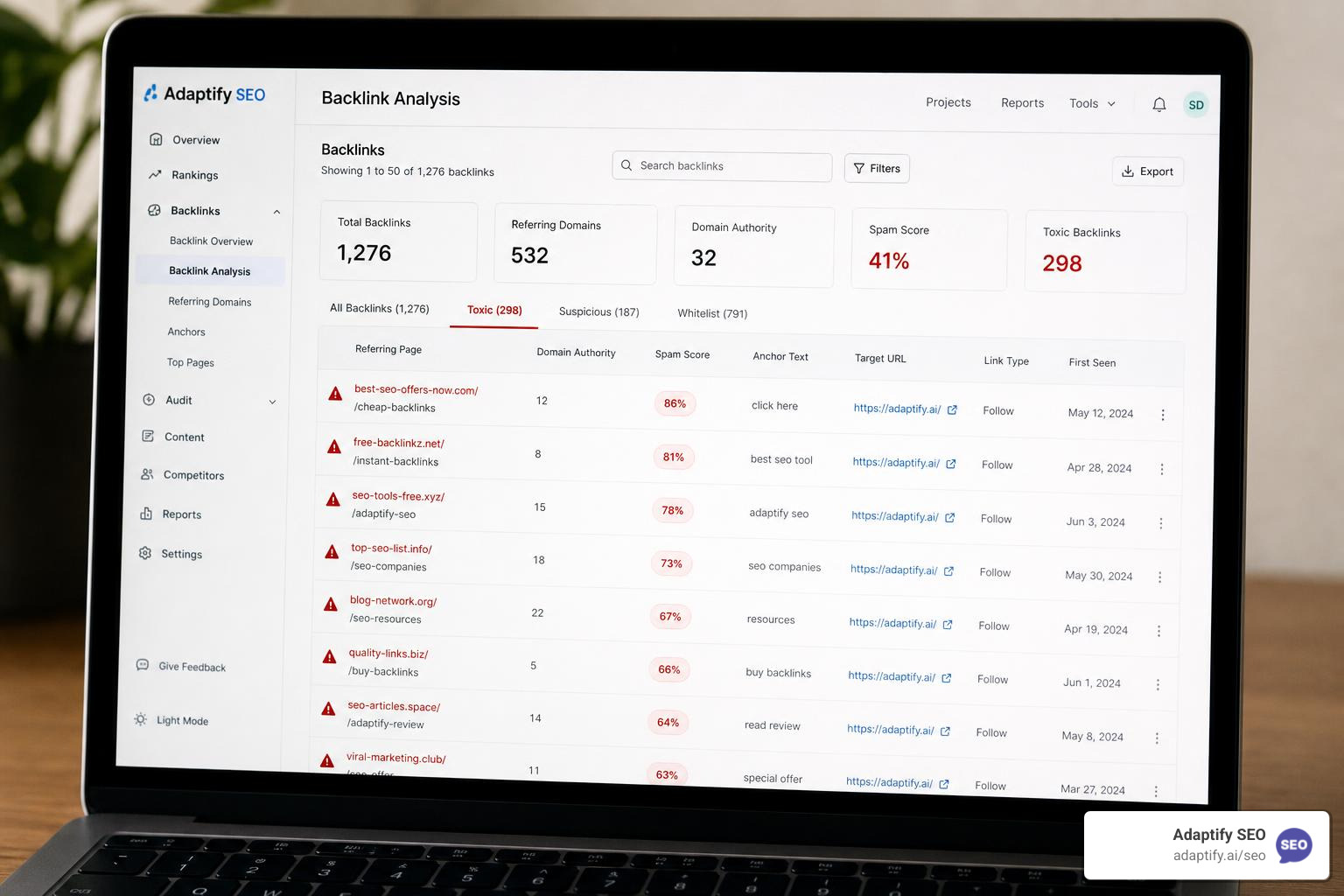
Learn how to disavow toxic backlinks, clean your profile, and recover rankings with this step-by-step guide.
Join 1,000+ agencies already delivering SEO and AI visibility from a single platform without increasing their headcount.Join 1,000+ agencies already delivering SEO and AI visibility from a single platform without increasing their headcount.