The Future is Now: Mastering Automated SEO for Better Results



Automated SEO optimization is the use of software and artificial intelligence (AI) to handle repetitive and time-consuming tasks within your search engine optimization workflow. This allows marketers and agencies to streamline processes, improve efficiency, and focus on higher-level strategy.
Automating SEO tasks is crucial in today's digital landscape for several reasons:
I am Hansjan Kamerling, a product designer and marketing consultant. My expertise in automated SEO optimization comes from years of building digital products and leveraging AI to revolutionize workflows.
The advent of AI, particularly Generative AI, has fundamentally reshaped SEO. It's not just about speed; it's about bringing a level of precision and depth that was previously unimaginable.
At its core, AI contributes to automated SEO through Machine Learning (ML) and Natural Language Processing (NLP). ML algorithms analyze colossal datasets to identify patterns and inform your strategy. For instance, AI can analyze user intent, commercial value, and Cost Per Click (CPC) for keywords, offering insights that would take a human specialist hours to uncover.
Generative AI has led to an explosion in content production. While some worry about "robotic" AI-generated content, the right approach allows AI to create authentic and valuable content, incorporating relevant images, citations, and news references. For example, AI tools can automatically generate optimized post titles, meta descriptions, and even proofread articles for quality at scale.
Beyond content, AI-powered tools streamline complex tasks like competitor analysis, site auditing, and internal linking. Feeding a technical SEO report into ChatGPT can yield amazing recommendations and fixes, leading to significant organic traffic increases. This demonstrates AI's capacity for predictive analytics, helping you anticipate trends and optimize proactively. The consensus among experts is that AI will handle up to 50% of routine SEO tasks within the next 3-5 years, freeing us up for more strategic endeavors.
Automating SEO tasks frees up valuable time and resources, allowing you to focus on the strategic and creative aspects of your work. It's about working smarter, not just harder. If you're curious about how these benefits can translate into tangible gains for your business, I encourage you to explore more about our SEO services at Adaptify.ai.
One of the most common questions is, "Which parts of SEO can actually be automated?" Thanks to AI and smart automation tools, a significant portion of your SEO workload can be streamlined.
From initial strategy to ongoing site health monitoring, these tools handle repetitive and data-heavy tasks. This includes Keyword Research, Content Strategy, Content Creation, Technical SEO, Link Building, and detailed Reporting. Let's explore how.
Keyword research used to be a meticulous, time-consuming process. AI has turned this on its head, making it easier to find high-potential keywords and understand user intent.
Here’s how AI-powered tools help:
Topic Ideation and Keyword Clustering: AI can brainstorm content ideas by analyzing online communities or suggest relevant blog post ideas. It’s also brilliant at grouping keywords into clusters, ensuring your content covers a topic comprehensively.
Competitor Keyword Analysis: Tools like the Semrush Keyword Magic Tool or Ahrefs' Keywords Explorer use advanced algorithms to reveal the keywords your rivals are ranking for, helping you spot content gaps.
Content Gap Analysis: AI can compare your website's content against top-ranking competitors to pinpoint missing pages, underperforming content, or new optimization opportunities.
Content Brief Generation: AI models like ChatGPT can create comprehensive content briefs in minutes, including headings, subheadings, and key points to guide your writers.
Automating these tasks helps you quickly identify valuable opportunities and build a strong content foundation. If you're looking to boost your content strategy, I highly recommend exploring our content solutions at Adaptify.ai.
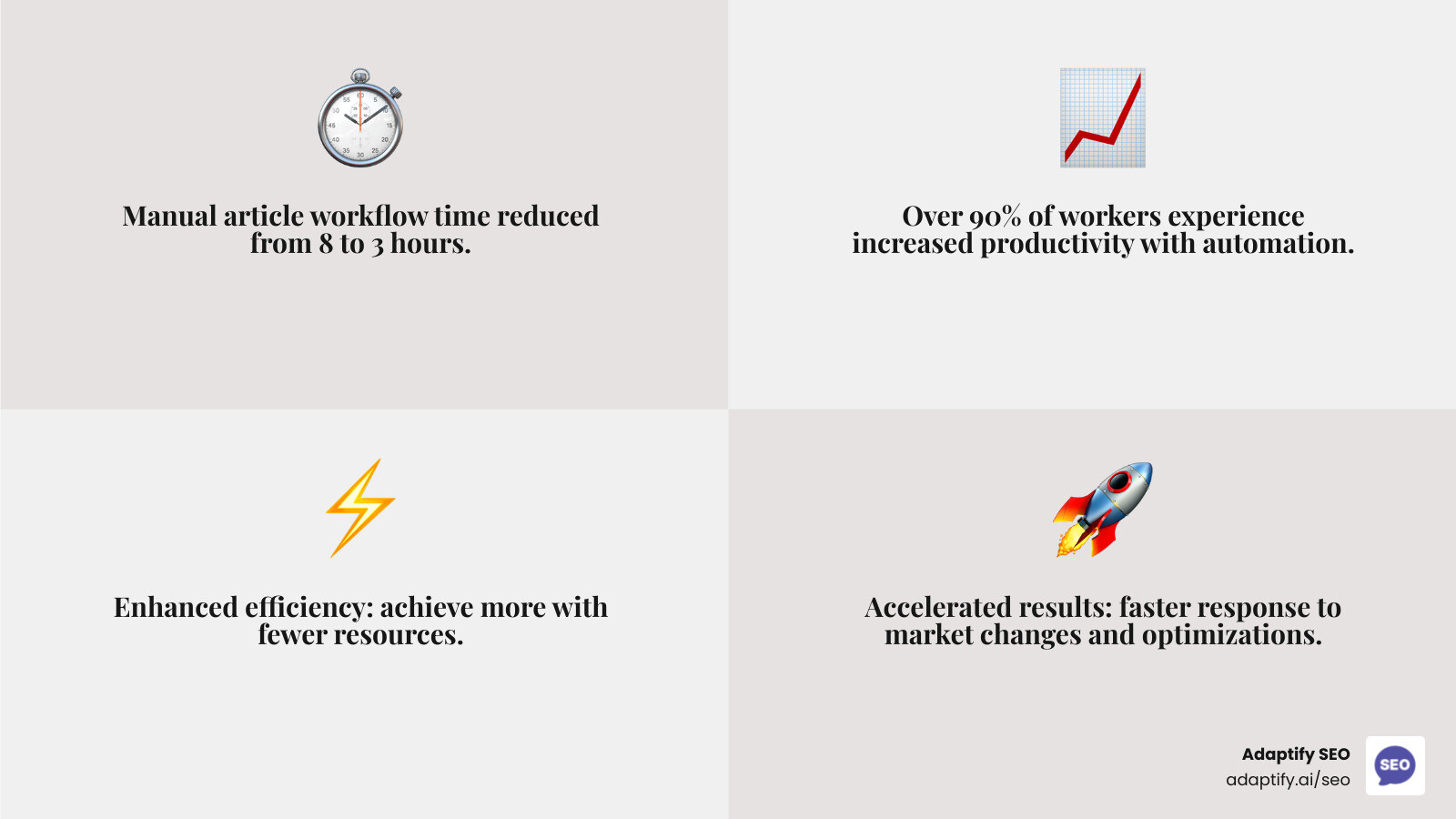
This is where AI truly shines, turning a long process into a much quicker one. An 8-hour content workflow can often be completed in just 2-3 hours.
AI-Assisted Writing: AI writing assistants like Jasper or Surfer AI are invaluable for drafting SEO articles and product descriptions. They can incorporate relevant keywords and adapt to a specific writing style.
Meta Tag Generation: Manually creating unique title tags and meta descriptions for thousands of pages is a nightmare. AI tools can automatically generate optimized meta tags that align with keyword search terms and user intent.
Internal Linking Suggestions: AI can scan your site and automatically suggest or insert relevant internal links. This improves user navigation and helps Google understand your site's structure.
Image Alt Text: AI can assist in generating descriptive, keyword-rich alt text for your images, which boosts accessibility and helps search engines understand your visuals.
Schema Markup: Automated tools can help generate and validate structured data markup, which can lead to richer, more eye-catching search results.
By using these tools, you can produce high-quality, SEO-optimized content at scale, ensuring every piece is fine-tuned for both search engines and human readers.
Technical SEO is often intimidating, but it's another area where automated SEO optimization excels. AI-powered tools can act as a vigilant watchdog, monitoring your site's health and flagging issues before they impact your rankings.
Here’s how AI simplifies technical SEO:
Site Crawling and Broken Link Detection: Tools like the Screaming Frog SEO Spider can be scheduled to automatically crawl your site, quickly pinpointing issues like broken links, redirect chains, and duplicate content.
Page Speed Monitoring: Since page speed is a critical ranking factor, automated tools can continuously monitor your site's load times and alert you to slowdowns.
Indexing Issues: AI can detect problems that might prevent your content from being indexed by search engines and even help deploy fixes automatically.
Sitemap Generation: Automation can generate and update your sitemaps, ensuring search engines always have a current map of your site's structure.
AI-Powered Technical Recommendations: I’ve personally seen AI provide amazing, prioritized recommendations from a technical SEO report, which contributed to a 4-5x increase in organic traffic. This highlights AI's ability to not just spot problems but also suggest clear, actionable solutions.
Automating these technical tasks drastically reduces manual effort, freeing up your team to implement fixes and make strategic improvements.

Integrating automated SEO optimization into your workflows is a strategic move that pays off. Think of it not as replacing your team, but as equipping them with superpowers to make their work easier and more impactful.
Before you automate, you need to understand your current manual processes. Start with a thorough audit.
Identify repetitive tasks: What SEO chores does your team do over and over? This could be keyword research, technical audits, or reporting. These are prime candidates for automation.
Calculate the time spent: Quantify the hours spent on these tasks. Seeing that an 8-hour workflow can be cut to 3 hours helps demonstrate the real value of automation.
Pinpoint bottlenecks: Where do your SEO efforts get stuck? Is it manual data analysis or the sheer volume of content creation? Automation can clear these blockages.
Prioritize automation opportunities: Focus on tasks that are highly repetitive, time-consuming, and directly impact your core SEO goals. This audit provides a clear roadmap for where automation will deliver the most value.
Selecting the right tools is crucial for successful automated SEO optimization. The market is full of options, so here are the essential features to look for:
Here’s a comparison of three leading AI SEO automation tools to give you a clearer picture:
| Tool | Best For | Key Automation Feature | Pricing (Approx. Start) |
|---|---|---|---|
| Gumloop | Comprehensive workflow automation, custom AI agents | Visual, drag-and-drop AI workflow builder; deep LLM & SEO tool integrations (e.g., Semrush without separate subscription) | $97/month |
| Alli AI | Large-scale on-page SEO automation & deployment | No-code, instant, and scalable deployment of on-page SEO changes across any CMS; self-adjusting to algorithms | $299/month |
| Surfer | Content optimization for Google & AI chats | AI-assisted writing, content gap analysis, automated internal linking, AI content detection/humanization | $99/month |
The "best" tool depends on your specific needs, budget, and the problems you’re trying to solve. For comprehensive solutions, consider how platforms like Adaptify.ai can bring these powerful capabilities together.
Once you’ve picked your tools, it’s time for integration. My advice is to Start Small. Don't try to automate everything at once. Pick one or two high-impact tasks, implement the automation, and fine-tune the process.
It’s also critical to set KPIs (Key Performance Indicators). Define what success looks like. Are you aiming for reduced time on tasks, increased organic traffic, better keyword rankings, or a higher ROI? Clear goals will guide your efforts.
Monitor rankings closely using automated rank trackers. They provide real-time updates so you can quickly see if your optimizations are working. Also, track organic traffic by connecting your tools with Google Analytics and Google Search Console. I’ve seen automated processes lead to a "4-5x organic traffic increase" by streamlining efficiency.
Finally, measure ROI. Is the monthly cost of your automation tool less than the cost of a human performing the same tasks? If so, it's a smart investment. Many tools provide the data needed to calculate this effectively.
Automated SEO optimization isn't a "set it and forget it" solution. Continuous monitoring and adjustment are key. Regularly check your dashboards, make incremental adjustments, and monitor their impact. To help quantify the potential return, you can always check out our SEO calculator.

While the power of automated SEO optimization is incredible, it's important to remember its limits. The best solutions arise when technology amplifies human talent, not replaces it. As Surfy, the AI writing assistant from Surfer, wisely said, "SEO automation isn't about replacing human expertise—it's about amplifying it."
When bringing AI into your SEO work, watch out for these common traps:
Over-reliance on AI: AI is fantastic for repetitive tasks, but the big picture, creative ideas, and deep understanding of user intent still require a human brain. It's not a complete replacement for strategic thinking.
Robotic Content: AI-generated content can feel "robotic and soulless" without a human touch. Use AI for a first draft, but always add your unique flavor, personal examples, and polish it for readability and factual accuracy.
Ignoring E-E-A-T: Google values Experience, Expertise, Authoritativeness, and Trustworthiness. An AI cannot have genuine experience or build authority on its own. This is where human experts are irreplaceable.
Lack of Strategic Direction: AI executes tasks but can't devise a comprehensive SEO strategy aligned with your business goals. This requires human critical thinking and market understanding.
Data Misinterpretation: While AI provides vast data, turning that data into smart actions still requires human expertise. Always double-check AI-generated information before making major decisions.
Google's Stance on AI Content: The key to ranking, regardless of how content is created, is quality and helpfulness. Relying solely on low-quality AI content to manipulate rankings is against Google's policies and will not work long-term.
The future of AI in SEO is exciting. We're just at the beginning of what's possible, with AI becoming more deeply integrated into every aspect of optimization.
Here’s a peek at what’s coming:
AI Overviews and Conversational Search: With Google's new AI Overviews, optimizing content will extend beyond traditional search results to AI-driven conversations.
Advanced SERP Analysis: AI will dig deeper into search results to understand subtle user intentions and determine what content formats resonate best with audiences.
Hyper-Personalization: AI's ability to analyze user data will enable highly personalized content experiences, boosting engagement and refining strategies in real-time.
Predictive SEO: Future AI tools won't just report current rankings; they'll predict future trends and warn of potential ranking shifts, allowing for proactive optimization.
Automated Backlink Outreach: AI is improving at finding and analyzing link opportunities at scale. It can identify relevant sites and automate parts of outreach campaigns. For more on this, explore our backlink services at Adaptify.ai.
The future is about balancing automation with human insight. By letting AI handle routine, data-heavy tasks, SEO professionals can focus on strategy, creativity, and building relationships—things AI can't replicate.
No, not fully. While automated SEO optimization tools are powerful for handling repetitive, data-heavy tasks like keyword research and site audits, they cannot replace human expertise. Crucial elements like high-level strategy, creative content direction, and building genuine relationships for link building still require human critical thinking and nuance. Automation augments human capabilities, allowing us to work smarter.
No, using AI for SEO is not inherently against Google's guidelines. Google's primary focus is on the quality and helpfulness of the content, not how it was produced. If you use AI to create high-quality, original, people-first content, you are in line with their goals. However, using AI to generate low-quality, spammy content simply to manipulate search rankings is a violation of their policies.
There is no single "best" AI tool for automated SEO optimization, as the ideal choice depends on your specific needs, budget, and existing workflow. For comprehensive workflow automation, a tool like Gumloop is powerful. For on-page content optimization, Surfer is a leader. For large-scale, no-code deployment of on-page changes, Alli AI offers a unique solution. The best approach is to identify your primary goals—be it content creation, technical audits, or keyword research—and try demos to see which tool best fits your team's needs.
We've explored how automated SEO optimization is no longer a futuristic dream but a powerful tool available today. AI is revolutionizing how we approach time-consuming tasks like keyword research, content creation, technical audits, and reporting.
The benefits are clear: significant time savings, increased productivity, cost reduction, and the ability to make data-driven decisions that propel your business forward.
Crucially, automation doesn't replace the human element; it amplifies it. It frees you to focus on high-impact strategy, creativity, and understanding your audience—insights only a human can provide. It’s about the powerful partnership between human expertise and artificial intelligence.
For agencies and businesses looking to scale, deliver exceptional value, and stay ahead, a comprehensive platform that unites these automated capabilities is essential. Adaptify.ai provides the end-to-end automation you need to thrive in this new era of SEO.
Ready to revolutionize your SEO efforts? Book a Demo today, and let's put automated SEO optimization to work for you.

Stop being invisible: discover what the best local SEO strategies for small businesses are to dominate Google Maps, reviews, and AI search...
Master localized SEO to rank your local business in Google Maps and drive more in-store visits.

Master local retail SEO to drive foot traffic from Google with proven strategies for GBP, reviews, and AI search optimization.
Join 1,000+ agencies already delivering SEO and AI visibility from a single platform without increasing their headcount.Join 1,000+ agencies already delivering SEO and AI visibility from a single platform without increasing their headcount.