The Game Plan: Building an Effective Search Optimization Strategy




A search optimization strategy is a roadmap for improving website visibility in search engines. It systematically combines keyword research, content creation, technical optimization, and link building to achieve business goals. An effective strategy includes:
The numbers tell the story: organic search delivers 53% of all website traffic, making it a critical digital marketing channel. Yet many agencies struggle with the manual intensity of SEO, from keyword research to securing quality backlinks.
Without a clear plan, SEO becomes a scattered collection of tactics that waste resources. A strategic approach transforms SEO from random optimizations into a systematic growth engine that delivers consistent results.
My experience scaling platforms to millions of users across fintech, automotive, and SaaS has shown that a well-executed search optimization strategy is the foundation for sustainable digital growth. I've seen how a strategic framework turns SEO efforts into measurable success.
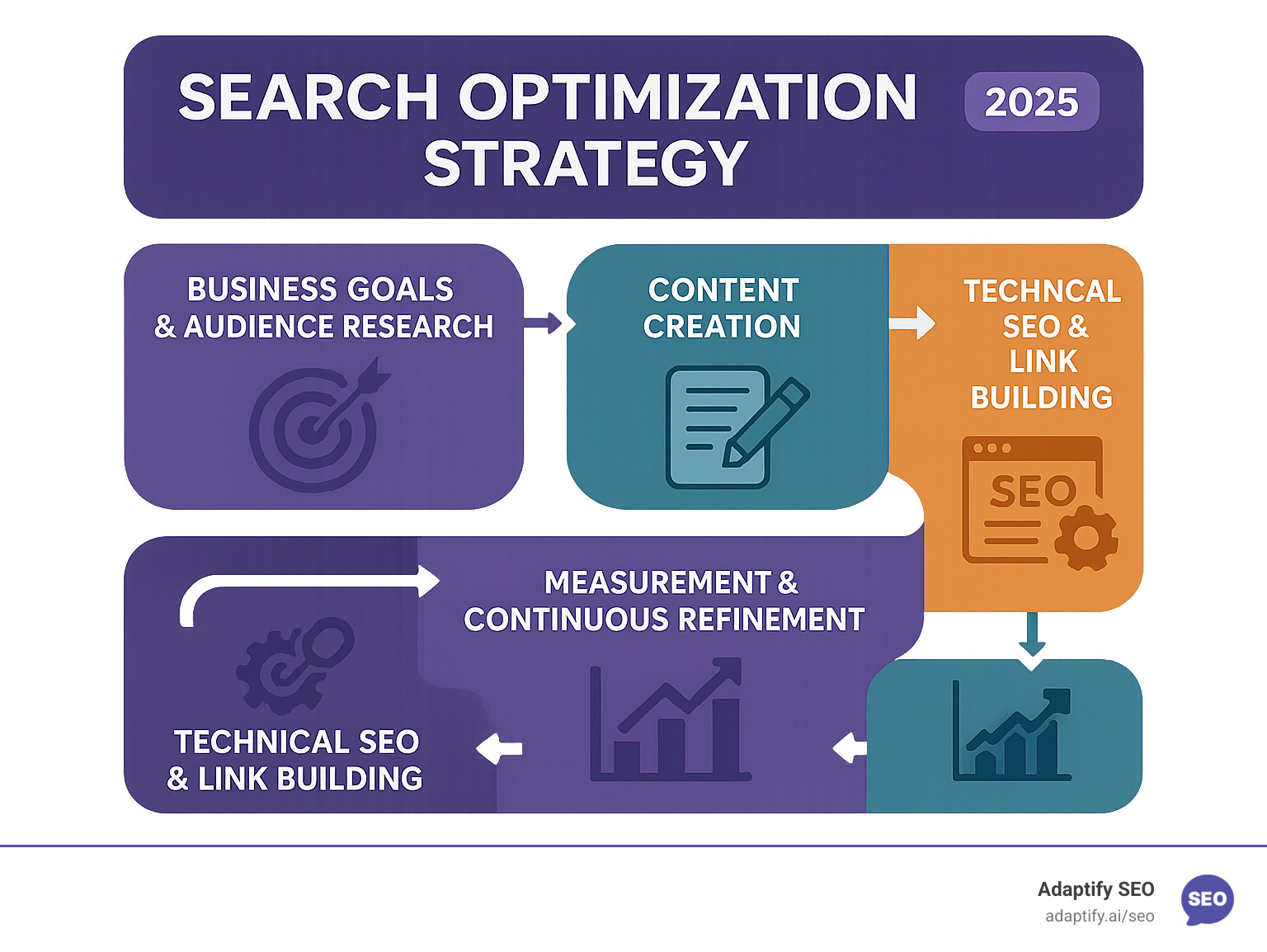
Building a search optimization strategy starts with a solid foundation. First, understand how search engines work: they crawl the web to find content, index it in their massive library, and rank it to provide the most relevant results for a user's query.
My goal isn't just to "rank #1"—it's to align SEO with real business objectives, like generating qualified leads or increasing sales. This requires thorough research. I dive deep into keyword research to understand what customers are searching for, conduct competitor analysis to see who's winning and why, and focus on search intent—what users really want when they type a query.
As Jean-François Monfette from BDC puts it: "A lot of searches are questions asking how to do something, and search engines aim to offer helpful content." Your job is to become that helpful content. For fundamentals, Google's SEO starter guide is an excellent resource.
Building detailed customer personas helps anticipate search queries. A small business owner might search for "how to get more website traffic," then later use a more specific query like "affordable SEO services for local businesses." These longer queries are called long-tail keywords.
Long-tail keywords have lower search volume but are incredibly powerful because they show high intent and are less competitive. When researching, I examine keyword difficulty (how hard it is to rank) and search volume (monthly searches) to prioritize efforts.
For comprehensive keyword research, I use tools like Google Keyword Planner for initial ideas, AnswerThePublic for understanding questions, and the Adaptify SEO Platform for advanced analysis and managing the entire search optimization strategy.
Studying competitors is about learning from their wins and spotting their weaknesses. I start with SERP analysis for target keywords, examining what type of content ranks—articles, product pages, or videos. I look at their typical word count and site authority.
I identify competitor strengths, like their detailed content, and hunt for content gaps where I can offer something better or more comprehensive. The real opportunity often lies in what competitors aren't doing well. Perhaps their content is superficial or outdated. This is where you can provide "information gain"—genuinely new or better information.
I also analyze their backlink profiles to understand their authority sources and find link-building opportunities. Understanding the competitive landscape isn't just about knowing who you're up against—it's about finding your unique path to success.
With research complete, the focus shifts to creating content that genuinely helps people. This is where a search optimization strategy comes to life. Quality content is the number one driver of your search engine rankings and there is no substitute for great content. When content serves the user, search engines notice.
My approach centers on content quality and relevance. I organize content using topic clusters and pillar pages—a hub-and-spoke model where a broad pillar page links to more specific cluster content. This structure signals expertise and authority to search engines. For agencies looking to scale this process, Adaptify.ai offers comprehensive content services that automate content creation tasks while maintaining quality.
On-page SEO makes great content findable and digestible.
/search-optimization-strategy-guide.I always avoid keyword stuffing. Google's spam policies are clear: cramming keywords unnaturally hurts your rankings.
Today's search landscape demands trustworthy information, which is where E-E-A-T comes in: Experience, Expertise, Authoritativeness, and Trustworthiness. These principles from Google's Search Quality Rater Guidelines influence how content is evaluated.

I always cite credible sources and showcase reviews to provide social proof. This focus on E-E-A-T is critical for "Your Money or Your Life" (YMYL) topics and aligns perfectly with creating genuinely helpful content that users and search engines value.
After building a solid on-site foundation, the search optimization strategy moves to off-page SEO. This is where many businesses either shine or struggle.
Think of backlinks as votes of confidence. When a reputable website links to mine, it boosts my domain authority and sends valuable referral traffic. It's not just about links; brand mentions and digital PR also build authority by establishing my presence in the industry conversation.
I've learned that creating link-worthy content is about providing unique value that others want to reference. You can't just ask for links—you have to earn them.
The best link-building strategy starts with content that people naturally share. Certain types of content act as backlink magnets:
For agencies finding this process overwhelming, Adaptify.ai's backlink services use AI to identify opportunities and streamline outreach.
Beyond creating great content, I also pursue active link-building opportunities:
Most importantly, I focus on building relationships with industry publications. Organic mentions from journalists and content creators who see me as a reliable source are often the most valuable. Authority building requires patience, but the results compound over time.
Imagine creating amazing content and earning great backlinks, only to have them on a slow, clunky website. This is why technical SEO is a non-negotiable part of any search optimization strategy.
Technical SEO is the behind-the-scenes work that ensures a flawless user experience. Your site architecture must be logical so search crawlers and users can easily steer it. Poor structure hurts user experience (UX), and Google notices when users leave in frustration.
Page speed is critical; users bounce from slow-loading sites. Google's mobile-first indexing means your mobile site is what primarily determines your rank, as most searches now happen on phones. As Gary Illyes from Google says, "MAKE THAT DAMN SITE CRAWLABLE." If search engines can't access your site, all other efforts are wasted.
I regularly use tools like Google's Lighthouse testing tool to monitor site performance and identify issues early.
Structured data (using Schema markup) is like giving search engines an instruction manual for your content. You explicitly tell them, "this is a product review" or "this is a local business."
While it doesn't directly boost rankings, it can lead to rich snippets in search results—like star ratings or prices—that improve click-through rates. It also helps you compete for featured snippets, the answer boxes at the top of search results.
I implement Schema.org markup for various content types to help search engines understand context and serve content to the right audience at the right time.
A search optimization strategy is not a "set it and forget it" task; it requires constant attention. The digital landscape is always shifting with algorithm updates and changing user behaviors.
That's why I define clear Key Performance Indicators (KPIs) that demonstrate real ROI (Return on Investment), not just vanity metrics. I need to track qualified visitors who become customers.
The world of search is evolving rapidly, especially with AI in search and the rise of voice search. My strategy must evolve with these trends to stay ahead.
I focus on metrics that tell the real story of success:
I rely on Google Search Console for direct insights into how Google sees my site and Google Analytics to understand user behavior and the full customer journey.
The future of search is here, powered by AI. The shift is toward Generative Engine Optimization (GEO), where success means creating content that AI systems can process and cite in generated responses.
Large Language Models (LLMs) are changing how information is consumed. My content must be clear, provide direct answers, and demonstrate strong E-E-A-T to earn citations in AI Overviews. The field has also branched into specializations like Local SEO for brick-and-mortar businesses, E-commerce SEO for online stores, and International SEO for global markets.
My role is to stay adaptable. The core principles of providing value remain, but the methods for achieving this goal continue to evolve. Building systems that can adapt quickly while focusing on helping people is the key to long-term success.
Think of SEM (Search Engine Marketing) as the umbrella term for all search engine visibility efforts. It includes two main disciplines:
A comprehensive search optimization strategy often uses both. PPC can deliver quick results while long-term SEO efforts build sustainable, lasting value.
The cost varies significantly based on your needs and resources:
SEO is an investment in your business's future. While paid ads stop when you stop paying, a solid search optimization strategy builds value over time, with most businesses seeing meaningful results within 3-6 months.
Avoiding common pitfalls can put you ahead of the competition. Here are the biggest mistakes to avoid in your search optimization strategy:
Building a powerful search optimization strategy is a multi-faceted process that weaves together research, high-quality content, technical excellence, and authority building. It's not a one-time project but an ongoing commitment that requires patience and continuous adaptation.
The beauty of SEO is its alignment with user needs. When you focus on providing genuine value—answering questions and solving problems—you naturally align your goals with those of search engines. This creates a sustainable path to growth.
My experience across various industries has shown that this holistic approach is the only way to achieve lasting success. The companies that thrive view their search optimization strategy as an investment in their customers' experience.
The landscape is evolving with AI-powered search, but the core principle remains: create exceptional value for real people. For agencies looking to streamline this entire process with the power of AI, Adaptify.ai provides a complete, automated solution. We empower agencies to build and execute winning strategies at scale, reducing manual effort across strategy, content, and link building. Adaptify SEO operates globally to serve clients wherever they are.
Book a Demo to see how you can build and execute winning strategies at scale.

Learn how an SEO automation system streamlines keyword research, content workflows, and reporting to scale your search operations efficien...

Discover what SEO tasks seo automation services can realistically automate for faster audits, keyword research, and content optimization.

Stop staring at blank pages. Use the best SEO article writing software to create optimized content that ranks in 2026.
Join 1,000+ agencies already delivering SEO and AI visibility from a single platform without increasing their headcount.Join 1,000+ agencies already delivering SEO and AI visibility from a single platform without increasing their headcount.