The Ultimate Guide to Writing SEO Proposals That Convert



Writing an SEO proposal is a critical skill for scaling your agency and winning more clients. A great proposal is your most important sales tool, but creating one that converts requires a specific approach.
The 5 Essential Components of a Winning SEO Proposal:
Competing for SEO clients is tough. Agency proposal win rates vary wildly from 31% to 81%, and the quality of the proposal is often the deciding factor. It acts as your sales pitch, a roadmap for the project, and a trust-builder that showcases your expertise.
For busy agency owners, proposal writing can feel like another time-consuming hurdle. Juggling client work with creating custom proposals from scratch for every prospect is unsustainable. The good news is that you don't have to reinvent the wheel. Successful agencies use a structured approach, combining templates with client-specific personalization to create professional proposals efficiently.
A poorly written proposal with vague promises and unclear pricing will fail. A well-crafted one that speaks to the client's needs, demonstrates expertise, and communicates value is what separates struggling agencies from those with a waitlist. Your proposal must also set realistic expectations: SEO is a long-term investment, and results take time.
I'm Hansjan Kamerling, and I've spent my career helping agencies scale through automation and strategy. I've seen how a powerful approach to writing an SEO proposal can transform an agency's ability to win and retain clients.
The work of writing an SEO proposal that wins starts long before you type a single word. It begins with research and a client-centric approach. Spend more time listening to their challenges and market position to understand the story behind their data. This allows you to tailor a proposal that speaks directly to their needs and makes them feel understood.

The findy call is your chance to become a trusted advisor. Asking the right questions is key:
As Tory Gray, CEO of The Gray Dot Company, says, "it's really important to listen to the client." When you do, the proposal practically writes itself.
After the call, perform a light website audit to show you've done your homework and can identify low-hanging fruit. This focused analysis should include:
Using tools like Adaptify's SEO tools for analysis can dramatically speed up this process. Our white-label SEO services handle the heavy lifting, letting you focus on strategy. The goal is to spot quick wins, like missing meta descriptions or broken links, to demonstrate immediate value.
To build credibility, contextualize the client's data against industry standards. This helps them see the potential for improvement. Key benchmarks include:
Combine these benchmarks with their historical data from Google Analytics to create a compelling narrative: Here's where you are, here's where you could be, and here's our plan to get you there. This data-driven approach demonstrates a clear path to improvement and turns prospects into clients.
After your research, it's time to structure your insights. Writing an SEO proposal is like building a bridge from your client's current state to their desired future. It's a narrative that proves you understand their business and have a clear plan for success.
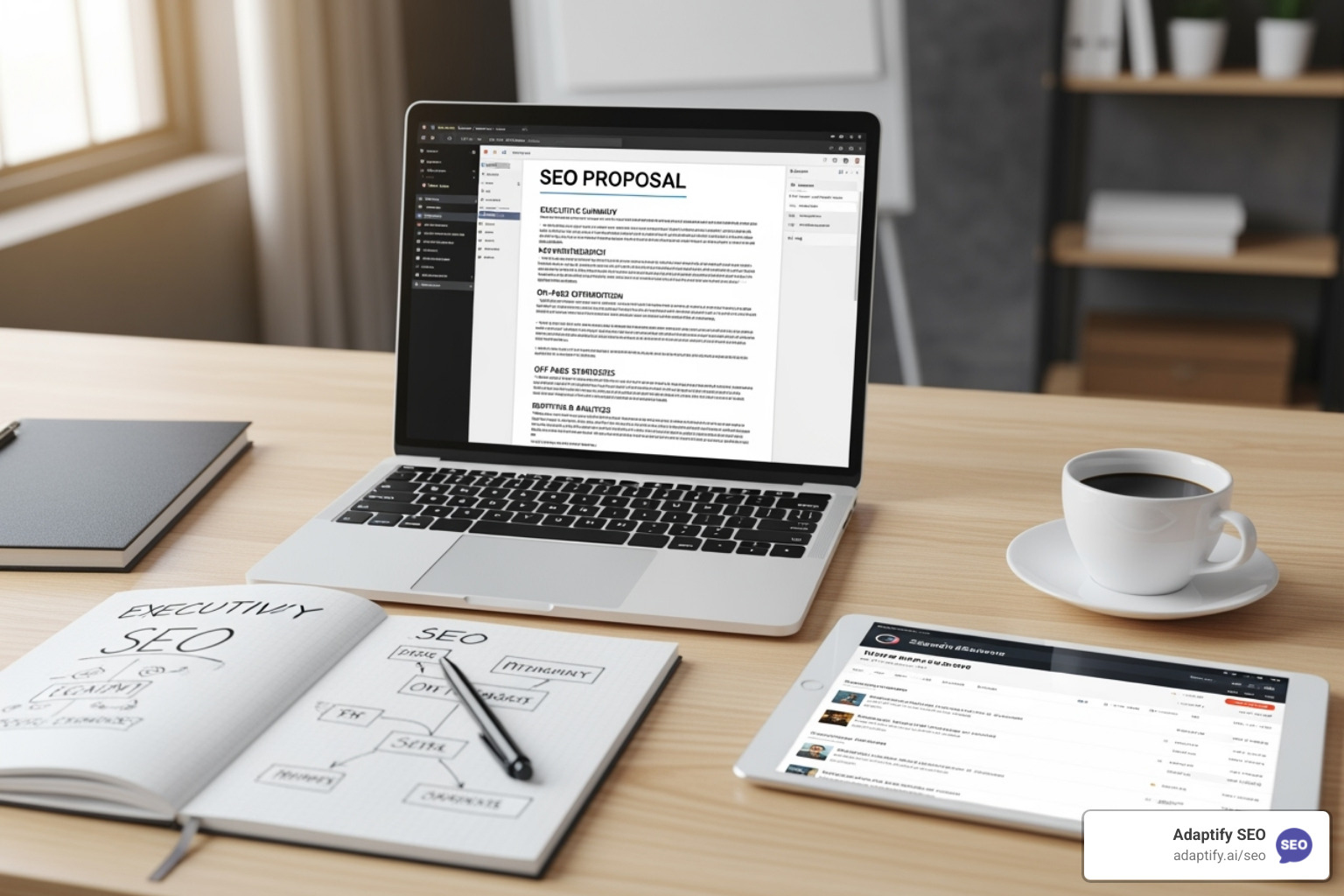
Your executive summary is your first impression. Make it count. Start with the client's logo and address them by name to show it's a custom document. Immediately reference the problem they shared with you, then pivot to the expected result, such as, "Our goal is to increase your organic leads by 30% in six months." Maintain an ROI focus and provide a high-level overview of your strategy in approachable terms. As strategist Rachel Claff advises, keep the language "friendly, and approachable."
This is the core of your proposal. A clear scope of work is critical to prevent misunderstandings later. Briefly explain what you'll do and why it matters:
SEO is a marathon, not a sprint. Be upfront about this to build long-term partnerships. Use a 30-60-90 day plan to outline initial activities: technical fixes in the first 30 days, content and outreach by 60 days, and early indicators of progress by 90 days.
Define objectives using the SMART goals framework. Instead of "increase traffic," propose something specific like, "Increase organic traffic by 25% in six months." Most importantly, manage expectations by emphasizing that SEO is a long-term strategy. As analyst Josh Pettovello notes, it "requires patience and persistence." Sharing examples of long-term growth builds trust and attracts the right kind of clients.
This is the persuasive part of writing an SEO proposal. You've laid the groundwork; now you must build a compelling case for why they should choose you. This is about demonstrating value, building trust, and making the decision easy.

Frame your pricing as an "investment" in growth, not a "cost." Present tiered pricing options to give clients a choice between foundational, comprehensive, or premium packages. Focus on value over price. As agency owner David Rooks notes, "It's rarely about price, it is about value." If clients push back, it's often because the value isn't clear.
Explain the "why" behind the investment by connecting each activity to their business goals. Project potential returns using their own metrics, like average customer value and conversion rates. Our SEO ROI calculator can help illustrate these gains. Be realistic and avoid guaranteeing revenue, but paint a clear picture of the potential return on their investment.
Trust is everything. Use social proof to show you can deliver on your promises. Include:
Social proof lets your satisfied clients do the selling for you, which is far more powerful than your own claims.
Don't get vague at the finish line. Your terms and conditions protect both you and the client. Clearly but briefly outline payment terms, cancellation policy, scope of work, and confidentiality in plain language.
Finally, include a crystal-clear call to action. Make it easy to say yes. Adaptify's integrated e-signature solution allows clients to sign digitally, removing friction. Outline the immediate next steps, such as, "Once signed, we'll send an onboarding questionnaire and schedule our kickoff call." As experts at Close.com advise, always communicate the next step to close the sale. Clarity closes deals.
Writing an SEO proposal shouldn't consume your entire week. By streamlining your process, you can focus on efficiency, consistency, and professionalism. Understanding common pitfalls and building smarter workflows helps you avoid deal-breakers and win more business.
Avoid these common proposal-writing mistakes that can cost you clients:
Using a template isn't cheating; it's working smarter. Templates save hours, ensure brand consistency, and provide a professional framework. However, customization is key. A template is a starting point, not the final product. Always personalize it with details from your client findy and audit.
Modern agency automation platforms like Adaptify.ai can transform your workflow. They streamline everything from strategy and content creation to link building, making proposal generation and fulfillment highly efficient. You can quickly create custom proposals, integrate data, and track client engagement.
To upgrade your process, download a free SEO proposal template and customize it. The goal is to work smarter on proposals so you can focus on delivering exceptional results.
Here are answers to common questions about writing an SEO proposal.
There's no magic number. Focus on value, not word count. A proposal should be comprehensive enough to build confidence but concise enough to be read. Typically, this means 5-15 pages, custom to the project's complexity. As consultant Geoff Kennedy says, get your most important points across "as efficiently as possible." Remove all fluff; if a section doesn't help the client make a decision, cut it.
Never guarantee specific rankings or revenue. Instead, set realistic projections based on data. Use historical data from similar clients as a benchmark. Then, apply the client's own metrics, like conversion rates and average customer value, to project potential revenue from increased traffic. For example, show how a projected traffic increase could translate into new customers and revenue. Focus on forecasting leading indicators you can influence, like keyword ranking improvements and organic impression growth, and always emphasize that significant results take several months.
Generally, no. Offering free proposals to qualified prospects is standard practice. However, it's crucial to pre-qualify prospects to ensure they have a realistic budget and are serious about investing. Don't waste hours on those who are just price shopping.
For complex enterprise projects, consider offering a paid findy or audit. This compensates you for your in-depth analysis and ensures the prospect is committed. Your time is valuable, so protect it by focusing your proposal efforts on prospects who are a good fit.
To recap, writing an SEO proposal that wins business comes down to one thing: personalization is not optional. A generic template will fail. A winning proposal shows you understand the client's goals, struggles, and how your work will deliver real business value.
A great proposal is the first step to a great partnership. It sets the tone, demonstrates your professionalism, and proves you're worth the investment. While crafting custom proposals can be time-intensive, you don't have to start from scratch every time.
By using a solid framework, customizing templates, and leveraging the right tools, you can create compelling proposals efficiently. Platforms like Adaptify.ai are designed to streamline your agency's entire process, from proposal creation to fulfillment, including strategy, content, and link building.
Less time on proposals means more time serving clients and building your agency. Take what you've learned, focus on value, set clear expectations, and make it easy for clients to say yes. Ready to streamline your agency's proposals with Adaptify? Let's make it happen together.

Compare automated SEO vs manual SEO to build a hybrid workflow that scales rankings with human oversight in 2026.

Master SEO service differentiation to stand out in a crowded market and prove your agency's unique business-first value.
Stop wasting hours—automate your SEO reports to boost agency efficiency and client trust.
Join 1,000+ agencies already delivering SEO and AI visibility from a single platform without increasing their headcount.Join 1,000+ agencies already delivering SEO and AI visibility from a single platform without increasing their headcount.