Unlock Your Site's Potential: Automated SEO Analysis Explained


Automated SEO analysis uses AI and machine learning to scan, evaluate, and report on your website's search performance without manual intervention. Instead of spending hours crawling through data, these tools deliver actionable insights in minutes.
Quick Answer - What Automated SEO Analysis Does:
The numbers tell the story. According to Statista, 49.1% of survey respondents expect AI to positively impact website traffic over the next five years. Meanwhile, agencies using automated tools report cutting content production time from 8 hours to just 3 hours per piece.
"SEO can be incredibly rewarding—but let's face it, it's also tedious," notes one industry expert. The hours spent on repetitive tasks like keyword research, tracking rankings, and technical audits can quickly drain your resources.
That's where automation changes everything. Tools now handle the grunt work while you focus on strategy and client relationships.
I'm Hansjan Kamerling, and I've spent years helping SaaS platforms scale through automated solutions, including working with data analytics platforms serving 40,000+ users with custom AI models. Through my experience with automated SEO analysis tools, I've seen how the right automation stack can transform agency operations from reactive to proactive.
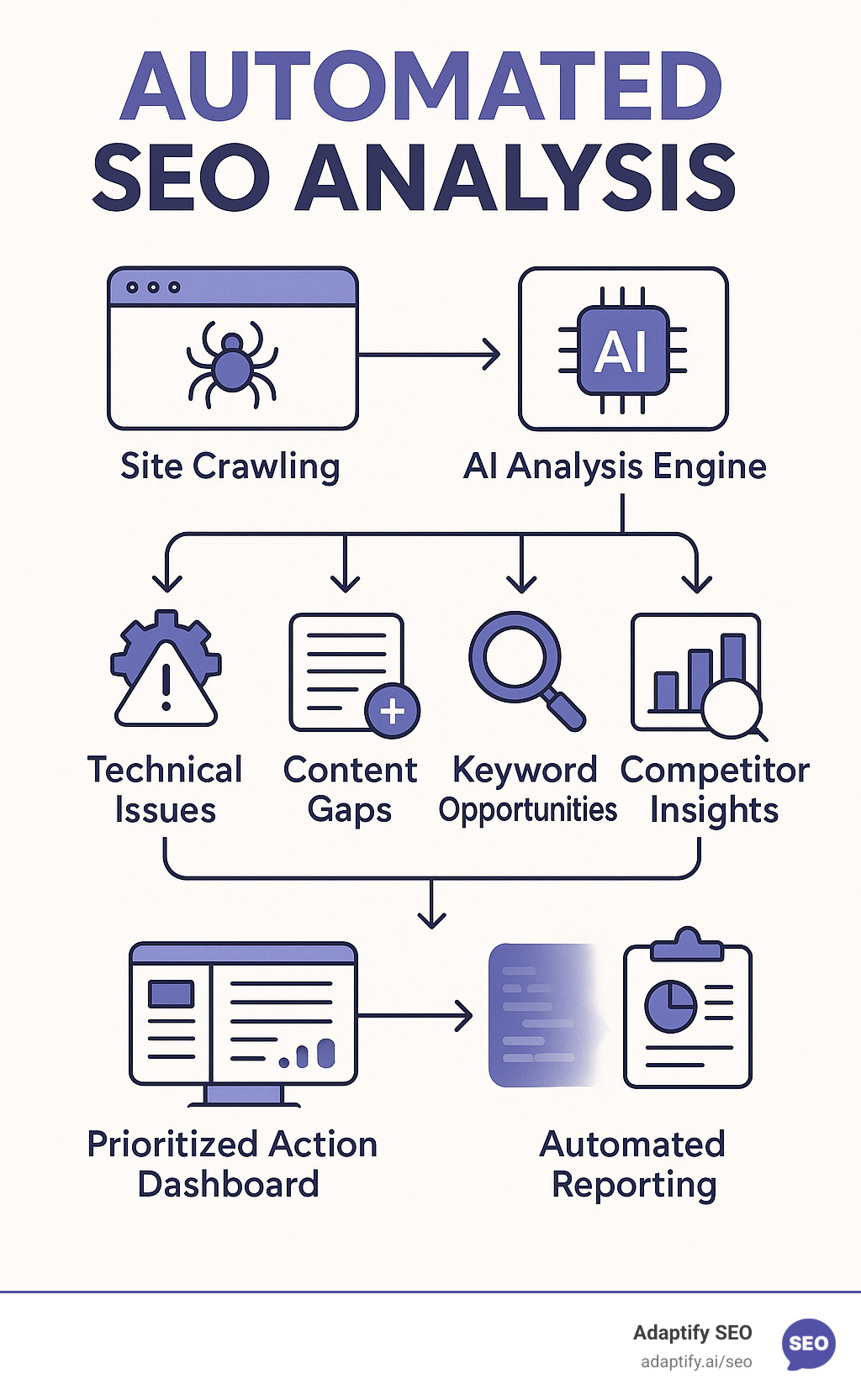
Think of automated SEO analysis as having a tireless SEO expert who never sleeps, never gets bored, and can process thousands of data points in seconds. But instead of relying on gut feelings or manual spot-checks, this digital expert uses cutting-edge technology to deliver insights that would take human analysts weeks to uncover.
The magic starts with crawlers—sophisticated bots that act like digital detectives, systematically visiting every corner of your website. These aren't your basic web scrapers from the early 2000s. Modern crawlers are incredibly smart. They understand JavaScript, can pretend to be different devices (mobile, desktop, tablet), and even know when to slow down so they don't crash your server.
Here's where it gets interesting: these crawlers feed everything they find into machine learning algorithms that have been trained on millions of websites. The AI doesn't just collect data—it actually understands what it's seeing. When it spots a page loading in 3 seconds, it doesn't just mark it as "slow." Instead, it calculates exactly how much traffic you're losing based on your industry, your competitors, and real user behavior patterns.
The big data processing is where things get really impressive. Modern tools don't just look at your website in isolation. They're simultaneously analyzing competitor benchmarks, search engine guidelines, user behavior data, and industry trends. It's like having access to a crystal ball that shows you exactly where you stand in the SEO landscape.
Scoring algorithms are the unsung heroes of automation. They take all this complex technical data and translate it into simple, actionable priorities. Instead of overwhelming you with 500 different issues, the system figures out which problems will actually move the needle. That missing meta description on your most popular page? High priority. The broken link buried in your footer that nobody clicks? Not so much.
One often-overlooked goldmine is log file insights. By analyzing your server logs, automated tools can see exactly which pages search engines are crawling, how often they visit, and where they're getting stuck. This reveals crawl budget issues that traditional tools completely miss.
If you want to dive deeper into how search engines actually interact with websites, the Google Search Console documentation offers excellent technical insights into what data search engines collect and why it matters.
The real genius of modern automated SEO analysis isn't in any single feature—it's in how these tools orchestrate multiple data streams into one unified picture. It's like conducting a symphony where every instrument represents a different data source.
Site crawling forms the foundation, but it's far more sophisticated than you might think. Advanced crawlers don't just visit pages—they experience your site the way search engines do. They check SSL certificates, analyze page structure, measure load times down to the millisecond, and even evaluate content quality using natural language processing.
While that's happening, API integrations are working overtime in the background. APIs are simultaneously pulling keyword rankings from search engines, backlink data from massive link databases, and competitor metrics from SEO platforms. Tools like SE Ranking, which has earned over 1,300 G2 reviews with an impressive 4.8/5 rating, have mastered this multi-source data aggregation.
Real-user metrics add the human element that crawlers can't capture. These tools integrate with Google PageSpeed Insights to pull actual user experience data—how long real visitors actually wait for pages to load, where they experience those annoying layout shifts, and at what point they give up and leave.
The heavy lifting happens in the cloud processing layer. Modern automated tools process millions of data points simultaneously, comparing your site against industry benchmarks and competitor performance in real-time. This distributed processing enables analysis that would literally take days to complete manually—if it were even possible.
Here's where automation really shines: the best tools don't just dump a pile of problems on your desk and wish you luck. They become your strategic advisor, guiding you toward solutions with clear, prioritized action plans.
Prioritized task lists rank issues by potential impact and how hard they'll be to fix. SEOptimer's reports, for example, categorize findings into three clear tiers: "Optimized" (100-90 points), "Needs work" (90-50 points), and "Not optimized" (50-0 points). This scoring system helps you focus on changes that will actually make a difference instead of getting lost in busy work.
Impact scores take the guesswork out of prioritization by quantifying the potential benefit of each fix. Instead of vague advice like "improve page speed," advanced tools get specific: "reducing load time by 1.2 seconds could increase traffic by 15% based on industry benchmarks." This data-driven approach makes it much easier to justify spending time and resources on specific improvements.
The cutting edge of automation includes auto-deploy capabilities that can actually implement certain fixes for you. Tools like OTTO SEO can automatically handle technical fixes through a simple pixel installation. The system detects issues like missing meta tags or improper schema markup and deploys corrections without any manual intervention—though they always include rollback options for safety.
When you're running automated SEO analysis, it's like having a health monitor for your website that never sleeps. But just like a doctor doesn't check every possible symptom, smart automation focuses on the metrics that actually move the needle.
Let's start with the big one: Core Web Vitals. These aren't just fancy technical terms—they're Google's way of measuring whether your site makes users happy or frustrated. Your automated tools should constantly track Largest Contentful Paint (LCP), First Input Delay (FID), and Cumulative Layout Shift (CLS).
Here's why this matters: Google's own research shows that pages meeting Core Web Vitals thresholds are 24% less likely to experience high bounce rates. That's not just better SEO—that's more customers sticking around.
On-page optimization factors might seem basic, but modern automation has transformed how we handle them. Your tools shouldn't just check if you have a title tag—they should evaluate whether it's actually good. Take Clearscope, which earned its 4.9/5 G2 rating from over 91 reviews by using natural language processing to ensure content matches what people are actually searching for.
Smart automation analyzes your title tags, meta descriptions, headers, and keyword usage against your competitors. It's like having an SEO expert constantly comparing your work to the top performers in your space.
Your backlink profile needs constant attention, and manual monitoring is practically impossible at scale. Automated tools track every new link you gain, every link you lose, and—crucially—changes in link quality. They'll flag potentially harmful links before they hurt your rankings and spot link-building opportunities by analyzing what's working for your competitors.
Content gap analysis reveals the opportunities hiding in plain sight. By comparing your content against top-ranking competitors, automation identifies topics you're missing, keywords you're under-optimized for, and content formats that could boost your SERP visibility. It's like having a research assistant who never gets tired of competitive analysis.
Don't overlook SERP feature tracking. Your automated tools should monitor your presence in featured snippets, local packs, image carousels, and other special search results. With Google's AI Overviews rolling out globally, tracking your brand's appearance in AI-generated responses is becoming crucial for staying visible.
The research backs this up. According to Statista's research on AI's impact on website traffic, nearly half of businesses expect positive traffic impacts from AI integration over the next five years. This makes automated monitoring of AI-driven search features not just helpful—it's essential for staying competitive.
Let me be honest with you—automated SEO analysis isn't a magic wand. After hundreds of implementations, I've learned that knowing both the wins and the pitfalls is crucial.
The time savings alone can transform an agency. One team that spent 30 minutes auditing each site now finishes in under 2 minutes; across dozens of clients that’s hours reclaimed every week.
Scalability follows naturally. A two-person agency now publishes 10–20 optimized blog posts every month through automated workflows—work that once demanded a much larger staff.
The consistency factor might be the most underrated benefit. People have off days or rush when deadlines loom; machines follow the same checklist every single time, so critical items aren’t missed.
Automation isn’t perfect. False positives can send you on wild-goose chases, and algorithm limitations sometimes ignore real-world context. Your role is to separate signal from noise.
| Aspect | Automated Analysis | Manual Analysis |
|---|---|---|
| Speed | Minutes to hours | Days to weeks |
| Consistency | Same process every time | Varies by analyst |
| Scale | Thousands of pages | Limited by humans |
| Context | Rule-based | Full nuance |
| Cost | Low per crawl | High labor |
| Accuracy | High on tech issues | Higher on strategy |
The sweet spot is treating automation as an ultra-efficient research assistant, not a replacement strategist. Agencies that thrive let machines crunch numbers, then apply human judgment to decide what actually moves the needle.
Choosing the right automated SEO analysis tools can feel overwhelming with so many options available. After testing dozens of platforms and helping agencies build their automation stacks, I've identified the standout performers that actually deliver on their promises.
Surfer AI has become my go-to recommendation for content optimization. What sets it apart isn't just its ability to analyze top-ranking pages—it's how the platform uses natural language processing to help you create content that works for both Google's algorithms and the new wave of AI chat interfaces like ChatGPT. With a 4.8/5 rating from over 532 G2 reviews, users consistently praise its accuracy and ease of use.
For comprehensive site auditing, Ahrefs Webmaster Tools delivers incredible value, especially considering their free tier includes 170+ SEO checks and 5,000 monthly crawl credits. Their Health Score system is particularly clever—it distills complex technical data into a single metric that makes it easy to track improvements over time and explain progress to clients.
SE Ranking shines when it comes to rank tracking and local SEO. Their geographic mapping features are a game-changer if you're managing clients across different locations. The platform's impressive 4.8/5 rating from over 1,374 G2 reviews reflects what I've experienced firsthand: reliable data and consistent performance that you can count on for client reporting.
Here's where things get exciting: OTTO SEO represents the future of automation. While it's newer to the market, its one-click pixel installation automatically detects and fixes technical issues without manual intervention. I've watched it identify missing meta tags and deploy schema markup corrections in real-time—something that would typically require developer involvement.
Don't overlook Screaming Frog SEO Spider, despite its steeper learning curve. This desktop application remains the gold standard for deep technical audits, especially when dealing with massive sites. It catches issues that web-based tools sometimes miss, making it invaluable for complex technical troubleshooting.
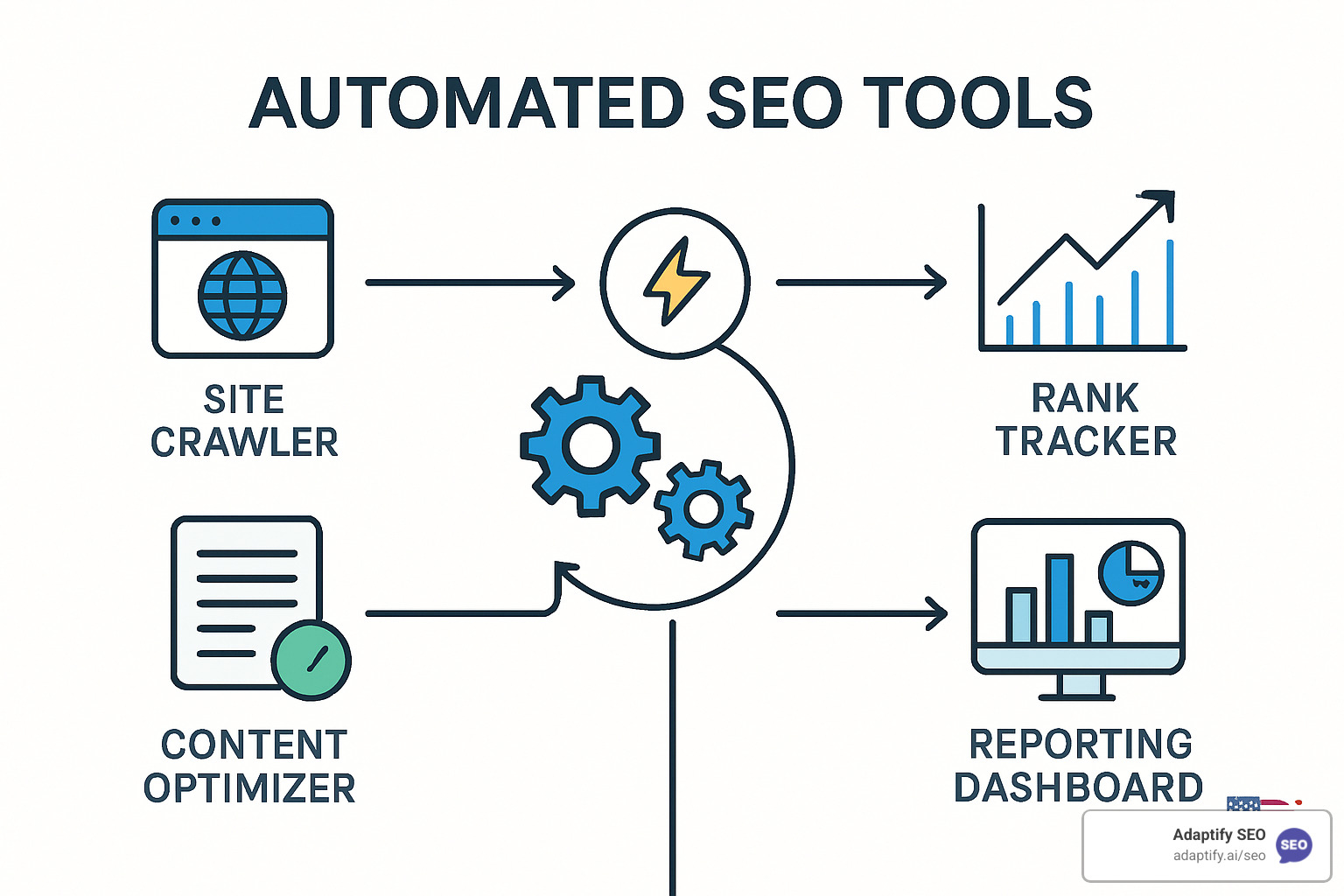
The magic happens when you connect everything together. Zapier bridges your SEO tools with CRMs, email platforms, and project management systems, creating seamless workflows that eliminate manual data transfer. Looker Studio transforms raw data from multiple sources into beautiful, automated dashboards that clients actually want to read.
Google Search Console integration should be non-negotiable in any automation stack. It provides the most authoritative performance data available, and modern tools that sync with GSC deliver insights you simply can't get elsewhere.
The Google SEO Starter Guide provides essential context for how these tools align with search engine expectations—definitely worth bookmarking as you build your automation strategy.
Creating an effective automated SEO analysis workflow isn't about using every tool available—it's about selecting the right combination and configuring them to work together seamlessly.
Site crawling frequency depends on your site's complexity and update schedule. Most websites benefit from weekly automated crawls, while high-volume e-commerce platforms should run daily scans. I always recommend scheduling these crawls during off-peak hours to avoid any potential impact on site performance. Tools like SEOptimer make this painless with unlimited analysis capabilities and flexible scheduling options.
Rank tracking requires a balanced approach. Focus your daily monitoring on your top 50-100 most critical keywords—the ones that drive real business results. Broader keyword sets can be tracked weekly without losing important insights. SE Ranking's local mapping features become particularly valuable here if you're serving geographic markets, allowing you to track performance variations across different locations.
Content optimization works best when it's baked directly into your content creation process. Rather than retrofitting optimization after the fact, integrate tools like Surfer into your CMS workflow. This way, writers can optimize content as they create it, making the process feel natural rather than burdensome.
Reporting dashboards should compile data from all your tools into client-ready formats automatically. The most successful agencies I've worked with have eliminated manual report creation entirely. Clients receive branded, comprehensive reports on schedule, which reduces administrative overhead while maintaining consistent communication.
Search algorithms never stand still, and your automated tools need to evolve with them. Staying current requires a proactive approach that goes beyond just hoping your tools update themselves.
Real-time alerts from Google Search Console should be your first line of defense. Set up notifications for traffic drops exceeding 20% or ranking losses for your most important keywords. These alerts often provide the earliest warning when algorithm changes affect your sites.
AI retraining happens automatically with quality tools, but verification is crucial. Check that your platforms regularly update their algorithms and scoring criteria. Tools that haven't refreshed their analysis methods in months may be providing outdated guidance that could actually hurt your rankings.
Best practice monitoring means staying connected to official Google communications and trusted industry sources. When Google announces major updates like Core Web Vitals or helpful content guidelines, ensure your automated tools quickly incorporate these changes into their analysis frameworks.
The key is building redundancy into your monitoring system. No single tool catches everything, but a well-integrated stack of automated solutions will keep you ahead of the curve.
Here's the honest truth: automated SEO analysis tools are incredibly reliable for technical issues, but they're not perfect fortune tellers.
When it comes to the nuts and bolts of SEO—broken links, missing meta tags, page speed problems—automated reports hit 85-95% accuracy. These tools excel at what they can measure objectively. After all, a 404 error is a 404 error, regardless of who (or what) finds it.
But here's where things get interesting. Accuracy drops significantly when tools try to make strategic recommendations that require understanding context, industry nuances, or user intent. An automated tool might flag your homepage for "low keyword density" without realizing you've intentionally optimized for brand searches rather than generic terms.
The secret sauce is knowing what to trust and what to double-check. Technical audits, keyword tracking, and performance monitoring are rock-solid when automated. But strategic decisions about content direction, link-building approaches, and competitive positioning? That's where human expertise still reigns supreme.
Tools like Ahrefs and SEOptimer have been refining their algorithms for years, processing millions of websites and learning from each analysis. Ahrefs alone processes over 25.5 million URLs, while SEOptimer serves 85,000+ customers globally. This massive dataset helps their machine learning models get smarter over time.
Think of automated tools as your incredibly thorough research assistant—they'll catch details you might miss and work around the clock, but you're still the strategist making the final calls.
The "right" frequency depends on your site's personality—how often it changes, how competitive your space is, and how much traffic you're managing.
For technical audits, most sites benefit from weekly scans. It's like a regular health checkup that catches problems before they become emergencies. But if you're running a large e-commerce platform with thousands of products coming and going, daily monitoring makes more sense.
Rank tracking works best with a two-tier approach. Monitor your top keywords daily—these are your money-makers that deserve constant attention. For broader keyword sets, weekly tracking provides enough insight without overwhelming you with data.
Content gap analysis doesn't need to be frequent. Monthly reviews work well, or whenever you've published significant new content. Think of it as stepping back to see the bigger picture rather than obsessing over daily changes.
Competitor monitoring should happen weekly for your direct rivals (the ones keeping you up at night) and monthly for broader market surveillance. You want to catch their big moves quickly without getting distracted by every minor tweak.
Backlink analysis benefits from weekly checks. New links can boost your rankings, but harmful ones can hurt fast. Quick detection means quick action, whether that's celebrating a great new mention or disavowing a sketchy link.
One client saw 15% traffic growth simply by switching from monthly to daily automated checks. They caught and fixed issues within hours instead of letting problems fester for weeks.
The short answer? Yes, and it's probably easier than you think.
CMS integrations are available for virtually every major platform. WordPress, Shopify, Webflow—they're all covered. Tools like Alli AI and OTTO SEO can even automatically implement fixes directly through your CMS. Imagine finding a technical issue and having it resolved without you lifting a finger. It's not magic; it's just really good automation.
Analytics connections create a unified view of your SEO performance. Most tools can pull data from Google Analytics, Search Console, and social media platforms into unified dashboards. Instead of juggling multiple browser tabs, you get everything in one place. SE Ranking and similar platforms excel at this kind of data aggregation.
Third-party workflows through Zapier open up endless possibilities. You can create automated sequences where SEO insights trigger specific actions across your entire marketing stack. For example, when your automated SEO analysis detects a ranking drop, it could automatically create a task in your project management system and send an alert to your team.
API access is available from most premium tools, which is fantastic news for agencies with specific workflow requirements. If you need custom integrations that don't exist out of the box, APIs give you the flexibility to build exactly what you need.
The integration landscape has evolved dramatically. What used to require custom development and technical wizardry now often works with simple point-and-click setups. The tools want to play nicely together—it's good for everyone when data flows smoothly between platforms.
Automated SEO analysis has quietly revolutionized how smart agencies and businesses approach search optimization. What started as a nice-to-have tool has become the secret weapon that separates thriving agencies from those still drowning in manual tasks.
The change is remarkable. Agencies are cutting content production time from 8 hours to just 3 hours per piece, while automated platforms now serve over 150,000 content creators, SEOs, and agencies worldwide. With nearly half of businesses expecting AI to boost their website traffic in the coming years, we're witnessing the early stages of a fundamental shift.
But here's what I've learned from working with countless agencies: the winners aren't just throwing automation at everything and hoping for the best. They're thoughtfully combining automated efficiency with human insight. The tools handle the tedious data collection and basic analysis, while human experts focus on strategy, creativity, and client relationships.
This balance is crucial. Automated SEO analysis excels at spotting technical issues, tracking rankings, and identifying content gaps. But it takes human judgment to understand why a competitor's strategy is working, how to adapt to algorithm changes, or what messaging will resonate with a specific audience.
At Adaptify SEO, we've built our entire platform around this philosophy. Our AI-driven approach handles the heavy lifting—from strategy formulation to content creation and PR link building—so agencies can focus on what they do best: growing their business and delighting clients.
The agencies scaling fastest today aren't the ones with the biggest teams. They're the ones who've learned to work smarter by letting automation handle routine tasks while preserving human expertise for strategic decisions. Whether you're managing one website or hundreds of client sites, the right automated stack becomes your force multiplier.
The future is already here for those ready to accept it. While others debate whether automation will replace human expertise, successful agencies are proving that the real opportunity lies in combining both effectively.
Ready to see how full-stack SEO automation can transform your workflow? Book a demo to explore how Adaptify SEO's comprehensive automation platform can streamline your processes and accelerate your results.

Stop being invisible: discover what the best local SEO strategies for small businesses are to dominate Google Maps, reviews, and AI search...
Master localized SEO to rank your local business in Google Maps and drive more in-store visits.

Master local retail SEO to drive foot traffic from Google with proven strategies for GBP, reviews, and AI search optimization.
Join 1,000+ agencies already delivering SEO and AI visibility from a single platform without increasing their headcount.Join 1,000+ agencies already delivering SEO and AI visibility from a single platform without increasing their headcount.