White Label Link Building Services Your Clients Will Actually Love




White label link building is when agencies outsource their backlink acquisition to specialized providers who deliver the work under the agency's own brand. Here's what you need to know:
What it includes:
Who it's for:
The numbers tell the story. Research shows that 52.3% of digital marketers report link building as the hardest aspect of SEO. Meanwhile, websites on Google's first page have an average of 3.8× more backlinks than positions 2-10. The challenge? A single quality link can take hours of research, outreach, writing, and follow-up.
That's where white label services come in. Instead of hiring an in-house team (which costs $4,000-$20,000 just for onboarding), agencies can tap into established networks and proven processes. The result? Faster delivery, consistent quality, and the ability to focus on what you do best - growing your agency.
If you're running an agency, you know the pain of promising SEO results while being bottlenecked by link building capacity. Your clients expect backlinks, but building them in-house means hiring specialists, managing complex outreach campaigns, and dealing with inevitable workload cycles.
This guide will show you how to bypass those headaches entirely. You'll learn how to evaluate white label providers, avoid common pitfalls, and deliver link building services that actually move the needle for your clients - all while maintaining healthy profit margins.
White label link building is like having a skilled team working behind the scenes while you get all the credit. It's a partnership where specialized agencies handle every aspect of link acquisition - from finding opportunities to securing placements - and deliver everything under your brand name.
Your clients never know you're working with an external partner. The white label provider stays completely invisible, like a ghostwriter for your SEO campaigns. You receive professional reports with your logo, detailed analytics, and high-quality backlinks that boost your clients' rankings.
This approach has exploded in popularity because link building is genuinely hard work. It requires specialized skills, established relationships with website owners, and frankly, a lot of patience. Most agencies would rather focus on what they do best - whether that's technical SEO, content strategy, or client relationships - instead of building an entire outreach department from scratch.
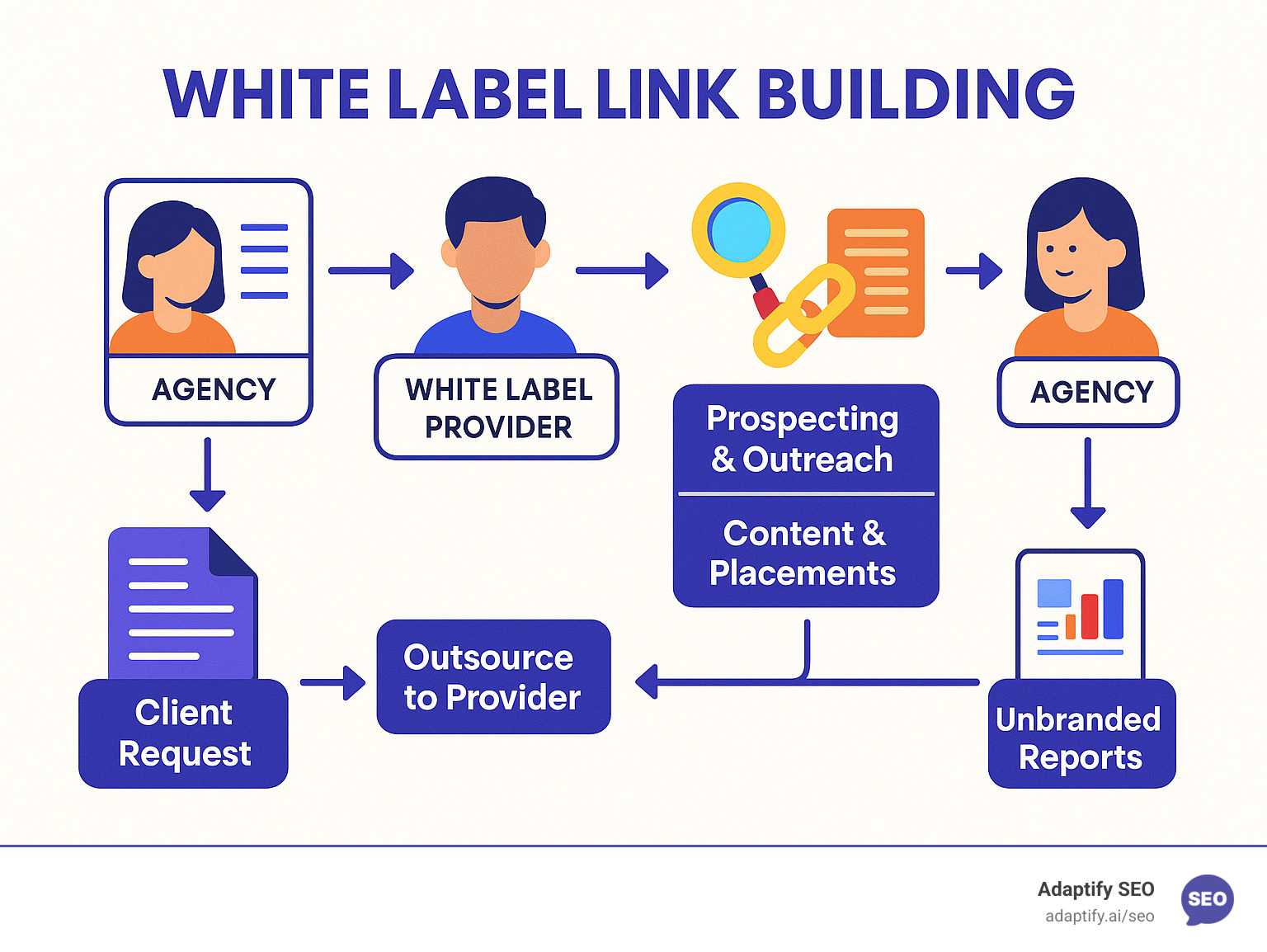
The process is refreshingly straightforward. When a client needs link building services, you simply pass their requirements to your white label link building partner. They take care of everything while you focus on growing your agency.
What makes this different from regular outsourcing is the branding element. Every deliverable comes back with your company's logo and formatting. Your client sees professional reports, detailed metrics, and quality backlinks - all appearing to come directly from your team.
This model works because it solves a fundamental challenge in the SEO world. Link building demands specialized expertise, proven outreach templates, and relationships that take years to develop. According to Google's SEO guidelines, quality link building focuses on creating valuable connections through legitimate editorial processes - exactly what experienced white label providers excel at.
Here's how a typical campaign unfolds:
Client Goal Analysis starts the process. Your white label partner analyzes your client's website, competitors, and identifies the types of links that will actually move the needle.
Strategic Prospecting comes next. Using their established databases and relationships, they identify high-authority websites in your client's niche with real organic traffic (typically 1,000+ monthly visitors).
Content Creation and Outreach is where the magic happens. Their team crafts personalized pitches, develops compelling guest post topics, and creates content that website owners actually want to publish. This includes manual outreach, guest posting opportunities, and HARO responses.
Placement and Reporting wraps up each campaign. You receive detailed, unbranded reports showing which links went live, their quality metrics, and the expected SEO impact. The entire process typically takes 3-4 weeks from start to finish.
Building an in-house team means hiring specialists at $4,000-$20,000 per person just for onboarding. Then there's the 3-6 month training period before they become effective. Add monthly tool costs of $500-$2,000, ongoing management overhead, and the challenge of scaling during busy periods.
White label services flip this equation entirely. You get immediate access to experienced specialists, established tools and infrastructure, and the ability to scale up or down based on client demand. Most providers report being at least 50% more cost-effective than traditional hiring when you factor in all the hidden costs.
White label link building works particularly well for:
SEO agencies offering comprehensive services but lacking specialized outreach expertise. If you're crushing it with technical SEO and content strategy but struggling with link acquisition, white label fills that gap perfectly.
Freelance consultants can suddenly compete with much larger agencies by offering enterprise-level link building services without hiring anyone or learning complex outreach strategies.
Digital marketing agencies focused on paid advertising, social media, or web development can expand into SEO without building entirely new departments. It's a natural way to increase client lifetime value.
The common thread? These are businesses that understand link building's value but recognize it requires specialized skills and significant time investment.
The math is simple: white label link building boosts margins and removes hiring headaches. Agencies that outsource see up to 40% higher profits on link projects while delivering results much faster.
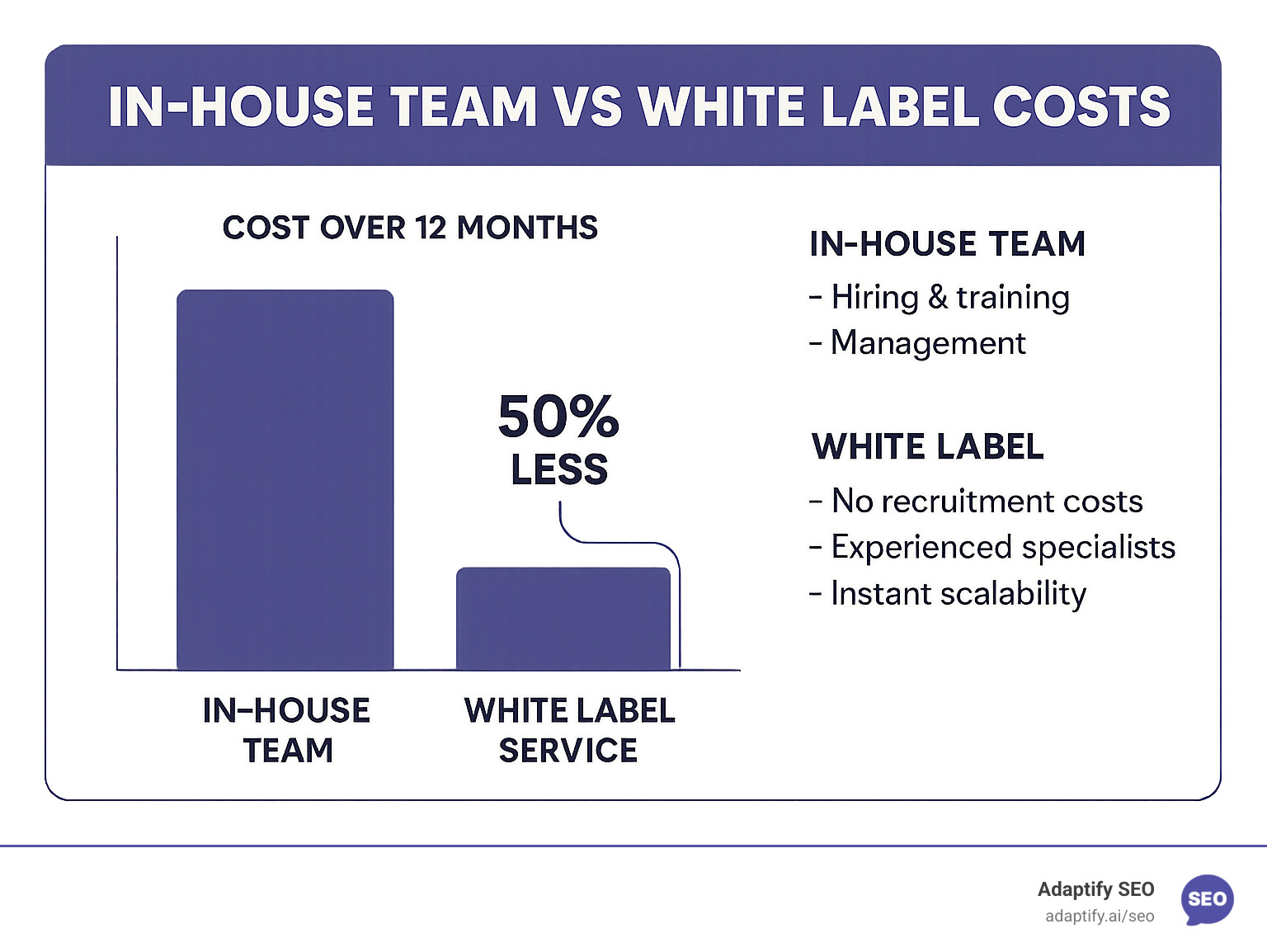
Hiring one outreach specialist costs $4,000–$20,000 before they produce any billable work. Add software, training, and management and the expense balloons, while agencies that outsource are already sending clients fresh links.
Providers run automated, battle-tested workflows, so you can ramp volume up or down on demand. Their specialized teams—prospectors, writers, and outreach pros—keep quality consistent while you stay lean. Many even supply real-time dashboards or API feeds so progress appears directly inside your client portal.
Agencies using white label partners have documented organic traffic lifts of 100–361% and routinely manage 20+ clients without adding staff. One agency slashed delivery times from eight weeks to four while increasing link margins by 40%.
Here's the truth about backlinks: they're only as good as the sites they come from. I've seen agencies get burned by providers who promise hundreds of links at bargain prices, only to deliver links from spammy sites that actually hurt their clients' rankings.
Not all backlinks are created equal, and not all white label providers understand this distinction. The best providers use rigorous vetting criteria to ensure every link will actually help your clients' SEO performance.
When evaluating white label link building providers, you need to know exactly what quality metrics they use. Here's what separates the pros from the pretenders:
Domain Rating and Domain Authority matter, but they're not everything. Most quality providers require minimum DR of 60+ or DA of 40+. But here's what many agencies miss: a relevant site with DR 45 can be more valuable than an irrelevant site with DR 80.
Organic traffic tells the real story. Target sites should have at least 1,000 organic visitors per month, though the best providers often set the bar at 5,000+. This ensures the linking site has real people reading it, not just inflated metrics from expired domains.
The inbound vs. outbound link ratio reveals whether a site is actually valuable or just exists to sell links. Quality sites maintain healthy ratios between links they receive and links they give out.
Content quality standards separate legitimate publications from content farms. Linking sites should publish original, well-written content regularly. Sites that only exist to sell links or publish low-quality guest posts will hurt your clients' SEO performance.
Niche relevance often trumps raw authority. A link from a marketing blog to a SaaS company's website carries more weight than a link from a general news site with higher metrics.
The landscape has changed dramatically since the early days of SEO. What worked in 2010 can get your clients penalized today. The best white label providers focus exclusively on tactics that align with Google's guidelines.
Guest posting remains the cornerstone of quality link building when done right. This means creating genuinely valuable, informative content for relevant websites in exchange for contextual backlinks.
The Skyscraper Technique works because it provides real value to website owners. You find popular content in your client's niche, create something significantly better, then reach out to sites that linked to the original piece.
Broken link building offers a win-win scenario. You identify broken links on relevant websites and offer your client's content as a replacement.
Digital PR and HARO responses through platforms like Connectively can earn mentions and links in news articles and industry publications. These links often come from high-authority news sites and carry significant SEO weight.
Resource page link building focuses on getting included on industry resource pages, tool roundups, and "best of" lists where your client's business naturally fits.
The common thread? All these tactics focus on providing genuine value rather than trying to manipulate search engines.
Transparency isn't just nice to have - it's essential for client retention. When clients can see exactly what they're getting for their investment, they're more likely to increase budgets and refer new business.
Real-time dashboards let clients log in anytime to see campaign progress, approved placements, and performance metrics. No more awkward calls asking "What's happening with our link building?"
Unbranded PDF reports should be detailed monthly summaries that you can deliver directly to clients under your agency's branding. These need to include link metrics, traffic impact projections, and next month's strategy.
Link replacement guarantees show that providers stand behind their work. Quality providers monitor placed links and offer free replacements if links are removed or sites lose their authority metrics.
Whether you're working with a white label provider or managing links in-house, you need the right tools to track performance and catch issues early.
Ahrefs offers the industry-leading backlink database and monitoring capabilities. Semrush provides a comprehensive SEO platform with strong link analysis features, plus competitive intelligence. Search Atlas is an emerging platform with extensive link prospecting capabilities that many agencies are starting to prefer for its user-friendly interface.
Don't overlook Google Search Console - it's free and gives you Google's own view of your clients' backlink profiles.
Finding the right white label provider can transform your agency's link building capabilities. Choose wrong, and you risk damaging client relationships and your reputation. The stakes are high, but the evaluation process doesn't have to be complicated.
Many agencies rush into partnerships without proper due diligence. They're attracted by low prices or big promises, only to find later that their provider uses questionable tactics or delivers poor-quality links. The result? Clients lose rankings, trust erodes, and agencies scramble to find legitimate alternatives.
Think of evaluating a white label link building provider like hiring a key employee. You wouldn't hire someone without checking references, and you shouldn't partner with a provider without thorough vetting.
Experience and track record matter more than flashy websites or sales pitches. Look for providers with at least 3-5 years of specialized link building experience. Ask for detailed case studies that show measurable SEO improvements, not just vanity metrics like "10,000 links placed."
Process transparency separates legitimate providers from black-hat operators. Quality providers should eagerly explain their exact workflow - from how they prospect websites to how they craft outreach messages. If a provider is vague about their methods or claims "proprietary secrets," that's often code for tactics they don't want you to know about.
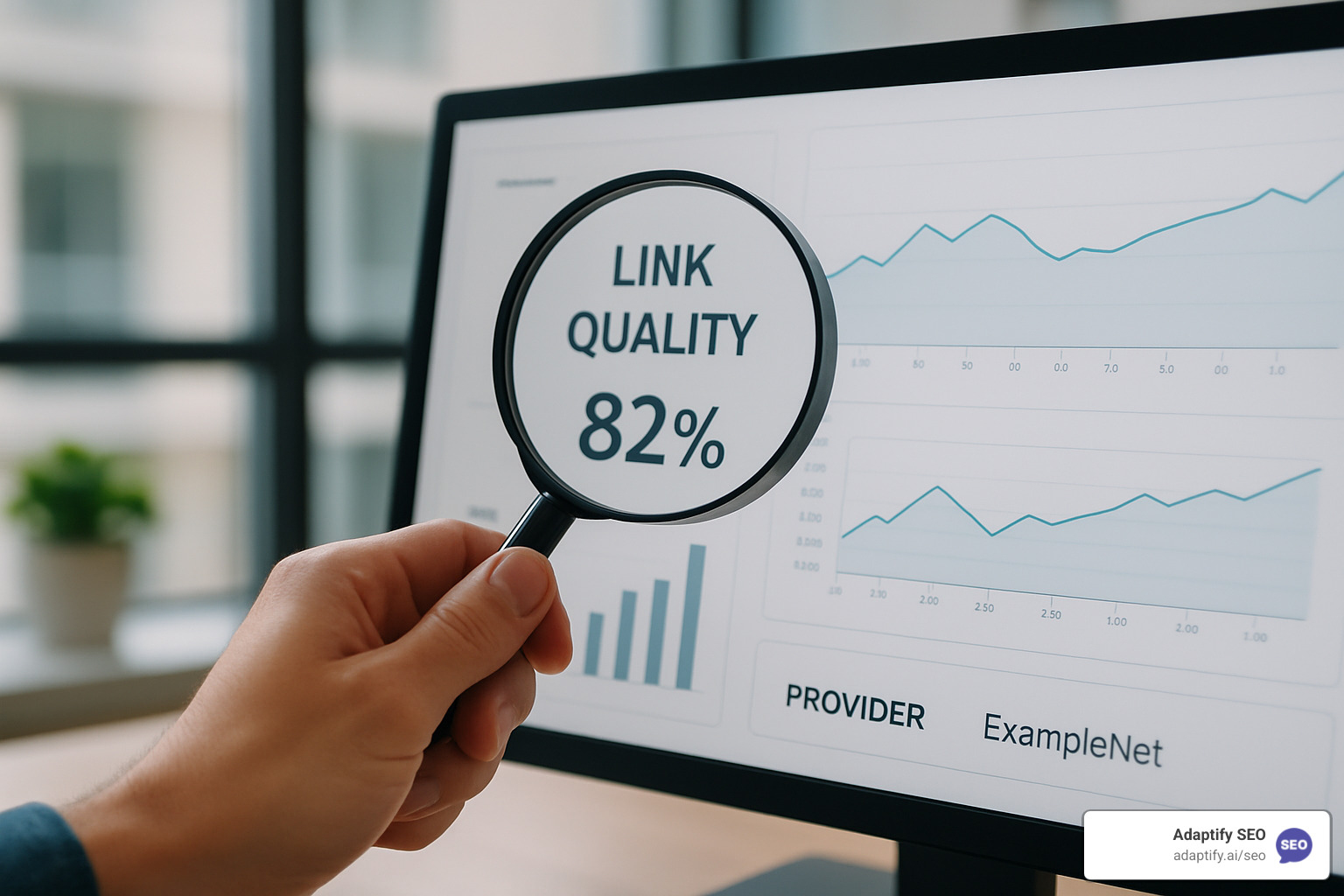
Sample link quality tells you everything about a provider's standards. Ask to see recent placements and personally evaluate the linking sites. Check their Domain Rating, organic traffic, content quality, and relevance to your clients' industries.
Real-time reporting capabilities show a provider's commitment to transparency. You should have access to campaign progress through dashboards or regular updates.
Client references from other agencies provide crucial insights. Quality providers maintain strong relationships with their partners and will connect you with satisfied customers. Pay attention to how long these relationships have lasted - high churn rates often indicate service issues.
Pricing transparency builds trust from the first conversation. The best providers clearly explain their pricing structure, what's included, and any additional costs.
The link building industry attracts bad actors who prey on agencies' desire for quick results. Learning to spot these red flags can save your agency from disaster.
Private Blog Networks (PBNs) represent the biggest threat to your clients' SEO. Any provider offering links from "exclusive networks" or "private sites" is likely using PBNs. These networks violate Google's guidelines and can trigger severe penalties.
Unrealistic volume promises should immediately raise suspicions. Real examples from the market include offers like "600+ links for $10" or "100 high-authority links for $50." Quality link building requires significant time and effort - these prices are impossible to achieve legitimately.
Link farms and directory spam tactics might seem harmless but actually hurt your clients' SEO. Providers who focus on directory submissions, forum links, or comment spam aren't providing value.
Fake guest post networks have become increasingly common. Some providers create networks of low-quality sites that exist solely to sell guest posts. These sites often have inflated metrics achieved through artificial means, but no real audience engagement.
Lack of quality guarantees indicates a provider who doesn't stand behind their work. Reputable providers monitor placed links and offer free replacements if links are removed or sites lose their authority.
High-pressure sales tactics often accompany questionable services. Be wary of providers who pressure you to sign long-term contracts or make large upfront payments.
You can research potential providers through verified reviews and case studies on Clutch, which offers independent evaluations of link building agencies.
Understanding pricing models helps you evaluate providers fairly and set appropriate margins for your agency.
Per-link pricing remains the most common approach, typically ranging from $300-$500 per quality link. This model offers predictability and makes it easy to calculate margins.
Monthly retainer models work well for agencies with consistent demand. You pay a fixed monthly fee for a certain number of links or hours of work.
Brokerage models offer maximum transparency by charging the actual cost to secure the link plus a fixed brokerage fee.
Hybrid models combine retainer fees with per-link charges, often used for high-volume partnerships.
When calculating ROI, consider factors beyond simple markup percentages. Time savings typically amount to 20-30 hours per month for a typical campaign. Client retention improvements from quality link building significantly reduce churn and increase lifetime value. The opportunity cost of building in-house capabilities often exceeds the markup you'll pay to a quality provider.
Most agencies find that white label link building becomes profitable within the first month and generates strong margins long-term.
Let's be honest about timelines - white label link building isn't a magic overnight solution, but the results can be impressive when you set proper expectations with your clients.
Most quality providers will get your first links live within 30 days of starting a campaign. The real question is when those links start moving the needle for your clients' rankings and traffic.
SEO impact timing depends heavily on your client's situation. If they're in a low-competition industry with decent existing authority, you might start seeing ranking improvements in 6-8 months. But if you're dealing with competitive sectors like finance or legal, be prepared for 12+ months before you see significant movement.
The traffic growth numbers are encouraging though. Research shows that clients have experienced organic traffic increases ranging from 100% all the way up to 361%. Of course, these results depend on the overall SEO strategy, not just the link building piece.
Here's what realistic monthly output looks like: a quality campaign typically secures 4-8 high-authority links per month. If a provider is promising dozens of links monthly, that's your cue to run - they're almost certainly using low-quality tactics that could hurt your clients.
Reputable white label providers have developed multi-step quality control processes that protect both your agency and your clients.
Manual site vetting is the foundation. Each potential linking site gets manually reviewed for metrics, content quality, and relevance before any outreach begins. No automated scraping of random websites here.
Google Guidelines compliance isn't optional - it's the baseline. All tactics must align with Google's Webmaster Guidelines. That means no paid links, no link schemes, and no manipulative practices that could trigger penalties.
The content review process is equally important. All guest posts and content pieces are reviewed for quality, originality, and natural link integration before publication.
Ongoing monitoring is what separates good providers from great ones. Quality links are monitored for at least 6-12 months after placement. If links get removed or sites lose their authority, the best providers offer free replacements without you having to ask.
Pricing transparency helps you set realistic client expectations and healthy margins for your agency. Current market rates for quality white label links typically fall in the $300-$500 per placement range, though several factors influence the final cost.
Site authority drives premium pricing. Links from DR 80+ sites will cost significantly more than DR 60 placements, but the SEO impact often justifies the investment.
Niche difficulty also affects pricing. Competitive industries like finance, health, and legal command higher rates because quality placements are harder to secure.
Content requirements matter too. Links requiring custom content creation cost more than simple niche edits where your client's link gets added to existing content.
Most providers offer volume discounts for agencies committing to higher monthly volumes. This is where the economics really start working in your favor.
The best providers use transparent pricing models where you can see exactly what portion goes to the publisher versus their service fee.
White label link building isn't just another service offering - it's your ticket to competing with the big agencies without the big overhead. Think about it: while your competitors are struggling to hire link building specialists (at $4,000-$20,000 per hire) and waiting months for them to become effective, you can start delivering results next week.
The math is simple. With 52.3% of marketers calling link building their biggest SEO challenge, and first-page results requiring 3.8× more backlinks than lower positions, agencies that can consistently deliver quality links have cracked the code. Your clients need these results, but they don't need to know how you deliver them.
What they care about is seeing their rankings climb and their organic traffic grow. Whether that happens through your in-house team or a white label partner is irrelevant to them - but it should matter a lot to your bottom line and sanity.
The agencies winning in this space have figured out a crucial truth: specialization beats generalization. Instead of trying to be experts at everything, they focus on what they do best and partner with specialists for the rest. Your core competency might be technical SEO, content strategy, or client relationships. Link building doesn't have to be one of them.
But here's the catch - choosing the wrong partner can backfire spectacularly. Those "600 links for $10" offers aren't just too good to be true; they're agency-reputation killers waiting to happen. Stick with providers who use transparent processes, offer quality guarantees, and can show you actual results from real campaigns.
When you find the right partner, something magical happens. Link building transforms from a time-consuming bottleneck into a profit center. Your clients get better results, your team focuses on high-value activities, and your margins improve. It's the kind of win-win-win scenario that makes business fun again.
The future belongs to agencies that can deliver comprehensive SEO results efficiently. White label link building gets you there faster than any other approach we've seen.
At Adaptify, we've built our entire platform around this same principle - using automation and specialization to deliver better SEO results with less manual effort. While we focus on automated strategy and content creation, we know that link building remains the missing piece for many agencies.
Ready to see how automated SEO services can work alongside your link building efforts to create an unstoppable client growth engine? Book a Demo and let's explore how to transform your agency's approach to SEO delivery.

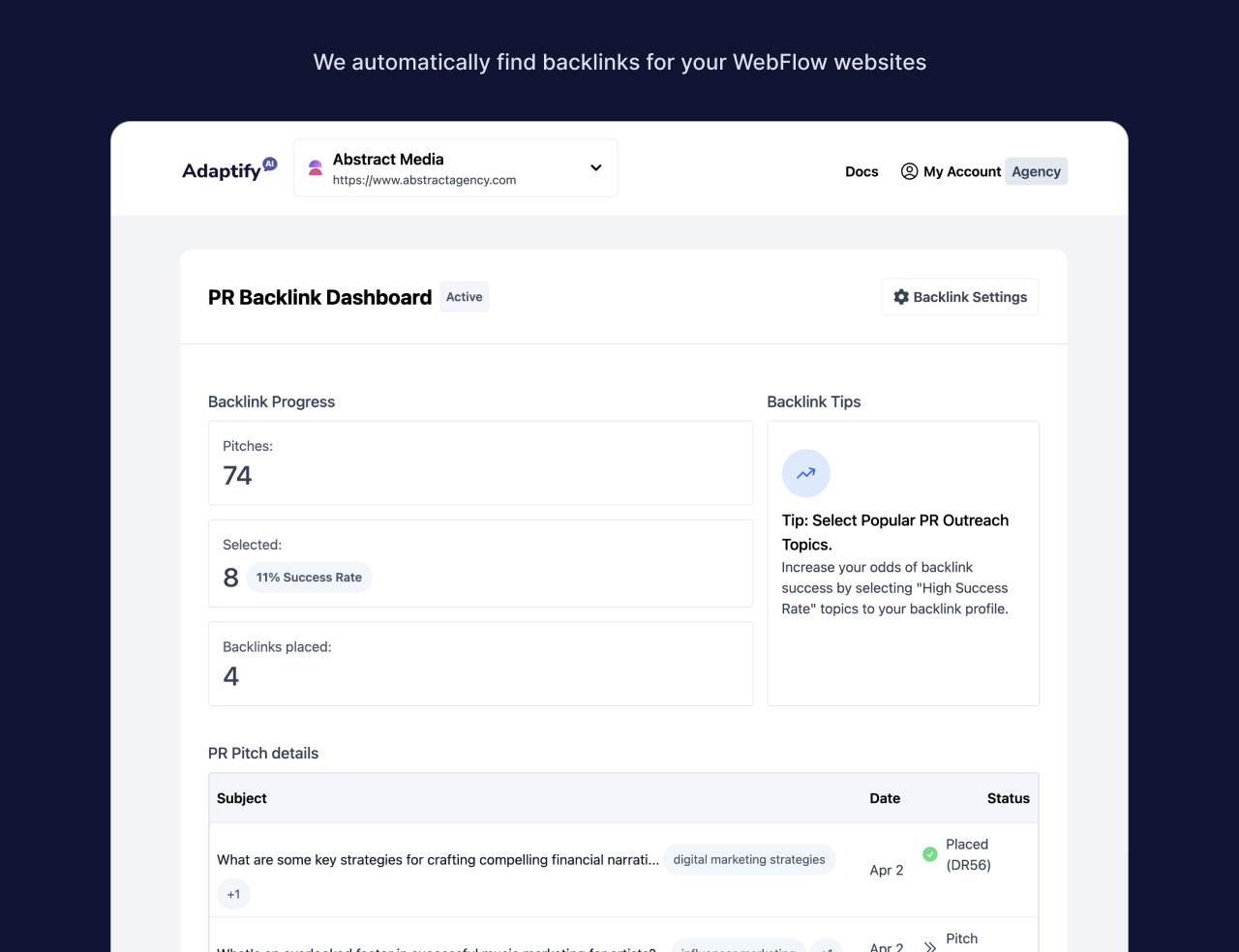
Discover how backlink automation software streamlines outreach, saves time, and scales your SEO strategy safely and effectively.
Track every backlink with an SEO backlink monitor—spot lost links fast, protect rankings, and boost ROI before competitors do.
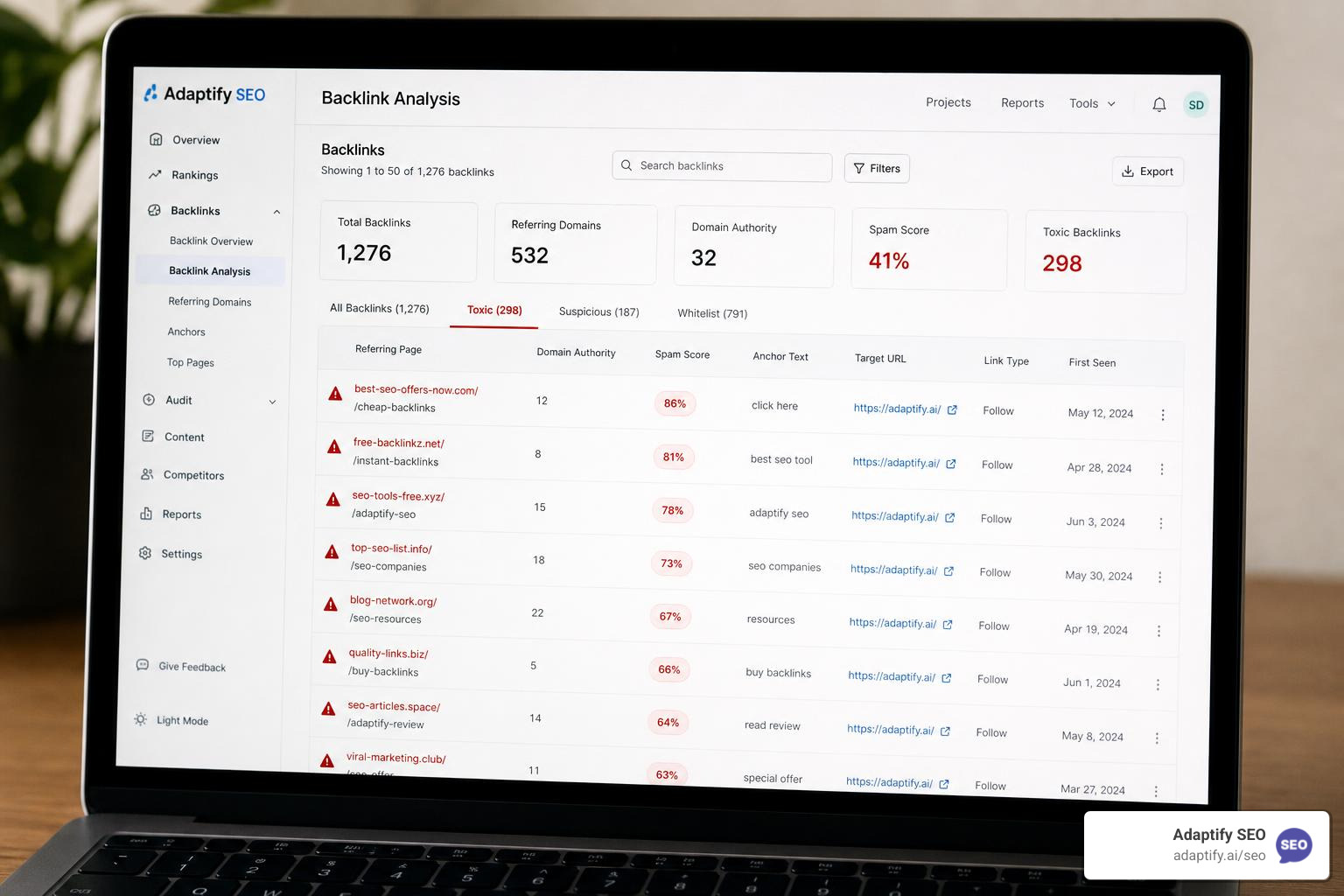
Learn how to disavow toxic backlinks, clean your profile, and recover rankings with this step-by-step guide.
Join 1,000+ agencies already delivering SEO and AI visibility from a single platform without increasing their headcount.Join 1,000+ agencies already delivering SEO and AI visibility from a single platform without increasing their headcount.