Write Less, Publish More: The Power of Automated Content




Automated content writing uses artificial intelligence (AI) to generate text and other digital media, streamlining content creation to make it faster and more scalable. As the demand for high-quality digital content grows, businesses are turning to automation to overcome the time-consuming and resource-intensive nature of manual production.
Automated content creation refers to material produced by software and algorithms with minimal human involvement. The goal is to optimize expensive and repetitive processes. For example, generating a long-form article with a tool like Copymatic.ai can take minutes instead of hours.
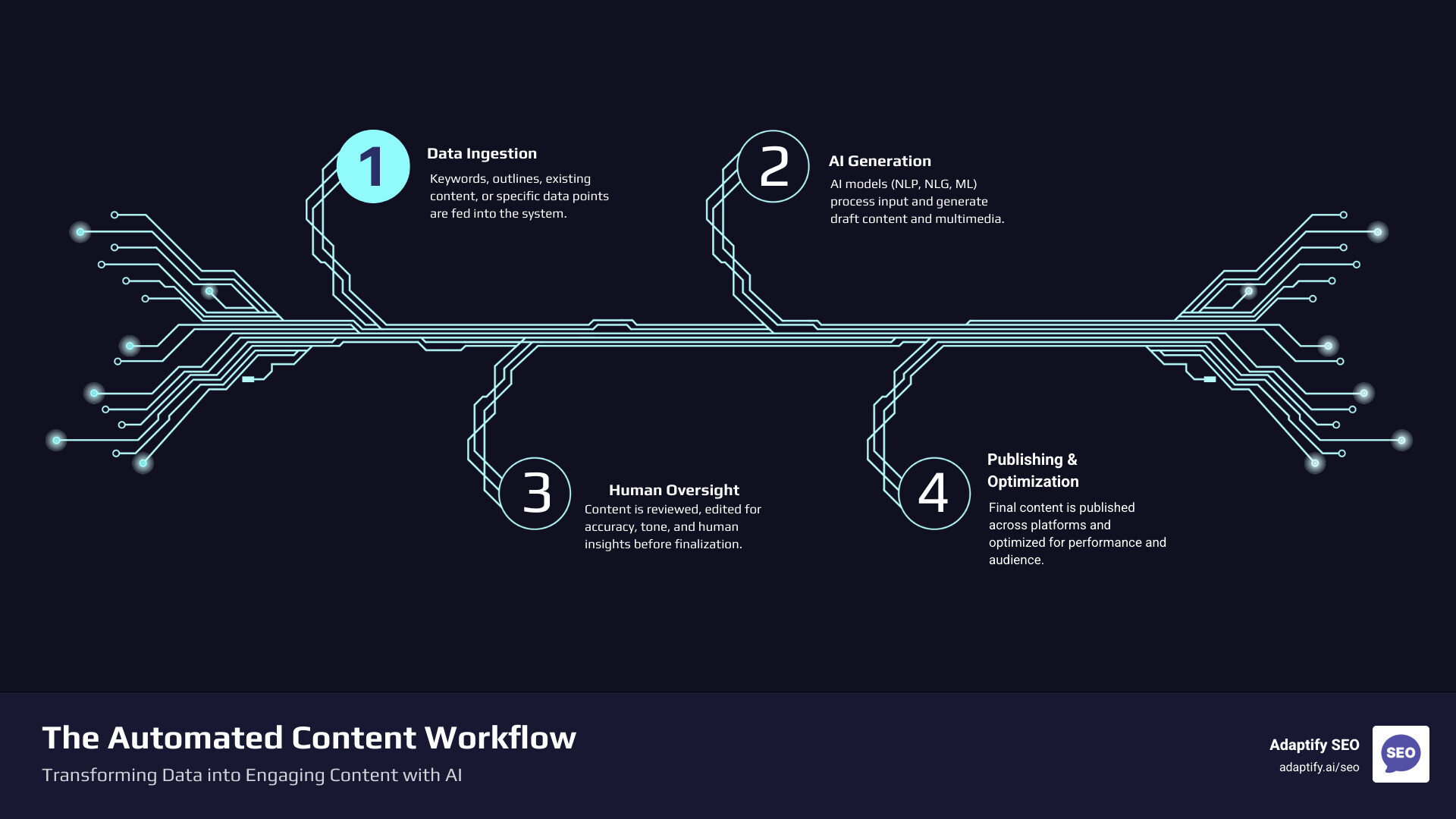
Several key technologies enable automated content writing:
Modern AI writing tools often use advanced large language models (LLMs) like OpenAI's GPT-4. Trained on vast text datasets, these models produce natural, unique, and creative content. The quality of the output is directly tied to the sophistication of the underlying AI infrastructure.
The versatility of Automated content writing extends to a wide range of digital content:
Automating these formats allows businesses to maintain a consistent online presence without being bogged down by manual production.
Automating your content workflow open ups significant efficiency and strategic advantages over manual creation. The primary benefits include:
These benefits fundamentally transform content marketing, enabling agencies to boost efficiency and deliver consistent, high-quality results.
Automated content writing excels at handling time-consuming marketing tasks:
Automating these tasks allows marketers to shift their focus from execution to strategy, leading to more impactful campaigns.
Maintaining a consistent brand voice is critical, and Automated content writing helps achieve this at scale.
By training AI models on your brand guidelines, all generated content can align with your established tone and style. This is especially valuable for agencies managing multiple clients. Furthermore, AI facilitates multi-channel publishing by repurposing a single piece of content, like a blog post, into social media updates, email snippets, and video scripts. For global businesses, AI can also assist with localizing content by translating and adapting materials for different languages and cultural contexts.
At Adaptify, we understand the importance of comprehensive content services. Our focus on More info about content services helps clients scale their content efforts while maintaining the quality and consistency their brand requires.

While Automated content writing offers powerful advantages, steer its challenges and ethical considerations. Responsible use requires awareness of potential issues like inconsistent content quality, a lack of authenticity, and the risk of over-reliance on technology.
Crucially, all AI-generated content requires rigorous fact-checking. AI models can "hallucinate" information, creating plausible but false statements. This makes human verification a mandatory step in the workflow.
To maximize the value of AI, it's important to address its limitations:
Ensuring high-quality, original content is paramount when using AI.
Regarding plagiarism concerns, most modern AI tools are designed to produce original text. For instance, some analyses show that "Copymatic has been voted as the AI writing tool generating with the lowest plagiarism rate: 2%." While the risk is low, it's still wise to use plagiarism checkers.
However, true uniqueness comes from fresh insights, which requires a human touch. This leads to the most critical practice: human oversight. AI should be an assistant, not a replacement. A human must review every piece of AI-generated content for accuracy, tone, and brand alignment.
Establish strong editing workflows and a quality assurance (QA) process. This should include fact-checking, language refinement, and adding a creative spark. The optimal approach combines automation for repetitive tasks with human creativity for strategy and refinement.
The market for Automated content writing tools is expanding rapidly. To simplify your choice, we've grouped them by their primary function.
These tools assist with all forms of written content, from social media posts to long-form articles.
AI is also changing the creation of visual media.
These tools ensure your content is optimized to rank in search engines.
Great SEO requires more than just content; it needs a smart strategy. Our SEO proposals are designed to integrate these powerful tools into a cohesive plan for our clients.
Integrating automated content writing into your SEO strategy is crucial for scaling production effectively. Search engines prioritize helpful, high-quality content, regardless of how it was created. This means your automated content must align with core SEO principles.
Focus on Google's E-E-A-T framework (Expertise, Experience, Authoritativeness, Trustworthiness). While AI can help cover topics comprehensively, human insight is needed to add the real-world experience and expert perspective that builds trust. Similarly, human judgment is essential to ensure content satisfies search intent and provides a positive user experience.
Automation excels at building topical authority by enabling the systematic creation of content clusters around core topics, signaling your expertise to Google.

Will Google penalize you for using AI content? The short answer is no, provided the content is helpful. Google's official guidance on AI-generated content clarifies that "the appropriate use of AI, or automation is not against our guidelines."
The focus is on value, not the creation method. Google's algorithms reward content that helps users, so a user-first approach is key. Low-quality, spammy content will be penalized whether it's written by a human or AI. High-quality, original, and helpful AI-assisted content is perfectly acceptable.
To succeed with AI-driven SEO, adopt a strategic approach:
Use AI as a powerful assistant to scale production, but always rely on the human element to ensure quality, accuracy, and strategic value.
Successful implementation of Automated content writing requires a strategic approach that integrates AI into your existing workflow, empowering your team rather than replacing it. The key is to blend automation with human expertise.
This table illustrates the shift from a manual to an automated workflow:
| Feature/Task | Manual Content Workflow | Automated Content Workflow |
|---|---|---|
| Ideation | Brainstorming sessions, manual trend research | AI-powered topic generation, keyword clustering |
| Drafting | Human writer from scratch | AI generates first draft, human refines |
| Research | Manual web searches, data compilation | AI pulls real-time data, summarizes sources |
| Optimization (SEO) | Manual keyword placement, readability checks | AI suggests optimizations, content scoring |
| Proofreading | Manual review, multiple human passes | AI grammar/style checks, human final review |
| Scaling | Limited by human capacity | High scalability, bulk content generation |
| Consistency | Dependent on individual writer | AI trained on brand voice ensures consistency |
Before you begin, set clear goals (e.g., faster production, cost savings), choose the right tools for your needs, establish a quality assurance (QA) process, and monitor performance to make data-driven adjustments.
The most effective strategy is a hybrid model where AI handles repetitive, data-heavy tasks, freeing up humans for creativity, critical thinking, and ethical oversight.
This approach relies on several key human-led practices:
Here is a streamlined, six-step workflow for integrating AI into your content process:
This iterative process combines the speed of AI with the quality and strategic depth of human oversight. Our own SEO process is built around such integrated workflows to deliver exceptional results.
The key takeaway is that Automated content writing is a powerful lever for efficiency and scale, not a replacement for human creativity. As the demand for digital content continues to grow, AI offers a way to produce high-quality, consistent material at an unprecedented speed.
The future of content creation lies in a hybrid model where intelligent automation empowers human ingenuity. By handling repetitive tasks, AI frees your team to focus on high-impact activities like strategy, unique insight generation, and building stronger brand connections. This is the core of a smart, modern content strategy.
At Adaptify.ai, we have built our automated SEO services with these principles in mind, specifically for agencies. Our platform streamlines the entire SEO workflow—from strategy and content creation to PR link building—all powered by AI. We provide a comprehensive, automated solution that reduces manual effort, allowing your agency to scale its services and deliver superior results to clients.
If you're an agency ready to improve your content and SEO efforts with the perfect blend of human brilliance and AI efficiency, we can help.

Stop being invisible: discover what the best local SEO strategies for small businesses are to dominate Google Maps, reviews, and AI search...

Master localized SEO to rank your local business in Google Maps and drive more in-store visits.

Master local retail SEO to drive foot traffic from Google with proven strategies for GBP, reviews, and AI search optimization.
Join 1,000+ agencies already delivering SEO and AI visibility from a single platform without increasing their headcount.Join 1,000+ agencies already delivering SEO and AI visibility from a single platform without increasing their headcount.