Write Smarter, Not Harder:Unlocking the Power of AI for SEO Content
Hansjan Kamerling
Feb 6, 202611 min read
Why Content Teams Are Turning to Automated Blog Post Writers
a writer collaborating with an AI robot on a computer - Automated blog post writer
Content creation is a relentless grind. Agency owners and marketing teams know the pressure: clients expect a consistent stream of fresh, SEO-optimized blog posts. But your team is drowning in keyword research, outlining, and the sheer time it takes to write quality content. Writer's block hits, deadlines loom, and scaling output without scaling headcount feels impossible.
This is where an automated blog post writer comes in. These AI-powered tools promise a solution, turning your ideas into draft blog posts in minutes instead of hours.
Quick Answer: What is an Automated Blog Post Writer?
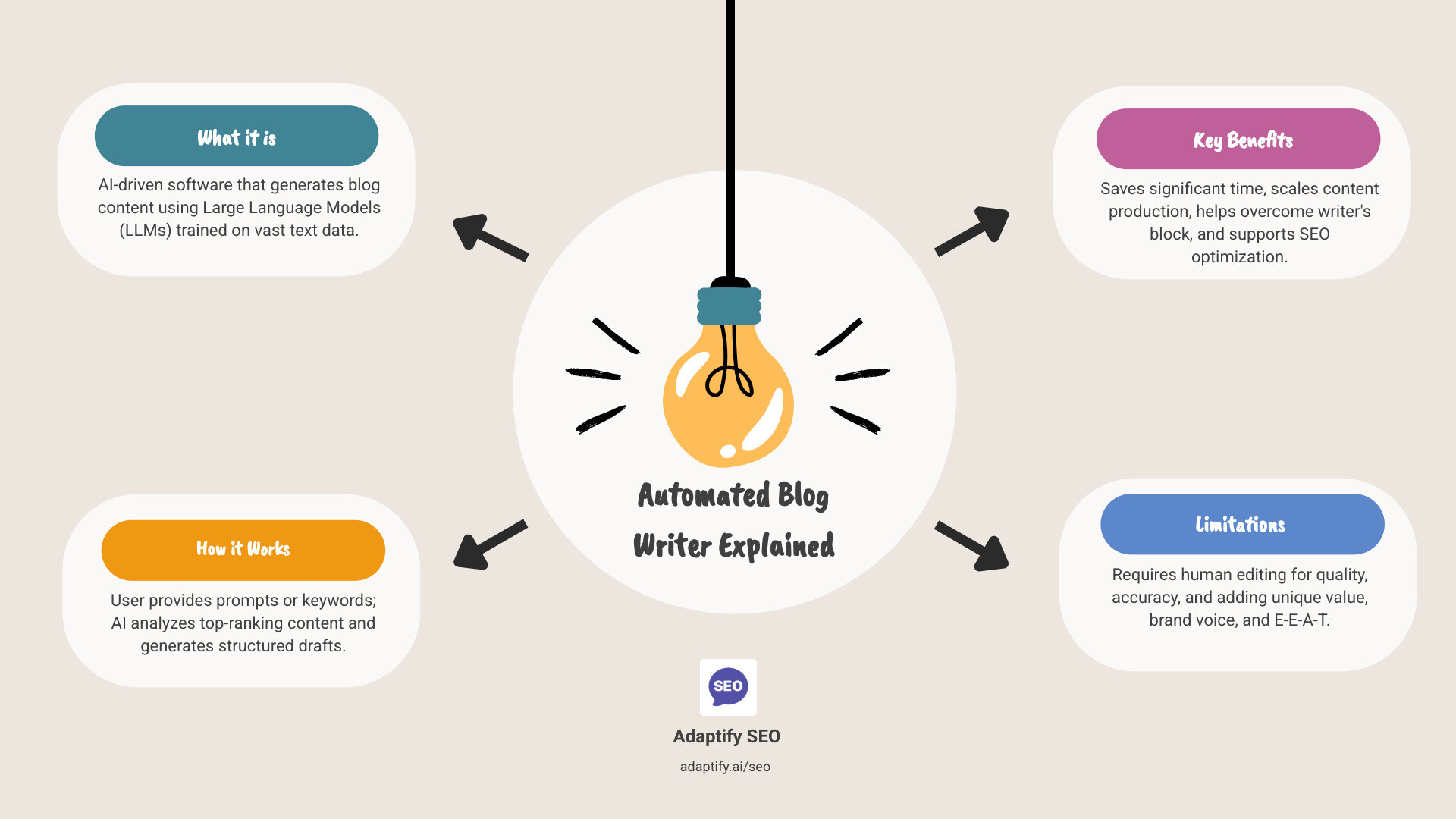
An automated blog post writer is AI-driven software that uses Large Language Models (LLMs) like GPT to create blog content. Here's what you need to know:
What it does: Generates blog outlines, drafts, and full articles from simple prompts or keywords.
How it works: Uses Natural Language Processing (NLP) to analyze patterns and predict text based on massive training datasets.
Key benefits: Saves time, scales content production, overcomes writer's block, and supports 134+ languages.
Main limitation: Requires human editing for brand voice, accuracy, and unique insights.
Best for: Agency owners and content teams looking to scale output without sacrificing quality.
Typical cost: From free trials to $19-$500+/month depending on features and team size.
The reality is simple: these tools can cut your content creation time by 70-80%, but they're not magic. They're powerful assistants that work best when paired with human expertise. Nearly 50% of content professionals now use AI tools daily, changing workflows and enabling companies to produce more content than ever before. The challenge isn't whether to use AI, but how to use it to scale content creation without sacrificing the quality, voice, or SEO performance that readers and search engines demand.
Infographic explaining the 5-step process from AI blog idea to published post - Automated blog post writer infographic brainstorm-4-items
What is an Automated Blog Post Writer and How Does It Work?
At its core, an automated blog post writer is a sophisticated AI tool designed to generate written content. It's powered by advanced technologies like Large Language Models (LLMs) and Natural Language Processing (NLP). LLMs are the "brains" of the operation—massive neural networks trained on vast amounts of text that can understand and generate human-like language.
The process begins with "prompt engineering." You provide a "prompt"—a set of instructions, keywords, or a topic. The AI uses NLP to understand your request and generate coherent, relevant text. This process dramatically reduces the manual effort of content creation, turning hours of brainstorming and drafting into minutes. For many, automation is more than a luxury; it's a lifeline for maintaining content output against all odds.
How AI Blog Writers Generate Content
The journey from a simple prompt to a full blog post involves several fascinating steps:
User Prompts & Keyword Input: You start by feeding the AI a topic and keywords, such as "benefits of cloud computing for small businesses," focusing on cost savings and scalability.
SERP Analysis: Many advanced tools analyze top-ranking content on Search Engine Results Pages (SERPs) for your keywords. This helps them understand what Google considers relevant and mimic successful content structures.
AI Models & Content Structure Generation: The AI uses its LLMs to generate a logical structure, including an introduction, headings (H2s, H3s), and a conclusion.
Draft Creation: The AI fills in the structured outline, generating paragraphs for each section based on your initial prompt and its analysis.
Tone of Voice Replication: Some sophisticated AI writers can analyze your existing content to learn and replicate your brand's unique tone, making the output sound less robotic.
This multi-step process allows these tools to quickly produce a first draft that's often 70-80% of the way to a finished, SEO-optimized article.
The Pros and Cons: Is an AI Writer Right for You?
Integrating an automated blog post writer into your workflow is a significant decision with compelling advantages and important caveats.
A scale balancing "Speed" and "Quality Control" - Automated blog post writer
The Upside: Boosting Efficiency and Creativity
The benefits of using an AI writer can be transformative for content teams facing relentless demand.
Productivity Gains & Time Savings: AI generates outlines and first drafts in minutes, cutting content creation time by as much as 70-80%. Some companies report saving thousands of hours annually.
Increased Content Velocity: Produce content at a much higher volume without scaling your headcount, allowing you to meet client demands more consistently.
Overcoming Writer's Block: Instantly generate ideas, outlines, or entire sections to get past the blank page and provide a strong starting point.
Idea Generation & Repurposing Content: Use AI to brainstorm new topics, create variations of existing content, or repurpose articles into social media posts, emails, or video scripts.
Multilingual Support: Serve global clients with tools that support over 100 languages, like the 134 languages offered by some platforms.
SEO Benefits: AI can assist with keyword research, topic clustering, and embedding on-page SEO best practices directly into the draft.
The adoption rate is telling: nearly 50% of content professionals now use AI tools daily, marking a fundamental shift in content production.
The Downside: Common Pitfalls and How to Avoid Them
While the upsides are compelling, approach AI with a realistic understanding of its limitations. AI is a powerful assistant, not a replacement.
Generic Output: AI can produce bland, repetitive content that lacks a unique voice or perspective. This is often called the "AI factor."
Lack of E-E-A-T: AI cannot replicate genuine Experience, Expertise, Authoritativeness, and Trustworthiness (E-E-A-T), which Google prioritizes. It synthesizes existing information, requiring human enrichment.
Factual Inaccuracies & "Hallucinations": AI models can generate incorrect information or confidently state falsehoods. Fact-checking is non-negotiable to protect your brand's credibility.
Plagiarism Risks: While tools aim for originality, there's a risk of unintentional plagiarism. Always use a plagiarism checker.
Over-reliance on Tools: Letting AI do all the work can lead to a decline in quality and a loss of brand voice.
Human Oversight is Key: The industry consensus is clear: you still need a human touch for fact-checking, brand voice alignment, adding unique insights, and ensuring the content resonates with your audience.
Your Guide to Choosing and Using an Automated Blog Post Writer
Navigating the crowded landscape of automated blog post writer tools can be overwhelming. Focus on practical aspects like integrations, pricing, user interface, and SEO capabilities.
How to Choose the Right Automated Blog Post Writer
When selecting an AI writing companion, consider these essential factors:
Free Trials & Word Limits: Always try before you buy. Many tools like Copymatic, Jasper, and Rytr offer free trials (e.g., Copymatic's 1,500-word free trial) to test their capabilities.
Language Support: For global clients, look for extensive language support. Some tools support over 134 languages.
SEO Tools & Capabilities: Prioritize features like keyword integration, on-page optimization suggestions, content scoring, and meta description generation.
Plagiarism Checker: Ensure the tool has a built-in plagiarism checker to protect your brand's reputation.
WordPress Integration: Direct integration with your CMS streamlines your publishing workflow.
Workflow Automation & [Zapier](https://try.zapier.com/annabyang?ref=tinkeringwithideas.io) Connectivity: The best tools fit into your tech stack, connecting with project management apps (Trello, ClickUp) and document storage (Google Docs) for automated workflows.
[LIST] of the Best Automated Blog Post Writer Tools
While many solutions exist, they cater to different needs. For agencies seeking a comprehensive, automated SEO solution, we recommend exploring Adaptify SEO.
Adaptify SEO: As an automated SEO service for agencies, Adaptify.ai streamlines the entire process, from strategy and content creation to PR link building. It's an integrated system designed to boost SEO efficiency and deliver results at scale. [Get started with Adaptify's AI Blog Writer](https://adaptify.ai/seo/) to see how we tackle the content challenge.
Other leading solutions include:
Copymatic: Known for generating SEO-rich blog posts with features like an Article Generator and WordPress integration.
Jasper: An "AI Content Automation" platform focused on maintaining brand voice and integrating into marketing workflows.
HubSpot AI Blog Writer: Integrates AI writing directly into HubSpot's marketing platform, ideal for generating outlines and drafts.
SurferSEO: An "optimization coach" that provides a "Content Score" to guide writers in creating content that ranks.
Integrating AI into Your Existing Content Strategy
Integrating an automated blog post writer is about empowering your team, not replacing it. Create a seamless "human-in-the-loop" model.
Define Your Workflow: Map your current process and identify bottlenecks where AI can assist.
Start with the Draft: Use the AI writer to generate initial drafts or outlines, where it shines brightest.
Leverage Project Management Tools: Use tools like Zapier to connect your AI writer to your project management system (e.g., Trello, ClickUp) to automate task creation.
Human Review & Improvement: This is the critical step. Have your team fact-check, infuse brand voice, add personal anecdotes, and refine the AI draft for E-E-A-T.
Align with Content Calendars: Ensure AI-generated content fits your overall strategy. AI can even help brainstorm topics for your calendar.
The Critical Role of Human Editing and Oversight
I cannot emphasize this enough: human oversight is essential. AI gets you 70-80% of the way there, but the final 20-30% is where value, authenticity, and brand identity reside. Human editors are required for fact-checking, brand voice alignment, adding personal stories, improving flow, and ensuring the content provides unique value that sets it apart. This human touch lifts content from merely informative to truly impactful.
Using an Automated Blog Post Writer for SEO and Optimization
One of the most compelling reasons to adopt an automated blog post writer is its potential for SEO. [Learn more about SEO content strategy](https://adaptify.ai/seo/overview/content) with Adaptify AI.
Keyword Research: AI tools can identify high-potential keywords and analyze search intent.
Topic Clustering: Build comprehensive topic clusters to establish topical authority, which Google loves.
On-Page Optimization: AI can integrate keywords naturally, suggest content length, structure posts with proper headings, and generate meta descriptions.
Internal Linking: Some tools can suggest contextual internal linking opportunities to strengthen site structure.
Content Score & Performance Tracking: Tools like SurferSEO provide real-time feedback on optimization levels.
Crucially, Google has clarified [it doesn't go against their guidelines](https://developers.google.com/search/blog/2023/02/google-search-and-ai-content#is-ai-content-against-google-searchs-guidelines) to use AI, as long as the content is helpful, valuable, and high-quality. You can confidently use AI to scale content, provided you maintain human oversight.
The Road Ahead: Future Trends in AI Content Generation
The world of AI is moving at lightning speed, and automated blog post writer technology is no exception. Here are several key trends shaping the future:
Agentic AI: Expect AI "agents" that can understand complex marketing needs and execute multi-step tasks autonomously, from research to promotion, based on a single prompt.
Deeper Workflow Automation: Tools will become more integrated, creating seamless "Content Pipelines" that automate every step from data intake to distribution.
Hyper-Personalization: AI will become better at tailoring content to specific audience segments and stages of the customer journey by learning from user data.
Brand Voice Learning & Enforcement: AI will become more sophisticated at learning and enforcing a unique brand voice, tone, and style across all content.
Predictive Content Generation: AI will proactively suggest content ideas based on market trends, competitor analysis, and predictive analytics.
Automated Content Refreshing: AI will analyze the performance of existing content and suggest or automatically implement updates to keep it fresh and relevant for SEO.
These advancements point towards a future where AI acts as a true co-pilot, allowing human marketers to focus on high-level strategy and creativity.
Frequently Asked Questions about Automated Blog Post Writers
Does Google penalize AI-generated content?
No. In early 2023, Google clarified that [AI-written content doesn't go against their guidelines](https://developers.google.com/search/blog/2023/02/google-search-and-ai-content#is-ai-content-against-google-searchs-guidelines). Their focus is on the quality and helpfulness of the content, not its origin. As long as your AI-assisted content is valuable, accurate, and meets Google's E-E-A-T (Experience, Expertise, Authoritativeness, Trustworthiness) standards through human oversight, it can rank well.
Can AI writers completely replace human writers?
No. An automated blog post writer is a powerful assistant, but it cannot replace human writers. Humans are essential for:
Empathy & nuance: Understanding audience emotions and cultural contexts.
Personal experience & unique insights: Sharing real-world anecdotes that provide authenticity (E-E-A-T).
Ethical considerations: Mitigating bias and aligning content with brand values.
The best results come from a collaboration between human ingenuity and AI efficiency.
How much do automated blog post writers cost?
The pricing for automated blog post writer tools varies widely, but most follow a similar structure:
Free Trials/Freemium Models: Many tools offer a free plan or trial with a word count limit (e.g., 1,500 words), which is great for testing.
Subscription Plans: Most operate on monthly or annual subscriptions. Prices can range from around $9-$29/month for individuals to $49-$99/month for pro plans.
Advanced/Enterprise: Plans for larger teams with extensive features, integrations, and higher word limits can cost $100-$500+/month or more, often with per-seat pricing.
When evaluating cost, consider the ROI from time saved and increased content velocity, which can quickly justify the investment.
Conclusion: Embracing AI as Your Content Co-Pilot
The journey to "write smarter, not harder" is undeniably paved with AI. The automated blog post writer has become an indispensable co-pilot for modern content teams, offering significant time savings, increased content velocity, and powerful SEO assistance.
However, the true magic happens when AI's efficiency is balanced with human ingenuity. The critical role of human editing, fact-checking, and infusing unique insights cannot be overstated. AI gets you most of the way there; human expertise makes your content shine.
As technology evolves, embracing AI is no longer optional—it's strategic. At Adaptify AI, we understand this balance. Our automated SEO solutions are designed to empower agencies, providing the tools to generate high-quality, SEO-optimized content efficiently while your team adds the unique value only humans can.
It's time to transform your content strategy. [Explore our automated SEO solutions](https://adaptify.ai/seo/) and find how Adaptify AI can help you achieve new levels of success.
Join 1,000+ agencies already delivering SEO and AI visibility from a single platform without increasing their headcount.Join 1,000+ agencies already delivering SEO and AI visibility from a single platform without increasing their headcount.