Write Smarter Not Harder with These AI Based Content Writing Tools




AI based content writing has transformed from a futuristic concept into an essential tool for content creators and agencies worldwide. With over 8 million users leveraging platforms like Rytr and 68.7% of SEO professionals trusting ChatGPT as their go-to AI model, the technology has proven its value in real-world applications.
Quick Answer: Best AI Writing Tools for 2024
The numbers tell a compelling story. Rytr users alone have saved over 25 million hours and $500 million in content creation costs. For agencies struggling with the manual intensity of content production, these tools offer a path to scale without sacrificing quality.
But here's the reality: not all AI writing tools are created equal. Some excel at long-form blog posts, others shine with social media copy, and a few specialize in maintaining your unique brand voice across thousands of pieces of content.
The key isn't replacing human creativity - it's amplifying it. As one Rytr user put it: "I almost couldn't believe it was real! I shared the results with a friend who couldn't believe it was written by AI."
I'm Hansjan Kamerling, and I've spent years helping AI startups design products used by millions of users, including platforms with custom-trained AI models. My experience with ai based content writing tools has shown me which ones actually deliver on their promises and which ones fall short when agencies need them most.
Think of ai based content writing like having a really smart writing assistant who's read millions of books, articles, and web pages. That's essentially what Large Language Models (LLMs) are - AI systems trained on massive datasets from across the internet.
Here's what might surprise you: about 95% of AI writing tools use the same underlying technology. Whether you're using ChatGPT, Jasper, or Rytr, they're often powered by similar LLMs like GPT or Claude. The real magic happens in how each platform packages this technology with different features and user experiences.
The process itself is beautifully simple. You type in a prompt and the AI combines everything it's learned about language with your specific request. It predicts what words should come next, building sentences that make sense and match what you're asking for.
But here's where things get interesting. AI works best when you collaborate with it rather than let it run wild. Without proper guidance, AI can produce generic or off-brand content. The real power comes from human oversight and strategic prompting. Users consistently report 3x productivity gains when AI generates initial drafts in their own voice, then they refine and polish the output.
AI based content writing has become a secret weapon against writer's block. Instead of wrestling with that intimidating empty document, AI gives you a starting point.
The key is using AI for focused tasks rather than trying to automate your entire creative process. Need five different headline options? AI excels at that. Want to brainstorm angles for a tricky topic? Perfect AI territory. Looking for email subject line variations? AI can generate dozens in seconds.
This approach works because AI handles the mechanical parts of ideation while leaving the creative decision-making to you. The productivity gains are real and measurable.
Let's address the elephant in the room: does Google penalize AI-generated content? The short answer is no - Google's official stance focuses on content quality, not how it was created. If your AI-generated content is helpful, original, and demonstrates real expertise, Google treats it the same as human-written content.
But there's a crucial "however" here. Generic AI output absolutely will struggle in search rankings. Google's algorithms have gotten sophisticated at identifying thin, repetitive content - whether it comes from humans or machines.
The secret to SEO success with ai based content writing lies in understanding what Google actually values. Search intent alignment remains paramount. E-E-A-T factors (Experience, Expertise, Authoritativeness, Trustworthiness) matter more than ever, which means AI content needs human expertise layered on top.
Fact-checking becomes non-negotiable with AI content. These systems can confidently state incorrect information, so human verification is essential before publishing anything that could impact your site's credibility.
I've spent countless hours testing AI writing platforms, and the landscape has dramatically evolved. While hundreds of tools claim to revolutionize content creation, only a handful actually deliver meaningful value for agencies and content creators.

ChatGPT didn't become the most trusted AI model among SEO professionals by accident. With 68.7% of surveyed experts considering it reliable and a solid 4.7/5 rating on G2, it's proven its worth in real-world applications.
What I love about ChatGPT is its versatility. Whether I'm brainstorming campaign ideas, creating blog outlines, or adapting content tone for different audiences, it consistently delivers useful results. The free tier provides genuine value, making it accessible even for freelancers just starting out.
Google's Gemini brings something unique to the table - real-time data access. While ChatGPT has a knowledge cutoff, Gemini can pull current information, making it invaluable for content about recent trends or breaking news.
Jasper commands a premium price starting at $49/month, but there's a reason it maintains a 4.7/5 G2 rating among enterprise users. This platform was built specifically for marketing teams who need to maintain brand consistency across massive content volumes.
The game-changer is Jasper's brand voice training. Upload samples of your existing content, and the AI learns to replicate your specific tone, style, and messaging approach. For agencies juggling multiple brand voices, this feature alone justifies the investment.
Copy.ai has built something special with over 90 templates focused specifically on marketing content. The free plan's 2,000 monthly words give you enough runway to test whether it fits your workflow, and the Infobase feature ensures all generated content stays anchored to your brand's voice.
Writesonic takes a data-driven approach that I find compelling. Starting at $20/month, it integrates directly with Ahrefs, Semrush, Google Search Console, and Analytics to inform content decisions with real SEO data rather than guesswork.
The platform's strength lies in its ai based content writing approach that considers search performance from the start. Real-time web research, competitor analysis, and automated internal linking suggestions help ensure your content has the best chance of ranking well.
With over 8 million users and a 4.9/5 satisfaction rating, Rytr has cracked the code on affordable AI writing. The free plan offers 10,000 characters monthly, while unlimited usage costs just $7.50/month - making it accessible for virtually any budget.
But Rytr's success isn't just about pricing. The platform focuses on short-form content where AI truly excels - email responses, social media ads, product descriptions, and other bite-sized content that agencies produce in bulk.
With 40+ content templates, a built-in plagiarism checker, Chrome extension for writing anywhere, and support for 40+ languages, Rytr delivers impressive functionality at an unbeatable price point.
While not pure content generators, editing tools play crucial roles in any ai based content writing workflow by ensuring quality and originality. Grammar checking platforms have evolved far beyond simple corrections into comprehensive writing assistants with real-time recommendations across platforms.
Paraphrasing and summarization tools specialize in helping avoid plagiarism while maintaining meaning, with some offering citation generation for research-based content.
For specialized needs, some platforms focus on fully automatic long-form content generation, while others target creative fiction writing as a creative partner for generating character names, sensory details, and overcoming plot blocks.
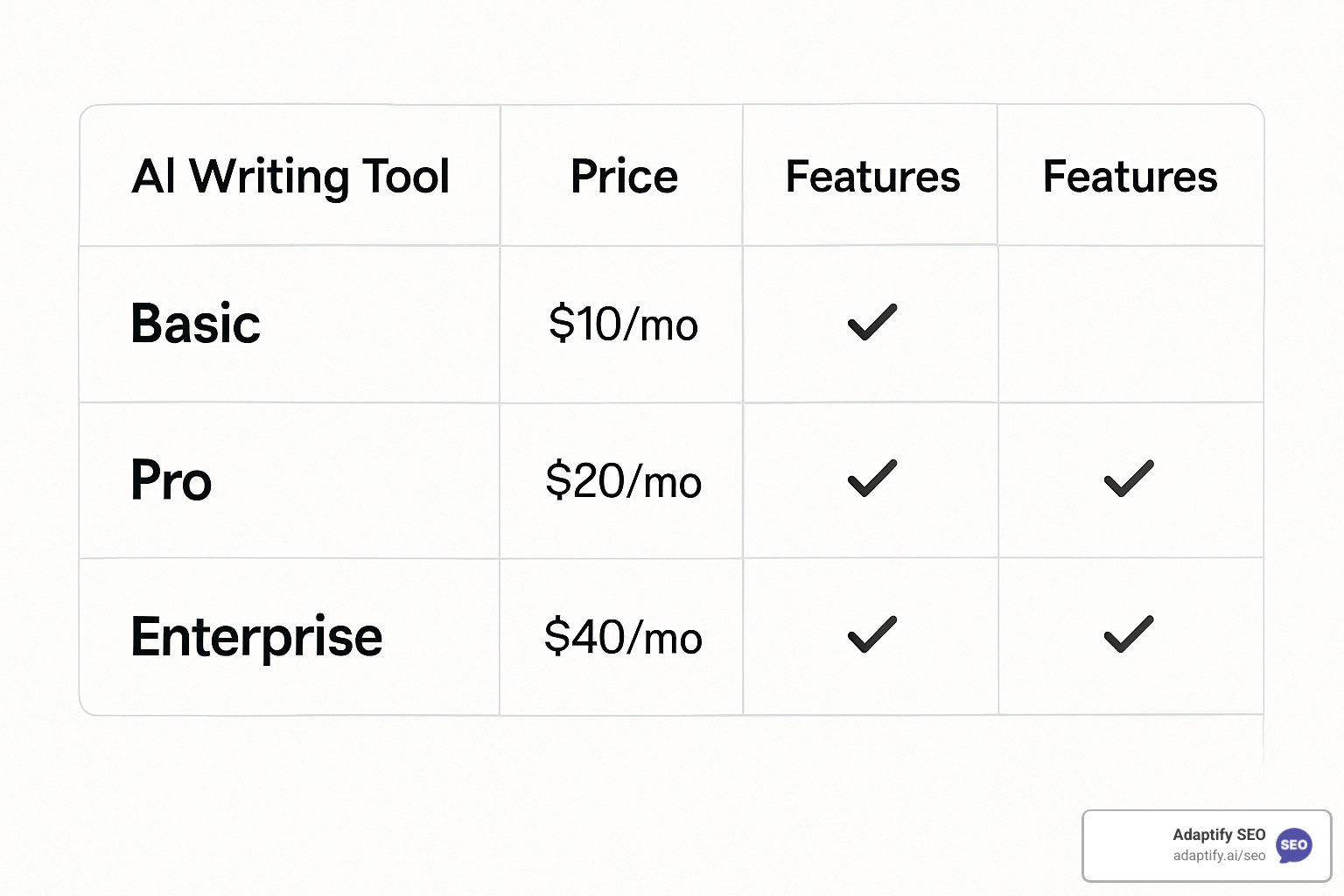
Picking the right ai based content writing tool feels a bit like choosing a car - you need to match the features to how you'll actually use it. After testing these platforms extensively, I've found that the "best" tool depends entirely on your specific workflow and budget constraints.
Let's break down the real-world costs and capabilities. ChatGPT remains the most accessible entry point at free or $20 monthly, making it perfect for agencies just testing the waters. Its general-purpose nature means you can handle everything from brainstorming sessions to draft creation, though you'll need to manually optimize for SEO.
Gemini matches ChatGPT's pricing but brings that crucial real-time data access. If your content often references current events or trending topics, this feature alone can save hours of manual research time.
| Tool | Monthly Cost | Best For | Key Features | Languages | SEO Integration |
|---|---|---|---|---|---|
| ChatGPT | Free/$20 | General writing, brainstorming | Versatile, Canvas model | Limited | Manual |
| Gemini | Free/$20 | Real-time content, research | Current data access | Multiple | Manual |
| Jasper | $49+ | Enterprise branding | Brand voice, AI agents | 30+ | Via integrations |
| Copy.ai | Free/$49 | Marketing campaigns | 90+ templates, workflows | 25+ | Basic |
| Writesonic | $20+ | SEO content | Research integration | Multiple | Advanced |
| Rytr | Free/$7.50 | Short-form, budget | 40+ templates, plagiarism check | 40+ | Basic |
| Grammarly | Free/$12 | Editing, compliance | Real-time grammar, style | English+ | No |
| Article Forge | $57+ | Bulk long-form | Automatic generation | Multiple | Built-in |
The pricing sweet spot for most agencies falls around Writesonic at $20 monthly. The integrated SEO research capabilities mean you're not just generating content - you're creating pieces that actually have a chance to rank. The platform's connection to tools like Ahrefs and Semrush eliminates the guesswork around search intent and competitor analysis.
Rytr's $7.50 unlimited plan represents incredible value for agencies focused on short-form content. Social media posts, email subject lines, and product descriptions - these are areas where AI truly shines, and Rytr handles them beautifully without breaking the budget.
On the premium end, Jasper's $49+ investment makes sense for agencies managing multiple brands with distinct voices. The brand voice training feature alone can save dozens of hours when you're producing content at scale. One agency owner told me they recovered their Jasper costs within the first month just from the time savings on client work.
The language support varies dramatically between platforms. Rytr's 40+ languages and Copy.ai's 25-language support open doors for international clients, while tools like ChatGPT remain more English-focused.
Here's what I've learned about matching tools to real agency needs: Budget-conscious creators gravitate toward Rytr for its unbeatable value proposition. SEO-focused teams find Writesonic's research integration worth the extra cost. Agencies with multiple clients often justify Jasper's premium pricing through brand voice consistency. General purpose work still works great with ChatGPT's free tier for most basic content needs.
The compliance and editing tools like Grammarly at $12 monthly aren't optional extras - they're essential parts of any ai based content writing workflow. Think of them as quality control rather than content generation.
Don't get caught up in feature lists that you'll never use. The most successful agencies I work with choose one primary tool and master it completely, rather than juggling multiple platforms that overlap in functionality.
Successfully implementing ai based content writing requires more than just choosing the right tool. Based on my experience and user feedback from thousands of implementations, here are the practices that separate successful AI adoption from disappointing results.
Most agencies fail at AI integration not because the technology doesn't work, but because they treat it like a magic wand instead of a sophisticated tool that needs proper guidance.
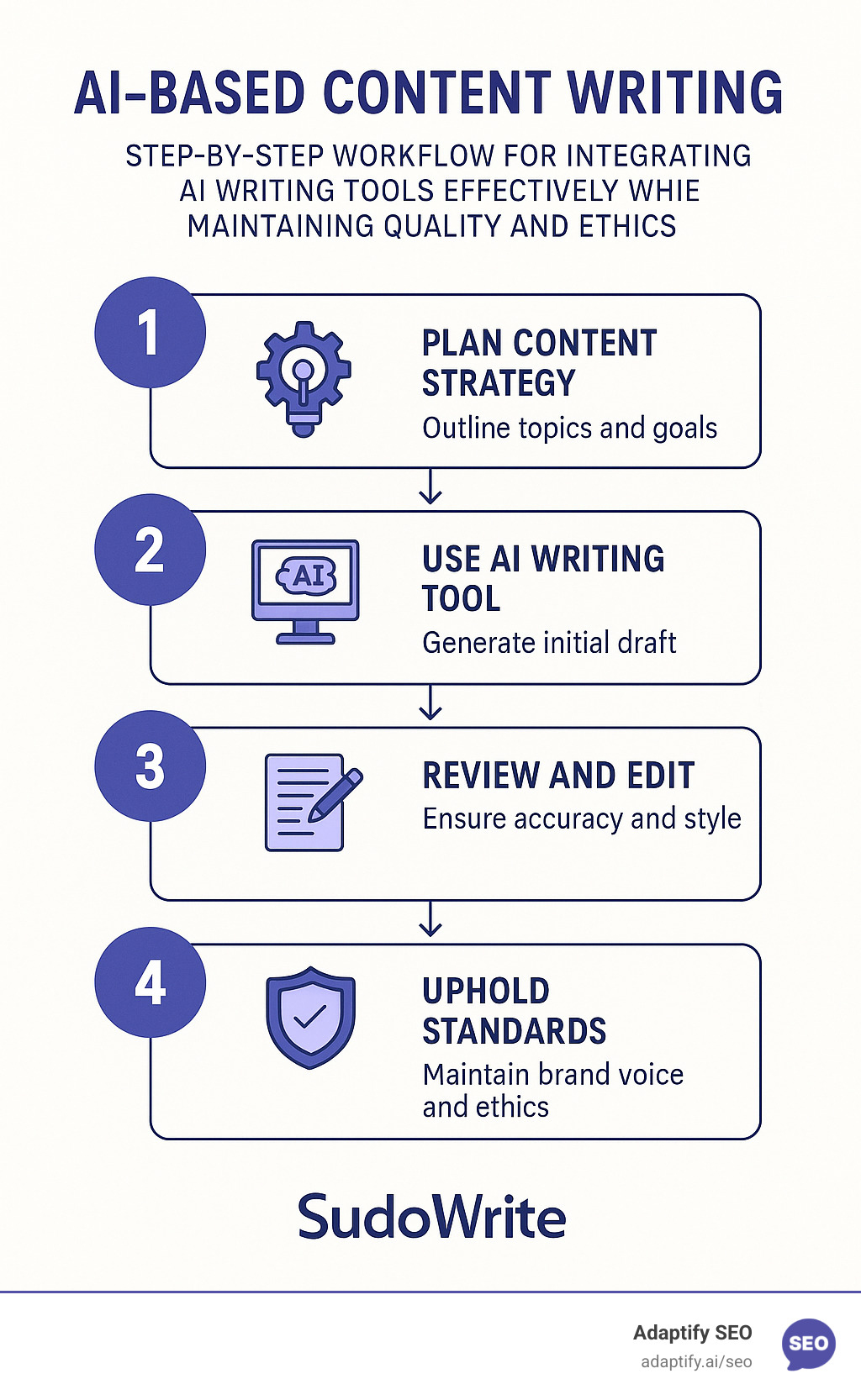
The most common complaint about AI content is that it sounds generic or "robotic." The solution isn't avoiding AI - it's training it properly on your brand voice.
The secret lies in giving AI enough context to understand not just what you want to say, but how you want to say it. Think of it like hiring a new writer - you wouldn't expect them to nail your brand voice on day one without guidance.
Successful approaches start with uploading writing samples to tools that can analyze your existing content. Most premium platforms can learn style patterns from your best-performing pieces.
Creating detailed style guides makes a huge difference too. Specify your tone preferences, vocabulary choices, and messaging frameworks. These details matter more than you'd think.
The most effective teams develop consistent prompt templates that include brand voice instructions. Instead of writing "Create a blog post about SEO," try "Write a friendly, conversational blog post about SEO that explains complex concepts simply, uses real examples, and maintains an encouraging tone for beginners."
The concern about AI plagiarism is legitimate but manageable with proper practices. Since most AI tools train on publicly available content, there's always a risk of reproducing existing material.
Built-in plagiarism checkers should be your first line of defense. Many tools offer monthly checks, which catches obvious duplication before it becomes a problem. But don't rely solely on automated checks.
Smart agencies avoid relying on a single tool for all content. Using multiple AI sources reduces the chance of consistently reproducing the same patterns.
The most important practice is human editing. Always review and modify AI output before publishing. This isn't just about catching errors - it's about adding your unique perspective and insights that make content genuinely valuable.
Adding original research creates content that AI simply can't replicate. Include your own data, case studies, or expert interviews. These unique elements make your content stand out from the sea of AI-generated material flooding the internet.
Scientific research on web-scale data shows that training datasets contain vast amounts of copyrighted material, making human oversight crucial for avoiding legal issues.
The most efficient ai based content writing workflows integrate seamlessly with existing tools and platforms. This reduces context-switching and improves productivity.
WordPress plugins offer direct CMS integration, letting you generate and edit content without leaving your dashboard. This seemingly small convenience saves hours of copying and pasting across platforms.
SEO tool connections provide the biggest competitive advantage. Integration with research tools means your AI content is informed by actual ranking data, not just guesswork.
Automation platforms like Zapier can connect AI writing tools to your broader marketing stack. Set up workflows that automatically generate social media posts from blog content, or create email sequences from product descriptions.
Browser extensions eliminate the need to switch between platforms constantly, working in any web text field.
The goal is making AI writing feel like a natural extension of your existing process, not a separate system requiring constant tool-switching.
Let's address the most common concerns I hear from content creators and agencies considering ai based content writing. These questions come up repeatedly in my conversations with marketing teams, and the answers might surprise you.
Here's the straightforward answer: Google doesn't penalize AI content simply because it's AI-generated. The search engine giant has been crystal clear about this - they focus on whether your content is helpful, original, and demonstrates real expertise.
But here's the catch that many people miss. AI content still needs to meet Google's quality standards, just like human-written material. Generic, low-value content won't rank well regardless of whether a human or AI created it.
The real question isn't whether Google penalizes AI content - it's whether your ai based content writing approach produces genuinely valuable material. I've seen AI-generated articles rank on the first page of Google, and I've seen them completely ignored. The difference comes down to how thoughtfully they're created and edited.
Google's E-E-A-T guidelines (Experience, Expertise, Authoritativeness, Trustworthiness) apply equally to all content. If your AI-generated piece demonstrates real expertise and provides unique value, it has the same ranking potential as any human-written article.
This is where modern AI tools truly shine, and the answer is a resounding yes - when you train them properly. I've watched agencies transform their content workflows by teaching AI to write in their specific brand voice.
The key is understanding that AI learns from examples. Tools like Jasper and Writesonic can analyze your existing content samples to understand your style patterns, preferred vocabulary, and messaging approach. One user told me their AI-generated content was so on-brand that clients couldn't tell the difference.
The effectiveness depends on several factors though. You need quality training samples that truly represent your brand voice. Consistency in your prompting and feedback helps the AI understand what you want. And human editing remains crucial for maintaining those subtle brand nuances that make your content uniquely yours.
I've seen agencies successfully maintain consistent brand voice across thousands of pieces of content using well-trained AI. The time savings are remarkable, but it requires upfront investment in training and ongoing refinement based on output quality.
Plagiarism concerns are completely valid, and I always recommend a multi-layered approach to protection. The good news is that avoiding plagiarism with ai based content writing is entirely manageable with the right practices.
Start with built-in plagiarism checkers - many tools like Rytr include them directly in the platform. But don't stop there. Always add your own original insights, research, and examples to AI-generated content. This personalizes the output and reduces any risk of duplication.
Never publish AI output without human modification. I make it a rule to edit and personalize every piece of AI-generated content before it goes live. This isn't just about plagiarism - it's about creating genuinely valuable content that serves your audience.
Cite your sources when referencing factual claims or statistics, and consider using multiple AI tools rather than relying on a single platform. This diversifies your content sources and reduces the chance of similar outputs.
The goal isn't to avoid AI entirely - it's to use it responsibly as a starting point for original content creation. When you combine AI efficiency with human creativity and expertise, you get the best of both worlds.
The change is complete. AI based content writing has moved from the field of "interesting experiment" to "can't-work-without-it tool" for smart agencies and content creators. When you see numbers like Rytr's 8 million users saving over $500 million in content costs, it's clear this isn't just hype - it's the new reality of content marketing.
Here's what I've learned after testing dozens of platforms and watching thousands of users succeed (and sometimes struggle): AI doesn't replace the human touch - it makes it more powerful. The agencies crushing it right now aren't the ones trying to automate everything. They're the ones using AI to handle the heavy lifting while focusing their human talent on strategy, brand voice, and those creative sparks that make content truly connect.
The beauty of today's ai based content writing landscape is that there's genuinely something for everyone. Tight budget? Rytr's $7.50 unlimited plan is almost embarrassingly good value. Managing enterprise clients with complex brand guidelines? Jasper's voice training capabilities are worth every penny of that $49 monthly investment. Need SEO integration that actually works? Writesonic's research features can transform how you approach content strategy.
But here's the thing - and I can't stress this enough - the best tool is the one you'll actually use consistently. I've seen agencies spend months debating between ChatGPT and Claude while their competitors were already scaling content production with whatever AI they picked first.
The agencies that accept ai based content writing now aren't just saving time and money (though those benefits are real). They're building capabilities that compound over time. Every prompt they refine, every brand voice they train, every workflow they optimize - it all adds up to a competitive advantage that gets stronger month after month.
At Adaptify SEO, we see this change happening across our agency partners every day. The smart ones aren't just using AI for content creation - they're looking at how automation can streamline their entire SEO process, from initial strategy through content creation to link building and reporting.
Ready to see how comprehensive SEO automation can amplify your AI content efforts and deliver measurable results for your clients? Book a Demo to find how Adaptify's platform can transform your agency's efficiency while your AI writing tools handle the content creation.

Stop being invisible: discover what the best local SEO strategies for small businesses are to dominate Google Maps, reviews, and AI search...
Master localized SEO to rank your local business in Google Maps and drive more in-store visits.

Master local retail SEO to drive foot traffic from Google with proven strategies for GBP, reviews, and AI search optimization.
Join 1,000+ agencies already delivering SEO and AI visibility from a single platform without increasing their headcount.Join 1,000+ agencies already delivering SEO and AI visibility from a single platform without increasing their headcount.