Your AI Co-Pilot: Maximizing SEO Content with Smart Tools




How can AI tools assist in content creation for SEO? They streamline the entire workflow, from ideation, research, and outlining to drafting, optimization, and analysis. For SEO agencies, content creation is essential but notoriously time-consuming. The manual work of keyword research, competitor analysis, brief writing, and optimization can bog down your team, pulling them away from high-level strategy.
AI is not a replacement for your team; it's an amplifier. Think of it as a content co-pilot that handles the repetitive tasks, freeing your experts to focus on strategic thinking, creative direction, and adding the unique insights that search engines reward.
The data supports this. Marketers using AI for ideation save significant time, and companies report dramatic increases in content output and reductions in production time. The key is to use AI as a tool within a human-led workflow, maintaining control over quality and strategy.
I'm Hansjan Kamerling, and I've helped numerous companies scale their digital presence with AI. Understanding how can AI tools assist in content creation for SEO is crucial for efficiency and quality. This guide will show you how to integrate AI into your content process to scale your agency without sacrificing quality or burning out your team.
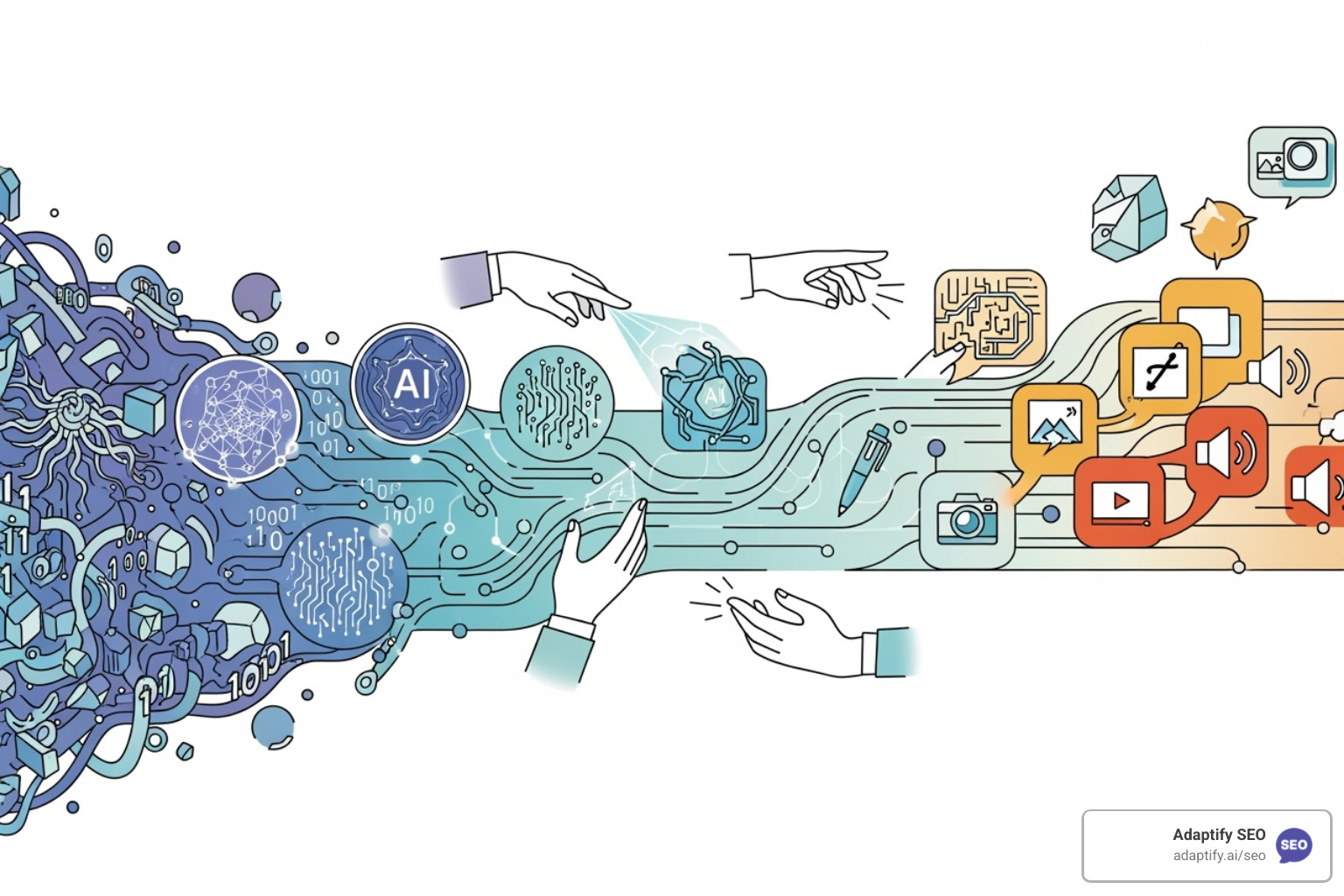
To understand how can AI tools assist in content creation for SEO, it helps to know the technology behind them. Most AI content tools are powered by Large Language Models (LLMs), which are trained on vast amounts of internet text to recognize and replicate patterns in language and information. This technology, known as Generative AI, can create new text, images, and more from user prompts.
These models use Natural Language Processing (NLP) to interpret human language, understanding the context and intent behind a request. When you ask for a blog post, NLP helps the AI grasp what you need and generate a relevant response.
Many content creators worry about Google's view on AI content. The good news is that Google's stance is quite reasonable. According to Google's guidance on AI-generated content, their systems focus on the quality of content, not how it was produced. There is no ban on AI content; the focus is on whether it is helpful, accurate, and user-centric.
This aligns with Google's Helpful Content Update, which rewards content made for people, not just for search engines. Using AI to produce low-quality spam will result in penalties, but the same is true for human-written spam. Quality is the ultimate metric.
Google's quality principles, known as E-E-A-T (Experience, Expertise, Authoritativeness, and Trustworthiness), are crucial here. While AI can produce structured text, it cannot replicate genuine first-hand experience, deep expertise, or the trust that comes from a real author.
As AI content becomes more common, the value of human expertise and authentic experience will only increase. AI is best used as a research and drafting assistant, while humans provide the critical strategy, nuance, and credibility that search engines and users value. The goal is to use AI for efficiency while your team injects the E-E-A-T signals that lead to top rankings.
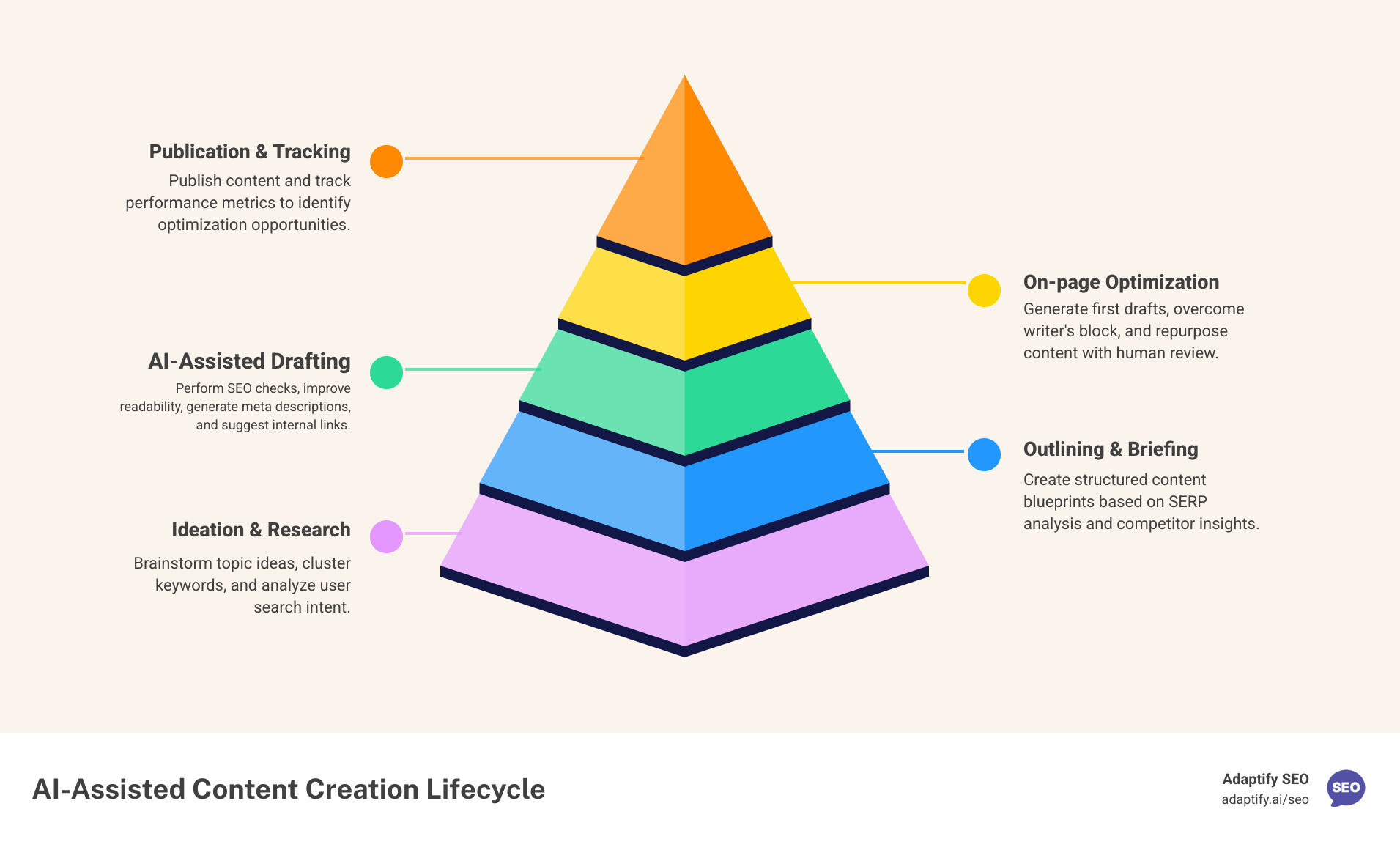
Let's get practical. AI can transform every stage of your content workflow, acting as an efficient assistant to your expert team.
The research phase, once a major time sink, is now dramatically accelerated by AI. Instead of manual analysis, AI handles the heavy lifting, allowing your team to focus on strategy.
By automating these tasks, AI frees SEO professionals to focus on strategy and client relationships. If you're looking to scale your content strategy, you can find more info about our content services.
A solid structure is key, and AI can act as your content architect. It builds detailed blueprints that streamline the writing process.
AI's role in drafting is powerful but requires human oversight. It's not about unsupervised automation but about using AI as a drafting assistant to overcome creative blocks and scale production.
After drafting, AI helps refine content for maximum SEO impact, turning good content into great content that ranks.
Using AI for optimization ensures every piece of content is tuned for search visibility, increasing its chances of ranking and attracting organic traffic.
The real magic of how can AI tools assist in content creation for SEO lies in the partnership between human creativity and machine efficiency. AI handles the prep work, but a human chef decides on the final product.

When integrated thoughtfully, AI delivers significant benefits:
AI is powerful, but it's not perfect. Smart users understand its limitations:
To get the benefits while avoiding the pitfalls, adopt a "human-in-the-loop" approach:
The AI tool landscape is crowded, but the right tools can be transformative. Instead of a detailed review of every option, it's more helpful to understand the main categories of tools you'll encounter.
These are the Swiss Army knives of the AI content world, integrating AI into comprehensive SEO toolkits. Platforms like HubSpot AI Tools or Semrush bundle features for keyword research, content brief generation, and on-page SEO analysis. They are valuable for consolidating your tech stack, though they can represent a significant investment. They aim to provide a single dashboard for much of the SEO content workflow.
These tools are your primary co-pilots for generating text. They are where the rubber meets the road in AI-assisted writing.
These tools excel at specific tasks within the content creation process and can be powerful additions to your workflow.
The right setup often involves a combination of these tools. You might use a general tool like ChatGPT for ideation, a specialized tool for optimization, and an all-in-one platform for tracking. These tools amplify a good strategy; they don't create one.
Here are answers to the most common questions about using AI for SEO content.
No. AI-generated content is not inherently bad for SEO. Google's primary concern is content quality and helpfulness, not its creation method. They have stated that AI-generated content is acceptable when it's done ethically. Low-quality, spammy content will perform poorly regardless of its origin. The key is to use AI to create valuable, user-centric content that aligns with Google's Helpful Content Update and E-E-A-T principles.
While detection tools exist, Google has clarified that its systems focus on content quality, not origin. They are not trying to penalize AI use but rather to demote unhelpful, low-quality content. Since Google uses AI extensively itself (e.g., in Search Generative Experience), the goal is not to be anti-AI but anti-spam. The risk isn't detection; it's creating content that is unhelpful to users.
AI is more likely to transform the role of content writers than replace them. The job will shift from manual drafting to higher-level tasks like strategy, editing, prompt engineering, and creative direction. The human elements of creativity, critical thinking, genuine experience, and storytelling are irreplaceable. As AI content becomes more common, authentic human insight will become a more valuable differentiator, making skilled writers who can leverage AI even more in demand.

As we've explored, the answer to how can AI tools assist in content creation for SEO is clear: they can revolutionize every stage of the process. From ideation and research to drafting and optimization, AI is changing how we work.
However, the key takeaway is that this is not about replacing humans with robots. It's about creating a powerful partnership. AI is the assistant that handles the time-consuming grunt work, freeing your team to focus on what machines cannot do: think strategically, inject genuine expertise, tell compelling stories, and add the unique human touch that makes content truly great.
AI can write, but it can't share a personal experience. It can analyze data, but it can't understand a customer's emotional journey. The content that wins in search is helpful, trustworthy, and demonstrates real expertise—all fundamentally human qualities.
The agencies that will thrive are those that strategically implement AI while keeping human oversight at the core of their workflow. For agencies struggling to scale SEO services efficiently, this human-AI partnership is essential.
At Adaptify.ai, we've built our solution around this principle. We integrate AI into every stage of the SEO process—from strategy to content to link building—so you can focus on growing your agency and delivering exceptional results. Ready to see how AI can transform your content workflow without sacrificing quality? Learn more about our automated SEO proposals and find how we can help you scale smarter, not harder.

Stop being invisible: discover what the best local SEO strategies for small businesses are to dominate Google Maps, reviews, and AI search...
Master localized SEO to rank your local business in Google Maps and drive more in-store visits.

Master local retail SEO to drive foot traffic from Google with proven strategies for GBP, reviews, and AI search optimization.
Join 1,000+ agencies already delivering SEO and AI visibility from a single platform without increasing their headcount.Join 1,000+ agencies already delivering SEO and AI visibility from a single platform without increasing their headcount.