Your Guide to SEO Specialist Services:From B2B to E-commerce Success
Hansjan Kamerling
Oct 24, 202520 min read
Why SEO Specialist Services Are Critical for Business Growth
SEO specialist services - seo specialist services
SEO specialist services are professional offerings that help businesses improve search engine rankings, drive qualified traffic, and increase revenue. These services cover a wide spectrum, from technical audits and content creation to link building and performance monitoring.
A specialist handles on-page SEO (content, meta tags), off-page SEO (backlinks, brand mentions), technical SEO (site speed, crawlability), and specialized fields like local and e-commerce SEO. This comprehensive approach is vital because over 90% of online experiences begin with a search engine, and 49% of marketers report that organic search delivers the best ROI of any channel.
My experience helping fintech startups raise millions and working with major brands like Nestle and BP has shown me that expert SEO specialist services are transformative. The right strategy can lift a business from obscurity to market dominance, making the difference between merely surviving and truly thriving.
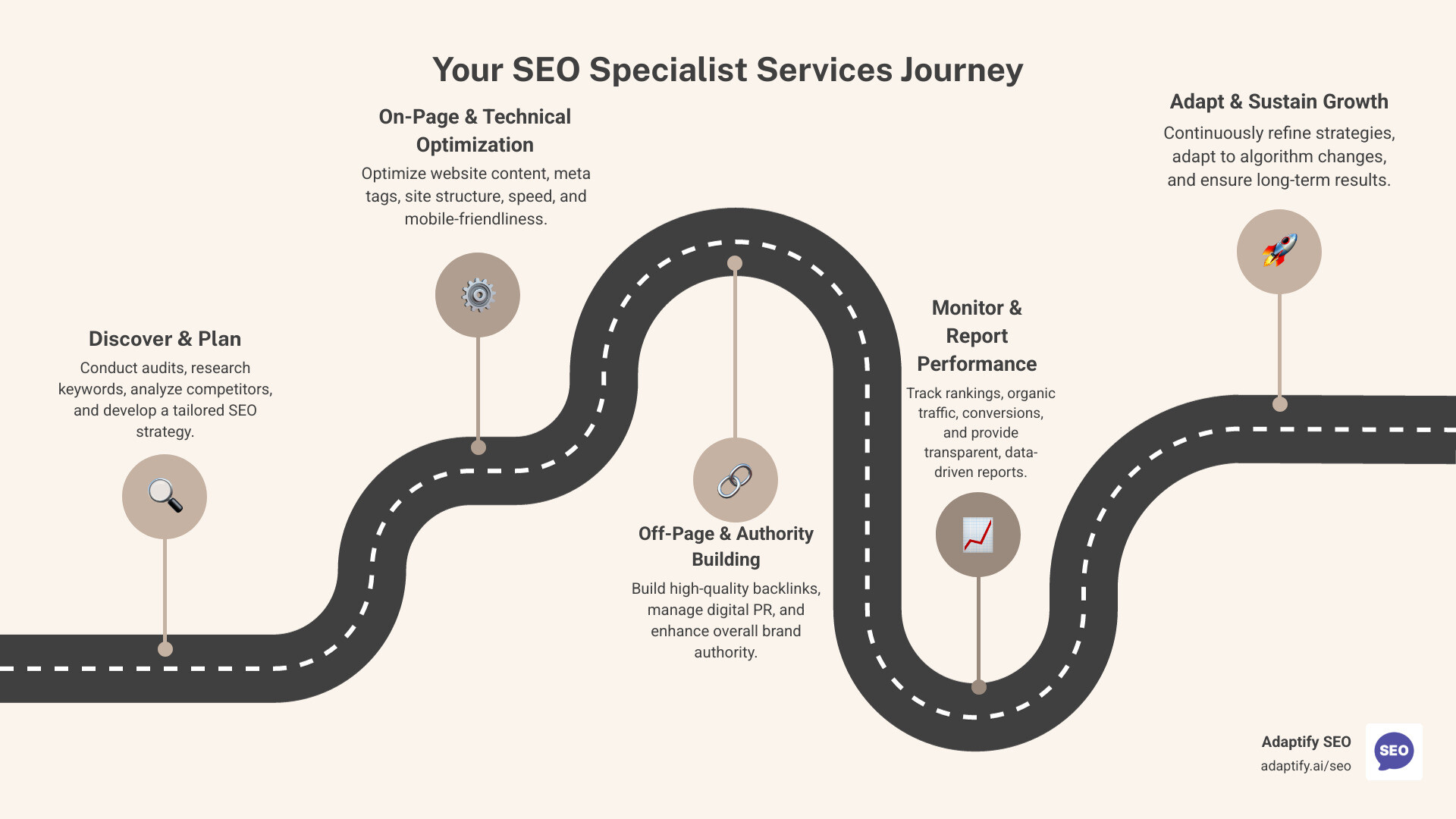
Infographic showing the complete SEO specialist services workflow from initial audit through keyword research, content optimization, link building, technical improvements, and performance monitoring with measurable results including traffic growth, ranking improvements, and conversion increases - seo specialist services infographic roadmap-5-steps
Understanding the Role and Impact of an SEO Specialist
An SEO specialist is a digital strategist who ensures your business appears when potential customers search for what you offer. They combine technical expertise with creative strategy to move your website from obscurity to the forefront of search results.
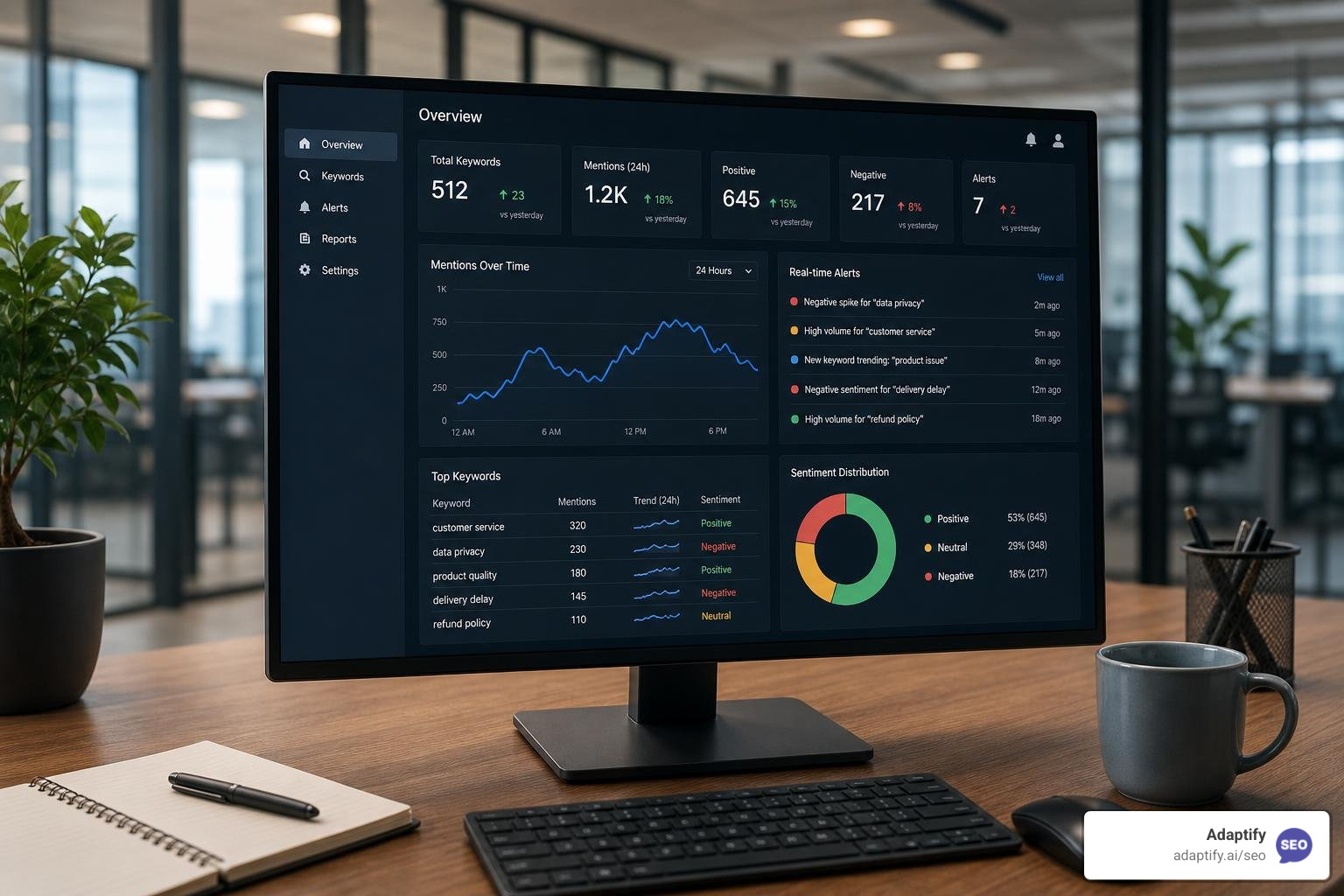
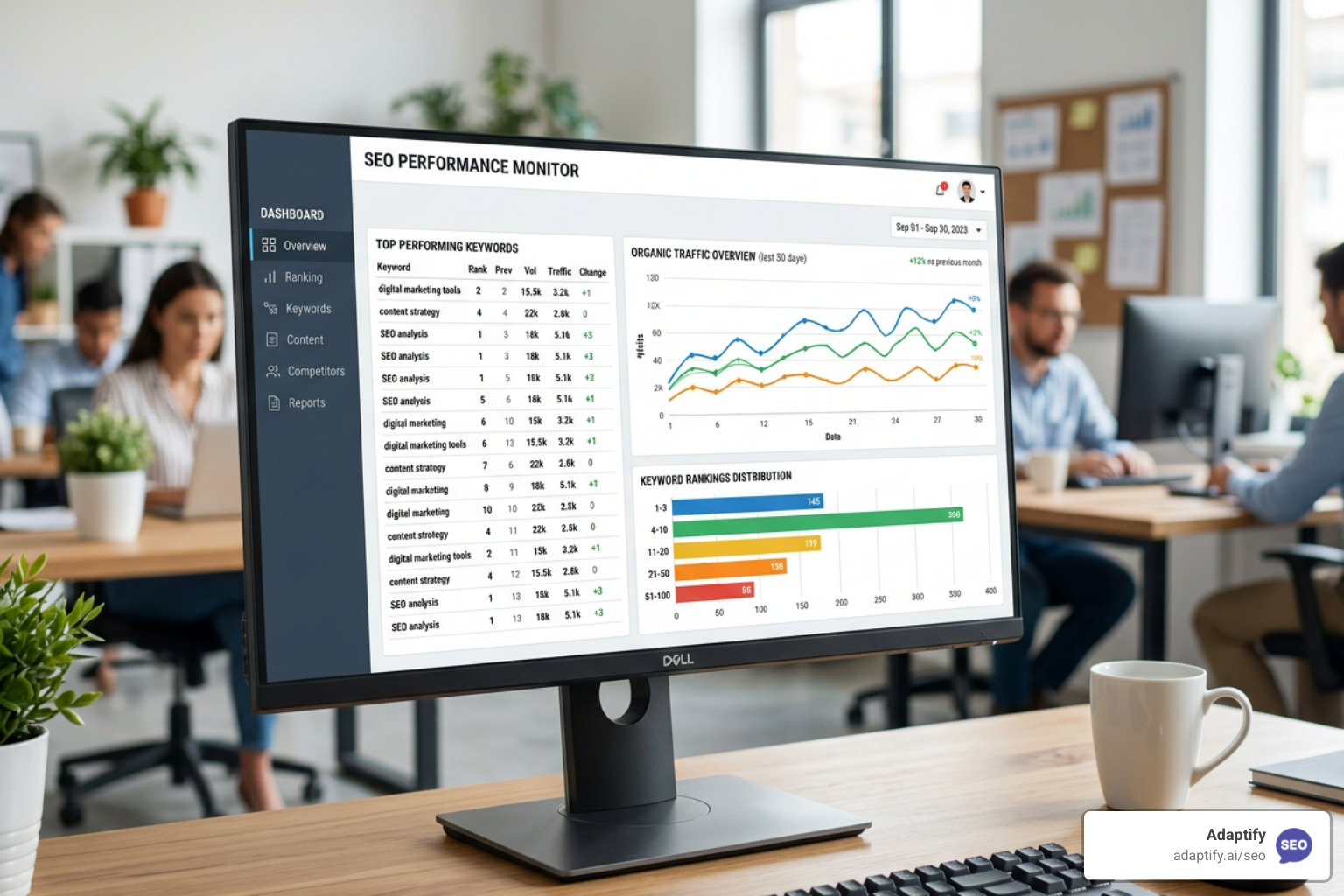
A professional analyzing data on multiple screens - seo specialist services
With over 90% of online experiences starting with a search engine and studies showing that 49% of marketers report organic search has the best ROI of any marketing channel, these services are essential. SEO specialists bridge the gap between search engine requirements and customer needs, focusing on driving qualified traffic that converts into leads and revenue.
What an SEO Specialist Does
An SEO specialist improves your site's performance through a variety of tasks:
Keyword Research: This is the cornerstone of any SEO strategy. Specialists use data to find the exact phrases your potential customers are searching for. This goes beyond simple volume metrics; it involves understanding search intent—the 'why' behind a query. They categorize keywords into informational (e.g., "how to choose an SEO specialist"), navigational (e.g., "Adaptify.ai login"), commercial (e.g., "best SEO services"), and transactional (e.g., "hire SEO specialist"). This allows them to map the right content to the right stage of the customer journey.
Competitor Analysis: They meticulously analyze what's working for your rivals to identify opportunities for your business. This involves dissecting their top-performing pages, identifying the keywords they rank for that you don't (a "content gap" analysis), examining their backlink profile to find potential link-building opportunities, and assessing their on-page and technical SEO strengths and weaknesses. Tools like Semrush and Ahrefs are invaluable here.
Website Audits: Specialists perform comprehensive technical check-ups to find and fix issues that harm your ranking. This includes identifying broken links, slow page speed, mobile usability problems, crawl errors that prevent Google from indexing your site, and issues with site architecture. A thorough audit is the foundation for all subsequent SEO work.
Content Strategy: They guide content creation to match search intent, ensuring your pages provide the answers searchers are looking for. This isn't just about sprinkling keywords. It's about developing topic clusters—groups of interlinked content around a central pillar page—to establish your website as an authority on a subject. They work with writers to create high-quality, helpful, and unique content that satisfies both users and search engines.
Link Building Coordination: They earn high-quality backlinks from reputable websites, which act as votes of confidence for search engines. This is a strategic process, not a numbers game. It involves outreach, digital PR, guest posting, and building relationships with other sites in your industry. They coordinate these efforts to build a natural and authoritative link profile over time.
Performance Monitoring: Using tools like Google Analytics and Google Search Console, they track key metrics like organic traffic, keyword rankings, click-through rates, and conversions. This data-driven approach allows them to measure progress against business goals and identify what's working and what needs adjustment.
Reporting and Collaboration: They translate complex data into clear, actionable reports for stakeholders. They work closely with web developers to implement technical fixes, with content creators to guide their work, and with broader marketing teams to ensure SEO is integrated into all digital marketing efforts.
Key Skills of a Top SEO Specialist
Effective SEO specialists possess a unique blend of skills:
Analytical and Critical Thinking: They interpret data to make informed decisions and understand the 'why' behind SEO strategies, not just the 'what'.
Technical Proficiency: They understand how websites and search engines work, enabling them to diagnose technical issues and communicate effectively with developers.
Content and Communication Skills: They can guide the creation of high-quality content and clearly explain complex SEO concepts to clients and team members.
Adaptability: The SEO landscape changes constantly, so specialists must be committed to continuous learning to stay ahead of algorithm updates.
Project Management: They juggle multiple tasks, from quick fixes to long-term campaigns, ensuring deadlines are met and goals are achieved.
Tool Mastery: Proficiency with a suite of platforms is non-negotiable for modern SEO analysis and reporting. This includes Google Analytics, Google Search Console, and industry-standard tools like Ahrefs, Semrush, Moz, and Screaming Frog.
The Core Spectrum of SEO Specialist Services
SEO specialist services are like a well-orchestrated symphony, with each element playing a crucial part. For any business—B2B, e-commerce, or SaaS—understanding these core services is the first step toward online success. SEO can be broken down into a few key pillars.
On-Page SEO Specialist Services: Optimizing Your Content
On-page SEO involves everything on your website that helps search engines and users understand your content. It's about creating a seamless and valuable user experience. Key activities include:
Content Optimization: Creating helpful, high-quality content that naturally incorporates the terms your audience is searching for. This also involves optimizing for semantic search by including related concepts and entities to provide comprehensive answers.
Keyword Mapping: Assigning specific primary and secondary keywords to each page to avoid internal competition, known as keyword cannibalization, and to ensure every page has a clear purpose.
Meta Tags: Writing compelling meta titles and descriptions that act as a 'movie trailer' for your page in search results, enticing users to click.
Header Tags (H1, H2, H3): Structuring content logically with a clear hierarchy. This improves readability for users and helps search engines understand the main topics of the page.
Internal Linking: Strategically connecting related pages within your site. This guides visitors to other relevant content, increases time on site, and shows search engines how your content is related, distributing page authority throughout your site.
User Experience (UX): Ensuring fast load times, easy navigation, and a mobile-friendly design to keep visitors engaged and reduce bounce rates.
Image Optimization: Compressing images for faster loading and using descriptive alt text to improve accessibility and help images rank in Google Images.
For agencies looking to streamline these tasks, automated solutions can handle much of this work efficiently. You can find more info about content services that leverage automation.
Off-Page SEO Specialist Services: Building Authority and Trust
Off-page SEO is about building your website's reputation and authority across the internet. It's about earning trust through external signals, primarily high-quality backlinks.
Link Building: This is the core of off-page SEO. It's the process of earning high-quality backlinks from relevant, authoritative websites. Each link acts as a vote of confidence. Effective tactics include:
Digital PR: Creating newsworthy campaigns, data studies, or expert commentary that naturally attracts media attention and links from high-authority news sites and blogs.
Guest Blogging: Sharing expertise on relevant industry blogs to reach new audiences and earn valuable, contextually relevant backlinks.
Resource Page Link Building: Finding pages that list useful resources in your niche and getting your content included.
Broken Link Building: Finding broken external links on other websites and suggesting your content as a replacement.
Brand Mentions: Even without a link, mentions of your brand across the web signal to search engines that you are a recognized entity. This concept, often discussed by industry leaders like WordStream, is crucial for building topical authority.
This process is time-intensive and requires strategic outreach, which is why many agencies explore automated solutions for more info about backlink services.
Technical SEO
Technical SEO is the foundation of your website. If search engines can't crawl, render, and index your site properly, all other efforts are wasted. Key components include:
Site Architecture: Designing a logical site structure that helps users and search engines navigate your content easily. A flat, well-organized architecture is ideal.
Crawlability and Indexing: Using tools like robots.txt and XML sitemaps to guide search engine bots, ensuring they can access and understand all important pages on your site.
Site Speed and Core Web Vitals: Optimizing for fast loading times is crucial, as industry data shows a 1-second page load delay can reduce conversions by 7%. This involves focusing on Google's Core Web Vitals: Largest Contentful Paint (LCP), Interaction to Next Paint (INP), and Cumulative Layout Shift (CLS).
Mobile-Friendliness: With Google's mobile-first indexing, having a site that works perfectly on all mobile devices is non-negotiable.
Schema Markup: Adding structured data (a type of code) to your site to help search engines understand your content more deeply. This can result in rich snippets (like star ratings or FAQs) in search results, which can significantly improve click-through rates.
HTTPS Security: A secure site (using HTTPS) is a baseline requirement for user trust and receives a minor ranking boost from Google.
Local and E-commerce SEO
These specialized services are custom to specific business models.
Local SEO: This is vital for businesses targeting customers in a specific geographic area, as nearly half of all Google searches (around 46%, according to data from various marketing analytics firms) seek local information. It involves optimizing your Google Business Profile, building local citations (mentions in online directories), managing reviews, and targeting location-specific keywords.
E-commerce SEO: This focuses on optimizing product and category pages to attract shoppers. Key tasks include writing unique and compelling product descriptions, structuring product categories logically, implementing product schema for rich results, managing faceted navigation to avoid duplicate content issues, and ensuring your e-commerce platform (like Shopify or WooCommerce) is technically sound for SEO.
Choosing Your SEO Partner: Consultant vs. Agency vs. In-House
Deciding who will manage your SEO is a critical business decision. Each option—consultant, agency, or in-house team—offers distinct advantages and disadvantages depending on your budget, needs, and long-term goals.
Comparing SEO Models
Here's a detailed breakdown of the three primary models for SEO specialist services:
Independent SEO Consultants:
Description: A single, highly skilled specialist who provides expert advice and strategy. They are often masters of a specific SEO niche (e.g., technical SEO, link building).
Pros: Deep expertise, direct communication, agility, and often more cost-effective for targeted projects.
Cons: Limited bandwidth (they can only do so much), potential single point of failure, and may lack the broad skill set of a full team.
Best for: Start-ups and SMBs needing strategic direction, a specific audit, penalty recovery, or training for an internal team.
SEO Agencies:
Description: A full team of specialists covering all aspects of SEO, from technical analysis and content creation to link building and reporting.
Pros: Comprehensive skill set, built for scalability, established processes, and access to a wide range of expensive tools. They can handle complex, ongoing campaigns from start to finish.
Cons: Higher cost (monthly retainers), may be less agile than a consultant, and your point of contact might be an account manager rather than the specialist doing the work.
Best for: Businesses that want to outsource their entire SEO function, need a wide range of services, and are ready to invest in a long-term, comprehensive strategy.
In-House Teams:
Description: Hiring one or more SEO specialists as full-time employees dedicated solely to your business.
Pros: Deepest possible brand and product integration, complete control over strategy and priorities, and immediate availability for collaboration with other departments.
Cons: Highest cost (salaries, benefits, training, tool subscriptions), significant recruitment challenges to find top talent, and risk of knowledge stagnation without external input.
Best for: Large enterprises where SEO is a core, non-negotiable competitive advantage and the budget exists to support a dedicated team.
Key Questions to Ask Before Hiring
Regardless of the model you choose, vetting your potential partner is crucial. Ask these questions to gauge their expertise and suitability:
Can you share case studies or examples of your past work? Look for results in a similar industry or for a business of a similar size. Pay attention to the metrics they highlight—are they vanity metrics like rankings, or business metrics like traffic, leads, and revenue?
What is your process for developing an SEO strategy? A good partner will talk about understanding your business goals, target audience, and competitors before ever mentioning tactics.
How do you measure success and what does your reporting look like? They should focus on KPIs that matter to your bottom line. Ask for a sample report to see if it's clear, insightful, and provides analysis, not just data.
How do you approach link building? This is a critical question. Run from anyone who talks about buying links or using private blog networks (PBNs). Look for answers centered on quality content creation, digital PR, and manual outreach.
How will you communicate with us? Establish expectations for communication frequency (e.g., weekly check-ins, monthly reports) and who your main point of contact will be.
What is your stance on AI in SEO? A modern specialist should have a clear, ethical approach to using AI as a tool to enhance strategy and efficiency, not as a shortcut to create low-quality, unhelpful content.
For agencies, a fourth option exists: white-label SEO services. This allows you to offer expert SEO to your clients under your brand without the overhead. It's like having an on-demand SEO department. You can learn more about white-label services and how they can help your agency scale.
The SEO Journey: Process, Timelines, and Measuring Success
SEO is an investment in long-term growth, not a quick fix. Like planting a tree, the initial work happens under the surface, building a strong foundation before visible growth appears. Understanding the process, timelines, and success metrics is key to a fruitful partnership.
A timeline showing the stages of an SEO campaign - seo specialist services
A Typical SEO Workflow
A successful SEO campaign follows a structured, cyclical roadmap. It's not a one-and-done checklist.
Audit & Discovery: This initial phase is a deep dive to understand the starting point. It typically includes a technical audit (analyzing crawlability, indexing, site speed, mobile-friendliness), a content audit (evaluating existing content for quality, relevance, and performance), and a backlink audit (assessing the quality and toxicity of existing links).
Competitor & Keyword Analysis: Building on the audit, the specialist researches the competitive landscape to identify who your true search competitors are. They perform in-depth keyword research to understand what your audience is searching for at every stage of their journey, identifying both high-volume head terms and high-intent long-tail keywords.
Strategy & Roadmap Development: This is where insights turn into a plan. The specialist creates a detailed strategy that connects SEO tactics directly to your business goals (e.g., increase qualified leads by 20%). This includes setting realistic KPIs, defining target audience segments, and creating a 6-12 month roadmap with clear priorities and deliverables.
On-Page & Technical Implementation: With a strategy in place, the foundational work begins. This involves fixing all the critical issues found in the technical audit, optimizing on-page elements like titles, meta descriptions, and internal linking, implementing schema markup, and improving site architecture.
Content Creation & Off-Page SEO: This is the ongoing engine of SEO growth. It involves executing on a content calendar to create valuable blog posts, articles, and landing pages that target the keywords identified in the research phase. Simultaneously, off-page campaigns are launched to build high-quality backlinks and brand mentions to boost the site's authority.
Monitoring & Reporting: SEO is data-driven. The specialist continuously tracks performance against the established KPIs using tools like Google Analytics and Search Console. They provide regular, transparent reports that don't just show data, but also provide analysis on what the data means, what actions were taken, and what the next steps are.
Ongoing Refinement: SEO is not static. The specialist must continuously analyze performance data, monitor competitor actions, and stay ahead of Google's algorithm changes. The strategy is constantly refined and adjusted based on these insights to ensure sustained growth and adapt to market shifts.
SEO Timelines and Results
One of the most common questions is, "How long until I see results?" The answer depends on factors like your website's history, the level of competition in your industry, and the aggressiveness of your budget.
Initial Results (3-6 months): You'll likely start to see positive movement in leading indicators. This includes improvements in keyword rankings for less competitive terms, better indexing, and a gradual increase in organic traffic.
Significant Improvements (6-12+ months): This is when the compounding effects of SEO truly kick in. You can expect to see substantial growth in organic traffic, a higher volume of leads and sales, and rankings for more competitive, high-value keywords.
SEO is a marathon. Competitors who started a year ago are reaping the benefits today, which is why consistency is crucial.
How to Measure SEO Success
Success isn't just about being #1. True success is measured by its tangible impact on your business. Key Performance Indicators (KPIs) include:
Organic Traffic Growth: An increase in qualified visitors from search engines. This should be analyzed by looking at non-branded traffic to measure true discovery.
Keyword Ranking Improvements: Upward movement for your target commercial and informational keywords. The #1 Google result captures a significant portion of clicks—some studies suggest nearly 40%—so ranking high on the first page is critical.
Click-Through Rate (CTR): The percentage of people who click your link in search results. A high CTR indicates that your titles and descriptions are compelling and relevant to the search query.
Conversion Rate: The percentage of organic visitors who complete a desired action (e.g., make a purchase, fill out a form, sign up for a newsletter). This is the ultimate measure of SEO ROI.
Backlink Profile Growth: An increase in the number of quality, authoritative domains linking to your site, indicating growing authority and trust.
Navigating the Future: SEO in the Age of AI and Algorithm Updates
The world of SEO is evolving faster than ever, largely due to the integration of artificial intelligence into search engines and constant Google algorithm updates. This doesn't mean SEO is dead; it means high-quality SEO specialist services are more valuable than ever for navigating this complex and dynamic landscape.
A brain with digital circuits, representing the intersection of AI and SEO - seo specialist services
Adapting to AI and Algorithm Shifts
Success in modern SEO requires adapting to major shifts driven by AI and user-centric updates:
AI in Content Creation: Google's stance is clear: it rewards helpful, reliable, people-first content, regardless of how it's created. AI should be used as a powerful tool to augment human expertise—for research, outlining, and data analysis—not to mass-produce generic, low-value content. The human element of experience and unique insight is irreplaceable.
E-E-A-T Framework: Google's emphasis on Experience, Expertise, Authoritativeness, and Trustworthiness (E-E-A-T) is paramount. This means content must be backed by credible authors, cite reputable sources, and demonstrate real-world experience on the topic. For 'Your Money or Your Life' (YMYL) topics, this is non-negotiable.
AI Overviews and Conversational Search: The rise of AI-generated answers at the top of search results changes the game. SEO must now focus on providing clear, concise, and factual information that is easily digestible by AI models. This includes using structured data and answering questions directly. The goal is to be the source for the AI Overview.
Constant Agility: Specialists must be committed to continuous learning and testing. They need to monitor industry news, analyze the impact of frequent algorithm updates (like Google's Core Updates), and be prepared to pivot strategies quickly. What worked six months ago may be ineffective or even harmful today.
The Growing Importance of Niche SEO Disciplines
As search becomes more diverse, specialists must develop expertise beyond traditional web pages:
Video SEO: With YouTube being the world's second-largest search engine, optimizing video content is critical. This involves keyword research for video, creating compelling titles and descriptions, using video transcripts, and encouraging engagement signals like likes and comments.
Visual Search: Tools like Google Lens are making visual search more common. This requires robust image optimization, including descriptive filenames, comprehensive alt text, and using high-quality, original images that can be identified by search algorithms.
Common Challenges for SEO Specialists
Even for experts, SEO presents daily challenges:
Keeping Up with Algorithm Updates: Google makes hundreds of changes a year. While most are minor, major core updates can cause significant ranking fluctuations that require immediate, in-depth analysis and strategic action.
Securing High-Quality Backlinks: In a world saturated with content, earning genuine, high-quality backlinks is harder than ever. It's a long-term effort that requires creativity, persistence, relationship-building, and consistently great content. There are no shortcuts.
Proving ROI and Managing Expectations: Because SEO results compound over time, specialists must be skilled at communicating progress and managing client expectations. This means focusing on leading indicators and tying SEO performance directly to business-level metrics like leads and revenue, not just rankings.
Navigating Misinformation: The industry is filled with outdated advice and providers promising guaranteed #1 rankings. Reputable specialists must educate their clients, setting realistic expectations and focusing on sustainable, ethical strategies that build lasting value.
Frequently Asked Questions about SEO Specialist Services
When exploring SEO specialist services, businesses often have similar questions. Here are straightforward answers to some of the most common inquiries.
What is the typical salary for an SEO specialist in Canada?
If you're considering an in-house hire, it's important to know the market rates in Canada. Salaries vary by experience and location:
Entry-level (0-2 years): $40,000 - $50,000 CAD per year.
Mid-level (2-5 years): $50,000 - $70,000 CAD per year.
Senior-level (5+ years): $70,000 - $100,000+ CAD per year.
These figures don't include benefits, bonuses, or the cost of recruitment and tools. For many, external SEO specialist services offer a more cost-effective way to access senior-level expertise.
What is the difference between SEO consulting and ongoing SEO services?
The two models serve different purposes:
SEO Consulting is typically a short-term, project-based engagement (3-6 months). You might hire a consultant for a specific task, like a technical audit, strategy roadmap, or site migration guidance. They provide the blueprint, and your team or another provider handles implementation.
Ongoing SEO Services are a long-term partnership (6+ months) focused on continuous implementation, monitoring, and adaptation. This approach allows for compounding growth as the provider consistently works on content, link building, and technical health to achieve and maintain your goals.
Can an SEO specialist guarantee #1 rankings on Google?
No. Any reputable SEO specialist or agency will tell you that guaranteeing a #1 ranking is impossible. Anyone who makes such a promise is likely using risky tactics or being dishonest.
Rankings cannot be guaranteed for several reasons:
Complex Algorithms: Google uses hundreds of constantly changing ranking factors.
Fierce Competition: Your competitors are also working to improve their SEO.
Unpredictable User Behavior: Google considers user interaction signals, which cannot be directly controlled.
Instead of guarantees, look for a partner who promises proven strategies, transparent reporting, and a focus on metrics that drive business growth, such as qualified traffic, leads, and revenue.
Conclusion
Investing in SEO specialist services is a critical step toward securing your business's digital future. With over 90% of online experiences starting in a search engine and organic search delivering the best ROI for many marketers, a strong SEO strategy is no longer optional.
From on-page optimization and technical health to building authority and adapting to AI, a comprehensive approach is essential. Whether you partner with a consultant, an agency, or an in-house team, the goal is the same: to achieve sustainable growth by connecting with customers who are actively looking for you.
For agencies, managing these complex and time-consuming tasks for multiple clients can be overwhelming. The manual grind of SEO execution often hinders scalability and profitability.
Adaptify.ai solves this problem. We offer a fully automated, white-label SEO solution designed for agencies. Our platform handles everything from strategy and content creation to PR link building, using advanced AI to deliver consistent, high-impact results. You can focus on growing your agency and managing client relationships, while we handle the execution.
Ready to see how automated SEO can transform your agency's service delivery?
Join 1,000+ agencies already delivering SEO and AI visibility from a single platform without increasing their headcount.Join 1,000+ agencies already delivering SEO and AI visibility from a single platform without increasing their headcount.