The Authority Advantage: A Guide to Improving Your Domain Score




If you want to improve domain authority, you need to focus on three core areas: building high-quality backlinks from reputable websites, creating valuable content that demonstrates expertise and trustworthiness, and maintaining strong technical SEO foundations including fast page speeds and mobile optimization. These strategies work together to strengthen your website's overall reputation and ranking potential.
Quick Steps to Improve Domain Authority:
Domain authority isn't just another vanity metric—it's a reflection of your website's overall strength and trustworthiness in the eyes of search engines. While it's not a direct Google ranking factor, the elements that build domain authority (quality backlinks, excellent content, solid technical foundations) are exactly what Google values. Research consistently shows that websites with higher domain authority scores tend to rank better and receive more organic traffic.
The challenge? Building domain authority is hard work. It requires sustained effort across multiple disciplines: content creation, link building, technical optimization, and continuous monitoring. For agency owners managing multiple clients, the manual intensity of these tasks can be overwhelming. One study found that 90% of websites don't get any organic traffic because they lack backlinks—the single most important factor in building authority.
Here's the reality: improving domain authority gets progressively harder as your score increases. Moving from a score of 20 to 30 is relatively achievable for most sites with consistent effort. But climbing from 70 to 80? That requires a completely different level of strategy and resources. The scoring system works on a logarithmic scale, meaning each point becomes exponentially more difficult to earn.
I'm Hansjan Kamerling, and I've helped scale SEO operations for platforms serving millions of users, from data analytics tools with 40,000+ users to automotive communities reaching 1 million members. Throughout my career working with SaaS startups and agencies, I've seen how the right approach can improve domain authority systematically, without the overwhelming manual work that typically comes with it.
When we talk about "domain authority," I'm referring to a predictive metric created by third-party SEO tools. It's a score, typically ranging from 0 to 100, that estimates how likely a website is to rank in search engine results. Think of it as a helpful gauge for understanding your website's overall strength and competitiveness in the online landscape.
Why does this matter? While it's crucial to understand that domain authority is not a Google ranking factor (Google has repeatedly confirmed it doesn’t use any kind of "site authority" score in its algorithm), it's incredibly important for SEO. The factors these tools use to calculate this score – primarily the quality and quantity of your backlinks – are indeed strong indicators of how Google does evaluate your site. So, if your domain authority score is high, it's a good sign that you're doing many things right in Google's eyes, and that your site has strong ranking potential. Moz's studies, for example, show that sites with high domain authority tend to rank higher and receive more organic traffic.
One interesting aspect of these authority scores is their logarithmic scale. This means that increasing your score from, say, 20 to 30 is much easier than going from 70 to 80. As your site becomes more authoritative, each additional point requires significantly more effort and high-quality signals.
Third-party tools calculate their proprietary authority scores using complex algorithms, often powered by machine learning. These algorithms analyze numerous factors to create a comprehensive picture of a website's strength. While the exact formulas are proprietary, I know they generally focus on:
Domain age also indirectly affects authority. Older, established domains often have a more mature and robust backlink profile, which naturally contributes to a higher authority score over time.
"What's a good score?" is one of the most common questions I hear. The truth is, there's no universal "good" score. It's all relative! A score that's excellent for a niche blog might be considered average for an industry giant.

I always advise my clients to look at their score in context:
For example, a DA of 30 might be excellent for a local business website, but a national e-commerce store would likely need a much higher score to be competitive. Benchmarking your website's authority against competitors is a crucial step in understanding your position and setting realistic goals.
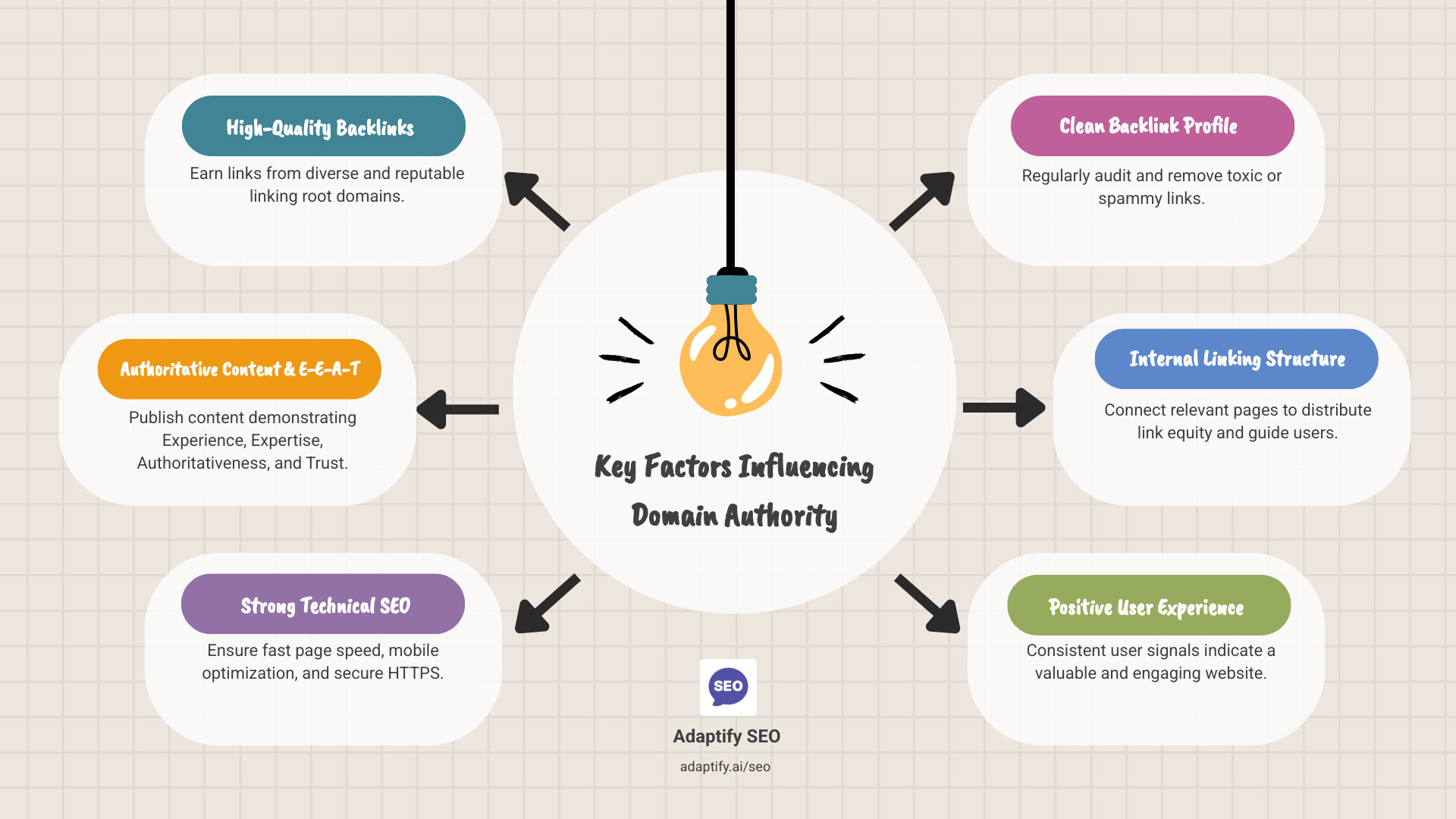
To truly improve domain authority, we need to implement a holistic SEO strategy. This isn't just about tweaking a few settings; it's about building a fundamentally strong, trustworthy, and user-friendly website. My approach focuses on several interconnected pillars: backlink acquisition, a robust content strategy, solid technical SEO, an outstanding user experience, smart internal linking, and diligent link audits.
For more information on how my team can assist with your backlink strategy, visit More info about our backlink services.
Backlinks are the lifeblood of domain authority. They act as "votes of confidence" from other websites, signaling to search engines that your content is valuable and trustworthy. A study by Ahrefs highlighted this perfectly, showing that 90% of websites don't get any organic traffic because they lack backlinks. It's not just about quantity; the quality and relevance of those links are paramount. You want links from authoritative, reputable sites that are relevant to your niche.
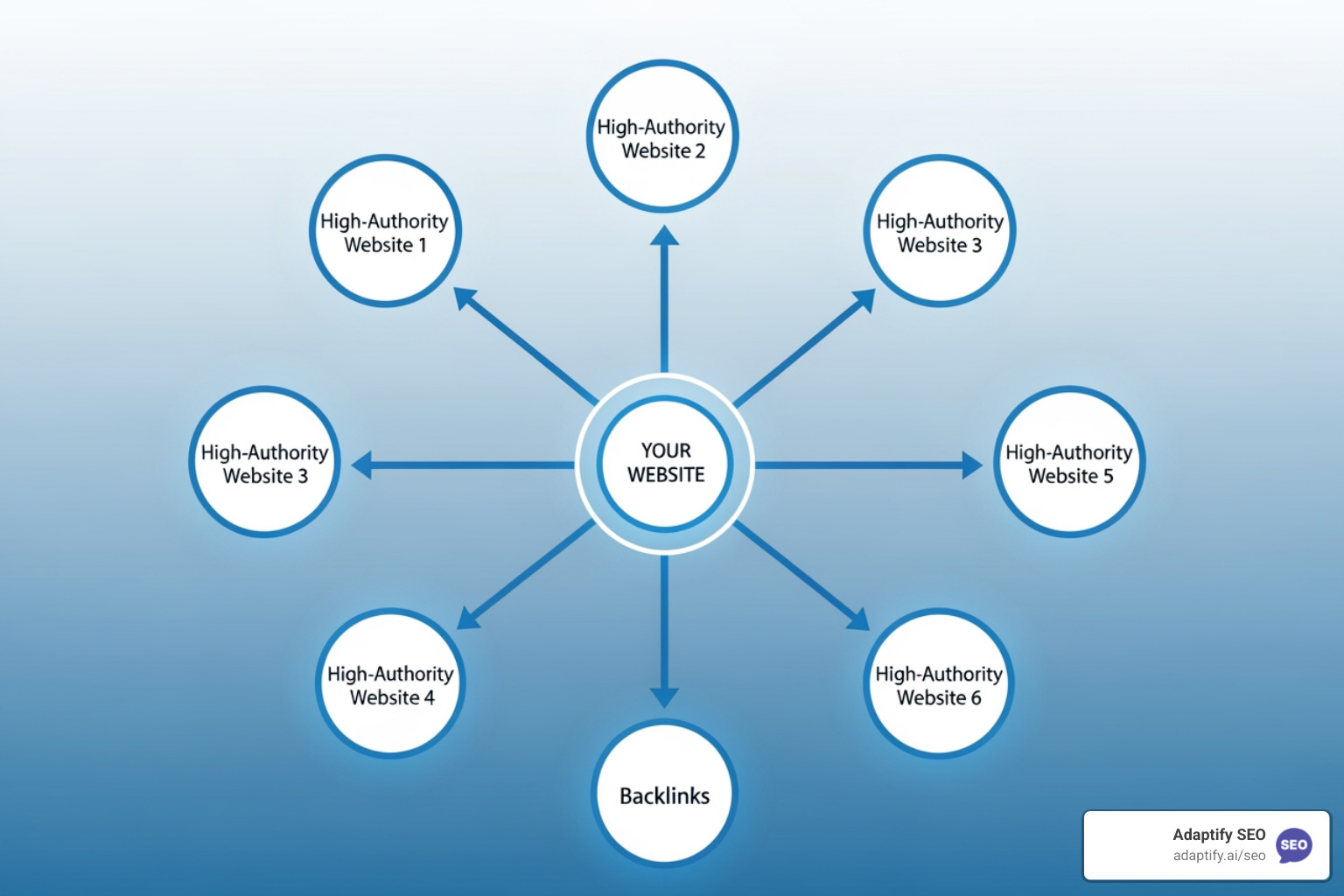
Here are my top strategies for building a high-quality backlink profile:
nofollow, the value still comes from exposure and referral traffic. Focus on sites with high authority and a relevant audience.A few backlinks from trusted, high-authority sites are far more impactful than dozens from unknown or low-quality sources. Prioritize relevance and editorial quality.
Content is king, but authoritative content wears the crown. To improve domain authority, your website needs to be a recognized, reliable source of information. This is where Google's E-E-A-T framework comes into play: Experience, Expertise, Authoritativeness, and Trustworthiness.
Creating in-depth blogs, comprehensive guides, videos, and other content that is superior to what's already out there will naturally attract attention and links. This kind of content not only satisfies users but also signals to search engines that your site is a valuable resource.
To learn more about how my team can lift your content strategy, visit More info about our content services.
While backlinks and content are often seen as the big guns for authority, a strong foundation of on-page and technical SEO is essential. Without it, even the best content and links might struggle to perform.
Beyond external backlinks, internal linking plays a crucial role. A well-structured internal link profile helps search engines find your content, understand its relevance, and pass authority between related pages. For instance, linking from a high-authority pillar page to supporting cluster content strengthens the entire topic cluster.
Just as good backlinks build authority, bad backlinks can actively harm it. Harmful or "toxic" backlinks are links from low-quality, spammy, irrelevant, or manipulative websites. These can include:
These types of links can lead to manual penalties from Google and significantly drop your domain authority score. That's why I conduct regular link audits.
Regularly cleaning up your backlink profile is as important as building new, high-quality links. It protects your site's reputation and ensures that your efforts to improve domain authority aren't undermined by negative signals.
Understanding how your authority score changes over time and how you stack up against competitors is crucial for refining your SEO strategy. It’s also important to grasp the nuances of different authority metrics and what might cause your score to fluctuate.
To help you with your SEO planning, you can use our More info about our SEO calculator.
As I mentioned, various third-party SEO tools provide their own versions of an authority score. Regardless of which tool you use, the process for checking and benchmarking is generally similar:
I typically recommend checking your authority score about once a month. This allows you to track progress over time without getting obsessed with daily fluctuations. The real value comes from:
While the term "domain authority" is widely used, it's actually a trademarked metric by one specific tool provider. Other tools have developed their own, equally valid, metrics for assessing a website's overall strength. These metrics, despite aiming for the same goal, can differ significantly in their calculation methods, the size of their link index, and how frequently they update.
| Metric Type | Calculation Methods (General) | Link Index Size (General) | Update Frequency (General) |
|---|---|---|---|
| Metric A (e.g., Moz DA) | Number of linking root domains, total links, link quality, other SEO factors, machine learning model. | Typically large | Monthly |
| Metric B (e.g., Ahrefs DR) | Focus on strength of backlink profile, quantity and quality of unique referring domains. | Very large | Weekly/Bi-weekly |
| Metric C (e.g., Semrush AS) | Link power, organic traffic, spam factors. Integrates backlink data and organic traffic estimates. | Large | Regularly |
| Metric D (e.g., Search Atlas DP) | Blends organic traffic and ranking keywords data from Google Search Console for actual performance. | Proprietary GSC data | Real-time/Frequent |
The key takeaway here is consistency. Choose one or two metrics that you find most useful for your benchmarking and stick with them. Don't compare a score from one tool directly with a score from another, as they are calculated differently and will almost certainly give you different numbers.
Seeing your authority score drop can be disheartening, but it's important to understand why it might happen:
When it comes to timelines for improvement, I always emphasize patience. Building authority is a marathon, not a sprint. While some strategies can offer quicker gains, significant and stable growth typically takes time:
Focus on the long-term, sustainable strategies, and view your authority score as a lagging indicator of your SEO health. If you're doing the right things, the score will eventually reflect that.
There are no guaranteed shortcuts to quickly improve domain authority. It is a long-term process that requires consistent effort in building quality backlinks, creating valuable content, and improving technical SEO. Focus on sustainable strategies, as quick-fix schemes can be harmful. Realistic timelines range from several months to over a year to see significant, stable growth.
No, Domain Authority is a third-party metric used in the SEO industry. Google has confirmed it does not use DA or any single "site authority" score in its ranking algorithms. However, the factors used to calculate DA, such as the quality and quantity of backlinks, are important ranking signals for Google. Therefore, a higher DA often correlates with higher rankings.
The single most important factor is your website's backlink profile. This includes the total number of unique websites (linking root domains) that link to you and the authority of those sites. Earning a few high-quality backlinks from reputable, relevant websites is far more impactful than acquiring many low-quality links.
To truly improve domain authority and secure long-term SEO success, you need to adopt a holistic and patient approach. It’s not about chasing a number; it’s about building a fundamentally strong, trustworthy, and valuable online presence. This means consistently focusing on:
As an expert who has seen the power of systematic SEO, I understand the challenges, especially for agencies managing multiple clients. The manual intensity of these tasks can be overwhelming. That’s where automated platforms like Adaptify can make a significant difference. My goal is to help you streamline these complex processes, from strategy formulation and content creation to PR link building, using AI to reduce manual effort and improve efficiency.
By focusing on these core principles and leveraging the right tools, you can systematically improve domain authority, drive more organic traffic, and ultimately achieve your business goals. Building authority takes time and dedication, but the results—higher rankings, increased visibility, and a stronger online reputation—are well worth the investment.
Ready to see how a strategic, automated approach can transform your SEO efforts? See our SEO case studies to find how Adaptify helps businesses like yours achieve remarkable growth.

Stop being invisible: discover what the best local SEO strategies for small businesses are to dominate Google Maps, reviews, and AI search...
Master localized SEO to rank your local business in Google Maps and drive more in-store visits.

Master local retail SEO to drive foot traffic from Google with proven strategies for GBP, reviews, and AI search optimization.
Join 1,000+ agencies already delivering SEO and AI visibility from a single platform without increasing their headcount.Join 1,000+ agencies already delivering SEO and AI visibility from a single platform without increasing their headcount.