Robots, Humans, and Rankings: The SEO Automation Reality Check




The debate over automated SEO vs manual SEO is one of the most important decisions agency owners face right now — and most are getting it wrong in one direction or the other.
Here is the quick answer:
| Factor | Manual SEO | Automated SEO |
|---|---|---|
| Speed | Slow — hours or days per task | Fast — minutes or seconds |
| Scalability | Limited by headcount | Scales without adding staff |
| Error rate | 5–15% (human error) | Under 1% for repetitive tasks |
| Cost per client/month | $3,000–$4,500 | $400–$600 tools + $800–$1,200 strategy |
| Strategic depth | High | Low without human oversight |
| Best for | Brand voice, E-E-A-T, outreach | Audits, reporting, rank tracking, briefs |
The honest verdict: Neither approach wins on its own. Manual SEO is too slow to scale. Automated SEO without human oversight creates quality problems that can hurt your rankings. The teams winning in 2026 are running both — with automation handling the repetitive scaffolding and humans owning the strategy.
The search landscape has shifted dramatically. AI overviews are built into Google results. Tools like Perplexity and ChatGPT are becoming search destinations in their own right. Mid-market and agency teams are being asked to audit hundreds of pages, track thousands of keywords, and ship dozens of content briefs every quarter — often with the same headcount they had two years ago. The old way of doing SEO manually, task by task, simply does not hold up at that volume.
At the same time, the teams that handed everything to automation and hit publish without a human in the loop have paid for it. Google's quality systems do not penalize AI involvement — they penalize thin, unhelpful, or inaccurate content. And when automation produces that at scale, one bad template becomes a site-wide problem fast.
I'm Hansjan Kamerling, a product designer and marketing consultant who has scaled AI-powered platforms and built growth systems for companies reaching millions of users — which is exactly where the automated SEO vs manual SEO question becomes unavoidable. In this piece, I'll walk you through where the line actually sits, what a safe hybrid workflow looks like, and how to build an SEO operation that scales without sacrificing quality.
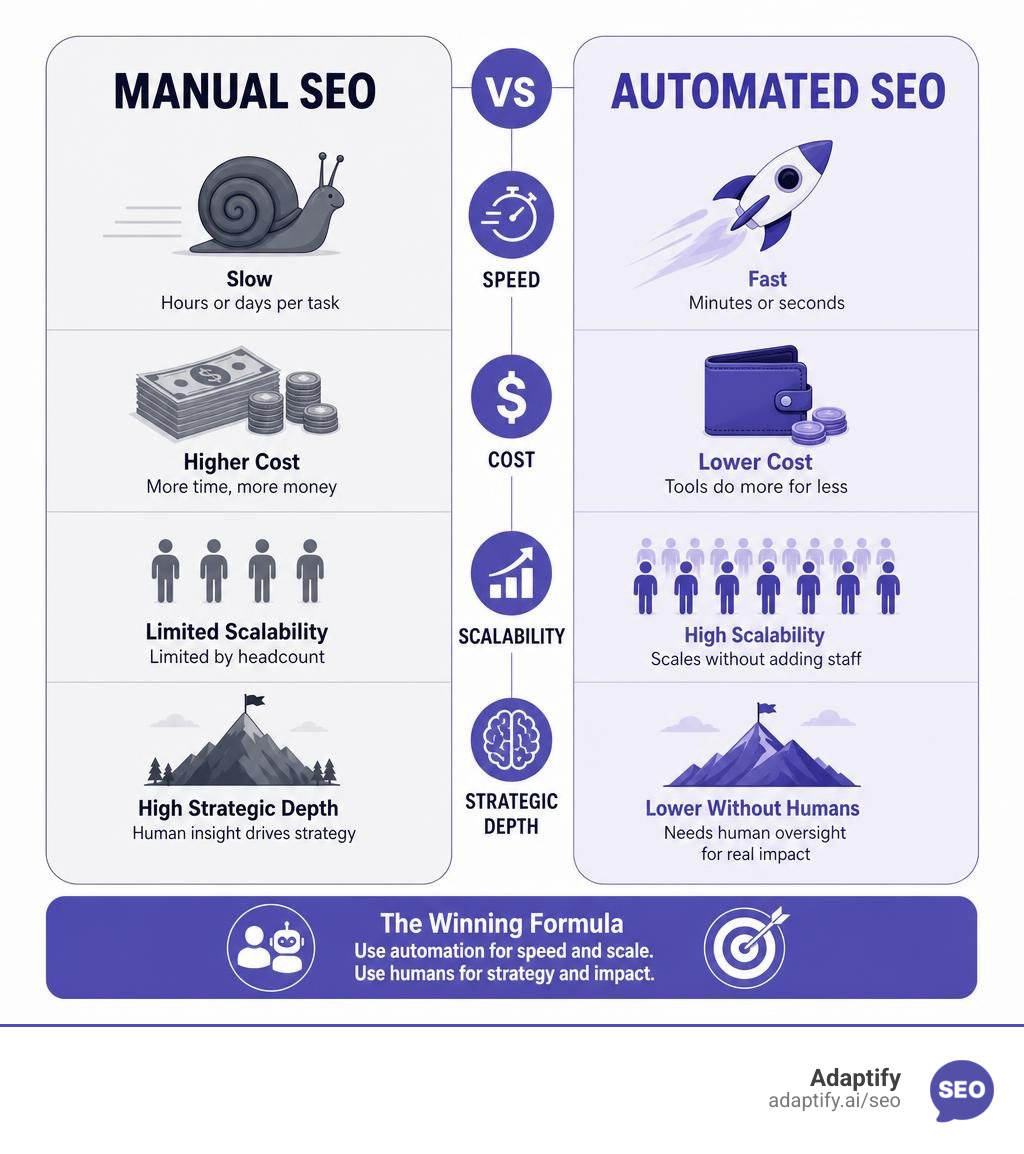
To understand where the industry is heading, we have to look at how we define both methodologies today. Manual SEO relies on human professionals executing every single step of the optimization cycle by hand. From manually pulling Google Search Console data into spreadsheets to writing individual meta tags for hundreds of pages, it is a craft built on hours of labor.
Automated SEO, on the other hand, delegates repetitive, data-heavy, and structured tasks to software systems. In my experience scaling marketing engines, the biggest mistake teams make is viewing automation as a lazy shortcut. True automation is about treating SEO as a system rather than a checklist.
By offloading the mechanical steps of search optimization to software, you clear the operational bottlenecks that keep your best strategists trapped in spreadsheet purgatory. If you want to understand how these systems function at a high level, I highly recommend reading Beyond Manual: What is SEO Automation and How Can It Help You to see how this transition shifts your team's focus from execution to strategy.
At its core, modern SEO automation operates on a continuous "crawl-analyze-act" loop. Rather than waiting for a human analyst to log into a tool, run a report, and notice a drop in rankings, automated systems use event-driven orchestration.
For example, a workflow can be built using platforms like Make, which natively connects to over 3,000 applications. If a REST API is required for a custom data source, a simple HTTP request module bridges the gap. The system monitors your live metrics, identifies anomalies, and triggers immediate alerts or draft optimizations.
When you rely entirely on manual execution, you run into severe operational drag. I often point out the Hidden Labor Costs: Manual SEO vs Automated Platforms that quietly eat away at agency margins. A human spending several hours a week copy-pasting data from Google Analytics into client slide decks is not just an inefficient use of budget; it introduces a 5% to 15% error rate that automated data pipelines completely eliminate.
There are certain tasks where human effort simply cannot compete with machine execution. Large-scale data processing is the most obvious.
Consider a mid-market e-commerce site with 5,000 URLs. A manual audit of canonical tags, redirect chains, and schema markup could take an in-house specialist days of meticulous crawling and analyzing. An automated scenario running nightly across those 5,000 URLs can catch a broken canonical tag or a sudden 404 error before search engine crawlers even index the page.
The same efficiency applies to rank tracking and client reporting. Instead of wasting the first week of every month compiling manual performance PDFs, smart agencies use automated systems to pull real-time search data and distribute interactive dashboards. If you are still building report decks by hand, you should explore how Automated SEO Reporting: The Secret Weapon for Agencies can instantly return dozens of billable hours back to your calendar.
Despite the power of automated systems, relying solely on robots is a fast track to search engine penalties. Google’s Helpful Content system is specifically designed to weed out low-effort, mass-produced pages that offer no unique value to the reader.
Machines excel at pattern recognition, but they lack real-world experience, original perspectives, and editorial nuance. They cannot interview your product engineers to extract a breakthrough insight, nor can they inject the authentic brand voice that builds trust with human readers. This is the core of E-E-A-T (Experience, Expertise, Authoritativeness, and Trustworthiness).
The same limitation applies to link building. While automated software can scrape contact details and manage outreach schedules, building genuine editorial relationships requires a human touch. Automated, spammy guest-post outreach is easily ignored or flagged. To protect your site’s authority, it is vital to understand when to leverage automation and when to rely on manual relationship-building, as detailed in The Auto-Pilot Approach to Backlinks: Is It for You?.
The most successful search operations in 2026 do not choose between automated seo vs manual seo. Instead, they deploy a hybrid model that combines the speed of machines with the strategic oversight of humans.

By building a "human-in-the-loop" workflow, you get the best of both worlds: unmatched production throughput and bulletproof quality control. The goal is to eliminate content operations drag — the endless bottleneck where drafts sit waiting for multiple rounds of reviews — without letting raw, unedited AI content slip onto your live site. To see how this balance is achieved in practice, take a look at AI-Powered SEO: Automate Your Way to the Top.
A highly effective hybrid workflow starts by letting automation handle the initial heavy lifting.
This structured pipeline ensures you never publish a "repeatable mistake" across your site. If you are looking to scale your organic footprint safely, you can follow this step-by-step approach in Beyond Manual: A Guide to Automating Blog Content for Scale.
If you are ready to transition your agency or brand toward an automated workflow, you must evaluate your tools carefully. Not all SEO software is built to handle the complexities of modern search. When testing platforms, I always look for these critical features:
llms.txt file)?Understanding these criteria is essential to building an efficient stack. For a deeper breakdown of what to look for, check out Beyond Manual: Unlocking Efficiency with Automated SEO Tasks.
The choice between manual and automated workflows comes down to business growth and return on investment. If your team is still spending dozens of hours every month on manual keyword research, basic site audits, and copy-pasting report metrics, you are hitting an artificial ceiling on your growth.
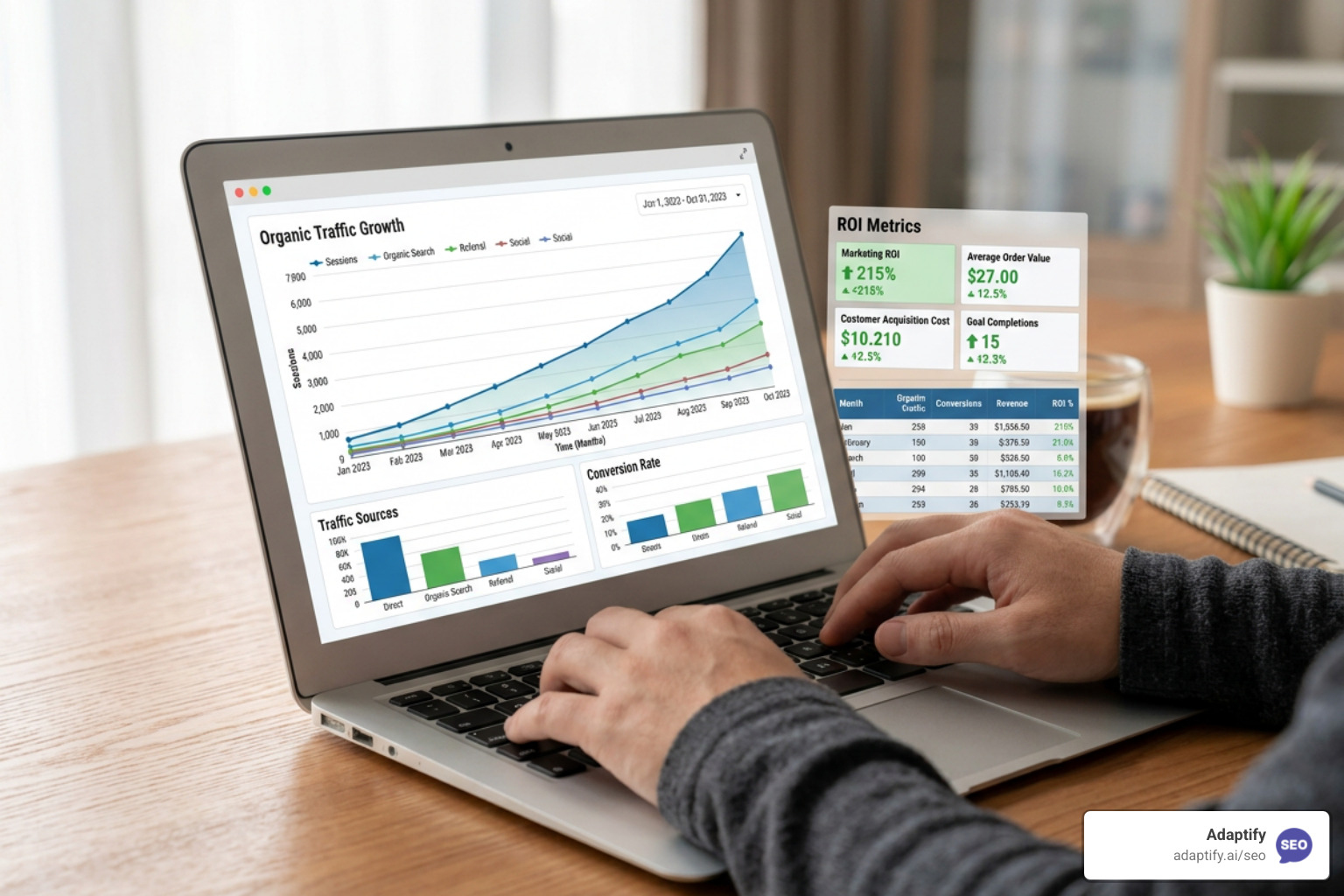
By automating the structural elements of your search strategy, you free your team to focus on high-level positioning, creative storytelling, and deep client relationships. This is exactly how modern agencies scale their client roster without needing to double their headcount.
At Adaptify, we build AI-powered systems designed to handle the heavy lifting of keyword strategy, high-quality content generation, and authoritative PR link building. If you are ready to see how intelligent automation can transform your organic performance and drive real business outcomes, Explore Adaptify Pricing to find the perfect plan for your business.

Master SEO service differentiation to stand out in a crowded market and prove your agency's unique business-first value.
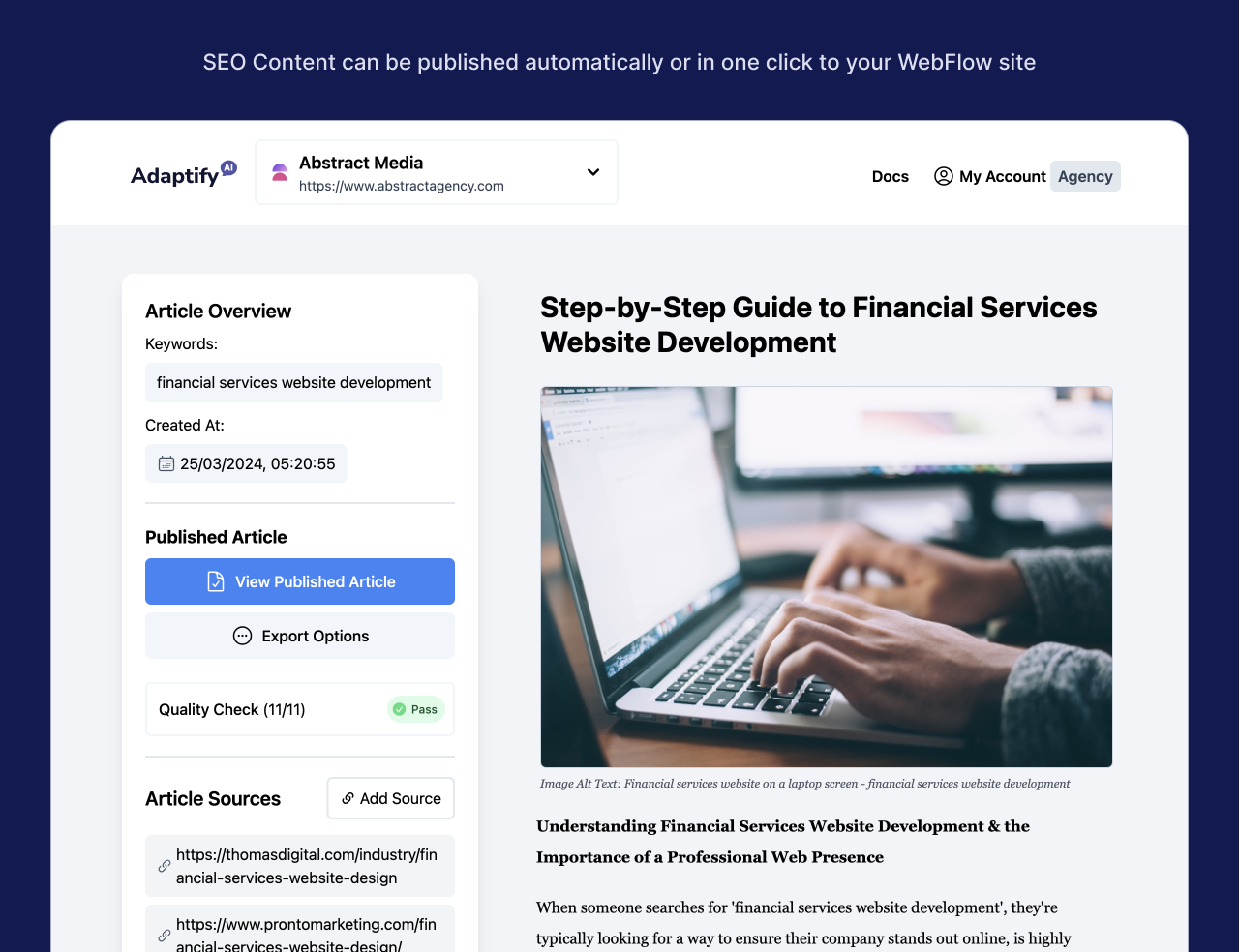
Stop wasting hours—automate your SEO reports to boost agency efficiency and client trust.

Stop pulling teeth for leads—partner with a dental SEO marketing agency to boost visibility and patient growth.
Join 1,000+ agencies already delivering SEO and AI visibility from a single platform without increasing their headcount.Join 1,000+ agencies already delivering SEO and AI visibility from a single platform without increasing their headcount.