First Impressions Matter: A Guide to Seamless SEO Onboarding




SEO client onboarding is the structured process of turning a signed contract into a productive working relationship — and it's the single biggest predictor of whether a client stays or leaves.
Here's a quick overview of what effective SEO onboarding covers:
The first 30 days of an SEO engagement are disproportionately important. They build the trust that has to survive months three through six — when ranking gains still lag behind the effort being put in. Without a clear process in place from day one, even the best SEO work gets undermined by access delays, miscommunication, and scope creep.
The research is consistent on this point: agencies that invest in a structured onboarding process see meaningfully better client retention. Those that skip it often face a slow unraveling — not because of bad strategy, but because of a shaky foundation.
I'm Hansjan Kamerling, a product designer and marketing consultant who has built digital systems for platforms reaching millions of users, and I've seen how a repeatable SEO client onboarding process transforms chaotic agency operations into scalable, trust-based client relationships. In the guide below, I'll walk you through every phase — from discovery and access provisioning to reporting setup and your first quick win.
When I first entered the agency world, I assumed our work would speak for itself. I believed that as long as we were building great backlinks and writing stellar content, clients would stick around. I was wrong.
The reality of agency growth in May 2026 is that client retention is won or lost in the very first weeks of the relationship. A chaotic kickoff creates immediate doubt. If a client has to chase you for updates, or if they receive a massive, confusing list of technical demands without context, their trust begins to erode before you’ve even optimized a single meta tag.

A structured onboarding process is the highest-leverage operational system you can build. It directly impacts your bottom line by:
By laying down a clean, professional foundation, you position your agency as a strategic partner rather than a transactional vendor. To understand how this fits into your broader growth plans, check out my thoughts on how to Unlock Your Potential: The Benefits of a Winning SEO Strategy.
An effective onboarding checklist is more than a simple to-do list; it's an operational roadmap. If you want a deep dive into the broader mechanics of agency-wide systems, you can explore this Agency Client Onboarding Checklist 2026: The Complete Step-by-Step Guide | Pitchsite Guides .
For an SEO-specific campaign, your onboarding checklist must contain these non-negotiable components:
Without a structured process, even seasoned agencies fall victim to the same three silent relationship killers:
By identifying these risks early, you can design a system that actively bypasses them. For a comprehensive look at scaling these operations, read The Ultimate Guide to SEO for Agencies.

To build a search strategy that actually moves the needle, you must first understand how your client's business operates. SEO is not just about driving traffic; it is about driving profitable traffic. To align your organic efforts with their commercial realities, you need to map out their core business model, profit margins, and target audience. For example, a product that generates only 10% of their total sales volume but carries a 40% profit margin deserves significantly more SEO focus than a high-volume, low-margin offering.
To see how this deep business alignment translates into campaign execution, take a look at The Game Plan: Building an Effective Search Optimization Strategy.
Treating discovery as a single, rushed 60-minute call is a recipe for missed details. I recommend breaking your discovery phase into a structured, four-call sequence to give each critical topic the focus it deserves:
Always record these calls (with explicit permission) and keep the transcripts. They serve as an invaluable baseline for understanding your client's brand voice and technical constraints.
Most clients fill out only 60 to 70 percent of intake fields when left to self-serve. However, that completion rate jumps to 95 percent or more when you guide them through the questions dynamically on a call.
Instead of dumping a massive, generic word document on them, customize your questionnaire to focus on what truly matters. Group your questions into logical categories:
For a practical guide on structuring these initial documents and setting the right tone, you can read SEO Client Onboarding: Process, Questionnaire, and Expectations Setting .
Before your team can write a single line of code or audit an existing page, you must secure access to their digital ecosystem. Chasing down usernames and passwords via email is not only insecure, but it also drags out your onboarding timeline.
A professional agency uses white-label client portals to centralize communication and make credential handoff seamless. To learn how to elevate your brand during this phase, check out White Label Client Portals: Elevate Your Brand and Streamline Communication.
To execute a modern SEO campaign, you require specific, verified permissions. Never accept plain-text credentials over email. Instead, direct your clients to share access securely through official platform permission screens or via a shared password vault like Bitwarden or 1Password.
Here are the non-negotiables you must secure:
Once credentials are provided, your team must verify them immediately by performing a real task (like pulling a 30-day GSC query report) to ensure the permissions are fully functional.
Once access is verified, you must establish a baseline. If you don't document where the client started, you won't be able to prove your value later. I like to structure our goals using a clear, three-tier KPI hierarchy:
[Tier 1: North Star Goal] -> e.g., Organic Conversions & Revenue
 |
[Tier 2: Performance Goals] -> e.g., Organic Sessions, Non-Brand Clicks, CTR
 |
[Tier 3: Activity Goals] -> e.g., Pages Optimized, Links Built, Technical Fixes
This hierarchy ensures that while we monitor daily activity and ranking metrics, we never lose sight of the client’s bottom-line business goals. For a deeper look at how to package and communicate these metrics clearly, read about Mastering Client Communication: The Power of White-Label Reporting.
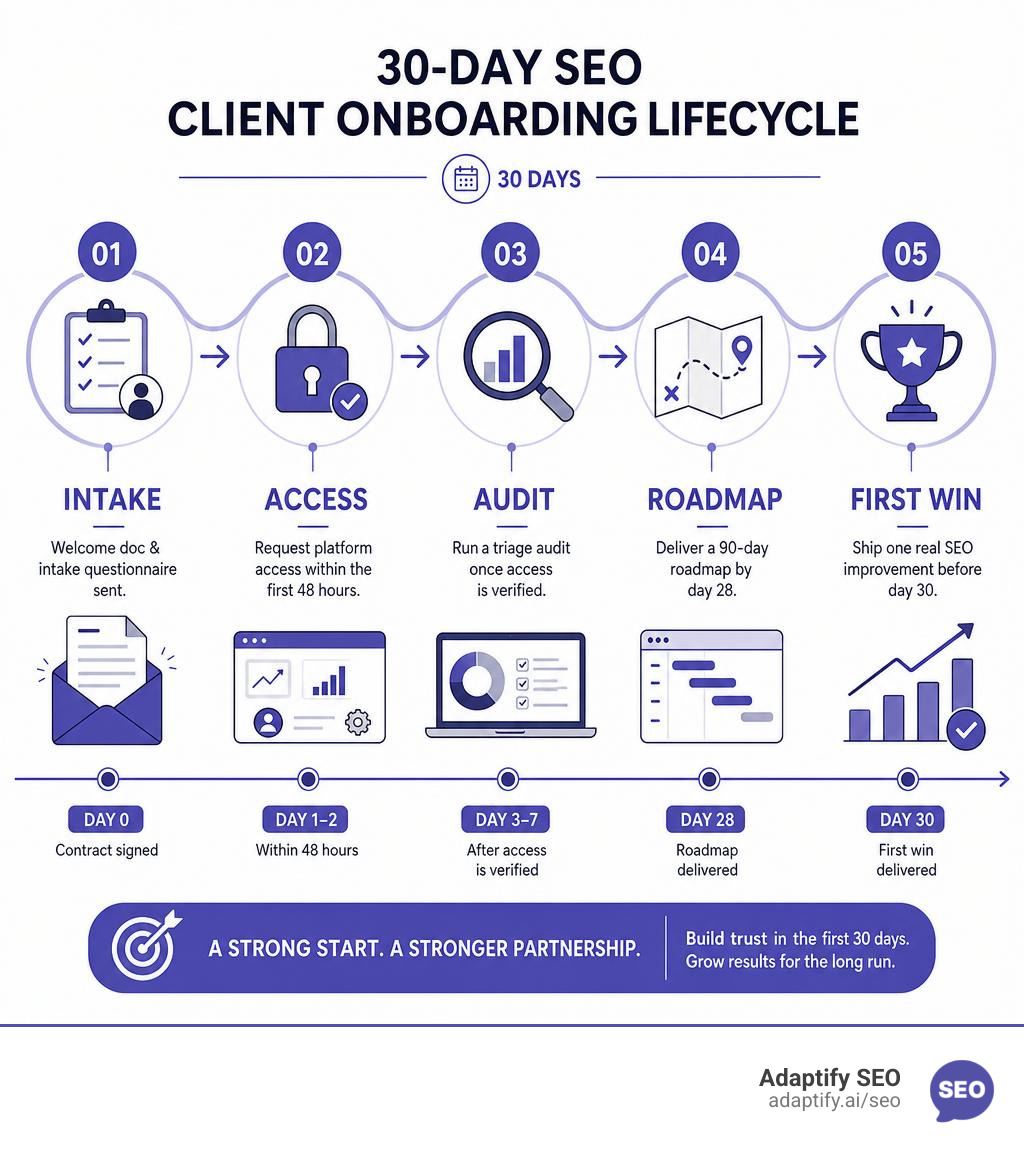
The first month of an SEO campaign should not be spent writing theoretical documents that sit in a shared drive. It must be an operational sprint designed to build trust, resolve critical technical blockers, and ship a visible improvement.
The table below outlines how to customize your onboarding speed based on the client's tier and urgency:
| Onboarding Operating Mode | Typical Duration | Audit Scope Focus | Primary Delivery Channel |
|---|---|---|---|
| Mode A: Express | 14–21 Days | High-Impact Triage (Technical & Indexation) | Direct Developer Sprint |
| Mode B: Standard | 28–35 Days | Balanced (Technical, Content Gap, & E-E-A-T) | Dedicated Client Portal |
| Mode C: Enterprise | 45–90 Days | Deep Diagnostic (Multi-site, International, & Log Files) | Custom Strategy Workshop |
Choosing the right operating mode ensures you deliver value at a pace that matches the client's scale. To see how to evaluate these agency dynamics from a client's perspective, check out Boost Your ROI: The Ultimate Guide to Evaluating Marketing Agencies.
To prevent the "month-two panic" where clients wonder what they are paying for, present a clear 90-day operational plan during your kickoff phase. This plan should be structured into four distinct, logical phases:
A common point of failure in SEO campaigns is the implementation handoff. You can write the best technical recommendations in the world, but if the client’s development team doesn't have the time or interest to implement them, your strategy dies.
During onboarding, you must explicitly define who is responsible for execution:
Always ask this critical question during your kickoff call: "When we find an SEO issue that requires development time, who decides whether it gets prioritized in the next sprint?" Identifying this internal champion early prevents your campaign from stalling. To understand how to balance internal resources against agency execution, read Agency or DIY: The Ultimate Showdown for Backlink Building.
A significant percentage of client churn is driven by poor communication rather than poor work quality. If a client goes weeks without hearing from you, they assume nothing is happening. Onboarding is your opportunity to set firm, professional communication boundaries.
Establish a clear communication protocol on day one:
Additionally, establish a consistent reporting cadence. The monthly check-in call is the second most important predictor of client renewal after actual KPI delivery. Use these sessions to review what your team found, what they fixed, and what is coming up next. For a look at how to scale these white-label relationships smoothly, read The Secret Sauce: How White Label SEO Can Transform Your Business.
For most standard campaigns, the core onboarding process should be fully completed within two weeks. This timeline starts with administrative setup and access verification in the first three days, moves into the kickoff meeting by day five, and concludes with the delivery of your initial triage audit and a 30-day relationship review to ensure everything is running smoothly.
The biggest mistake is treating onboarding as "intake theater" — a passive exercise of collecting data and passwords without establishing clear operational ownership. If you don't identify who on the client’s side is responsible for approving content and pushing code updates live, even the most brilliant SEO strategy will sit unimplemented in a shared folder.
No. Do not overwhelm a new client with a massive, multi-page document detailing every minor, low-impact issue on their site. Instead, run a quick triage audit focused strictly on high-impact indexing errors, broken redirects, and critical technical blockers. Save the exhaustive, deep-dive audits for month two, once your workflow, communication channels, and access permissions are fully established.
A seamless SEO client onboarding process is the foundation of a long-term, high-value agency relationship. By standardizing your intake, securing platform access early, and delivering a clear 30-day quick win, you build the operational trust required to sustain a successful, multi-year SEO campaign.
However, executing this level of manual onboarding, content strategy, and link building across dozens of clients can quickly overwhelm a growing agency. That is where automation becomes your competitive advantage.
At Adaptify.ai, we offer automated SEO services specifically designed to help agencies scale. Our platform streamlines time-consuming tasks like search strategy formulation, high-quality AI content creation, and high-authority PR link building. By automating your backend fulfillment, you can focus on what matters most: onboarding new clients, building strong relationships, and growing your agency.
Ready to scale your organic search fulfillment effortlessly? Learn more and Scale Your Agency with Adaptify today.

Compare automated SEO vs manual SEO to build a hybrid workflow that scales rankings with human oversight in 2026.

Master SEO service differentiation to stand out in a crowded market and prove your agency's unique business-first value.
Stop wasting hours—automate your SEO reports to boost agency efficiency and client trust.
Join 1,000+ agencies already delivering SEO and AI visibility from a single platform without increasing their headcount.Join 1,000+ agencies already delivering SEO and AI visibility from a single platform without increasing their headcount.