Health Insurance for New Immigrants: Your Guide to Lawful and Affordable Coverage




Health insurance for new immigrants in the U.S. is not straightforward — but here is a quick summary of your main options:
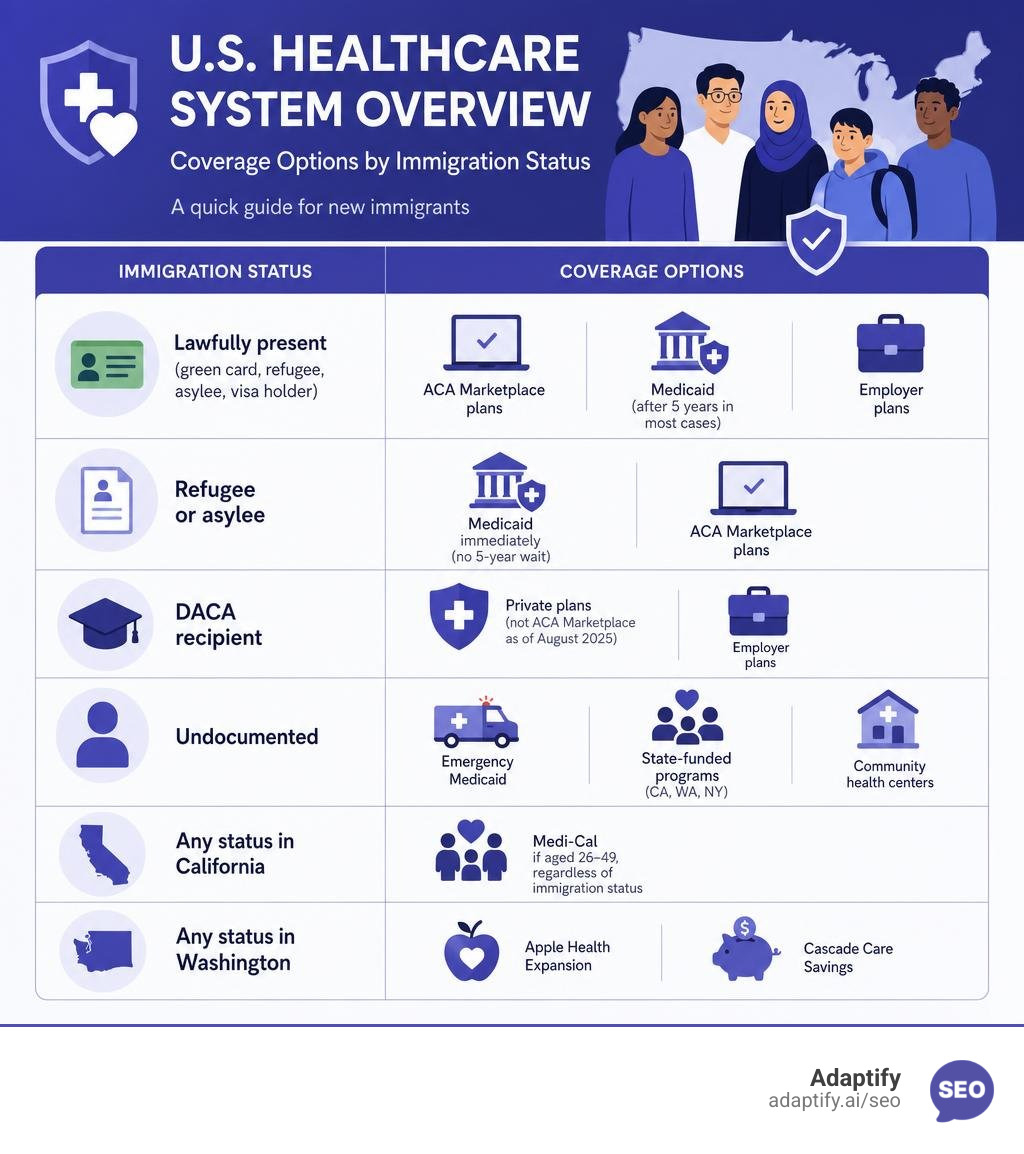
| Your Immigration Status | Main Coverage Options |
|---|---|
| Lawfully present (green card, refugee, asylee, visa holder) | ACA Marketplace plans, Medicaid (after 5 years in most cases), employer plans |
| Refugee or asylee | Medicaid immediately (no 5-year wait), ACA Marketplace |
| DACA recipient | Private plans (not ACA Marketplace as of August 2025), employer plans |
| Undocumented | Emergency Medicaid, state-funded programs (CA, WA, NY), community health centers |
| Any status in California | Medi-Cal if aged 26-49, regardless of immigration status |
| Any status in Washington | Apple Health Expansion, Cascade Care Savings |
Moving to a new country is already overwhelming. Figuring out health coverage on top of that? That's a whole other challenge.
Here's the reality: a single doctor's visit in the U.S. can cost between $250 and $350 without insurance. A heart attack can run at least $25,000. An ICU stay after a stroke can exceed $150,000. These are not edge cases — they are the everyday stakes of being uninsured in America.
And far too many immigrants are in exactly that position. As of 2025, 46% of likely undocumented immigrant adults report being uninsured. Even among lawfully present immigrants, 1 in 5 lack coverage. Compare that to just 6% of U.S.-born citizens, and the gap becomes impossible to ignore.
The reasons are real: waiting periods, eligibility restrictions, language barriers, and fear of how applying might affect immigration status. Many new arrivals don't know which programs they qualify for, or they assume they don't qualify at all.
This guide cuts through the confusion. Whether you just arrived on a green card, are waiting on an adjustment of status, or are undocumented and looking for any available option — you'll find clear, practical answers here.
I'm Hansjan Kamerling, a product designer and marketing consultant who has worked across SaaS, fintech, and data-driven platforms, and through that work I've spent considerable time researching how complex systems — including health insurance for new immigrants — can be made more accessible and easier to navigate. That same clarity-first approach shapes everything in this guide.

When you first arrive in the United States, navigating the public health insurance system can feel like trying to solve a puzzle with missing pieces. The primary federal platform for finding health coverage is the Affordable Care Act (ACA) Marketplace, accessible via HealthCare.gov.
If you are a lawfully present immigrant—which includes lawful permanent residents (green card holders), refugees, asylees, and those on valid non-immigrant visas (such as student or work visas)—you are fully eligible to purchase health plans through the Marketplace.
Even better, if your household income falls between 100% and 400% of the Federal Poverty Level (FPL), you may qualify for premium tax credits that significantly lower your monthly payments. To understand exactly who qualifies under federal guidelines, you can review the official list of eligible statuses on the Health coverage for lawfully present immigrants | HealthCare.gov portal.
While the ACA Marketplace is open to most lawfully present newcomers, government-funded programs like Medicaid and Medicare come with much stricter limitations.
For Medicaid, most "qualified non-citizens" (including green card holders) are subject to a standard federal waiting period known as the five-year bar. This means you must reside in the U.S. under a qualified legal status for at least five years before you can enroll in Medicaid.
However, there are crucial exemptions. Refugees, asylees, and humanitarian immigrants do not have to wait five years and can access Medicaid immediately upon arrival. Furthermore, many states have opted to waive the five-year bar entirely for pregnant individuals and children. You can find detailed local eligibility pathways through resources like the Immigrant Families - Maryland Health Connection page, which highlights how states manage these federal rules.
Medicare, the federal program for seniors aged 65 and older, has similar hurdles. To qualify, a new immigrant must have lived in the U.S. as a green card holder for at least five consecutive years. Additionally, to receive premium-free Medicare Part A (hospital insurance), you must have accumulated 40 quarters (about 10 years) of work history in the U.S. If you do not have this work history, you will have to pay a substantial monthly premium for Part A.
Another major obstacle for low-income senior immigrants is "sponsor income deeming." When you immigrate to the U.S. via family sponsorship, your sponsor signs a Form I-864 (Affidavit of Support). For programs like Medicaid, the government "deems" or counts your sponsor's income as your own. This makes it incredibly difficult to qualify for public assistance, even if you personally earn nothing.
Because federal restrictions leave many newcomers without options, several forward-thinking states have stepped in with state-funded health programs.
The landscape is also shifting rapidly for Deferred Action for Childhood Arrivals (DACA) recipients. Historically, DACA recipients were excluded from federal health programs. Under recent policy changes, DACA eligibility has faced legal hurdles, including an August 25, 2025 rule that restricted Marketplace access, prompting legislative efforts like the H. R. 5008 (HEAL for Immigrant Families Act) to permanently codify and expand access to health programs for DACA holders and other undocumented individuals.
Your legal status dictates your health insurance pathway. If you are undocumented, you are excluded from federal Medicaid and cannot purchase plans on the ACA Marketplace. However, you can still access Emergency Medicaid, which covers life-threatening medical emergencies (including childbirth) if you meet your state's income requirements.
The legislative environment remains volatile. The Congressional Budget Office (CBO) estimates that health coverage restrictions in recent reconciliation laws will result in 1.4 million lawfully present immigrants becoming uninsured by 2034.


If public programs are out of reach, private health insurance is your next best option. For many new immigrants, the most affordable and comprehensive route is through an employer-sponsored group health plan. If you are starting a business or working independently, navigating this space requires a different strategy. I highly recommend reading my guides on Health Insurance For Entrepreneurs Your Guide To Navigating The Marketplace and Blueprint For Wellness Navigating Health Insurance For Engineers to understand how to structure your own coverage.
If you are in a transition phase—such as waiting for your green card approval while on a visitor visa—you cannot buy standard domestic health insurance. In this bridge period, you must rely on short-term travel medical insurance or immigrant-specific plans.
When shopping for these temporary plans, you must choose between two main structures:
In 2026, travel health insurance for visitors to the U.S. ranges from $19 to $172 per month, depending on your age, policy limits, and whether you require coverage for the acute onset of pre-existing conditions. For detailed options on temporary bridge insurance, the New Immigrants Health Insurance guide is an excellent starting point.
If you are moving across the border to Canada instead, the provincial rules differ significantly. For instance, you might look into Newcomer health insurance - Saskatchewan Blue Cross or check the rules for obtaining a provincial health card via the Nova Scotia Health Card portal to see how Canadian provinces handle newcomer waiting periods.
A very common fear among new immigrants is that applying for health insurance will hurt their chances of getting a green card or citizenship.
Let me be clear: Applying for or receiving ACA Marketplace savings, Medicaid, or CHIP will not make you a "public charge." Under U.S. Citizenship and Immigration Services (USCIS) guidelines, using health benefits does not affect your immigration status, with the sole exception of receiving government-funded, long-term institutional care (like living in a nursing home at the government's expense).
Additionally, you do not need a Social Security Number (SSN) to apply for health insurance if you do not have one. When applying for family members, only the person requesting coverage needs to provide their status. If you are an undocumented parent applying for your U.S.-citizen children, you can safely omit your own SSN or immigration status. By law, your personal data is protected and cannot be shared with immigration enforcement agencies like ICE.
For those interested in exploring alternative ways to manage medical costs, you might find my article on Alternative Answers How To Get Your Holistic Care Covered helpful, or read about options tailored for specific fields in Aicpa Beyond Navigating Health Insurance Options For Accounting Professionals.
Securing health insurance for new immigrants is a critical step in building a stable, healthy life in the United States. While the system has its barriers, the financial risk of remaining uninsured is simply too high. Interestingly, research shows that annual per capita healthcare expenditures for immigrants are actually 30% lower than those for U.S.-born citizens ($5,453 vs. $7,838), proving that newcomers are highly resilient—they just need fair access to the right plans.
If you are running a business or managing an agency and want to reach audiences searching for complex topics like this, you need a marketing strategy that is as precise as it is automated. At Adaptify, we specialize in helping agencies scale their search presence through AI-driven SEO services, content creation, and automated link building.
To see how we can streamline your organic growth, explore our pricing or sign up for an account at the Adaptify Login page today.

Going Hyperlocal: The Ultimate Guide to Modern Local SEO Trends - Learn about Local SEO trends.

Master the best local SEO strategies to rank higher in Google Maps and drive more local customers in 2026.

Get help with local SEO to rank higher in Google Maps and dominate neighborhood search results.
Join 1,000+ agencies already delivering SEO and AI visibility from a single platform without increasing their headcount.Join 1,000+ agencies already delivering SEO and AI visibility from a single platform without increasing their headcount.