Health Insurance for Entrepreneurs: Your Guide to Navigating the Marketplace




Health insurance for entrepreneurs is one of the most important — and most confusing — financial decisions you'll make when you work for yourself. Unlike traditional employees, self-employed workers, freelancers, and gig workers don't have an HR department to hand them a benefits packet. You're on your own to find coverage that fits your health needs and your budget.
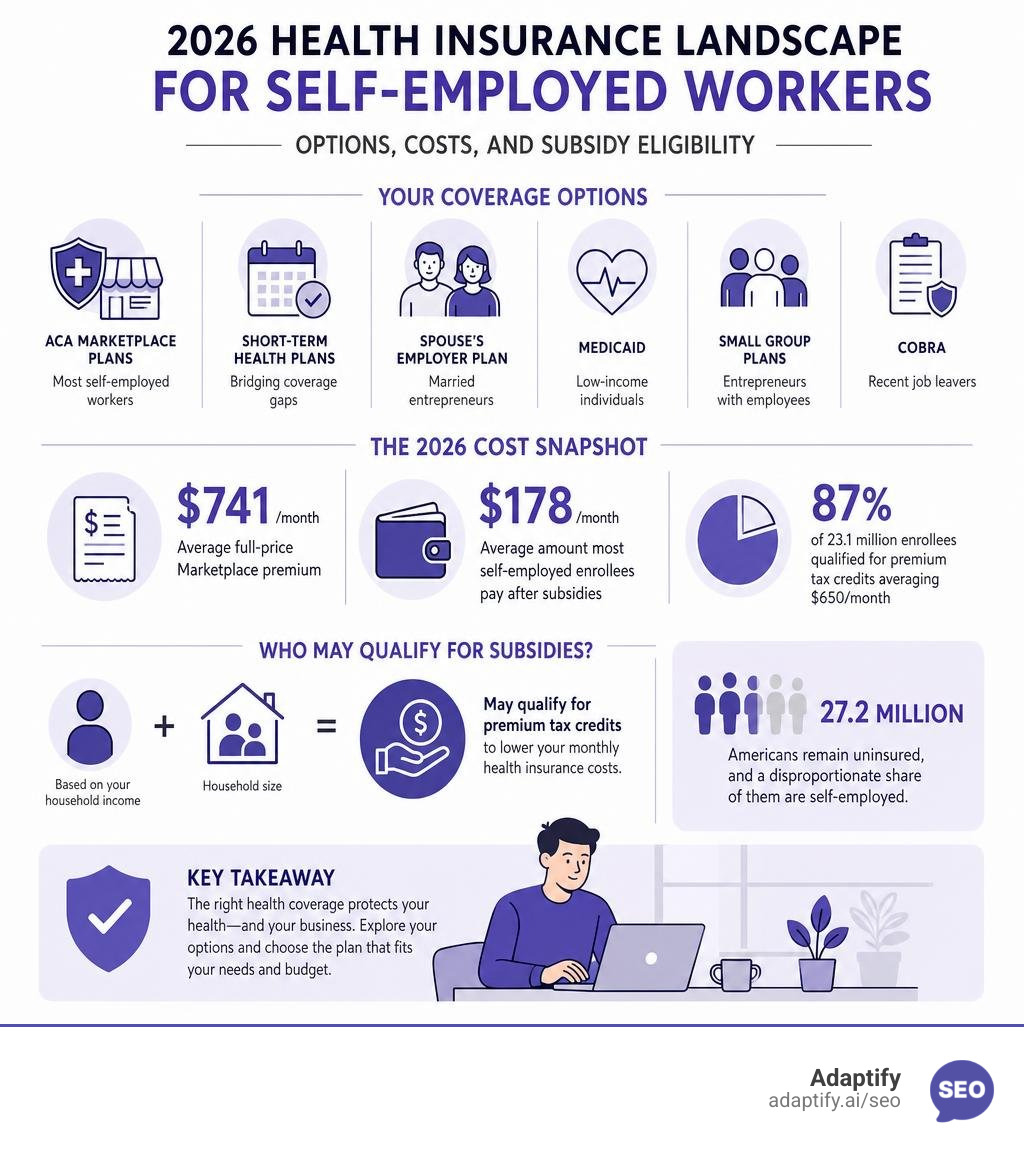
Here's a quick look at your main options:
| Coverage Option | Best For | Key Consideration |
|---|---|---|
| ACA Marketplace plans | Most self-employed workers | Subsidies available based on income |
| Short-term health plans | Bridging coverage gaps | Limited benefits, no pre-existing coverage |
| Spouse's employer plan | Married entrepreneurs | Depends on spouse's open enrollment |
| Medicaid | Low-income individuals | Free or low cost, income limits apply |
| Small group plans | Entrepreneurs with employees | Year-round enrollment, broader benefits |
| COBRA | Recent job leavers | Full premium cost, short-term bridge |
The numbers tell a striking story. As of 2026, the average full-price Marketplace premium sits at $741 per month — but most self-employed enrollees pay closer to $178 per month after subsidies. Around 87% of the 23.1 million people who enrolled in Marketplace plans for 2026 qualified for premium tax credits averaging $650 per month. Still, roughly 27.2 million Americans remain uninsured, and a disproportionate share of them are self-employed.
The challenge is real. Working for yourself brings freedom — but it also means navigating a complex system without a safety net built in. For digital agency owners and independent consultants, every hour spent decoding insurance policies is an hour taken away from scaling client campaigns and growing your business.
I'm Hansjan Kamerling, a product designer and marketing consultant who has worked as a freelancer across multiple industries, including a fintech startup, automotive platforms, and SaaS companies — all situations where navigating health insurance for entrepreneurs was a very personal challenge. In this guide, I'll break down every option clearly so you can make a confident, informed decision.
When you step away from corporate life, you lose the convenience of group major medical plans, but you gain the flexibility to build a coverage strategy that actually matches your lifestyle. To find the right fit, you must weigh different healthcare networks (like PPOs and HMOs), understand out-of-pocket costs, and compare policy features.
Let's look at the baseline options available to self-employed individuals, freelancers, and small business owners.
The Affordable Care Act (ACA) Marketplace is the starting point for most solopreneurs. These plans are standardized into metal tiers—Bronze, Silver, Gold, and Platinum—which represent how you and the insurer split costs.
Every ACA plan is legally required to cover 10 essential health benefits, including mental health care, prescription drugs, emergency services, and maternity care. Best of all, they cannot deny you coverage or charge you more for pre-existing conditions.
Normally, you can only sign up during the annual Open Enrollment Period (typically November 1 to January 15). However, if you experience a qualifying life event—such as leaving your job to start a business, moving, getting married, or having a baby—you trigger a 60-day Special Enrollment Period (SEP).
If you are transitioning to self-employment, finding the right policy can feel overwhelming. You can search and compare plans easily through platforms like OwnYourCoverage — Health Insurance for Self-Employed & Independent Workers. For a deeper look at how other technical professionals manage this transition, check out this guide on how engineers navigate health coverage.
If the Marketplace isn't the right fit for your budget or medical needs, there are several alternative pathways to explore.
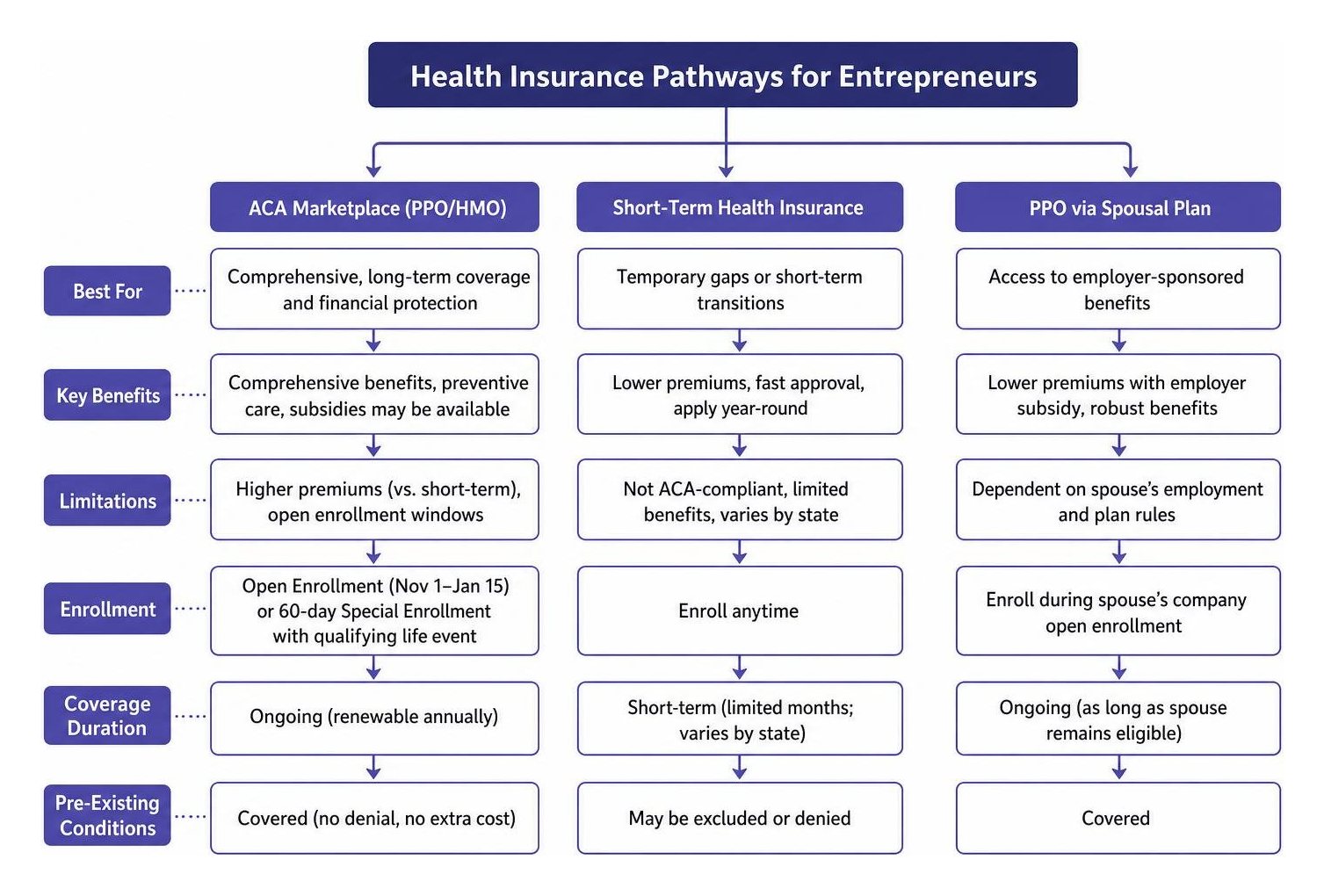
Short-term plans are designed to bridge temporary coverage gaps. They typically offer lower premiums and allow you to apply year-round with fast approval times. However, they are not ACA-compliant. They can deny coverage for pre-existing conditions, rarely cover maternity or mental health, and have strict duration limits that vary significantly by state.
If your spouse has access to an employer-sponsored plan, joining their policy is often the most cost-effective route. It typically offers robust benefits at a lower premium because the employer subsidizes a portion of the cost.
If you recently left a job, COBRA allows you to keep your previous employer's health plan for up to 18 months. However, because you must pay the entire premium yourself plus a 2% administrative fee, it is usually incredibly expensive. For most entrepreneurs, transitioning to a Marketplace plan during their 60-day SEP window is a much cheaper option.
If your business is in its early stages and your income is low, you might qualify for Medicaid. In states that expanded Medicaid, eligibility is based purely on income (typically up to 138% of the Federal Poverty Level). You can apply for Medicaid at any time of the year.
If you are a specialized independent contractor, such as a traveling medical professional or a freelance consultant, you might require a plan that travels with you. You can explore tailored PPO options through 1099 Health Coverage for Locum Tenens Providers | Ten99 Health. Additionally, if you prefer integrated medicine, you should learn how to get holistic care covered to ensure your therapies are eligible for reimbursement.

The rise of the gig economy has sparked new, customized benefits frameworks designed specifically for solopreneurs. Rather than trying to squeeze into a rigid corporate plan, you can build a customized captive health plan.
For instance, platforms like Solo Health Collective allow a "business of one" to establish a self-funded major medical health plan. These customized frameworks often utilize massive national PPO networks (like the Multiplan PHCS network) to give you access to over a million providers nationwide, without the geographic restrictions common to regional Marketplace HMOs.
Similarly, administrative suites like Besolo | Business of One Platform for Benefits, Taxes & Admin help solo business owners organize their operations. By bundling LLC or S Corp compliance with corporate-quality benefits like PPO health insurance, dental, and vision, these platforms act like your personal, outsourced HR department.
When designing your coverage, do not overlook supplemental options. Standard major medical plans rarely include comprehensive dental or vision care. Adding low-cost supplemental policies for dental, vision, or critical illness protection ensures that a sudden dental emergency or broken pair of glasses won't derail your business's cash flow.
Managing health insurance for entrepreneurs is not just a medical decision; it is a financial strategy. As your business grows, your health insurance choices will directly impact your tax liabilities and your ability to recruit talent.
For digital agency founders, scaling operations while managing administrative overhead like healthcare is a constant balancing act. Just as you look for smart ways to automate your business growth—such as using the automated SEO and content solutions from Adaptify SEO to scale your agency's organic reach without manual effort—you must also take a strategic, streamlined approach to your benefits.
The biggest challenge for self-employed individuals on the Marketplace is estimating their Modified Adjusted Gross Income (MAGI) for the upcoming year. Because your premium tax credits (subsidies) are based on this estimate, fluctuations in your business revenue can lead to surprises at tax time.
If you underestimate your income, you may have to pay back some or all of your premium subsidies when you file your taxes. If you overestimate, you will receive a refund for the credit you missed.
Additionally, the "subsidy cliff" returned in 2026. This means households earning more than 400% of the Federal Poverty Level (FPL) lose eligibility for federal premium subsidies entirely. Keeping a close eye on your monthly revenue and updating your Marketplace application as your income changes is the best way to avoid a costly tax bill.

Fortunately, the tax code offers excellent incentives to help offset the cost of health insurance for entrepreneurs:
If you are over age 65 or transitioning to Medicare, you can even explore specialized Medicare Advantage Medical Savings Accounts (MSAs), which operate similarly to an HSA for seniors. You can read more about these unique financial vehicles through the Business Owner/Self Employed – Fenyx Health Group MSA.
For a more comprehensive look at how financial professionals structure these benefits, take a look at our guide on navigating health insurance for accounting professionals.
As your business grows from a solo venture to an enterprise with employees, your health insurance strategy must evolve. Offering health insurance is one of the most powerful recruiting and retention tools available to small business owners.
If you have at least one W-2 employee (who is not your spouse or a business partner) and fewer than 50 full-time equivalent employees, you qualify for small group health insurance. Unlike individual plans, small group plans can be enrolled in year-round, and they often feature more robust provider networks and lower out-of-pocket maximums.
For fast-growing, venture-backed startups looking to attract top-tier talent, traditional group plans might not cut it. Tech-forward options like Rivendell - Health Insurance for Startups offer modern benefits like $0 net deductibles (via employer-funded HSAs), integrated mental health care, and dedicated Slack/iMessage support channels to help your team navigate their care seamlessly.
Choosing the right coverage takes time, but protecting your physical and financial health is the ultimate investment in your business's future. Take the time to evaluate your needs, consult a tax advisor if necessary, and choose a plan that gives you the peace of mind to focus on what you do best: building your business.

Master search engine optimization and marketing with proven SEO and SEM strategies that boost visibility, drive organic traffic, and deliv...

Discover health insurance for engineers: group rates via ASCE, IEEE, portable plans, small firm options, and pro tips to save.

Discover how medical SEO specialists elevate your practice with targeted strategies for local search, E-E-A-T, & patient growth.
Join 1,000+ agencies already delivering SEO and AI visibility from a single platform without increasing their headcount.Join 1,000+ agencies already delivering SEO and AI visibility from a single platform without increasing their headcount.