How to Win Friends and Influence SEO Clients




SEO business development is the practice of combining search engine optimization expertise with structured sales and partnership strategies to grow an agency's client base and revenue.
Here is a quick breakdown of what it involves:
Most agency owners already know SEO works. The research backs it up — SEO-generated leads close at a 14.6% rate, compared to just 1.7% for outbound methods like print or direct mail. And with 81% of shoppers researching products online before buying, the demand for SEO services has never been higher.
The problem is not demand. The problem is pipeline.
Many agencies are excellent at delivering SEO. They are not always excellent at selling it. Winning new clients requires a repeatable system — one that generates leads, qualifies them quickly, and converts them into long-term partnerships without burning through your team's time.
That gap between doing great SEO and growing a great SEO business is exactly what this guide is designed to close.
I'm Hansjan Kamerling, a product designer and marketing consultant who has helped scale digital platforms from early-stage startups to millions of users — and SEO business development sits at the intersection of strategy and growth that I've seen determine which agencies thrive and which stay stuck. In the sections ahead, I'll walk you through the systems, skills, and strategies that actually move the needle.
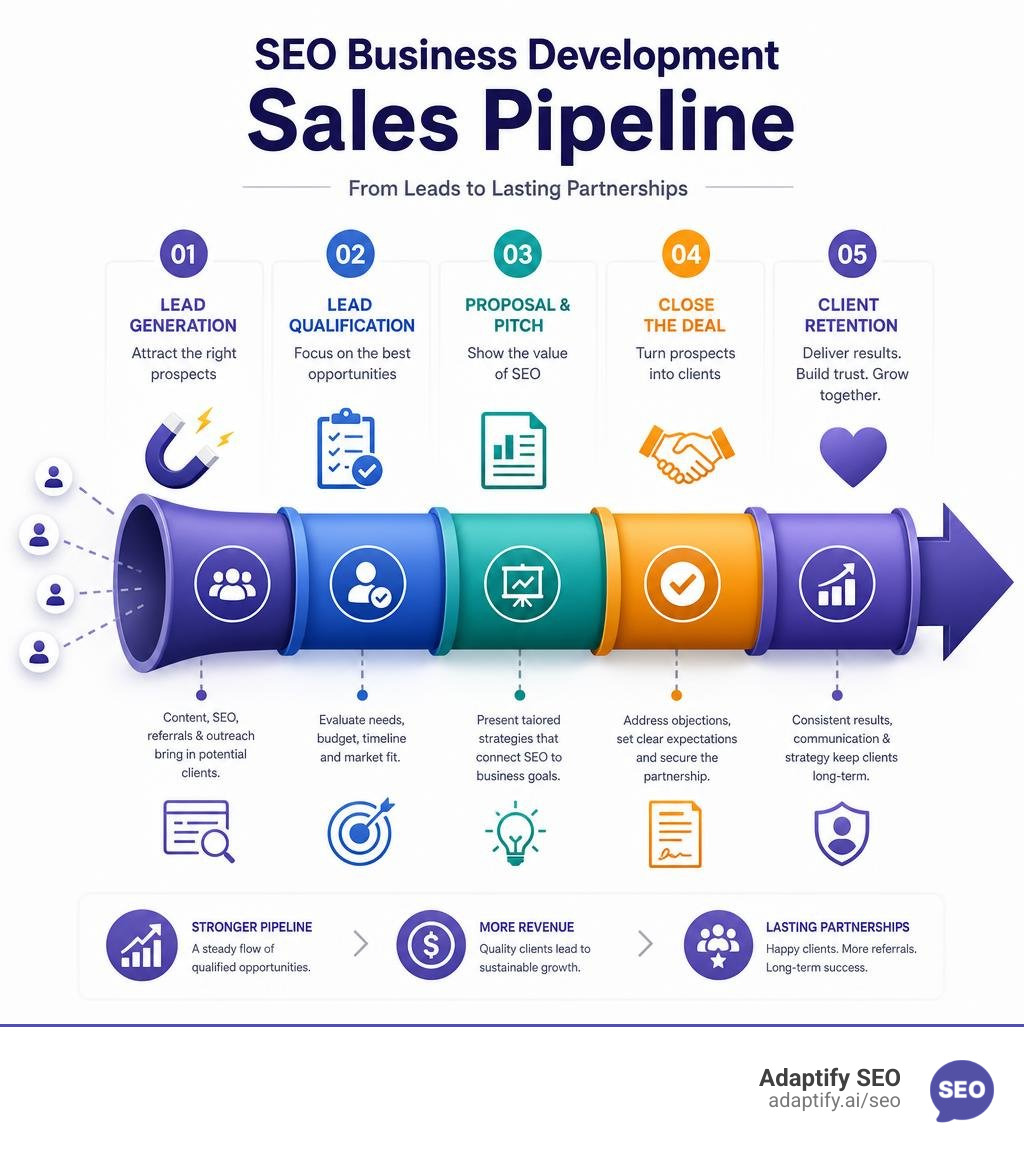
When many people hear "business development," they picture slick-talking salespeople cold-calling lists of strangers to hit a monthly quota. But in our industry, SEO business development is a completely different animal.
Traditional business development is often generalist; a sales representative might sell web design, custom software, or social media management using the exact same generic sales script. Traditional SEO, on the other hand, is highly technical, focusing entirely on delivery—optimizing meta tags, building backlinks, conducting keyword research, and monitoring digital analytics to move organic search rankings.
SEO business development bridges these two worlds. It is the strategic process of identifying, qualifying, and closing high-value organic search partnerships by translating technical SEO mechanics into tangible business growth metrics.

When I talk to agencies struggling to scale, the root cause is almost always a lack of specialized business development. They are trying to sell technical audits to business owners who do not know what a canonical tag is—and frankly, do not care. If you want to scale your operations, you need to stop selling "SEO services" and start selling "future revenue engine capacity."
To understand how to position your agency as a growth partner rather than a line-item expense, check out The Ultimate Guide to SEO for Agencies. By shifting your focus from search rankings to commercial scaling, you transform your sales conversations from technical lectures into strategic business consultations.
An SEO Business Development Manager (BDM) is the commercial engine of a modern marketing agency. Unlike a traditional account executive who simply handles incoming leads, or an SEO specialist who spends their day in code and content, the SEO BDM owns the entire growth pipeline.
Their core responsibilities include:
To understand how this role compares to standard sales positions, let's look at the differences:
| Responsibility | Traditional Sales Representative | SEO Business Development Manager |
|---|---|---|
| Primary Goal | Short-term transaction / quick close | Long-term partnership / sustainable organic growth |
| Key Metric | Volume of deals closed | Client lifetime value (LTV) and monthly recurring revenue (MRR) |
| Technical Knowledge | Low to moderate (product features) | High (crawling, indexing, search intent, algorithmic shifts) |
| Sales Approach | Feature-benefit pitching | Educational, consultative auditing |
| Proposal Focus | Pricing packages and deliverables | Customized commercial growth roadmaps |
This specialized career path is highly sought after by modern agencies. For a deeper look at what agencies expect from these professionals, you can explore the SEO Business Development Manager Position or review the expectations outlined in the Seer Interactive - Senior Business Development Manager role.
If your agency is ready to transition from chaotic founder-led sales to a predictable, structured revenue model, it may be time to Hire a Business Development Manager to Accelerate Growth so you can focus on high-level strategy while a dedicated professional builds your pipeline.
To succeed in this role, an individual must possess a unique blend of hard and soft skills. You cannot close a six-figure SEO contract with charm alone, nor can you close it by reading an XML sitemap aloud to a Chief Marketing Officer.
Not all leads are created equal. In fact, chasing the wrong clients is the fastest way to run an agency into the ground. A high-performing SEO BDM spends as much time qualifying leads out of the pipeline as they do nurturing them in.
To build a healthy sales pipeline, you must balance outbound prospecting with a robust inbound pipeline. If you want to learn how top-tier agencies build these systems from scratch, read The Ultimate Guide: How Digital Marketing Agencies Land New Clients.
When qualifying a lead, I recommend using a strict four-question filter before investing any time in creating a custom proposal:
An effective SEO business development strategy uses a hybrid model.
Inbound lead generation is your highest-converting channel. The most effective way to generate inbound leads is to rank for the actual problems your clients search for. For example, instead of trying to rank for "SEO services," create content targeting queries like "how to get more clients for my law firm" or "why is my Shopify store traffic dropping."
Additionally, leveraging LinkedIn organic by sharing real, anonymized Google Search Console screenshots and actionable frameworks builds immense authority.
Outbound prospecting, however, should not be ignored. Instead of sending automated cold emails to thousands of random webmasters (which usually end up in spam), focus on highly personalized, account-based marketing (ABM).
Find a business in your target niche, run a quick manual review of their site, and send a personalized video showing them three specific areas where they are losing traffic to their direct competitors. This shows value upfront and immediately separates you from the noise of generic sales pitches.
Once you have qualified a prospect, it is time to deliver a proposal that closes. Most agencies make the mistake of sending a 40-page technical audit filled with errors, warning signs, and jargon. This does not close deals; it just overwhelms the client.

A winning proposal should be concise, clear, and structured around the prospect’s business objectives. I recommend structuring your proposals like this:
For inspiration on how to position yourself as a high-value growth partner rather than a transactional vendor, look at how top consultants frame their value on sites like SEO Consultant & Growth Strategist | Shane McKay .
Furthermore, before you send your next proposal, make sure you understand how sophisticated clients evaluate agencies by reading Boost Your ROI: The Ultimate Guide to Evaluating Marketing Agencies. This knowledge will help you address their hidden objections before they even voice them.
To maximize your closing rate, implement the 3-3-3 rule of sales follow-up:
This level of discipline ensures you maintain momentum and show the prospect that your agency is highly responsive and professional.
The landscape of SEO is shifting faster than ever. As of June 2026, generative AI search overviews, algorithm updates, and shifting user behaviors are redefining how search engines work.
Google’s market share has adjusted slightly as users turn to alternative search platforms, and AI Overviews now trigger on nearly half of all tracked queries. For an SEO BDM, this means client education is a core part of the sales cycle.
You must explain to prospects that traditional keyword stuffing is dead. Today, search engines prioritize user experience, authoritative brand mentions, and conversational search patterns. We must optimize not just for traditional search engines, but for Generative Engine Optimization (GEO) and Answer Engine Optimization (AEO).
For many agencies, delivering this level of advanced, multi-faceted SEO across dozens of clients creates an operational bottleneck. This is where leveraging automation becomes a competitive advantage.
By using Adaptify.ai, agencies can automate technical strategy formulation, content creation, and high-quality PR link building using advanced AI workflows. This allows your team to scale without sacrificing quality, ensuring you can deliver on the ambitious promises made during the business development process.
If your agency is hitting a delivery ceiling and you are struggling to keep up with client demands, explore your options in Beyond Capacity: How to Effectively Outsource Your SEO. For agencies looking to expand their link portfolio efficiently, choosing between an Agency or DIY: The Ultimate Showdown for Backlink Building is a critical strategic decision.
Many successful agencies choose to white-label these complex operations to maintain high margins; you can learn how by reading The Secret Sauce: How White Label SEO Can Transform Your Business or checking out White Label Wonders: A Guide to Seamless Link Building Reselling.
An SEO Business Development Manager should focus on commercial metrics that directly impact agency growth:
AI has streamlined the sales cycle significantly. Instead of spending hours manually crawling a prospect's site to find errors, BDMs can use AI-driven prospecting tools to generate personalized audits in minutes.
Furthermore, AI helps model search trends and predict how optimizations will perform in Google's AI Overviews, giving prospects clearer projections of their future organic visibility.
Compensation for SEO Business Development Managers varies based on experience and location. In the United States, base salaries typically range from $85,000 to $125,000 per year, with total compensation reaching $100,000 to $150,000+ when uncapped commissions and performance bonuses are included. In the United Kingdom, base salaries generally range from £50,000 to £90,000 total compensation.
Winning new clients and scaling an agency does not require magic; it requires a structured, repeatable system for SEO business development. By focusing on qualification, translating technical SEO into business results, and leveraging modern automated workflows, you can build a pipeline of high-value, long-term partners.
If you are ready to remove the operational bottlenecks holding your agency back, Adaptify SEO Services offers a fully automated, AI-powered solution for strategy, content creation, and link building. Let us handle the delivery so you can focus on winning friends, influencing clients, and scaling your business.

Stop being invisible: discover what the best local SEO strategies for small businesses are to dominate Google Maps, reviews, and AI search...
Master localized SEO to rank your local business in Google Maps and drive more in-store visits.

Master local retail SEO to drive foot traffic from Google with proven strategies for GBP, reviews, and AI search optimization.
Join 1,000+ agencies already delivering SEO and AI visibility from a single platform without increasing their headcount.Join 1,000+ agencies already delivering SEO and AI visibility from a single platform without increasing their headcount.