What SEO Tasks Can Realistically Be Automated by SEO Automation Services?




SEO automation services are software tools and platforms that handle repetitive, time-consuming SEO tasks automatically — freeing your team to focus on strategy and creative work instead of manual grunt work.
Here is a quick breakdown of what they do and why they matter:
If you run an SEO agency, you already know the problem. There are only so many hours in a day, and a huge chunk of them disappear into audits, reports, rank checks, and meta tag updates. These are tasks that follow a clear, repeatable pattern — which means they are exactly the kind of work that machines can do faster, more consistently, and without burning out.
The numbers back this up. Over 60% of marketing teams already use AI tools to optimize performance. Teams that automate see 3x faster content delivery and 40% higher targeting accuracy. And 82% of enterprise SEO specialists plan to invest more in AI-powered tools for technical SEO automation in 2026.
The real question is not whether to automate. It is what to automate — and what to keep in human hands.
That line is blurry for a lot of agency owners right now. Some tasks are obvious candidates for automation. Others, if handed over to a machine without oversight, can quietly damage rankings or produce content that feels generic and off-brand.
This guide walks through exactly which SEO tasks can realistically be automated today, which ones cannot, and how to build a workflow that gets the best of both.
I'm Hansjan Kamerling, a product designer and marketing consultant who has built AI-driven SaaS products and growth systems for platforms with tens of thousands of users — experience that directly shapes how I approach SEO automation services at Adaptify. In the sections below, I'll break down the automation landscape so you can make smarter decisions about where to invest your team's time.
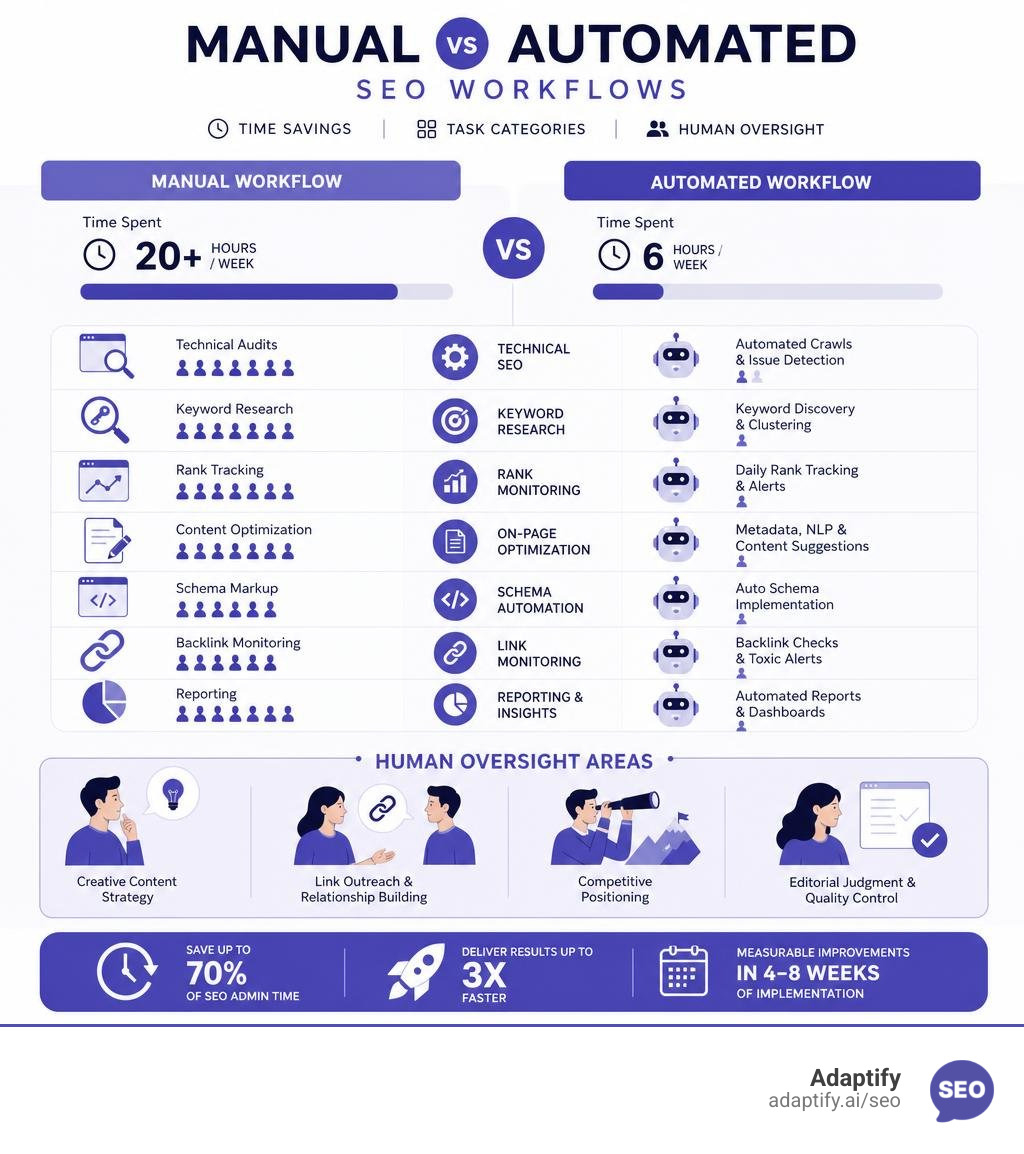
To understand how far we have come, we need to look at how modern seo automation services differ from traditional practices. Traditional SEO is highly manual and reactive. You run an audit, export a giant spreadsheet, manually group keywords, write briefs from scratch, and send reports at the end of the month.
Automated SEO shifts the heavy lifting to intelligent systems. By integrating directly with your marketing stack and CMS platforms, automation tools turn disconnected tasks into a streamlined pipeline.
To help you visualize where the line is drawn, here is a comparison of what can be fully automated, partially automated, or left entirely to humans. For a deeper dive into the fundamentals, check out our guide on Beyond Manual: What is SEO Automation and How Can It Help You.
| SEO Task Category | Manual Approach | Automated Approach | Human Oversight Needed? |
|---|---|---|---|
| Technical Auditing | Manual crawling, exporting CSVs, sorting issues. | 24/7 continuous scans, automated issue detection. | No (only for implementing complex architectural changes). |
| Keyword Research | Copy-pasting metrics, manual search intent guessing. | AI-driven clustering, real-time volume analysis. | Yes (to select final priority clusters aligned with business goals). |
| Content Generation | Blank-page drafting, manual optimization. | AI drafting, semantic scoring, optimization briefs. | Yes (essential for brand voice, fact-checking, and final edits). |
| Schema & Markup | Writing JSON-LD code by hand, manual testing. | Real-time schema generation based on page elements. | No (can be fully automated and pushed to CMS). |
| Backlink Monitoring | Checking link health and toxic links one by one. | Real-time link tracking, alert triggers for lost links. | Yes (for strategic outreach and relationship building). |
Technical SEO is highly deterministic. A page either has a canonical tag or it does not. A redirect is either broken or it works. Because these tasks rely on clear, binary rules, they are perfect candidates for full automation.
Instead of waiting for a monthly audit to find broken links or crawl errors, modern seo automation services scan your site 24/7. This real-time monitoring plays a massive role in protecting your rankings. If a developer accidentally pushes a change that breaks your Core Web Vitals or block-crawls your site via robots.txt, you will receive an alert within minutes rather than discovering the drop in organic traffic weeks later.
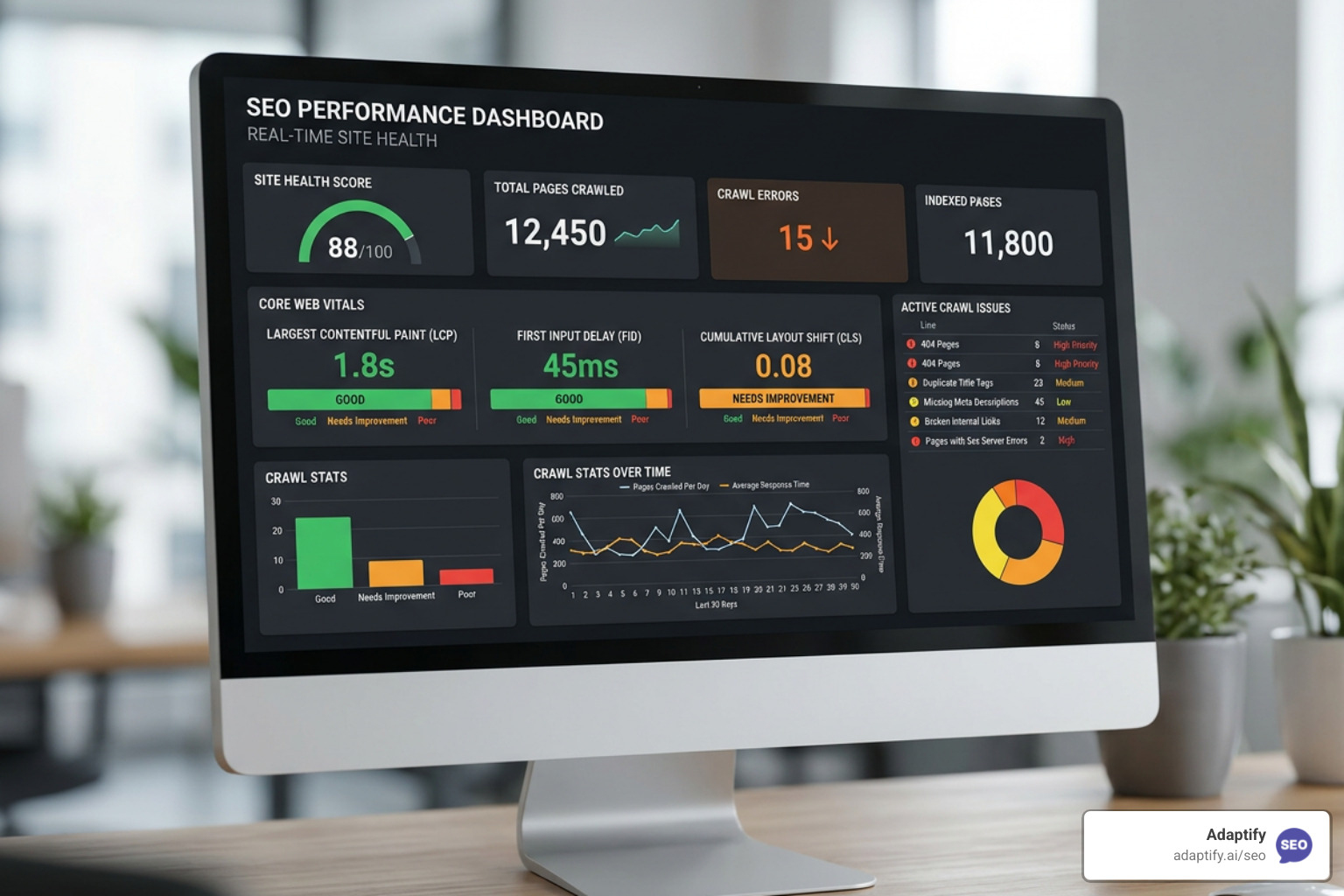
These tools integrate directly with Google Search Console to track indexing status and crawl optimization. In fact, automating technical scans saves teams up to 15+ hours per week. By identifying issues instantly, you can maintain peak site health without wasting your developers' time on manual diagnostics. To learn more about setting up these systems, read Beyond Manual: Unlocking Efficiency with Automated SEO Tasks.
Keyword research used to take days of filtering spreadsheets. Today, cloud-based SEO tools, which hold a 68% market share, handle this in seconds.
Modern automation tools do not just pull raw search volume; they analyze keyword intent, identify competitor gaps, and construct entire topical maps automatically. AI and machine learning power these tools by recognizing semantic patterns—grouping keywords into clusters so you can target a whole topic rather than a single phrase.
For agencies managing multi-location clients, local SEO has also received a massive upgrade. With 63% of local SEO platforms rolling out AI-based keyword suggestions, agencies can automatically map out localized search intent across dozens of zip codes in minutes. If you want to scale your local clients, our The Local SEO AI Automation Playbook outlines exactly how to build this workflow.
Can you fully automate content? The short answer is: you shouldn't, but you can automate about 80% of the workflow.
Writing content entirely on autopilot without human review is risky. However, using AI to research, draft, and optimize your content is incredibly effective. This approach saves over 15 hours per content plan and helps businesses achieve up to 3x faster content delivery.

Furthermore, search is shifting. With the rise of Generative Engine Optimization (GEO), optimizing only for traditional blue links is no longer enough. You need to optimize for AI search visibility so your brand gets cited in AI summaries like ChatGPT, Claude, and Google's AI Overviews.
Companies implementing AI-driven technical SEO and structured content fixes are achieving up to a 75% AI Overview capture rate and a 21% increase in keyword growth. To make sure your automated content meets quality standards, align your workflow with Google's guidance on AI-generated content. For a step-by-step strategy on balancing AI efficiency with human quality, read AI-Powered SEO: Automate Your Way to the Top.
If you need to scale your website to thousands of pages—such as directory listings, local landing pages, or e-commerce categories—manual creation is impossible. This is where programmatic SEO comes in.
Programmatic SEO uses structured datasets and templates to generate thousands of unique, high-quality, intent-matched pages fast. Combined with automated schema markup, these systems ensure that search engines can easily crawl, index, and understand your pages at scale.
Using automated templates guarantees that your brand voice, canonical tags, and index controls remain consistent across every page. This scalable infrastructure is why programmatic SEO has become a go-to strategy for high-growth startups and enterprise sites. You can explore how to master these high-scale strategies in our article, The Future is Now: Mastering Automated SEO for Better Results.
Link building is the most human-centric part of SEO. Building relationships, pitching journalists, and earning high-quality PR backlinks requires genuine human interaction.
However, the administrative tasks around link building can be fully automated. You can automate:
By automating your data collection and reporting, you can save up to 70% of your admin time. To decide if an automated approach to off-page authority is right for your agency, read The Auto-Pilot Approach to Backlinks: Is It for You? and learn how to stop wasting time on manual reports in Stop Wasting Hours and Automate Your SEO Reports Already.
Implementing seo automation services is not about replacing your team; it is about supercharging them. When you automate the repetitive, data-heavy tasks, your strategists can spend their time on what actually moves the needle: creative angles, brand messaging, and deep client relationships.
At Adaptify, we build automated SEO systems specifically for agencies. Our platform streamlines everything from keyword strategy and content creation to automated PR link building. We give your agency the leverage to scale your client list and deliver compounding organic growth without needing to constantly hire more hands.
Ready to see how much time your agency can save? Book an Adaptify Demo today, and let's put your repetitive SEO tasks on autopilot.

Learn how an SEO automation system streamlines keyword research, content workflows, and reporting to scale your search operations efficien...

Stop staring at blank pages. Use the best SEO article writing software to create optimized content that ranks in 2026.

Discover SEO agencies best practices for technical SEO, content strategy, and authority building that drive real revenue growth.
Join 1,000+ agencies already delivering SEO and AI visibility from a single platform without increasing their headcount.Join 1,000+ agencies already delivering SEO and AI visibility from a single platform without increasing their headcount.