The No-BS Guide to SEO Agencies Best Practices




SEO agencies best practices are the difference between organic growth that compounds over time and wasted budgets that produce nothing but pretty ranking reports.
Here is a quick summary of what the best SEO agencies actually do differently:
| Best Practice | What It Means in Practice |
|---|---|
| Revenue-focused KPIs | Track leads, conversions, and revenue — not just rankings |
| Three-pillar strategy | Balance technical SEO, on-page content, and off-page authority |
| Documented SOPs | Repeatable workflows that deliver consistent results at scale |
| E-E-A-T optimization | Build trust signals through expertise, authorship, and citations |
| AI search integration | Optimize for Google AI Overviews and generative engine citation |
| Transparent reporting | Clear communication connecting SEO activity to business outcomes |
| White-hat link building | Earn backlinks through digital PR and quality content — never shortcuts |
Google processes over 8.5 billion searches every day. On average, 69% of clicks go to the first five organic results. That means the gap between page one and page two is not a small difference — it is often the difference between a business growing and standing still.
Yet most businesses struggle to evaluate whether their agency is actually doing the right things. Vanity metrics like raw keyword rankings and traffic volume look impressive in a slide deck. They rarely tell you whether SEO is generating revenue.
The landscape has also shifted fast. In 2026, AI Overviews appear in over 16% of searches. FAQ rich results were deprecated in May 2026. The LCP threshold for Core Web Vitals dropped from 2.5 seconds to 2.0 seconds. Agencies that have not updated their playbooks are quietly falling behind while charging the same monthly retainer.
This guide cuts through the noise. It covers what separates top-performing agencies from average ones, how to evaluate a potential partner, and the specific practices that drive real, measurable results.
I'm Hansjan Kamerling, a product designer and marketing consultant who has applied SEO agencies best practices across SaaS platforms, fintech startups, and growth-stage products — including a data analytics platform with 40,000 users and a search experience used by millions across 33 online marketplaces. The patterns I have seen repeated across every high-performing engagement are exactly what this guide is built on.
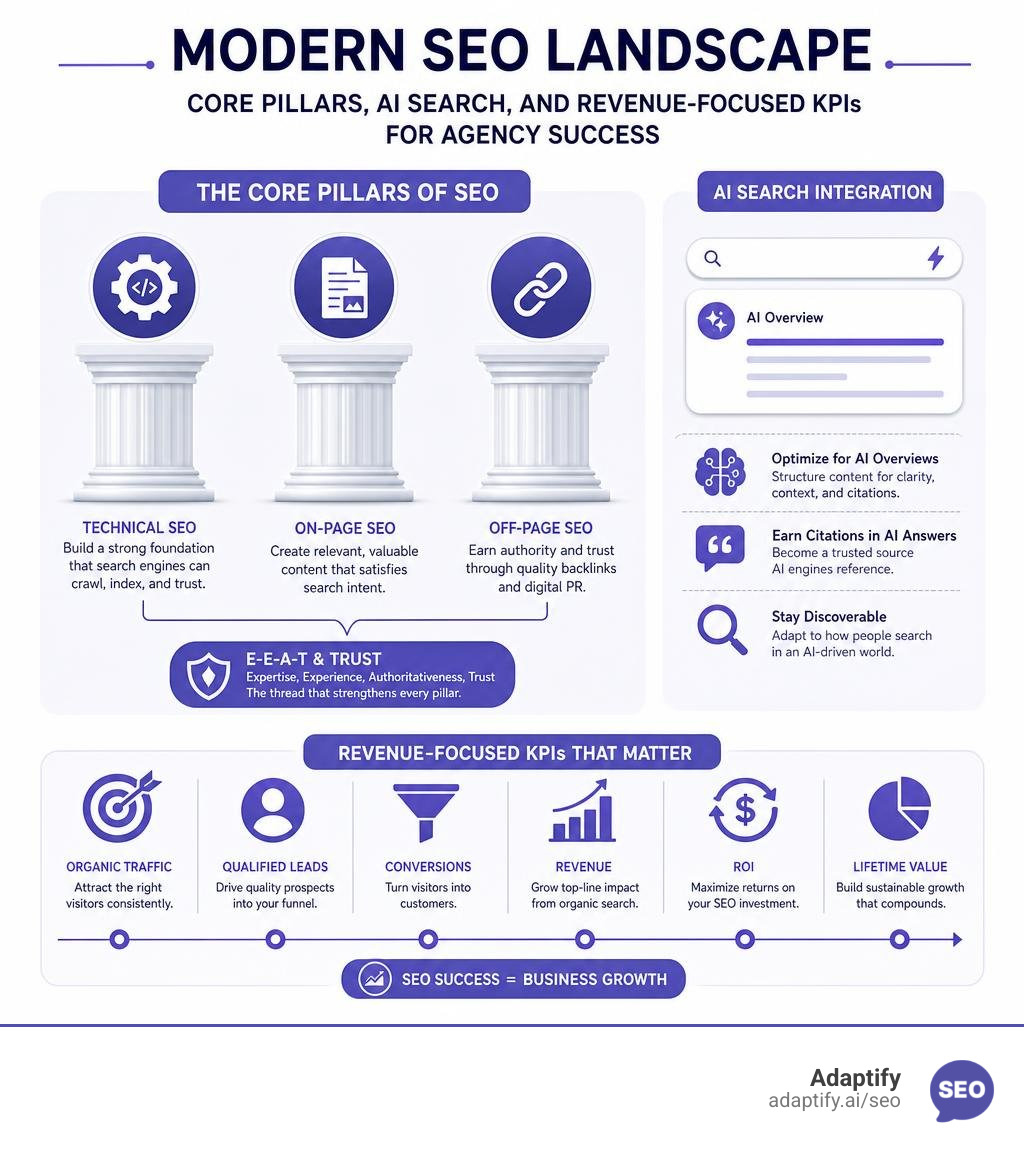
When I look at an agency's approach, I look for balance. If an agency focuses entirely on content creation but ignores site architecture, they are building a mansion on a swamp. If they focus solely on backlinks but ignore user experience, they are inviting guests to an empty house.

A truly comprehensive approach requires balancing the three pillars of search engine optimization: technical performance, on-page alignment, and off-page authority. Understanding how search engines work — from the initial crawl and indexation to the final ranking calculation — is essential.
Top agencies know that search engine operations rely on a finite crawl budget. If your site is bloated with duplicate pages, broken links, or slow-loading scripts, Google's crawlers will leave before finding your most important content. To learn more about how a balanced campaign transforms your bottom line, check out Unlock Your Potential: The Benefits of a Winning SEO Strategy.
Technical SEO is the foundation of your search engine visibility. If search engine crawlers cannot easily find, understand, and render your pages, your content will never rank.
The best agencies monitor your site's health weekly. They focus heavily on Core Web Vitals, which Google relies on to measure user experience. As of March 2026, the standard for a "good" Largest Contentful Paint (LCP) has dropped to under 2.0 seconds. Cumulative Layout Shift (CLS) must remain under 0.1, and Interaction to Next Paint (INP) must be under 200 milliseconds.
An agency should also optimize site architecture by eliminating redirect chains, ensuring secure HTTPS protocols, and maintaining clean XML sitemaps. They make sure the site is responsive across all devices, as 58 percent of online searches come from mobile devices. If your agency isn't regularly auditing your crawlability and indexation using tools like Google Search Console, they are missing the baseline of technical performance. For a solid understanding of these fundamentals, you can refer to the Google Search Central Starter Guide.
In 2026, content is no longer about keyword density; it is about topical authority and semantic relevance. Top agencies build structured topic clusters — a central pillar page supported by closely related spoke articles, all connected via internal links.
This clustered approach is critical for Generative Engine Optimization (GEO). Research shows that clustered content earns over three times more citations in AI Overviews than standalone pages. Additionally, AI crawlers like GPTBot and ClaudeBot often do not execute JavaScript, meaning agencies must serve content as server-side rendered HTML to remain eligible for AI search citations.
Your content must also demonstrate Google's E-E-A-T framework (Experience, Expertise, Authoritativeness, and Trustworthiness). The best agencies do this by:
For a deeper dive into structuring your content assets, see The Game Plan: Building an Effective Search Optimization Strategy.
Backlinks remain one of Google's strongest ranking signals. However, the days of buying cheap directory links or participating in reciprocal link schemes are long gone. Today, top agencies prioritize quality over volume.
They build domain authority through digital PR and high-quality journalist outreach. This involves creating "link bait" content — such as original research reports, surveys, and interactive tools — that natural publishers want to cite. They also run broken link reclamation campaigns and monitor unlinked brand mentions.
When evaluating an agency's link-building process, ask about their quality thresholds. They should have strict limits on spam scores, minimum Domain Rating (DR) requirements, and a clear strategy for maintaining natural anchor text diversity. To understand the operational differences between managing this in-house versus hiring external specialists, read Agency or DIY: The Ultimate Showdown for Backlink Building.
Choosing an agency is a major financial and strategic decision. The wrong partner won't just cost you your monthly retainer; they will cost you months of lost organic momentum.

When evaluating potential partners, look closely at their track record, transparency, and pricing models. Avoid agencies that hide behind "proprietary methods." If they cannot explain their keyword research, content prioritization, and technical auditing processes in plain English, they are likely using outdated tactics.
Request detailed case studies that show real business outcomes — such as growth in qualified leads, pipeline value, or direct revenue — rather than just raw traffic increases. To learn how to run a comprehensive evaluation of marketing agencies, read Boost Your ROI: The Ultimate Guide to Evaluating Marketing Agencies.
To help you quickly separate top-tier agencies from low-cost providers who rely on outdated shortcuts, I have mapped out the key differences below:
| Top-Tier Agency | Low-Cost Provider |
|---|---|
| Focuses on revenue, pipeline, and conversions | Focuses on vanity metrics like raw keyword volume |
| Conducts custom, in-depth technical and content audits | Offers generic, automated "one-click" checklists |
| Complete transparency with direct tool access | Secretive tactics and hidden workflows |
| Custom content built on E-E-A-T and original data | Low-quality, mass-produced content with keyword stuffing |
| White-hat digital PR and editorial link outreach | Bulk backlink packages from private blog networks (PBNs) |
A major red flag is any agency that guarantees top search rankings. Google explicitly warns against this. Because search engine algorithms change constantly, no legitimate provider can guarantee a position-one ranking.
Instead, look for partners who focus on sustainable, long-term growth and understand your specific industry challenges. For a comprehensive look at how professional search services scale B2B organizations, check out Beyond the Basics: Understanding B2B SEO Services for Sustainable Business Growth.
The fastest-growing agencies in 2026 are not necessarily those with the most talented individual strategists. They are the ones that have successfully turned talent into repeatable, scalable systems.
They do this by building comprehensive Standard Operating Procedures (SOPs). An effective SEO SOP includes five core elements: a clear trigger, step-by-step instructions, inputs and outputs, a designated owner, and a strict quality standard.
By standardizing workflows for technical audits, keyword research, content briefs, and link outreach, agencies ensure that every client receives senior-level output, regardless of which account manager is assigned to the project. To see how top agencies structure these internal workflows, refer to The Ultimate Guide to SEO for Agencies.
The first 30 days of an agency partnership set the trajectory for the entire engagement. A chaotic onboarding process breeds doubt that even the best technical work cannot easily repair.
Top agencies use a structured, multi-step onboarding framework to transition from a signed contract to active campaign execution:
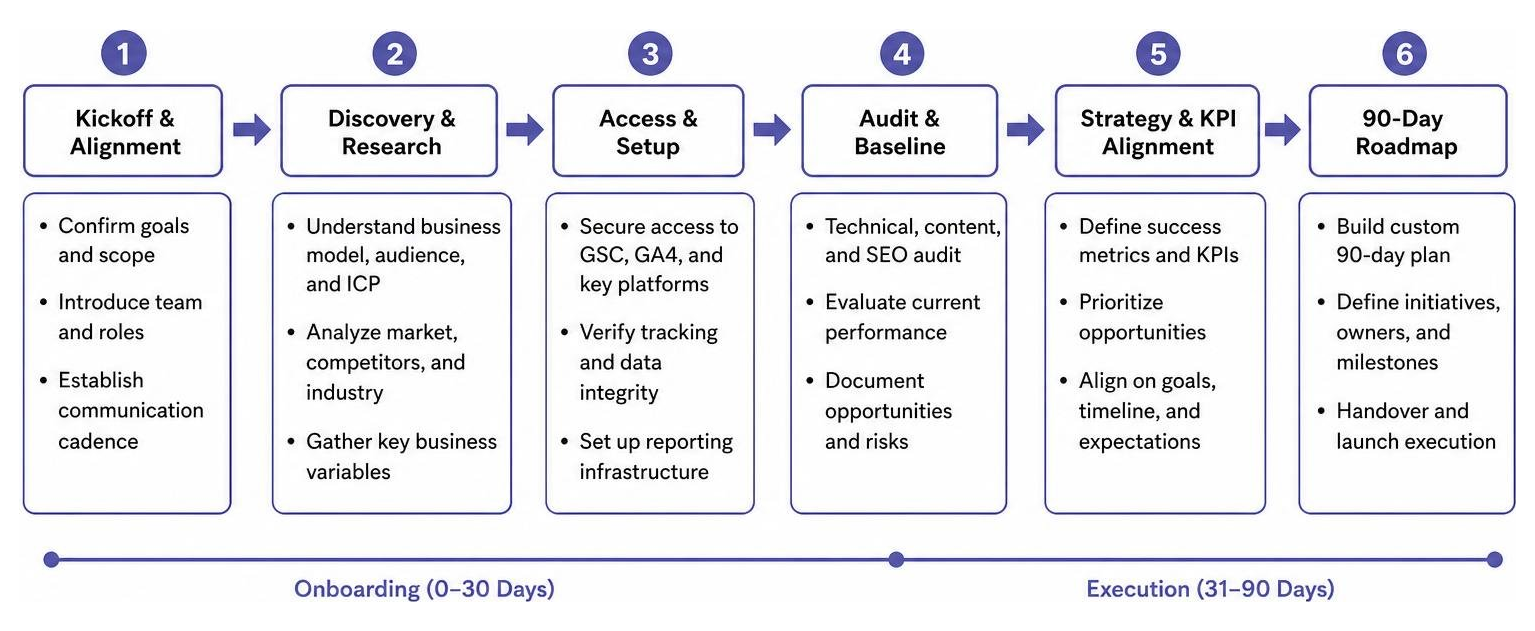
During this phase, agencies gather business variables, run a structured discovery sequence, and provision access to essential tools like Google Search Console and Google Analytics 4. They establish a clear baseline of your current organic performance and align on KPIs before building a custom 90-day execution roadmap.
This is where modern automation makes a massive difference. At Adaptify.ai, we specialize in providing automated SEO services designed specifically for agencies. By streamlining time-consuming processes like keyword strategy formulation, content creation, and PR link building using advanced AI, we help agencies eliminate manual bottlenecks. This allows teams to focus on high-level strategy, client communication, and driving measurable ROI. To explore how automation is reshaping agency operations, read The Future is Now: Mastering Automated SEO for Better Results.
The search landscape in 2026 is faster, more technical, and more competitive than ever. Winning organic traffic requires a commitment to SEO agencies best practices — from technical excellence and topical authority to transparent, revenue-connected reporting.
If you are an agency looking to scale your operations, reduce manual overhead, and deliver consistent, high-quality results for your clients, it is time to embrace automated workflows. Explore how Adaptify can streamline your strategy, content, and link building by visiting Adaptify.ai.
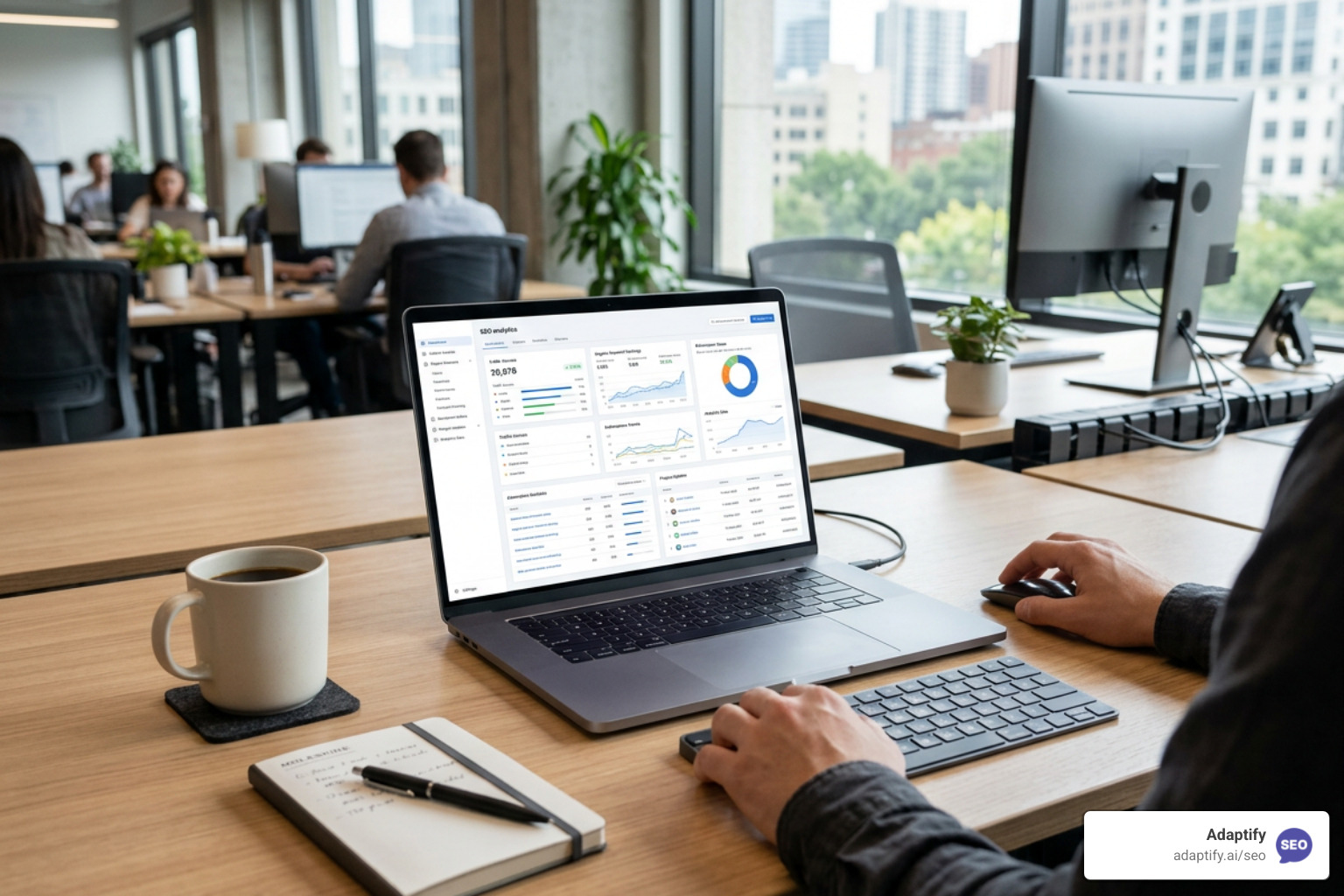
Learn how an SEO automation system streamlines keyword research, content workflows, and reporting to scale your search operations efficien...

Discover what SEO tasks seo automation services can realistically automate for faster audits, keyword research, and content optimization.
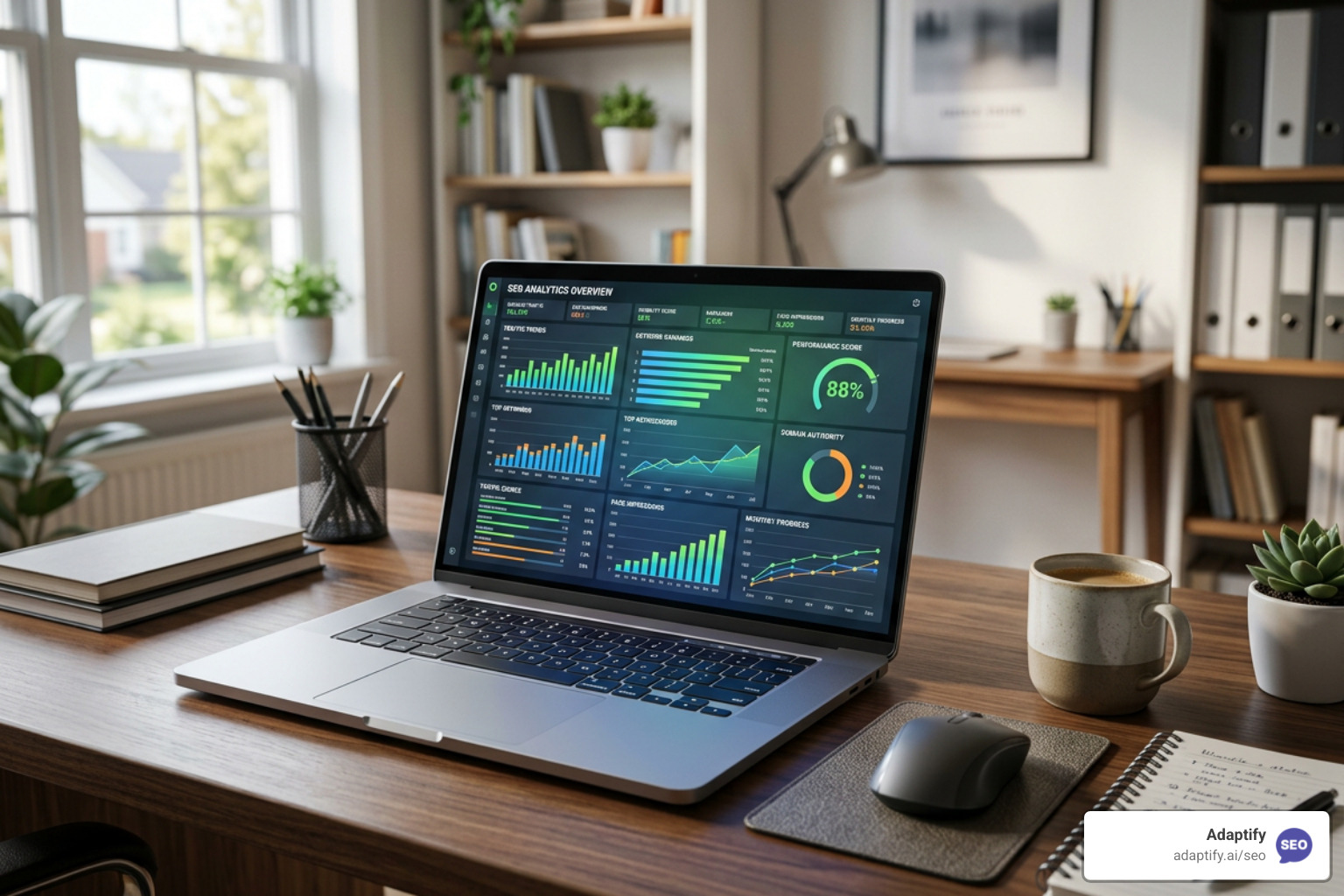
Stop staring at blank pages. Use the best SEO article writing software to create optimized content that ranks in 2026.
Join 1,000+ agencies already delivering SEO and AI visibility from a single platform without increasing their headcount.Join 1,000+ agencies already delivering SEO and AI visibility from a single platform without increasing their headcount.