Work Smarter, Not Harder: Choosing the Perfect SEO Automation System


An SEO automation system is a connected set of software, data sources, and workflows that handles repeatable SEO work - from keyword discovery and content briefs to publishing, monitoring, and client reporting - while people retain control of strategy and quality.
For agency owners, the key distinction is simple:
| Individual SEO tools | SEO automation system |
|---|---|
| Solve one task at a time | Connect tasks into one repeatable workflow |
| Require manual copying, checking, and handoffs | Move data between research, content, CMS, and reporting automatically |
| Can add tool sprawl | Create a clear operating system for SEO delivery |
| Help people work faster | Help an agency produce consistent work at scale |
The right system can remove the grunt work that slows teams down: pulling search data, grouping keywords, building first-pass briefs, formatting drafts, tracking rankings, spotting content decline, and refreshing dashboards. It should not replace sound judgment. Search strategy, client context, original ideas, editorial review, and quality backlink relationships still need experienced people.
That balance matters. One practitioner reported cutting blog production from roughly eight hours to no more than three by automating supporting steps while keeping the actual writing human-led. For an agency, those saved hours can become room for better strategy, more client work, and stronger quality control.
I am Luke Heinecke, CRO at Adaptify, with more than nine years in marketing and agency operations, including founding and exiting a performance marketing agency. I have worked closely with teams building an SEO automation system to reduce manual work across research, content, links, publishing, and reporting without treating automation as a substitute for expertise.
When agencies tell me they are struggling to scale their search engine optimization operations, the issue is almost never a lack of skilled people. It is tool fragmentation.
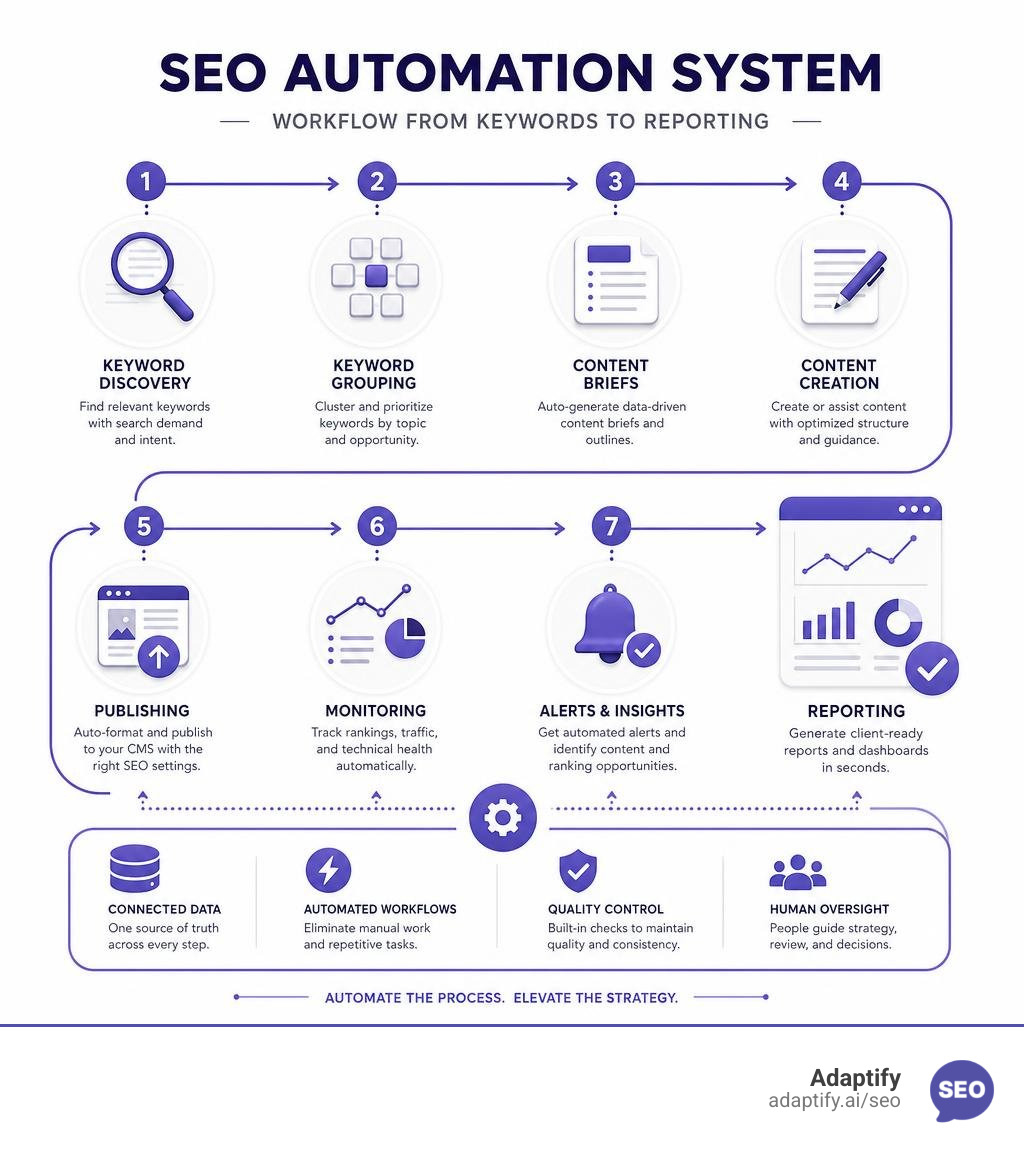
A modern SEO automation system shifts your business away from disconnected tasks toward systemic workflow orchestration. Instead of treating SEO as a series of isolated chores, a connected platform links data flows and programmatic tasks together so your team spends energy on strategy rather than administration.
Most agencies rely on an patchwork stack: one platform for keyword research, another for rank tracking, spreadsheets for clustering, Google Docs for writing, and manual logins to update client CMS platforms.
This approach creates data silos. Your account managers waste hours copying metrics between tabs, re-formatting content briefs, and manually emailing writers.
An integrated SEO automation system replaces manual handoffs with smooth API integrations and automated process connectivity. To understand how connecting these nodes transforms daily operations, read our deep dive on Beyond Manual: What Is SEO Automation and How Can It Help You. When data flows directly between search analytics tools, content engines, and publishing channels, your agency eliminates human copy-paste errors and reclaims billable hours.
Not every search optimization task belongs in an automated pipeline, but heavy operational workflows certainly do. The ideal tasks for an SEO automation system include:
If you are wondering where to draw the line between software execution and human strategy, explore What SEO Tasks Can Realistically Be Automated by SEO Automation Services.

To build a reliable search infrastructure, you need to understand how the system layers fit together. A scalable architecture uses node-based flows to move information from initial data scraping through content enrichment and into CMS synchronization without manual intervention.
Content production is historically the largest operational bottleneck for growing agencies. In a manual setting, creating a single landing page or long-form blog post can take anywhere from 8 to 10 hours from topic ideation to publication.
By designing an end-to-end content workflow within your SEO automation system, you drastically reduce cycle times. The system handles brief generation, outline creation, keyword placement, and internal link suggestions automatically.
Our internal testing and partner feedback show that automated supporting steps cut landing page and blog creation down to 2 to 3 hours per asset—while leaving full editorial control in human hands. Learn more about optimizing your publishing pipeline in Beyond Manual: Unlocking Efficiency with Automated SEO Tasks.
Finding low-competition opportunities at scale requires evaluating thousands of terms simultaneously. Manual SERP review simply does not scale when managing dozens of client accounts in 2026.
An automated engine connects keyword intent models with real-time SERP scraping to group search terms by topical authority. Instead of building manual spreadsheets, your system evaluates ranking difficulty, groups primary and secondary keywords into coherent page maps, and hands your content team a ready-to-write strategy. For a complete breakdown of this process, see Unlock Your Site's Potential: Automated SEO Analysis Explained.
Automated reporting is more than just sending a monthly PDF to clients; it is an early warning system for content performance.
By connecting Google Search Console data with continuous search tracking, your SEO automation system monitors click trends and alerts you the moment historical pages experience content decay. Sorting pages by click drops over comparative timeframes allows your team to refresh declining articles before traffic loss impacts business outcomes. Read our full guide on constructing a central operations hub in Your SEO Command Center: Mastering Tasks with a Management Platform.
Choosing software requires balancing operational speed against delivery quality. Here is how manual SEO compares to a fully automated agency workflow:
| Workflow Step | Manual SEO Process | Integrated SEO Automation System |
|---|---|---|
| Keyword Research | Export CSVs, manually sort, group in spreadsheets (4–6 hours) | Automated scraping, AI clustering, intent mapping (15 minutes) |
| Content Briefs | Manually inspect top 10 SERP results, paste headings (2 hours) | Programmatic brief generation with heading patterns and entities (5 minutes) |
| Content Creation | Write, format, upload, tag, and add links manually (6–8 hours) | Automated outline generation, human writing/editing, direct CMS sync (2–3 hours) |
| Client Reporting | Manually take screenshots, compile slides (3–5 hours per client) | Real-time, white-label dashboards connected to search data (Automated) |
The financial justification for implementing an automated system comes down to labor costs. Manual SEO requires high-salaried strategists to spend upwards of 60% of their working hours on administrative data handling.
When you implement an SEO automation system, you eliminate hidden operational drag. A team that previously managed five client accounts per account manager can seamlessly handle fifteen or twenty without burning out or compromising output quality. To calculate your agency's efficiency savings, review Hidden Labor Costs: Manual SEO vs Automated Platforms.
The biggest mistake I see agency leaders make is attempting to automate 100% of their strategic thinking or content generation. Fully unguided AI writing leads to generic articles, inaccurate details, and severe brand risk.
Human oversight must remain central to your architecture. Use your SEO automation system to handle data gathering, structure creation, draft staging, and technical tracking—but require experienced human strategists to review campaign directions and human editors to polish publishable content. Check out Robots, Humans, and Rankings: The SEO Automation Reality Check to understand how to preserve strategic balance.
Yes, an advanced SEO automation system can execute continuous site crawls to detect broken links, missing meta descriptions, redirect loops, and crawling errors. Certain platforms can even inject auto-generated schema markup directly into CMS headers or suggest automated technical fixes, though major structural site updates should always be reviewed by a developer.
Systems protect quality by inserting mandatory human review gates into the workflow. Rather than auto-publishing AI drafts directly to client sites, the system generates detailed briefs and initial outlines, forcing drafts through human editorial checks for tone, brand context, and factual accuracy before final CMS distribution.
Modern systems require very little custom coding. Most agencies deploy automation using no-code workflow builders, standard API integrations, and pre-built webhooks. If your team understands basic trigger-and-action logic, you can construct a connected system within a few days.

Scaling an agency in 2026 does not require hiring an army of junior analysts to copy data across spreadsheets. By deploying a connected SEO automation system, you give your team the infrastructure needed to deliver top-tier search strategy, high-ranking content, authoritative link acquisition, and white-labeled reporting in a fraction of the time.
At Adaptify, we help growth-focused agencies automate their organic search operations end-to-end. From multi-channel strategy and automated content generation to digital PR link building and white-labeled reporting dashboards, our platform gives you a complete engine for client success.
Ready to transform your agency operations and reclaim your billable hours? Explore Adaptify features or request a live demo today to see our automated SEO system in action.

Discover what SEO tasks seo automation services can realistically automate for faster audits, keyword research, and content optimization.

Stop staring at blank pages. Use the best SEO article writing software to create optimized content that ranks in 2026.

Discover SEO agencies best practices for technical SEO, content strategy, and authority building that drive real revenue growth.
Join 1,000+ agencies already delivering SEO and AI visibility from a single platform without increasing their headcount.Join 1,000+ agencies already delivering SEO and AI visibility from a single platform without increasing their headcount.