AI in SEO Is Here to Stay Here’s What Actually Matters


AI in SEO is the use of artificial intelligence to improve how websites rank, how content gets created, and how search engines find and present information to users.
What AI in SEO actually covers:
Search has changed permanently. Users no longer just scan a list of blue links. They get synthesized answers pulled from multiple sources, generated in real time by AI. Google's AI Overviews, ChatGPT, Perplexity — these tools act as intermediaries between your content and your audience.
The implication for agency owners is significant. The manual SEO playbook — researching keywords one by one, refreshing content by hand, guessing at what Google wants — is no longer fast enough.
Two forces are colliding at once. Search engines are using AI to generate smarter, more personalized results. And SEO teams are using AI to keep pace with those engines. Both are accelerating.
The data backs this up. According to McKinsey, generative AI is projected to deliver $460 billion in incremental productivity in marketing over the next decade. And 58% of SEO professionals already plan to integrate generative AI into their workflows this year.
This is not a future trend. It is already reshaping how search works — and who wins visibility in it.
I'm Hansjan Kamerling, a product designer and marketing consultant at Adaptify AI, with a background building AI-powered products for startups and scaling platforms used by millions — experience that directly informs how I approach AI in SEO strategy. In this guide, I'll walk you through what actually matters: from how AI is changing search infrastructure to the practical workflows that help agencies scale SEO without the grunt work.
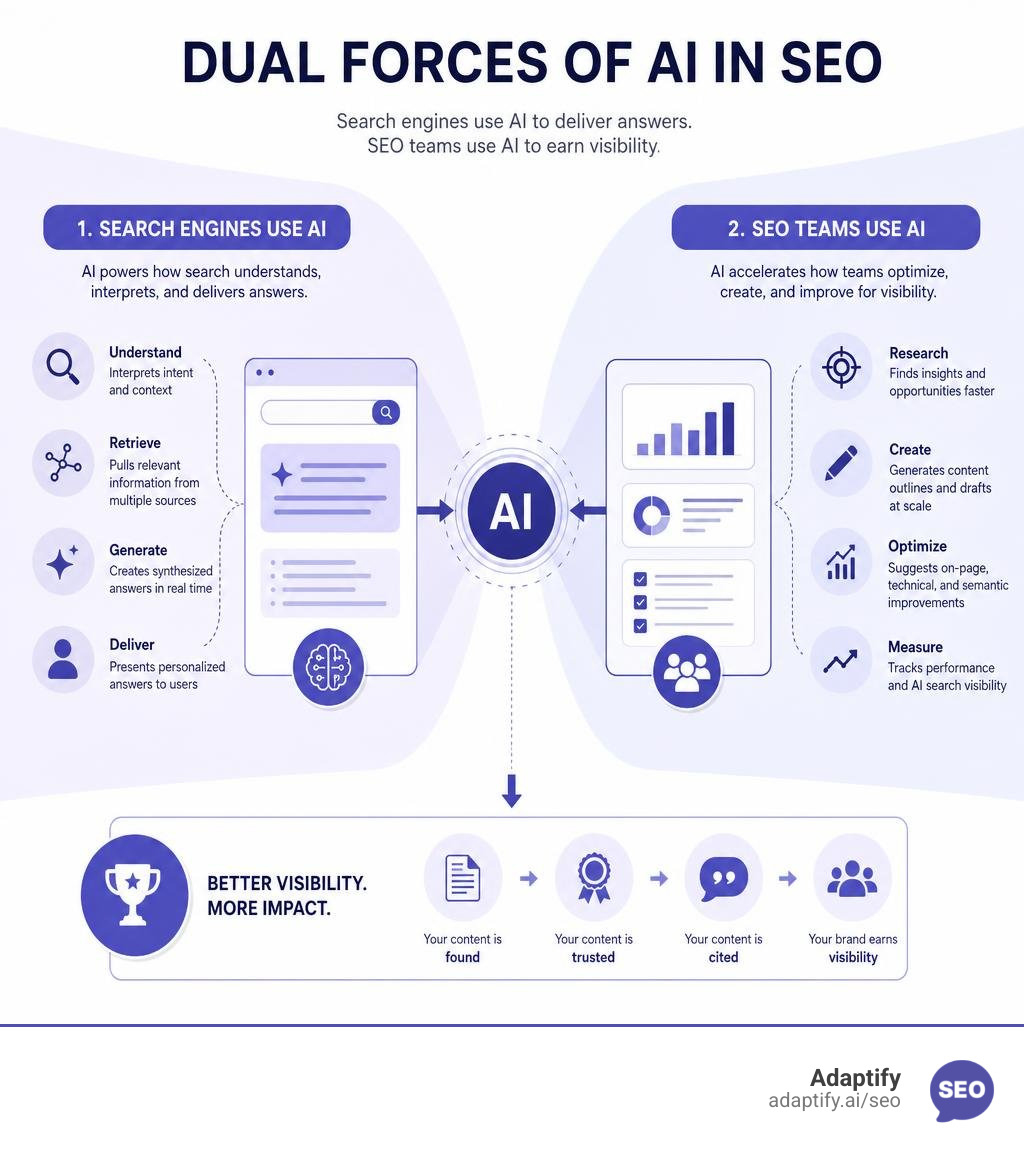
To succeed in the modern search landscape, we have to look under the hood of how search engines actually retrieve information today. The old model of crawling, indexing, and ranking based on simple keyword matches has evolved into something much more dynamic.
Today's search systems rely heavily on two core mechanisms: Retrieval-Augmented Generation (RAG) and query fan-out.
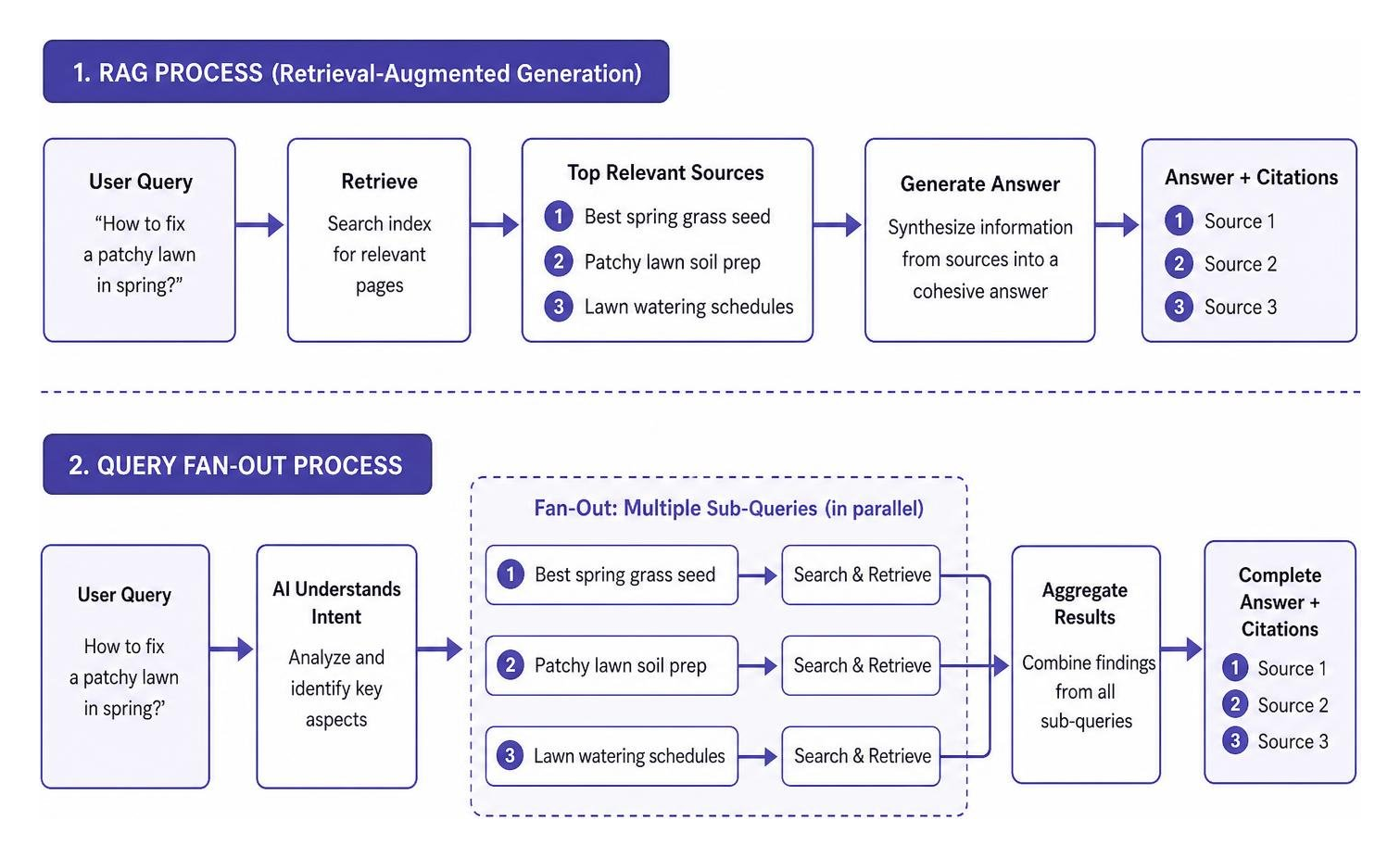
Retrieval-Augmented Generation (RAG) is the process where an AI system takes a user's query, fetches relevant, authoritative web pages from its search index, and synthesizes those pages into a single, cohesive answer. Instead of forcing the user to visit five different sites to compare information, the AI does the reading for them and lists the sources as citations.
At the same time, search engines use "query fan-out." When a user inputs a complex query, the AI system splits it into multiple concurrent, related sub-queries to gather a complete picture. For example, a search for "how to fix a patchy lawn in spring" might trigger background queries for "best spring grass seed," "patchy lawn soil prep," and "lawn watering schedules."
This shift has birthed two new concepts in the search community:
Understanding these mechanisms is crucial if you want to leverage The AI Advantage: Adapting Your SEO for the Generative Era to keep your agency's clients ahead of the curve.
In traditional SEO, we optimized for the "ten blue links." We focused on head terms, keyword density, and raw backlink volume. In the era of AI-powered search, the focus shifts to intent, context, and passage-level relevance.
AI models do not index whole pages as single blocks of text anymore. They slice content on formatting boundaries—like headings, bulleted lists, and tables—to pull self-contained passages that answer highly specific questions. This means the unit of competition has changed. You are no longer just trying to rank your entire page first for a broad keyword; you are trying to make sure your specific paragraph is the one chosen to answer a user's long-tail query.
This change opens up a massive opportunity for smaller websites. In traditional search, a massive domain authority gap might prevent a small business from ever reaching page one. However, studies show that ChatGPT cites pages ranking in traditional organic positions 21 or worse almost 90% of the time, provided those pages contain highly specific, extractable answers. By focusing on intent and passage-level clarity, smaller sites can bypass traditional page-one competition entirely.
Furthermore, optimizing for these conversational queries pays off. Users arriving from non-Google AI search platforms often convert up to 4.4 times better than standard organic search visitors. Why? Because the AI has already done the heavy lifting of educating them. By the time they click your citation, they already know you have the exact solution to their problem. To prepare your business for this shift, you must focus on Future-Proofing Your SEO: Adapting to AI's Evolution by 2025.
Google's AI Overviews (formerly SGE) represent the most significant change to the SERP in a generation. To ensure your clients' sites are cited in these blocks, you need a targeted, tactical playbook.
First, we must understand how AI Overviews pick their sources. They rely on Google's core ranking and quality systems, meaning your foundational SEO must be spotless. But to win the actual citation, you need to structure your content for extraction.
Here are the high-impact tactics that work right now:
For a deeper dive into these strategies, you can read the comprehensive guide on How to Optimize for Google AI Overviews in 2026: A Playbook - LLM Pulse .
Keyword research is the foundation of any SEO campaign, but doing it manually for dozens of clients is an operational bottleneck. This is where AI excels, allowing agencies to scale their output dramatically.
Today, 60% of marketers use AI tools to research keywords, while 48% use them to brainstorm content ideas, and 38% use them to build content briefs and outlines.
Instead of looking at keywords as isolated search queries, I use AI to group keywords into semantic clusters. By analyzing search intent, AI can automatically group hundreds of search terms into a single topic hub. This allows us to map out a client's entire topical authority roadmap in minutes rather than days.
AI also streamlines competitor gap analysis. By feeding competitor sitemaps or top-performing URLs into an AI analyzer, you can instantly identify the exact topics and subheadings your competitors are ranking for that your clients are missing. This data can then be used to generate comprehensive, optimized content briefs for your writing team. To see how these workflows can give your agency an edge, explore AI SEO Tools: Your Secret Weapon for Search Domination.
While AI is incredibly powerful, letting it run on complete autopilot without human oversight is a recipe for disaster. The most successful agencies use AI to handle the volume and data processing, but rely on human experts for strategic judgment and quality control.
About 34% of marketers currently use AI to update or refresh existing content—a highly effective use case. Over time, content naturally loses its search visibility. AI can analyze your existing pages against current SERPs, identify outdated statistics or missing subtopics, and suggest quick refreshes.
However, when using AI to draft or optimize content, you must keep the "human-in-the-loop." Purely AI-generated content often lacks brand voice, original insights, and emotional resonance. It can also introduce "hallucinations"—factual errors presented as absolute truths.
My advice for implementing AI in your agency's content workflow:
By establishing these guardrails, you can safely Automate Your Way to the Top: Mastering AI for SEO Success.
Traditional rank tracking—monitoring whether you are in position #1 or #3 for a specific keyword—only tells half the story in 2026. To prove your value to clients, you must track your visibility inside AI search features.
Google Search Console is beginning to roll out specialized reporting for generative AI features, but manual tracking of AI Overviews across different devices and locations is virtually impossible to scale.
To solve this, we track the "share of answer" metric. This measures how often your client's brand is cited across a cluster of high-intent, conversational queries within a specific niche.
Additionally, we must shift our reporting metrics from raw, site-wide traffic to engaged user actions. Because AI search users are highly pre-educated, they may drive less "informational" traffic to your site, but the traffic that does arrive is far more likely to convert. Tracking form submissions, demo sign-ups, and direct sales from AI referral sources is the true measure of success in the generative era. Learn more about setting up these advanced tracking frameworks with AI-Powered SEO: Automate Your Way to the Top.
As with any major industry shift, the rise of AI in search has brought a wave of myths and misconceptions. Let's clear up what actually matters—and what you can completely ignore.
llms.txt file to rank in Google AI Overviews.
Google has officially confirmed that its search crawlers ignore llms.txt files for ranking and generative features. While these files can be useful for guiding non-Google AI crawlers, they do nothing for your Google visibility.The integration of AI into the search landscape is not a temporary trend or a gimmick. It represents a fundamental evolution in how information is organized, retrieved, and consumed. For marketing agencies, this evolution presents a clear choice: adapt and scale, or get left behind.
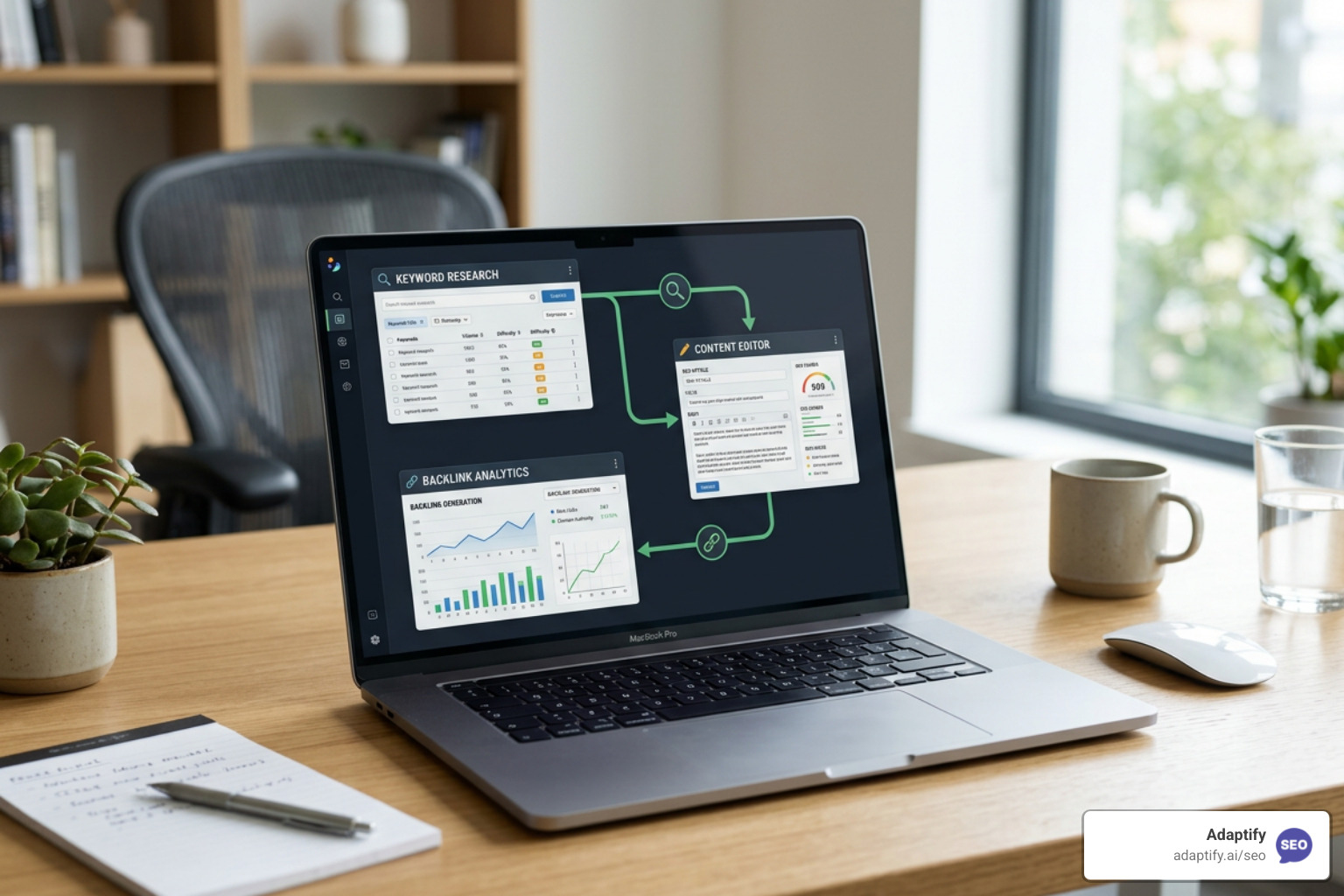
At Adaptify.ai, we build the tools that allow agencies to thrive in this new era. We automate the repetitive, time-consuming tasks of SEO—from initial keyword clustering and competitive gap analysis to content brief generation and PR link building.
By automating your base-level SEO workflows, you eliminate human error, slash your operational costs, and free up your team to focus on high-level strategy and client relationships. You do not need a massive headcount to scale your agency's revenue; you just need the right technology.
If you are ready to transition your agency from manual workflows to a high-efficiency, AI-driven growth engine, it might be time to bring in specialist expertise. Read more about why partnering with an expert is the right move in The Brains Behind the Bots: Why You Need an AI SEO Consultant.
Ready to see how automation can transform your agency's bottom line? Start Your Free Trial with Adaptify today and take control of the AI search frontier.

Stop being invisible: discover what the best local SEO strategies for small businesses are to dominate Google Maps, reviews, and AI search...
Master localized SEO to rank your local business in Google Maps and drive more in-store visits.
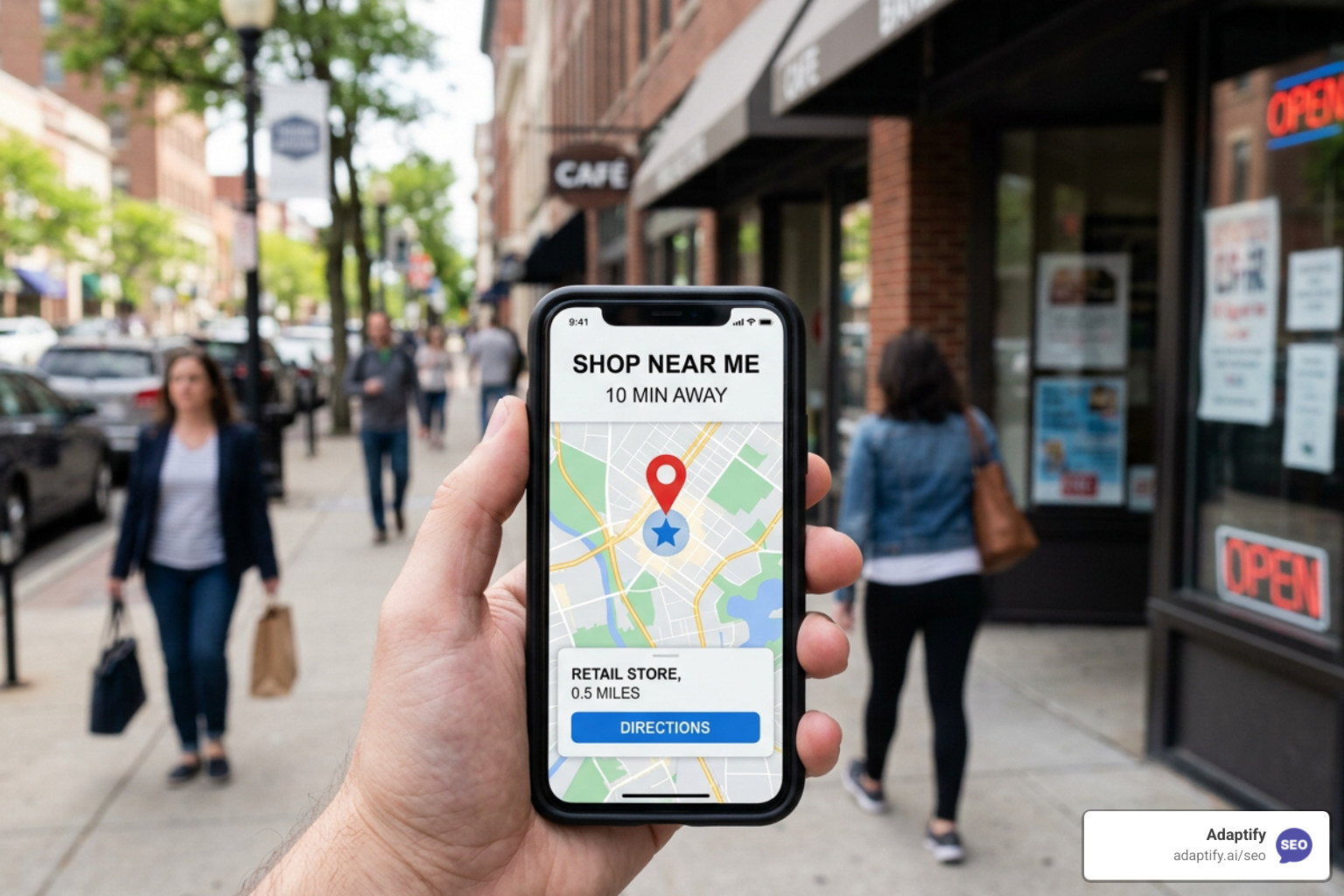
Master local retail SEO to drive foot traffic from Google with proven strategies for GBP, reviews, and AI search optimization.
Join 1,000+ agencies already delivering SEO and AI visibility from a single platform without increasing their headcount.Join 1,000+ agencies already delivering SEO and AI visibility from a single platform without increasing their headcount.