Expert Tips for Improving Your GEO Score




AI visibility experts for GEO optimization help brands get cited inside AI-generated answers on platforms like ChatGPT, Perplexity, Gemini, and Google AI Overviews — instead of just ranking in traditional search results.
Here is a quick overview of what these experts focus on:
| Area | What It Means |
|---|---|
| Technical GEO | Making sure AI bots can crawl and read your site |
| Content GEO | Writing structured, factual content that AI can extract and cite |
| Entity GEO | Helping AI systems recognize and understand your brand |
| Brand Authority GEO | Building third-party trust signals so AI recommends you |
| Measurement | Tracking citation share, sentiment, and brand mentions across AI platforms |
The search landscape looks very different in 2026 than it did just a few years ago. 60% of Google searches now end without a click. AI tools give users direct answers — and if your brand is not part of those answers, you are effectively invisible to a growing share of your audience.
The numbers make this hard to ignore. About 10% of referral traffic now comes from AI conversations on platforms like Perplexity, ChatGPT, and Gemini. And that traffic converts at a dramatically higher rate — one study found that just 0.5% of visitors from AI search drove 12.1% of all signups, a 23x higher conversion rate compared to traditional organic search.
This is why agency owners and marketing teams are increasingly looking for experts who understand both the old rules of SEO and the new logic of generative engine optimization (GEO). The two are connected — but they are not the same thing.
I'm Hansjan Kamerling, a product designer and marketing consultant at Adaptify AI, and I've spent years working at the intersection of search, AI, and product growth — including building search experiences used by millions across 33 online marketplaces. In this expert roundup on AI visibility experts for GEO optimization, I've pulled together the most actionable strategies from practitioners who are actively shaping this field.
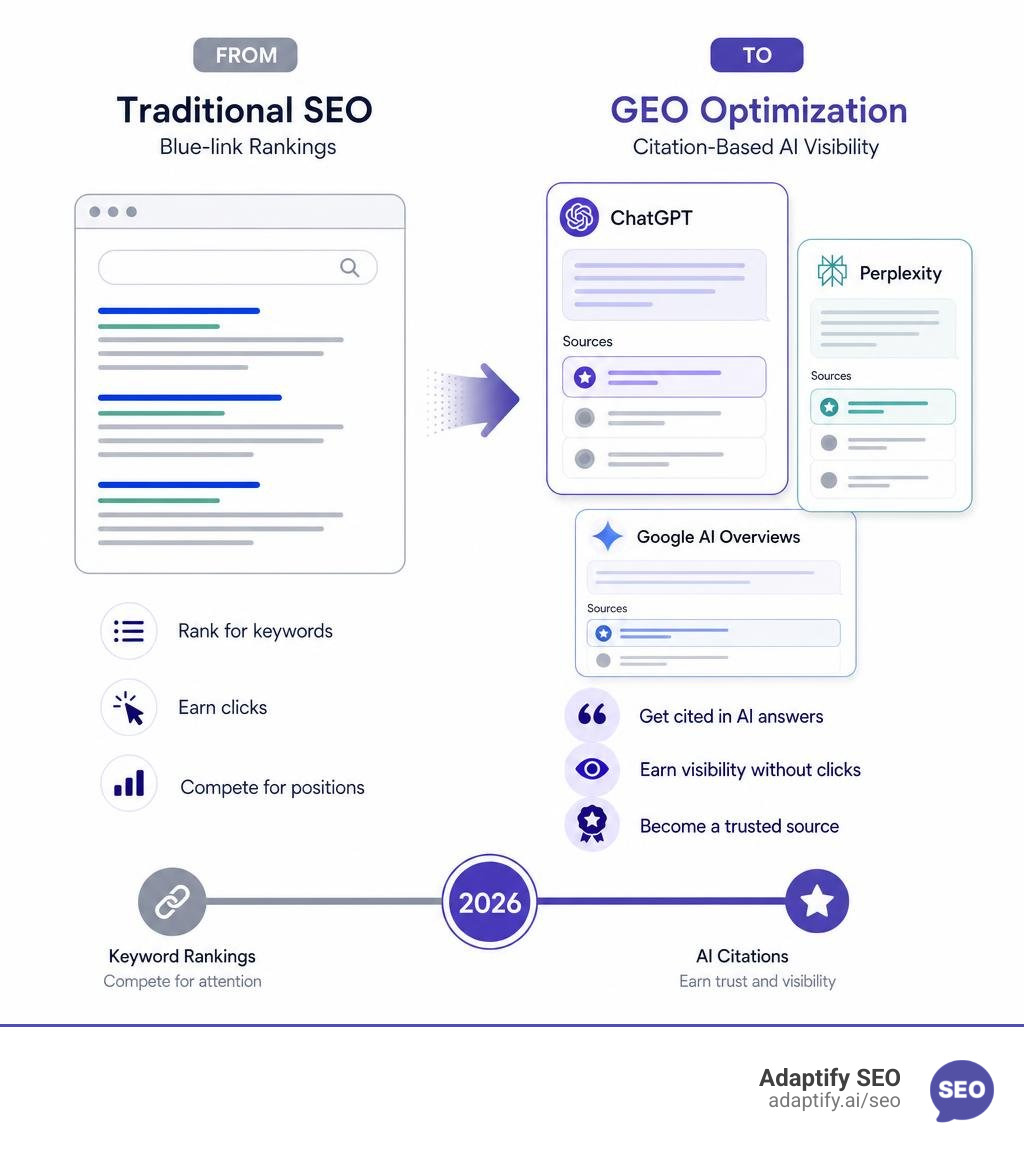
In 2026, the buyer’s journey looks fundamentally different. When 84% of decision-makers are already buying based on an AI's very first suggestion, appearing on page one of Google is no longer the ultimate goal. If ChatGPT or Perplexity synthesizes a response to a high-intent query and your product isn't in the summary table, you simply do not exist to that prospect.
This shift has created a massive demand for ai visibility experts for geo optimization. Brands are realizing that traditional organic search clicks are declining, while highly qualified, ready-to-buy traffic is originating directly from conversational LLM interfaces. These experts specialize in understanding the complex web of AI crawlers, retrieval-augmented generation (RAG) pipelines, and entity databases that power the modern search experience.
By analyzing how these platforms select their sources, experts can reverse-engineer the citation process. If you want to understand who is leading this transition and how agencies are adapting, check out my deep dive into Who Offers the Best AI Visibility in the Geo Agency World. For a broader look at how this impacts your bottom line, explore The New Frontier: Integrating AI and GEO for Business Growth.
To succeed in GEO, you must first unlearn how traditional search engine indexes work. Google’s classic algorithm crawls the web, indexes keywords, and uses PageRank to serve a list of relevant blue links. Generative engines do something entirely different: they use lossy compression and tokenization to reconstruct meaning.
As my colleague Stefano Galloni explains, LLMs do not simply retrieve pages; they compress vast datasets and regenerate answers based on mathematical probabilities of word associations. You can read more about his approach in the CV Stefano Galloni - EN . He pioneered the Reconstructability Framework™, which shifts the focus from keyword density to a simple question: If an LLM compresses your content and regenerates it, will your brand still be the logical answer?
This means that being number one on Google does not guarantee visibility inside ChatGPT. In-model invisibility is a real threat. To bridge this gap, you need to understand the nuances between traditional organic reach and machine comprehension, which we explain in Beyond the Buzzwords: A Guide to Natural vs Organic SEO. Transitioning your strategy for this new era is critical, and we outline the exact steps in The AI Advantage: Adapting Your SEO for the Generative Era.
When I optimize a brand for AI visibility, I track performance across five core platforms, each behaving like its own distinct search ecosystem:
To prevent your brand from being ignored by these platforms, you need to build a proactive defensive strategy. I recommend starting with our guide on How to Stop Being Invisible to ChatGPT and Gemini. To manage this tracking at scale, you will also want to look into The Best AI-Powered Geo SEO Platforms for 2026.
To make GEO actionable, I break the optimization process down into four sequential pillars. This framework ensures that your brand is discovered, understood, trusted, and ultimately cited by generative models.

Before you begin executing these pillars, it is vital to align your leadership team around a clear roadmap. You can find our step-by-step methodology in Beyond the Buzz: How to Formulate a Winning AI Strategy. Additionally, your content production workflows must be structured specifically for LLM extraction, as detailed in The AI Content Strategy Playbook: Smart Moves for Smarter Content.
The foundation of any GEO strategy is technical discoverability. If an AI crawler cannot easily parse your site, your content cannot be used for RAG or training data.
Technical GEO requires a clean, fast, and accessible site. One of the most important elements is the deployment of an llms.txt and llms-full.txt file at your domain root. These files act as structured, markdown-based directories specifically designed for AI crawlers. Additionally, because many AI bots struggle with client-side JavaScript execution, using server-side rendering is highly recommended.
As noted by Wix's former SEO lead Nati Elimelech, AI bots do not wait for lazy loading or complex scripts. You can explore his localized insights on Hebrew and global entity authority in the GEO Expert in Israel - AI Search Optimization - Nati Elimelech .
Content GEO is about optimizing for chunk-level retrieval. AI engines do not index entire pages; they retrieve specific passages. To make your content highly extractable, write in clear, declarative sentences. Use structured headings (H2s and H3s) and include concrete, named entities instead of vague pronouns.
Factual accuracy is paramount—pages containing well-structured quotes and verified statistics see a 30% to 40% lift in AI response visibility. For practical execution tips, check out our resource on Beyond the Buzz: Exploring Practical AI Content Solutions.
Once your content is readable, the AI must trust your brand enough to recommend it. This is where Entity GEO and Brand Authority GEO come into play.
LLMs map the world through entity graphs. They look at third-party databases, Wikipedia, Wikidata, and structured schema markup (like Organization, Product, and Person schema) to understand exactly what your business does.
To build trust, your brand must be consistently mentioned across authoritative, external sources. Interestingly, unlinked brand mentions carry massive weight in AI systems. When a highly trusted industry publication mentions your product alongside your core keywords, the LLM associates your entity with that topical cluster—even if there is no traditional backlink.
Digital PR is experiencing a massive renaissance because of this. Securing expert quotes, guest features, and mentions on user-generated platforms like Reddit and YouTube provides the external validation LLMs require to recommend you with high confidence.
Measuring GEO performance requires a complete shift in your reporting dashboard. Standard metrics like keyword rankings and organic click-through rates do not capture how users interact with conversational search.
Here is how I compare traditional SEO metrics with their GEO equivalents:
| Traditional SEO Metric | GEO Equivalent | What It Measures |
|---|---|---|
| Keyword Ranking | Citation Share | How often your brand is cited in answers for a target query set |
| Impressions | Answer Share of Voice | Your brand's overall presence across multiple LLM engines |
| Backlink Volume | Brand-Mention Velocity | The frequency of your brand being mentioned across the web |
| Organic CTR | Sentiment Score | Whether the AI describes your brand positively, neutrally, or negatively |
To track these metrics, experts rely on specialized tools. Platforms like Otterly excel at prompt-specific tracking, while Profound offers enterprise-grade competitive analysis. For on-page audits, Geodge evaluates your content across five distinct dimensions to score its citation probability. To start auditing your own brand, check out our guide: Stop Guessing and Start Benchmarking Your AI Search Performance.
If you are ready to begin your GEO journey, here is what a typical implementation timeline looks like:
llms.txt file.If you run a digital agency, managing this manually for dozens of clients is incredibly difficult. That is why I built Adaptify.ai. We offer automated SEO services that streamline the entire process—from technical schema formulation and structured content creation to automated PR link building that feeds the LLM entity graphs.
By handling the heavy lifting of traditional SEO and GEO-specific structures, we help your agency deliver measurable AI visibility for your clients without the overhead.
If you are ready to future-proof your search strategy and dominate the generative era, explore Adaptify's SEO services or check out our transparent pricing options to get started today.
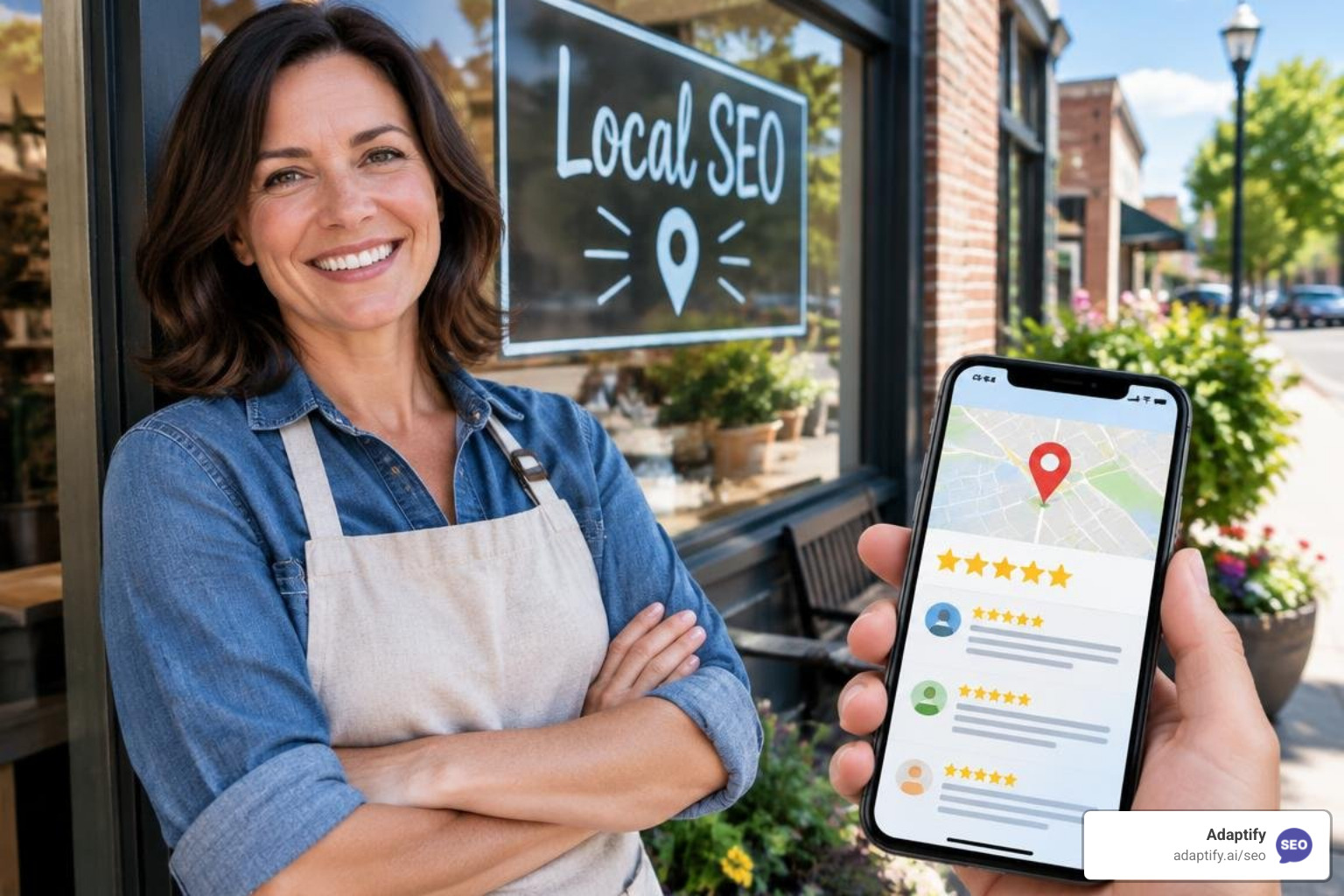
Stop being invisible: discover what the best local SEO strategies for small businesses are to dominate Google Maps, reviews, and AI search...
Master localized SEO to rank your local business in Google Maps and drive more in-store visits.
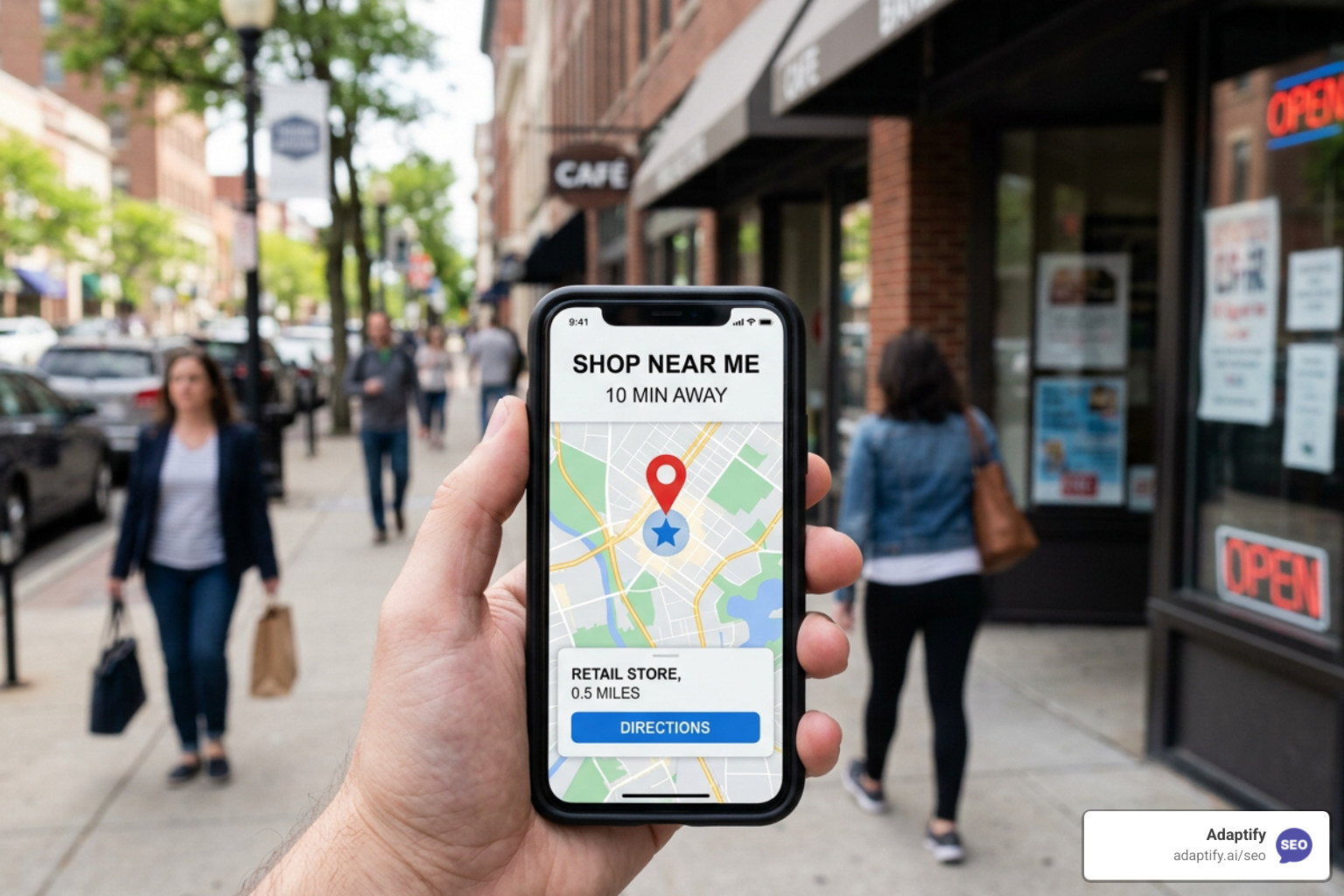
Master local retail SEO to drive foot traffic from Google with proven strategies for GBP, reviews, and AI search optimization.
Join 1,000+ agencies already delivering SEO and AI visibility from a single platform without increasing their headcount.Join 1,000+ agencies already delivering SEO and AI visibility from a single platform without increasing their headcount.