The Best AI Powered GEO SEO Platforms for 2026




AI powered GEO SEO is changing how websites get discovered — and if you run an agency, you need to know which platforms are built for this new reality.
Here are the top AI powered GEO SEO platforms for 2026 at a glance:
| Platform | Best For | Key Feature |
|---|---|---|
| Adaptify SEO | Agencies scaling GEO workflows | Automated audits, citation building, GEO schema |
| Profound | Enterprise brand monitoring | AI answer tracking across LLMs |
| Ahrefs Brand Radar | Brand mention tracking | AI citation and mention monitoring |
| geo-lint | Developer teams | Open-source GEO linting with 97 rules |
| GEO AI Core | Technical implementation | llms.txt generation, AI crawler management |
| GEO Optimizer (geo-optimizer-skill) | Site-wide AI readiness scoring | 0-100 AI citation readiness score |
| BreznGEO | WordPress sites | Automated GEO signals on publish |
Search is not what it was two years ago. When someone asks ChatGPT, Perplexity, or Google AI Overviews a question, they get a direct answer — not a list of ten blue links to scroll through. The website that gets cited in that answer wins the click. The ones that don't get cited? They're invisible, no matter how well they rank on a traditional SERP.
The numbers tell the story clearly. AI-referred traffic has grown +527% year over year. That traffic converts at 4.4x the rate of traditional organic search. And Gartner predicts that search traffic to websites will drop by 50% by 2028 as AI answers absorb more queries.
Yet only 23% of marketers are actively investing in Generative Engine Optimization (GEO). That gap is a real opportunity — especially for agencies who move early.
The challenge is tooling. Traditional SEO platforms were built for a world of keywords, backlinks, and rankings. GEO requires a different set of signals: structured content, brand mentions, llms.txt files, AI crawler access, and citation density. Most legacy tools don't measure any of that.
This guide is specifically for agency owners who want to compare the platforms that do handle GEO — so you can decide which one fits your workflow and your clients' needs.
I'm Hansjan Kamerling, a product designer and marketing consultant who has helped scale platforms from fintech startups to marketplaces used by millions, and through my work at Adaptify AI I've spent the last few years studying how AI powered GEO SEO is reshaping content strategy for agencies at scale. The platforms below are the ones worth your time in 2026.
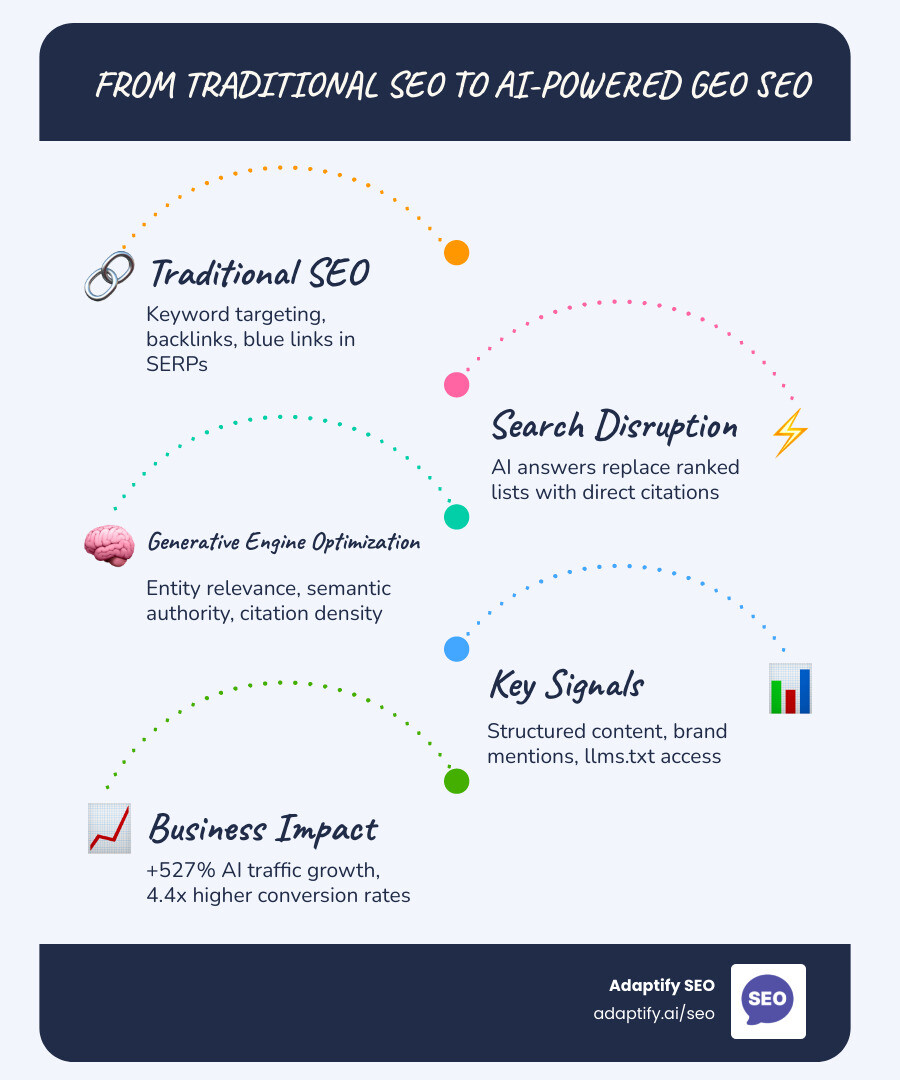
To win in the modern search landscape, we have to understand the core mechanical shift from indexing pages to training models. Traditional SEO was a game of keywords, backlink counts, and technical crawlability. AI powered GEO SEO, or Generative Engine Optimization, is entirely about model relevance and entity resolution.
When an AI engine like ChatGPT, Perplexity, Google AI Overviews, or Bing Copilot receives a query, it does not look for a list of pages containing exact keyword matches. Instead, it uses Retrieval-Augmented Generation (RAG) to find factual, contextually-dense paragraphs that directly answer the prompt. If you want a technical overview of the concept, retrieval-augmented generation is the process of combining information retrieval with generative AI outputs. It resolves entities (your brand, your product, your founders) and assesses their semantic relevance and authority across the web.
This is why we are seeing a massive rise in the zero-click experience. Users get their answers directly inside the chat interface. If your site is not cited as a source, you miss out on high-intent traffic.
If you are new to this concept, I highly recommend checking out our Beginner's Guide to GEO AI SEO to get grounded in the basics. Once you understand the baseline, you can read about The AI Advantage: Adapting Your SEO for the Generative Era to understand how these models think.
To help visualize this paradigm shift, I have mapped out how traditional search metrics compare directly to GEO metrics:
| Metric Category | Traditional SEO Focus | AI Powered GEO SEO Focus |
|---|---|---|
| Primary Goal | Rank #1 on search result pages | Secure direct citations inside AI answers |
| Input Signal | Search keywords and search volume | User prompts and conversational intent |
| Authority Proof | Backlink volume and Domain Authority | Entity mentions, Wikidata, and E-E-A-T signals |
| Content Structure | Long-form articles optimized for keywords | Direct Answer Blocks, tables, and Q&A schema |
| Success Metric | Click-Through Rate (CTR) and Pageviews | Reference Rate and Sentiment Score |
If you want your content to be cited by large language models, you have to format it in a way that their scrapers and encoders prefer.
First, use citable claims. AI models love numbers, statistics, and concrete data. Research shows that pages containing clear quotes and statistics enjoy a 30% to 40% higher visibility in AI responses. Instead of writing "Our software makes teams much faster," write "Our software delivers an 80% reduction in metadata update times."
Second, every page should open with a Direct Answer Block. This is a self-contained, fact-rich passage of roughly 134 to 167 words that directly answers the primary question of the page. AI crawlers use these exact blocks as ready-to-use snippets for their generative summaries.
Third, make heavy use of FAQ formatting and schema-rich data. Applying JSON-LD structured data (specifically Organization, FAQPage, and Article schema) can lift LLM extraction accuracy from a mere 16% to 54%.
Finally, configure your technical infrastructure to invite AI bots. Ensure your robots.txt explicitly allows AI crawlers like GPTBot, ClaudeBot, and PerplexityBot. You should also deploy an llms.txt file at your root directory-this is a markdown file that acts as a structured, machine-readable directory specifically for AI models.
For local businesses, the stakes are even higher. I discuss how AI assistants are changing local search discovery in our guide, Local SEO is Dead, Long Live GEO: Boosting Local Visibility in AI.
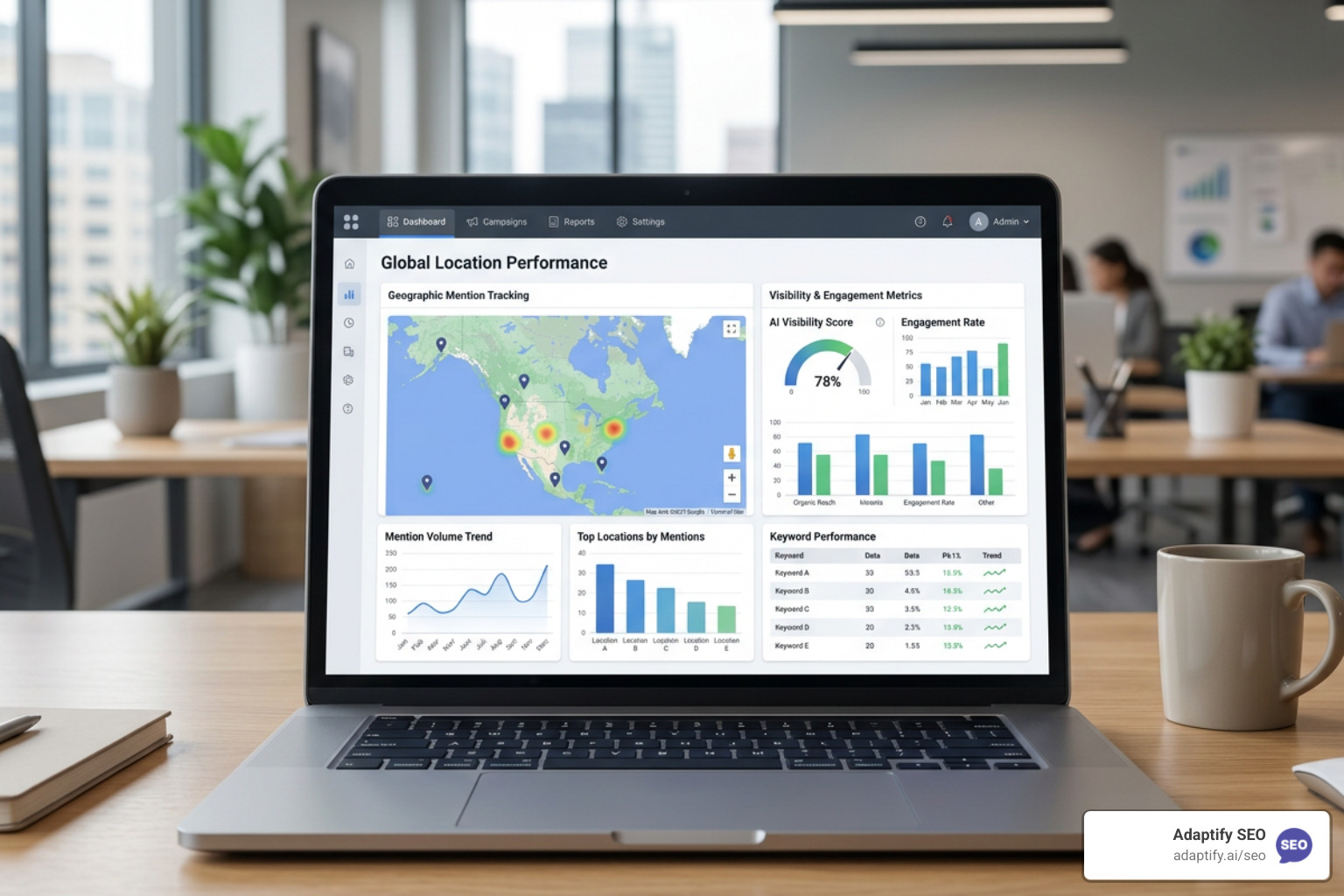
Now that you know how GEO works, let's look at the actual platforms you can use to track, audit, and optimize your clients' sites in 2026.
For agencies managing dozens or hundreds of clients, manual GEO optimization is impossible. You cannot manually rewrite thousands of pages, build custom schema for every blog post, and check daily if ChatGPT is citing your clients.
This is where Adaptify SEO comes in. Our platform is built specifically to streamline agency workflows and scale AI powered GEO SEO across large client portfolios.
Adaptify SEO automates the entire process:
By automating these tedious tasks, agencies can save hundreds of hours of manual labor. If you want to dive deeper into how to position these services to your clients, read our guide on how to Future-Proof Your Agency: A Guide to AI-Powered SEO.
For enterprise brands with dedicated data science or engineering teams, building a custom tracker is a viable path. Some brands build custom Python scripts that query the APIs of OpenAI, Anthropic, and Google Gemini directly.
By programmatically running hundreds of target prompts through these APIs, you can track:
While custom API scripts offer incredible flexibility, they are expensive to maintain. API costs can add up quickly, and LLM output structures change frequently, which can break your parsing scripts. For most agencies, a dedicated platform is much more cost-effective.
If you have a developer-centric team or manage static sites (like Next.js or Astro), open-source developer toolkits are incredibly powerful.
The standout tool here is geo-lint, an open-source GEO linter that features 97 built-in rules (including 36 specific GEO rules, 34 traditional SEO rules, and 14 content quality checks). It is built to run directly in your IDE (like Claude Code, Cursor, or GitHub Copilot) or as part of your CI/CD pipeline.
With geo-lint, you can establish an autonomous lint-fix loop. The AI agent scans your markdown files, detects violations (such as a missing Direct Answer Block or a vague statistic), applies the fix using precise suggestions, and re-lints until the code is perfectly clean.
Similarly, GEO AI Core is a zero-dependency TypeScript engine that helps you generate llms.txt files, manage AI crawler permissions, and track AI bot crawls in a GDPR-compliant way. These tools make it easy to prevent your AI-readiness score from dropping during code deployments.
If your clients are on WordPress, you don't need to write custom code to get basic GEO signals in place. You can use plugins like BreznGEO (a free AI SEO & GEO plugin for WordPress) to automate the heavy lifting.
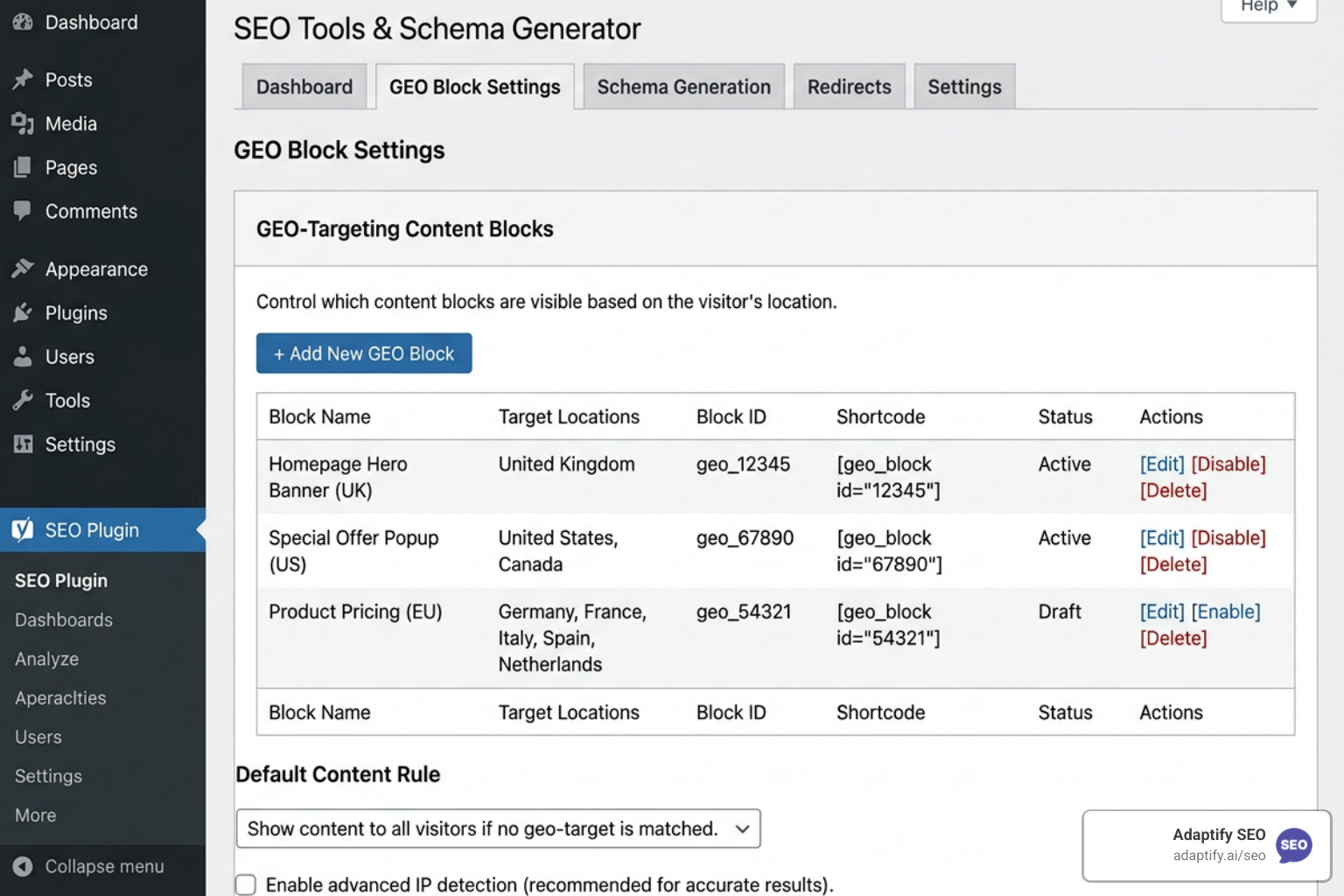
BreznGEO allows you to connect your own API keys (from OpenAI, Anthropic, or Google Gemini) so you pay the AI providers directly for tokens rather than paying a hefty monthly software subscription. It costs less than a fraction of a cent per post to generate:
llms.txt directories.This makes it incredibly cost-effective to ensure every new blog post is immediately ready for AI search engines the moment you hit publish.
Measuring traditional SEO is easy: you track keyword rankings, organic impressions, and clicks. Measuring GEO is more complex because AI engines personalize their answers and don't always send click traffic.
To measure your success in 2026, you must track Reference Rates and Brand Mentions. A reference rate is the percentage of target queries where an AI engine cites your domain as a source.
Brand mentions are also critical. In the generative era, unlinked brand mentions on high-authority sites (like Reddit, Wikipedia, or major industry publications) correlate 3x more strongly with AI visibility than traditional backlinks. AI models are trained on these public datasets, so being talked about in authoritative communities directly influences whether an LLM remembers you.
I explore how these visibility metrics tie back to actual business growth in The New Frontier: Integrating AI and GEO for Business Growth.
To keep up with the speed of AI search, content teams must transition away from slow, manual SEO workflows. Traditional workflows—where a writer drafts a post, an editor reviews it, an SEO specialist manually adds metadata, and a developer uploads it—are too slow for 2026.
By using automated, AI-agent-driven optimization workflows, you can scale content production while maintaining perfect GEO standards. AI agents can scan your entire content inventory, detect structural gaps, and automatically apply metadata, schema, and Direct Answer Blocks.
Organizations that use AI-powered content platforms report a 35% faster content creation rate, an 80% reduction in metadata update times, and a 70% increase in web traffic.
If you want to master this transition, check out our playbook, Beyond the Bots: Mastering AI SEO for Tomorrow's Search. You can also read about practical content workflows in Beyond the Buzz: Exploring Practical AI Content Solutions and The AI Content Strategy Playbook: Smart Moves for Smarter Content.
To understand how to position these automated workflows against organic and national campaigns, read Beyond the Buzzwords: A Guide to Natural vs. Organic SEO and Unlocking National Reach: What a National SEO Agency Can Do for You.
Traditional SEO focuses on getting your website to rank high in the organic blue links of search engine results pages (SERPs) to drive click traffic. AI powered GEO SEO focuses on optimizing your content and brand entities so that AI assistants and generative search engines cite and recommend your brand directly inside their conversational answers.
Your robots.txt file controls whether AI scrapers (like GPTBot or PerplexityBot) are allowed to crawl your site to gather training data or retrieve real-time information. An llms.txt file is a clean, markdown-formatted directory that provides these crawlers with a highly structured, easily readable map of your content, significantly increasing the odds that the model will understand and cite your pages.
AI-referred traffic converts at 4.4x the rate of traditional search because the user journey is highly pre-filtered. By the time a user clicks a citation link inside an AI chat, they have already completed their initial research, compared options, and asked specific follow-up questions. The user clicking your link is already a high-intent buyer who knows exactly why your product or service fits their needs.
The search landscape is shifting rapidly, and legacy SEO tactics are no longer enough to keep your clients visible. To win in 2026, agencies must adopt automated, AI powered GEO SEO workflows that optimize for language models and search engines simultaneously.
At Adaptify SEO, we provide the automated tools you need to run GEO audits, generate structured, citable content, and build brand authority at scale.
If you are ready to future-proof your agency and deliver higher-converting traffic to your clients, explore our automated solutions.

Stop being invisible: discover what the best local SEO strategies for small businesses are to dominate Google Maps, reviews, and AI search...
Master localized SEO to rank your local business in Google Maps and drive more in-store visits.

Master local retail SEO to drive foot traffic from Google with proven strategies for GBP, reviews, and AI search optimization.
Join 1,000+ agencies already delivering SEO and AI visibility from a single platform without increasing their headcount.Join 1,000+ agencies already delivering SEO and AI visibility from a single platform without increasing their headcount.