The New Frontier: Integrating AI and GEO for Business Growth




AI-powered geo and seo strategies for businesses are no longer optional; they're the essential framework for digital survival and growth. As artificial intelligence fundamentally transforms how users discover, consume, and synthesize information, businesses must aggressively adapt their digital strategies to remain visible and relevant. The era of simply ranking on a search engine results page (SERP) is being superseded by an era of being cited as a trusted source within an AI-generated answer.
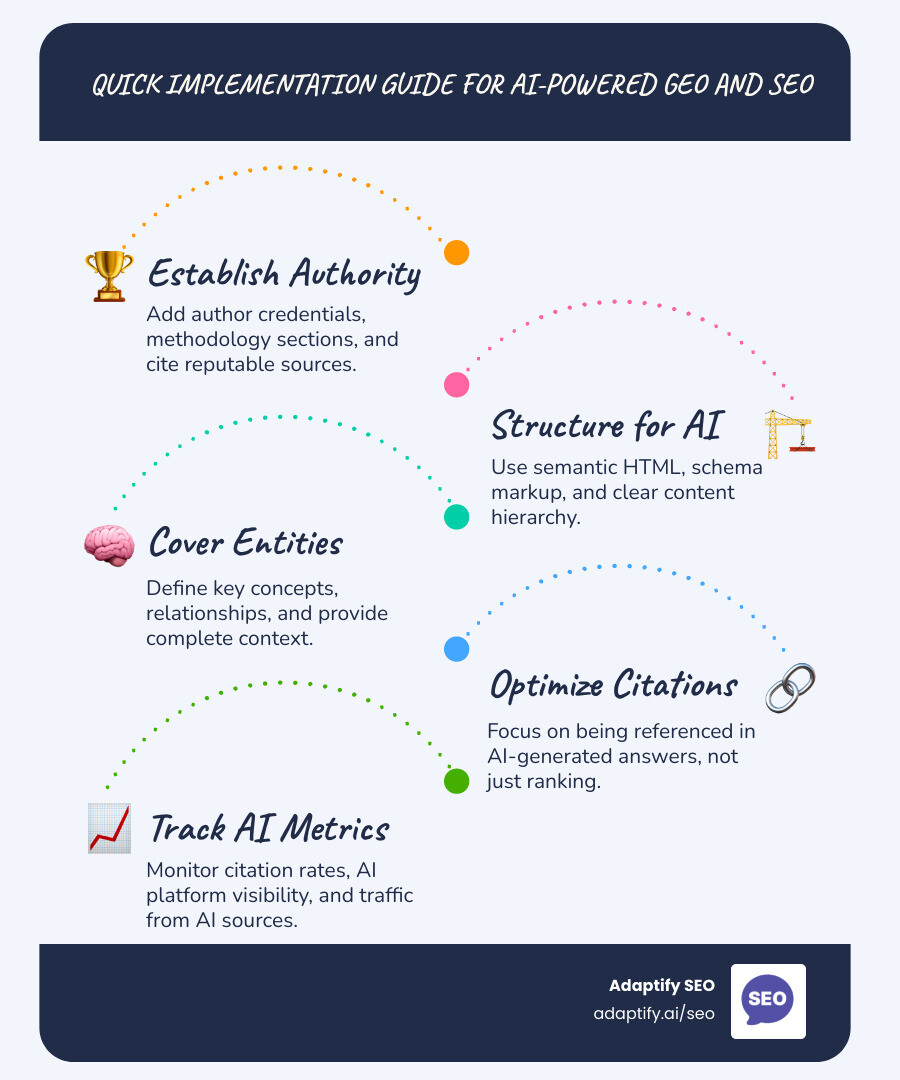
Quick Implementation Guide for AI-Powered GEO and SEO:
The numbers paint a stark and compelling picture of this new reality. AI-generated answers now appear in over 35% of Google search results, a figure that is climbing steadily. Furthermore, a staggering 42% of users under 30 now begin their information-seeking journeys on AI-native platforms instead of traditional search engines. This behavioral shift is not a fleeting trend; it's a permanent evolution in information consumption. As one prominent industry analysis recently concluded: "The rise of generative AI search engines... has completely revolutionized users' search experiences, prioritizing direct answers over lists of websites."
This represents a fundamental rewiring of how information flows from creator to consumer. Traditional SEO focused on optimizing web pages to rank for specific keywords. Today's reality demands that we optimize entire domains of knowledge to be cited, synthesized, and trusted by AI engines like ChatGPT, Perplexity, and Google's AI Overviews. The goal is no longer just to be found, but to become the foundational source of truth for the AI itself.
The stakes could not be higher. Gartner predicts a 25% decrease in traffic from traditional search engines by 2026, a forecast that many experts now believe may be conservative. This seismic shift makes it absolutely critical for agencies and businesses to master these new strategies immediately. The early adopters who build authority and structure their content for AI will capture significant market share, establishing a defensible moat while laggards struggle with diminishing visibility and relevance.
I'm Hansjan Kamerling, and with over a decade of experience at the forefront of digital marketing, I've guided businesses through major technological shifts, from the rise of mobile to the dominance of social media. I've seen firsthand how embracing ai-powered geo and seo strategies for businesses can unlock unprecedented growth. This guide will provide you with the actionable framework to navigate this change and emerge as a leader.
If you've meticulously perfected your traditional SEO playbook only to watch your traffic plateau or decline, you are not alone. The ground has shifted beneath our feet. AI engines like ChatGPT and Perplexity are now the primary interface for many users, answering their questions directly and often obviating the need to click through to a website. This is why mastering AI-powered GEO and SEO strategies for businesses is no longer a forward-thinking luxury but an immediate necessity. The old playbook is not just outdated; it's becoming obsolete.
Continuing to focus solely on traditional SEO is like meticulously arranging deck chairs on a ship that's changing course. For years, we've been conditioned to obsess over keyword rankings, backlink velocity, and metrics from tools like Ahrefs and Semrush. While these elements still form a part of the foundation, users have begun to bypass the entire system we were building for. They are getting direct, synthesized answers from AI platforms.
The data confirms this behavioral earthquake. Click-through rates for top-ranking organic listings have dropped by a staggering 18% in the past year alone. This isn't a minor fluctuation; it's a direct consequence of AI's efficiency. When a user asks an AI for a product recommendation, a travel itinerary, or a complex explanation, they receive a neatly packaged summary compiled from multiple authoritative sources. No clicking required.
This phenomenon gives rise to zero-click searches on an unprecedented scale. While incredibly efficient for users, this is potentially devastating for businesses whose models depend on website traffic for leads, ad revenue, or sales. The stark prediction from Gartner of a 25% decrease in traffic from traditional search engines by 2026 feels more probable every day. The role of AI has rapidly evolved from a search engine to an information synthesizer. It doesn't just find your content—it reads it, understands it, cross-references it, and repackages it for the end-user. This changes absolutely everything about how we must approach online visibility.
If you're wondering how to adapt, our SEO overview page breaks down how modern agencies are making this transition.
Enter Generative Engine Optimization (GEO)—the necessary evolution of SEO for the AI era. GEO is a strategic framework focused on making your content so authoritative, well-structured, and trustworthy that AI engines choose to cite and feature it in their generated answers.
To put it in an analogy: Traditional SEO was about getting your business an invitation to a massive party (the first page of Google). You hoped someone would see you and talk to you (click your link). GEO is about becoming the renowned expert at the party whom everyone gathers around to listen to and quote. Your goal shifts from earning a click to earning a citation. You are optimizing for authority and influence within the AI's knowledge base, not just for a transient position on a list.
GEO is rapidly emerging as the next critical frontier in digital optimization. Your content must be crafted with such clarity, accuracy, and structural integrity that AI platforms like ChatGPT, Perplexity, and Google AI Overviews not only understand it but prioritize it as a definitive source. The ultimate objective is to become the go-to reference in your specific domain, ensuring your brand's expertise is intricately woven into the fabric of the AI's response.
Understanding the operational difference between an AI engine and a traditional search engine is like comparing a university research librarian to a library card catalog. The card catalog can tell you where to find a book (a link), but the research librarian can read multiple books, synthesize their key findings, and give you a direct, comprehensive answer (an AI response).
| Criteria | Traditional SEO | Generative Engine Optimization (GEO) |
|---|---|---|
| Primary Goal | Drive website clicks from SERPs | Become a cited, authoritative source in AI answers |
| Core Focus | Keywords and backlinks | Entities, topics, and contextual relevance |
| Content Strategy | Keyword-optimized articles and landing pages | Comprehensive, authoritative knowledge hubs and guides |
| Key Signals | Domain authority, on-page SEO, link velocity | E-E-A-T signals, data transparency, structured data, citation networks |
| Success Metrics | Keyword rankings, organic traffic, CTR | AI citation rate, share of voice in AI answers, brand mentions |
| Technical Focus | Crawlability, site speed, mobile-friendliness | All of the above, plus advanced schema markup and content structure |
Traditional search engines primarily look for signals of relevance—does this page match the keywords? AI engines, on the other hand, look for signals of truth—is this source credible, expert-driven, and trustworthy? This critical distinction makes E-E-A-T (Experience, Expertise, Authoritativeness, Trustworthiness) the absolute bedrock of GEO success. AI engines are designed to identify and amplify genuinely authoritative sources, making shortcuts and superficial content more ineffective than ever.
Measurement must also evolve. Instead of celebrating a #1 ranking that fewer people will click, you'll track how often your brand's insights appear in AI-generated responses. Instead of obsessing over click-through rates, you'll monitor citation rates and your share of voice in AI answers. Traditional SEO is the non-negotiable foundation upon which the essential structure of GEO must be built.
Now that we've established the critical "why," let's deconstruct the actionable "how." Implementing effective ai-powered geo and seo strategies for businesses requires a disciplined commitment to a new set of core principles. These principles guide how we create, structure, and present content, forming a comprehensive strategy that speaks fluently to AI engines while delivering unparalleled value to human users. This is not about tricks or hacks; it's about building a fortress of authority.
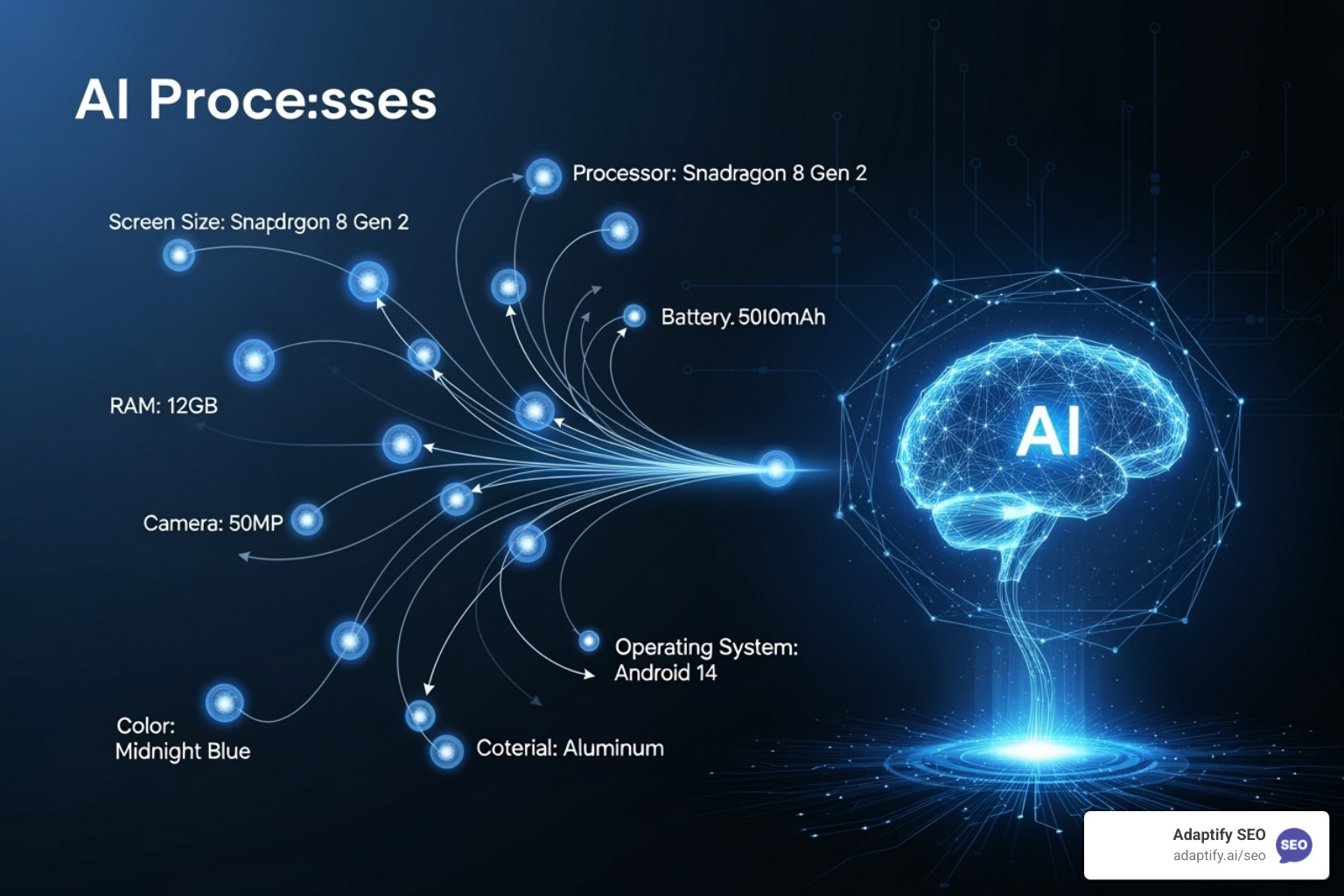
In the world of generative AI, trust is the most valuable currency. AI models are explicitly programmed to prioritize and cite sources that demonstrate genuine E-E-A-T (Experience, Expertise, Authoritativeness, and Trustworthiness). This framework is no longer a vague guideline; it is the gold standard for earning AI citations and establishing digital dominance.
At Adaptify SEO, our backlink services have evolved to focus on building this type of authoritative profile that AI search engines demand, ensuring your clients' content is recognized and promoted as a trusted source.
Perfectly structured content is essential for AI comprehension. If your content is a brilliant library of information, then structured data is the detailed catalog that allows the AI librarian to find exactly what it needs instantly. Without it, even the best content can be overlooked.
<p>, <h1>, and <h2>. Use tags like <article>, <section>, <nav>, <blockquote>, and <table> to give the AI clear semantic cues about the purpose and relationship of different content blocks.Product, FAQPage, HowTo, Article, LocalBusiness) to explicitly tell AI engines what your content is about. An e-commerce site that implemented detailed Product schema with features, pros, and cons saw a 64% increase in AI citations for its product comparison articles.FAQPage schema, makes it incredibly easy for an AI to extract precise answers for specific user queries.To ensure your implementation is correct, use a tool like the Schema Markup Validator to check that your code is clean and AI-ready.
AI search thinks in terms of entities (a person, place, organization, or concept) and the relationships between them. To earn citations, your content must demonstrate a deep, comprehensive coverage of the entities it discusses, moving far beyond simple keyword matching.
Understanding the theory of Generative Engine Optimization is one thing; successfully implementing and measuring it at scale is the challenge that separates leaders from laggards. This section provides a practical roadmap for integrating GEO into your existing workflows and proving its immense value to stakeholders.
Crucially, GEO complements and enhances traditional SEO—it does not replace it. A strong technical SEO foundation remains absolutely essential. GEO builds upon this foundation by adding a new layer of optimization specifically designed for how AI models process and prioritize information.
Here’s a structured approach to this integration:
FAQPage or HowTo schema? Can you reformat dense paragraphs into scannable bullet points? Identify and prioritize this low-hanging fruit for quick wins.Successfully implementing ai-powered geo and seo strategies for businesses requires a modern toolkit capable of managing these new complexities and scaling your efforts efficiently.
Essential GEO tools include:
Note: Adaptify SEO provides a unified platform designed for this new reality, automating many of these complex processes and integrating traditional SEO and GEO workflows to free up your team to focus on high-level strategy.
Success in GEO demands a new analytics dashboard. While traditional metrics like organic traffic and keyword rankings still have a place, they don't tell the whole story. GEO introduces a new set of Key Performance Indicators (KPIs) that measure influence and authority.
Key GEO KPIs to track:
By focusing on these advanced metrics, you can paint a clear and compelling picture of your GEO performance and its impact on the business's bottom line. You can view some of our successful case studies here.
The search landscape never stands still, and the pace of change is accelerating exponentially. The ai-powered geo and seo strategies for businesses that work today are just the beginning. The companies that will dominate the next decade are those who not only master the present but actively anticipate and prepare for the future. AI search is still in its infancy; the next wave of developments will make current capabilities seem primitive by comparison.
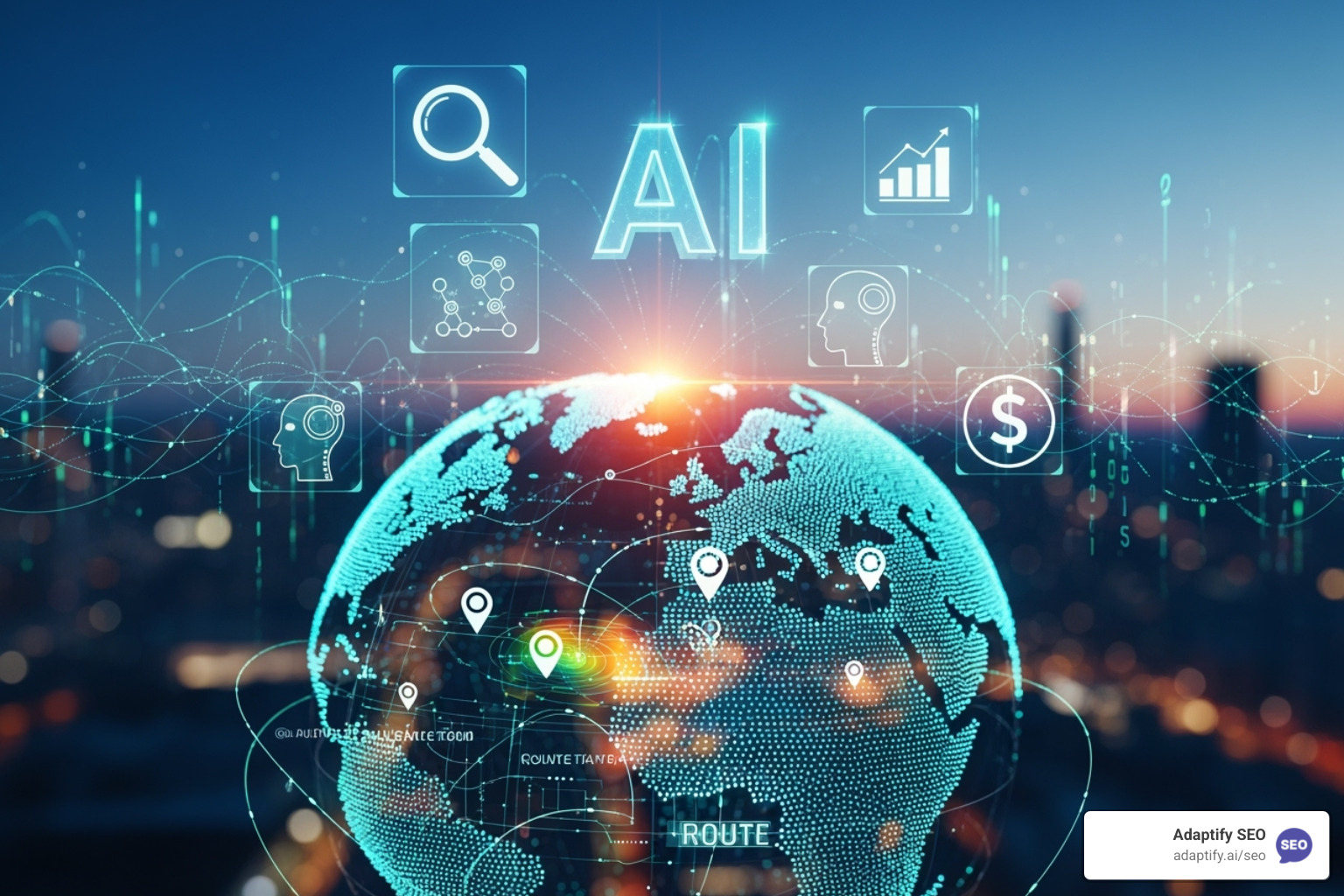
Generative AI is the engine that is finally making voice search truly useful. When a user asks a smart speaker like Amazon's Alexa or Google Assistant a question, they expect a single, direct, conversational answer—not a list of ten blue links read aloud. This fundamental shift toward natural language queries and spoken answers means your content must be optimized to answer questions in the same way a human expert would speak.
Voice search queries directly feed generative engines. When a user asks, "Hey Google, what's the best way to prune a rose bush in the spring?" the AI synthesizes an answer from the most authoritative and clearly structured sources it can find. If your gardening blog has a page with a clear, step-by-step HowTo schema, you are positioned to become the source for that spoken response. This is a massive opportunity for visibility in screenless environments.
FAQ schema is your secret weapon for capturing these conversational queries. By structuring your content with proper FAQPage markup, you are essentially creating a script for the AI. You are teaching it exactly which questions you answer and providing the precise, concise responses it needs, making your content prime for citation in both voice and text-based AI interfaces.
The ultimate future of search is an answer of one, customized for each individual user. AI is rapidly learning to tailor results based on a user's search history, past purchases, calendar, real-time location, and stated preferences. This means that generic, one-size-fits-all content will increasingly struggle to compete for attention.
For example, a user asking for "a good dinner recipe" might get a response that considers their known gluten allergy, the ingredients they have in their smart fridge, and the fact that it's a Tuesday night so they probably want something quick. Businesses that can structure their data to be useful for this level of personalization (e.g., a recipe site that tags every recipe with dietary info, prep time, and ingredients) will win.
Multimodal search represents the next major technological leap. AI models like Google's Gemini can already process and understand text, images, video, and audio simultaneously. Soon, a user will be able to point their phone's camera at a leaking pipe under their sink and ask, "How do I fix this and what parts do I need?" The AI will need to understand the visual input (the type of pipe and leak) and the text query to provide a helpful, actionable response. This requires businesses to move beyond text-only content. A plumbing supply company that has a library of well-described videos and diagrams will dominate in this new multimodal search reality.
The importance of broad context cannot be overstated. Research on User Behavior in AI-Assisted Search shows that users engage more deeply and have higher trust in AI responses that provide comprehensive context, sources, and related concepts. This reinforces the critical need for complete entity coverage. The AI wants to understand not just what your product does, but how it fits into the broader ecosystem, who it's for, and what problems it solves.
As businesses begin to navigate the complexities of ai-powered geo and seo strategies for businesses, several common and critical questions arise. Addressing these concerns is key to building confidence and driving adoption of this new framework. Here are answers to the most pressing questions we hear from clients.
No, GEO does not replace traditional SEO—it builds directly upon it and elevates its purpose. Think of traditional SEO as the essential foundation and framework of your house. A solid technical infrastructure, including fast loading speeds, flawless mobile-friendliness, clean code, and a logical site architecture, remains a critical quality signal for both traditional search engines and the crawlers that feed AI models. You cannot build a smart home on a crumbling foundation.
GEO is the advanced intelligence and connectivity you install within that well-built house. It makes everything more responsive, context-aware, and valuable to the occupant (the user). However, it relies completely on the underlying structure being sound. Therefore, the most effective and resilient strategy is a hybrid approach that combines a rock-solid SEO foundation with a sophisticated GEO framework to capture visibility and traffic from all sources, now and in the future.
Local search is a prime example of where AI is already synthesizing vast amounts of data to provide a single best answer. When a user asks, "What's the best Italian restaurant near me that's open now and has outdoor seating?" the AI is processing real-time location data, operating hours, business attributes, user reviews, and other contextual signals in an instant.
AI engines like Google's Gemini heavily rely on structured local data, making your Google Business Profile (GBP) and on-site local schema more valuable than ever. To compete, businesses need dedicated local GEO strategies, often managed with platforms like Yext or BrightLocal. Effective local GEO involves:
At Adaptify SEO, we help businesses integrate and automate these local GEO strategies, driving highly qualified, high-intent traffic from AI-generated local recommendations.
Yes, but with extremely important caveats. AI is a powerful assistant for content creation. Tools like Jasper or Copy.ai can be used for brainstorming topics, generating structured drafts, creating schema markup, and identifying content gaps. It can handle much of the heavy lifting and dramatically increase efficiency.
However, to establish the genuine authority (E-E-A-T) that AI engines value above all else, human oversight and expertise are non-negotiable. An expert in the field must review, edit, fact-check, and add unique insights to ensure the content is accurate, reliable, and builds genuine trust. AI-generated content, on its own, often lacks the personal experience, nuanced understanding, and novel insights that demonstrate true expertise. The best approach is a symbiotic one: use AI for research, structure, and initial drafting, but rely on human experts to add the irreplaceable layer of authenticity that makes content truly authoritative for both human readers and AI engines.
GEO is a long-term strategy, not a short-term tactic. Unlike traditional SEO, where you might see ranking changes in weeks, GEO is fundamentally tied to building genuine authority and trust, which takes time. The initial phase involves technical and structural changes, like implementing schema and restructuring content, which can show results in AI visibility within 2-4 months as crawlers re-index your site. However, the core of GEO—becoming a cited, authoritative source—is a gradual process that builds over 6-12 months and beyond. The results, a defensible moat of authority, are far more durable than simple keyword rankings. Early adopters who start now will have a significant, compounding advantage over those who wait.
Not at all. While large enterprises can scale GEO efforts across vast websites, small and medium-sized businesses have a significant advantage in a different area: niche authority. A smaller business can more easily become the definitive, trusted expert in a very specific vertical or geographic area. For example, a local law firm can focus on becoming the cited authority for "divorce law in San Diego," or a boutique e-commerce store can dominate the entity for "handmade leather messenger bags." By focusing narrowly and deeply, smaller businesses can build the E-E-A-T signals that AI rewards, allowing them to compete effectively for the most valuable, high-intent queries in their niche.
We are living through the most dramatic and rapid shift in digital marketing in over a decade. The comfortable and predictable days of focusing primarily on keyword rankings and link-building are over. The game has been fundamentally and irrevocably changed. The strategies that brought success yesterday are the very ones that will lead to obsolescence tomorrow.
The transition from a keyword-ranking mindset to becoming an authoritative, citable source for AI is the new reality. When a user asks an AI a question, they expect and receive a direct, synthesized, trustworthy answer. If your business's content is the primary source for that answer, you have achieved something far more powerful and durable than a temporary top search ranking. You have become part of the knowledge fabric itself.
Businesses that are adapting now—by relentlessly focusing on the core principles of Authority, Structure, and Comprehensiveness—are not just playing defense. They are building a deep, sustainable competitive moat. Their information gets cited, their brands become synonymous with trust, and their expertise is woven into the millions of answers that users receive every day. This is how market leadership will be defined in the coming years.
However, attempting to implement these sophisticated ai-powered geo and seo strategies for businesses manually is impractical and unsustainable at any real scale. The sheer complexity of managing E-E-A-T signals across an entire website, deploying and validating structured data, and tracking AI citation metrics can quickly overwhelm even the most capable in-house or agency team.
This is where intelligent automation becomes your indispensable secret weapon. Streamlining these advanced strategies not only saves countless hours of manual labor but also ensures the consistency and precision required to win. It frees up your most valuable resource—your team—to focus on high-level strategy, client relationships, and creating genuinely exceptional content.
For agencies and businesses ready to lead this revolution rather than be disrupted by it, the right platform is essential. At Adaptify SEO, we have built our entire system around this new AI-first reality. Our platform is designed to handle the complex orchestration of foundational SEO and advanced GEO, transforming a daunting, manual process into an efficient, scalable, and results-driven operation.
The opportunity window to gain a first-mover advantage is closing faster than many realize. Early adopters are already capturing authority and seeing results, while those clinging solely to traditional SEO are beginning to see their traffic and influence erode. Your next move will determine whether you lead this monumental change or spend years scrambling to catch up.
Ready to dominate the new era of search? Book a Demo with Adaptify SEO to see how our automated platform can transform your strategy, future-proof your business, and deliver the results that turn clients into long-term, loyal partners.

Stop being invisible: discover what the best local SEO strategies for small businesses are to dominate Google Maps, reviews, and AI search...
Master localized SEO to rank your local business in Google Maps and drive more in-store visits.
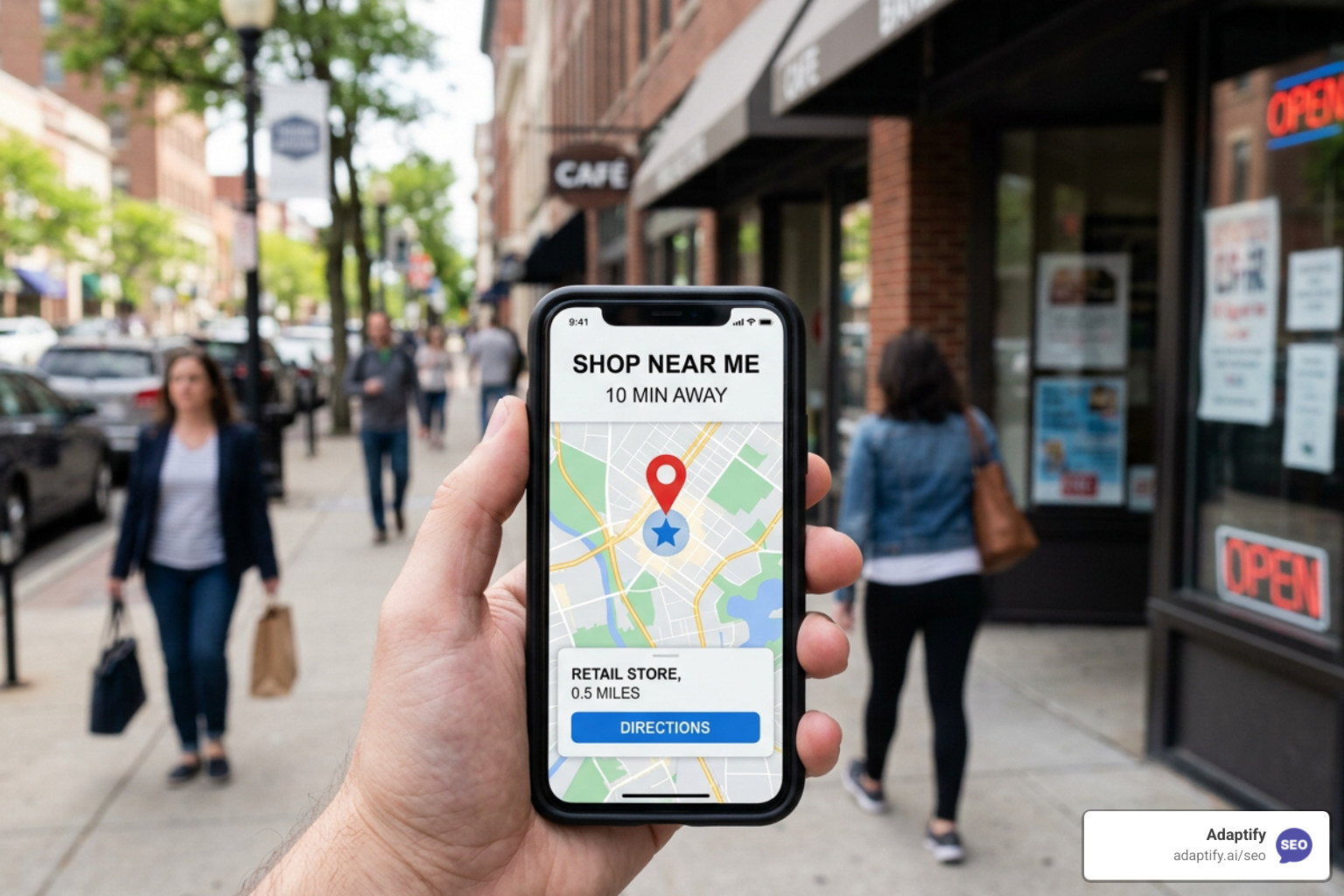
Master local retail SEO to drive foot traffic from Google with proven strategies for GBP, reviews, and AI search optimization.
Join 1,000+ agencies already delivering SEO and AI visibility from a single platform without increasing their headcount.Join 1,000+ agencies already delivering SEO and AI visibility from a single platform without increasing their headcount.