Stop Guessing and Start Benchmarking Your AI Search Performance




The best practices benchmarking AI answer visibility competitors GEO space is moving fast — and most agency owners are still flying blind.
Here is a quick answer to what you need to do:
Right now, your brand is being evaluated in two separate places at the same time. Traditional search engines rank your pages. Generative engines — like ChatGPT, Perplexity, and Google AI Overviews — decide whether to mention your brand at all inside their synthesized answers. These are two very different competitions, and most brands are only showing up for one of them.
The scale of this shift is hard to ignore. Google AI Overviews now reach more than 2 billion users monthly across 200+ countries. ChatGPT has 700 million weekly active users. Of 21.9 million Google searches analyzed in recent research, 25% triggered an AI Overview result. And here is the part that should get your attention: visitors referred from AI tools convert at twice the rate of other traffic sources, in one-third the number of sessions.
Yet most brands have no idea whether they appear in these answers — let alone how they compare to competitors.
That is the gap this guide closes. I am Hansjan Kamerling, a product designer and marketing consultant for SaaS platforms at Adaptify AI, and my background in building data-driven growth systems for AI startups informs everything I share here about best practices benchmarking AI answer visibility competitors GEO. In the sections ahead, you will find a practical, repeatable framework to measure where you stand, where your competitors are winning, and exactly what to fix.
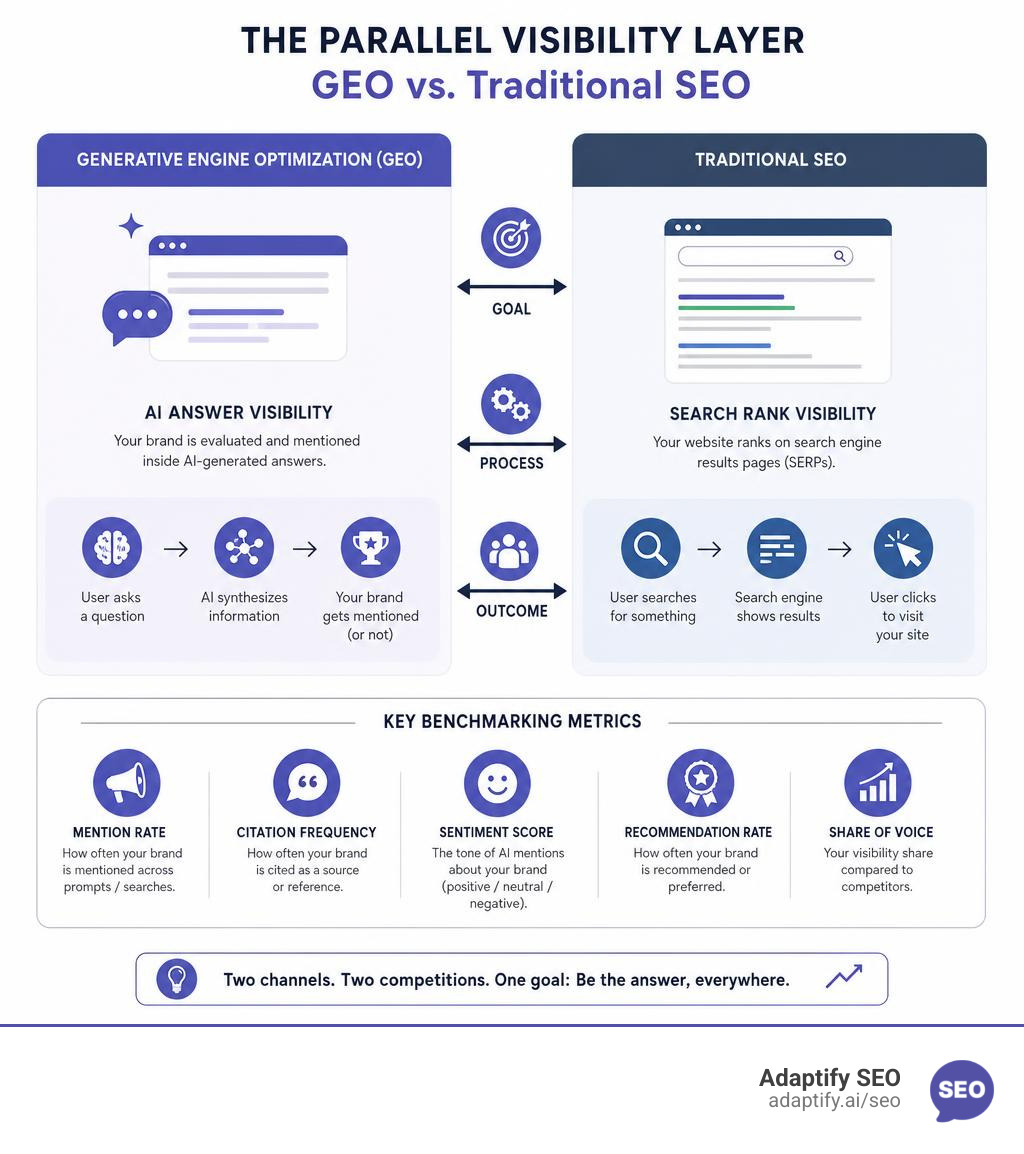
Traditional SEO is a game of blue links. You optimize for keywords, build backlinks, and hope Google places your website at the top of a page filled with ads.
Generative Engine Optimization (GEO), on the other hand, is the art and science of ensuring your brand is understood, trusted, and cited by Large Language Models (LLMs) when they synthesize answers.
When a user asks Perplexity for the "best project management tool for creative teams," the engine doesn't just rank websites. It browses the web, reads user reviews, analyzes community discussions on Reddit, and synthesizes a direct recommendation. If your brand is not in that synthesized response, you are invisible. You can learn the fundamentals of this shift in our Beginners Guide to Geo AI SEO.
To understand why this requires a completely different playbook, let’s look at how they compare side-by-side:
| Feature/Metric | Traditional SEO | Generative Engine Optimization (GEO) |
|---|---|---|
| Primary Goal | High rankings on Search Engine Results Pages (SERPs) | Inclusion and positive framing in synthesized AI answers |
| Competition Surface | Blue links, featured snippets, local packs | Multi-model answers (ChatGPT, Claude, Gemini, Perplexity) |
| Success Metrics | Organic traffic, keyword rankings, impressions | Share of Voice (SoV), mention rate, citation frequency |
| Key Authority Signals | Domain authority, backlinks, page speed | Entity clarity, third-party mentions, structured data |
| User Interaction | User clicks a link to find the answer | "Zero-click" reading; user gets the answer instantly |
If you think AI search is just a passing trend, the 2026 data says otherwise. AI referral traffic is growing by roughly 1% each month. While organic search still accounts for the majority of web traffic, AI search has quietly become a highly qualified conversion engine.
Because LLMs do the heavy lifting of researching, filtering, and summarizing options for the user, the visitors who do click through from an AI citation are incredibly deep in the buying funnel. They aren't browsing; they are verifying. This is why AI-referred visitors convert at twice the rate of traditional search traffic.
Furthermore, search engines are pushing generative modes everywhere. Google's AI Overviews are triggered on more than 25% of queries overall, and in high-intent industries like Healthcare, that number climbs to a staggering 48.7%. If you want to keep your brand top-of-mind, you must adapt your approach. I recommend reading about The AI Advantage: Adapting Your SEO for the Generative Era to understand how to position your business for this shift.
Generative engines do not think like traditional search crawlers. They rely on Retrieval-Augmented Generation (RAG) to pull real-time information from across the web and combine it with their pre-trained knowledge.
According to the GEO Benchmark Report, several key factors dictate which brands get cited:

Benchmarking is not just about keeping score; it is about finding the exact gaps in your content that allow your competitors to steal your potential customers.
When you implement best practices benchmarking AI answer visibility competitors GEO, you move from guessing why you aren't showing up in ChatGPT to having a precise, actionable roadmap. You can find a deep dive on how to run this process in this guide on How to Benchmark Your AI Search Visibility Against Competitors in 2026: A Step-by-Step GEO Framework.
To build a reliable benchmarking system, you cannot rely on running a couple of manual searches on your phone. You need a structured, repeatable framework:
Start by building a list of 50 to 100 prompts that represent your ideal customer's buying journey. Don't just use keywords; write them as natural, conversational prompts. Divide them into four categories:
Run these prompts across ChatGPT, Perplexity, Gemini, and Google AI Overviews. Record whether your brand is mentioned, if you are cited with a link, and how your product is framed. If you want to follow a highly detailed, portable manual process, check out this guide on How to Benchmark Your AI Visibility Against Competitors(Step-by-Step Guide).
Your AI Share of Voice is calculated using a simple formula: $$\text{AI Share of Voice} = \left( \frac{\text{Prompts where your brand is mentioned}}{\text{Total prompts tracked}} \right) \times 100$$ Calculate this for your brand and your top three competitors to see who truly owns the digital narrative.
Look at the prompts where your competitors are mentioned but you are completely absent. What sources are the LLMs citing for those answers? If they are citing a specific Reddit thread or a comparison table on an industry blog, that is your cue to engage in that thread or build a better comparison asset on your own site.
To measure your progress over time, I recommend tracking these five core metrics monthly, as detailed in the guide on GEO Benchmarks: Metrics for Measuring Visibility in AI SEO Results in 2026:
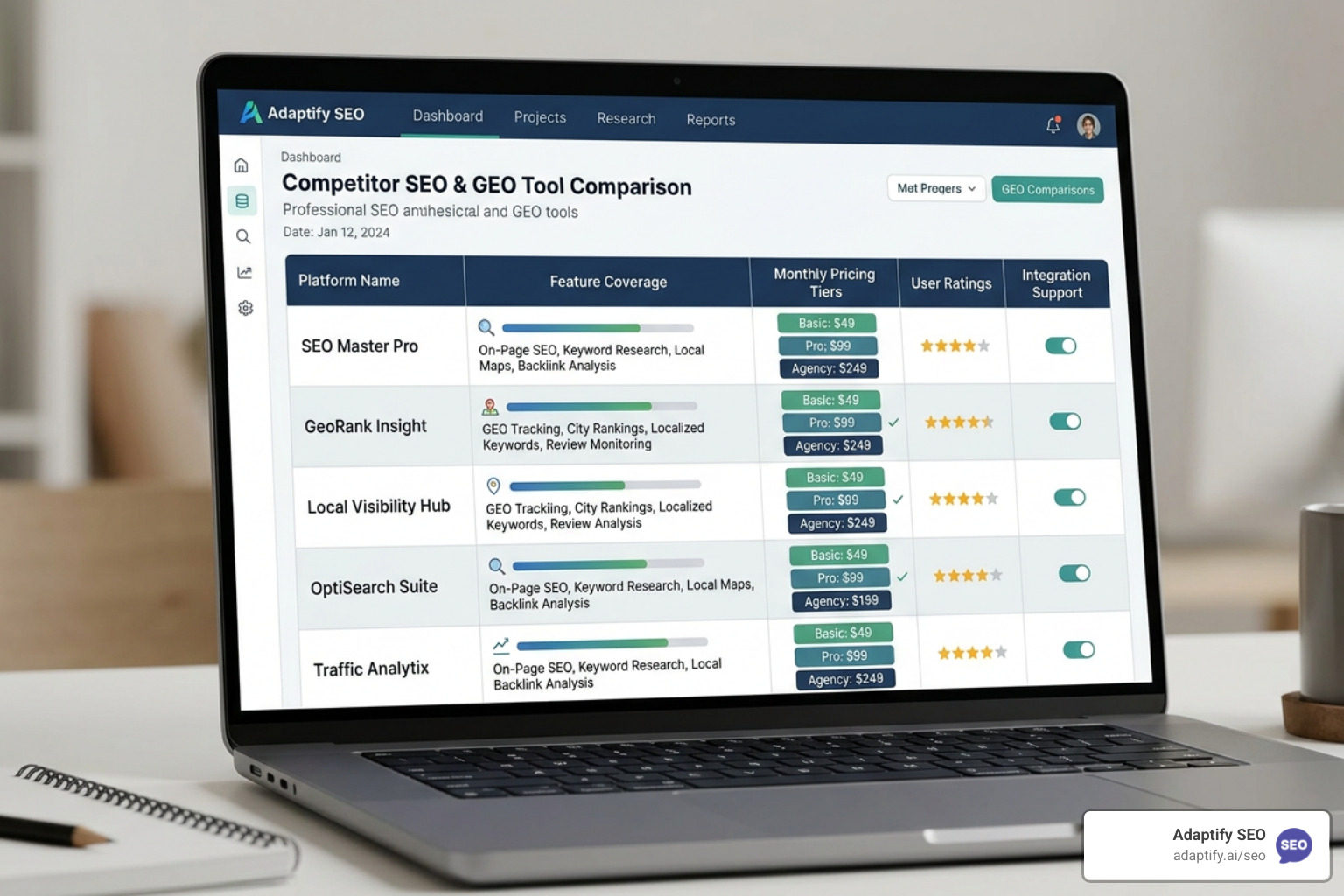
Choosing the right tool is critical. If you are a small agency, you don't need a custom enterprise data pipeline. If you are an enterprise, a basic spreadsheet tracker won't cut it. To see who is leading the pack, read our analysis on Who Offers the Best AI Visibility in the GEO Agency World.
Enterprise teams typically deal with thousands of products, multiple regions, and complex brand guidelines. For these teams, manual tracking is impossible.
The standard enterprise approach involves:
If you want to design a custom framework for this, you can read more about How To Conduct Competitive Benchmarking For Generative Ai?.
For growing agencies and SMBs, you need actionable insights without the enterprise price tag. The best approach is to use tools that automate prompt testing and provide clear, visual dashboards.
This is where Adaptify AI shines. We build automated SEO and GEO workflows that allow agencies to track their clients' AI visibility, identify content gaps, and automatically generate the exact content needed to close those gaps—all within a single, white-labeled dashboard.
GEO is not a replacement for traditional SEO; it is an extension of it. The content you write to rank on Google is the same content LLMs crawl to train their models and answer live user queries. The key is to build a workflow where every piece of content you produce serves both channels. You can explore this integration in detail in The New Frontier: Integrating AI and GEO for Business Growth.
AI crawlers behave differently than standard search bots. To make sure they can read and extract your content efficiently, follow this checklist from our AI Visibility Audit for SaaS: The 12-Point Framework We Use on Every Client:
llms.txt file at your root directory helps LLMs quickly find clean, markdown-formatted summaries of your site.If you want LLMs to cite your website, you need to publish "citation magnets"—content formats that AI engines love to reference when answering complex prompts. Our research shows that these four formats perform best:
To take your content strategy to the next level, I highly recommend reading Beyond the Basics: Advanced AI Strategies for SEO Success.
As you begin optimizing for AI visibility, keep an eye out for these common traps:
Initial signs of GEO progress—like appearing in Google AI Overviews or Perplexity live searches—can show up within 4 to 8 weeks after optimizing your content and schema. However, because foundational LLM models rely on periodic training cycles, building sustained visibility and authority across offline models (like standard ChatGPT or Claude responses) typically takes 3 to 6 months of consistent optimization and digital PR.
Yes, but not in the way they used to. Traditional backlinks still build your domain authority, which helps your site rank higher in search indexes that AI search engines crawl. However, for GEO, unlinked brand mentions on highly authoritative sites (like TechCrunch, Wired, or Wikipedia) carry immense weight. LLMs use these co-occurrence patterns to understand your brand's relationships and authority, even if there isn't a direct hyperlink.
Local GEO relies heavily on structured data, map pack consistency, and local reviews. If you run a localized service or agency, ensuring your LocalBusiness schema is perfectly implemented and your Google Business Profile is active is critical.
To understand how local search is changing and how to track your performance geographically, read our guides on Local SEO is Dead, Long Live GEO: Boosting Local Visibility in AI and Heatmap Your Way to the Top: Mastering Geogrid Rank Tracking.
The shift from traditional search engines to generative engines is the biggest evolution in digital marketing since the mobile web. If you are still relying solely on traditional SEO keyword tracking, you are missing the parallel visibility layer where modern buyers make their decisions.
By implementing best practices benchmarking AI answer visibility competitors GEO, you can stop guessing and start systematically growing your brand's presence inside the answers that matter.
At Adaptify.ai, we help agencies scale their operations and secure their clients' future in this AI-first world. Our automated platform handles the complex, manual tasks of SEO strategy, high-quality content creation, and authoritative link building, leaving you free to focus on growing your business.
Start scaling your agency's AI search visibility today and ensure your clients are the ones being recommended, cited, and trusted by the search engines of tomorrow.

Stop being invisible: discover what the best local SEO strategies for small businesses are to dominate Google Maps, reviews, and AI search...
Master localized SEO to rank your local business in Google Maps and drive more in-store visits.
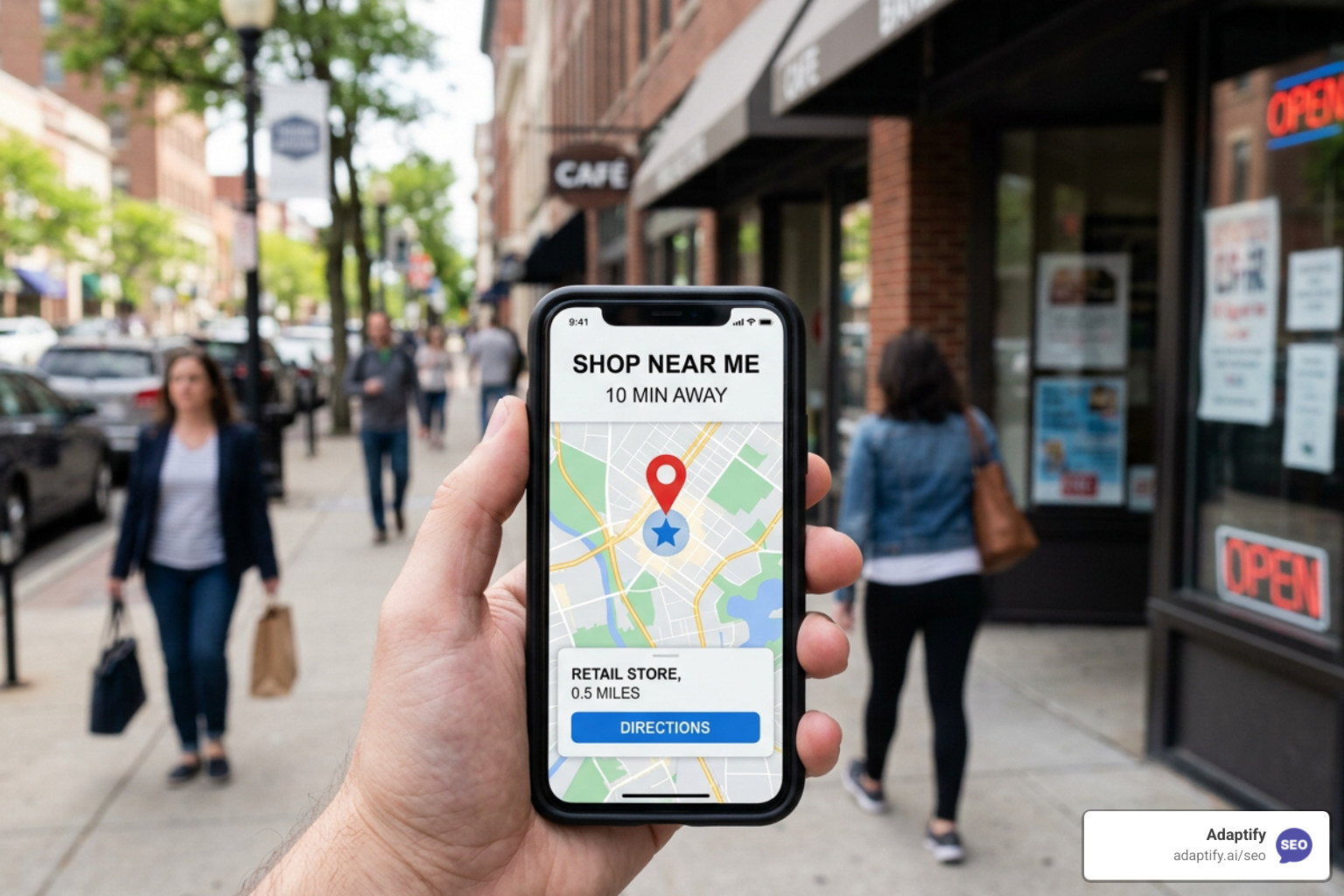
Master local retail SEO to drive foot traffic from Google with proven strategies for GBP, reviews, and AI search optimization.
Join 1,000+ agencies already delivering SEO and AI visibility from a single platform without increasing their headcount.Join 1,000+ agencies already delivering SEO and AI visibility from a single platform without increasing their headcount.