PR Link Building Guide: How to Earn High-Authority Backlinks




PR link building is the practice of earning backlinks from high-authority media outlets, journalists, and publications — not by asking for links directly, but by creating stories, data, and expert commentary that journalists genuinely want to cover.
Here's a quick summary of what it involves:
Nearly half of all SEO professionals — 48.6% — now rate digital PR as the single most effective link building tactic available. That's not a coincidence. Google's algorithm has shifted decisively toward rewarding genuine authority, and there's no faster path to genuine authority than earning coverage in publications your audience already trusts.
The gap between PR link building and traditional link building is also growing. Sites running consistent digital PR campaigns earn three to five times more high-authority links than those relying on outreach alone. A single placement in a DR 80+ publication can outweigh hundreds of low-authority directory links.
But PR link building isn't just about SEO metrics. It builds brand reputation, drives real referral traffic, and creates compounding visibility that keeps working long after the article goes live.
I'm Hansjan Kamerling, a product and marketing consultant who has worked across fintech, SaaS, and growth-stage startups — including helping a fintech startup raise an £8 million seed round where PR link building and brand authority played a direct role in positioning. In this guide, I'll walk you through everything you need to build a high-impact PR link building strategy from the ground up.
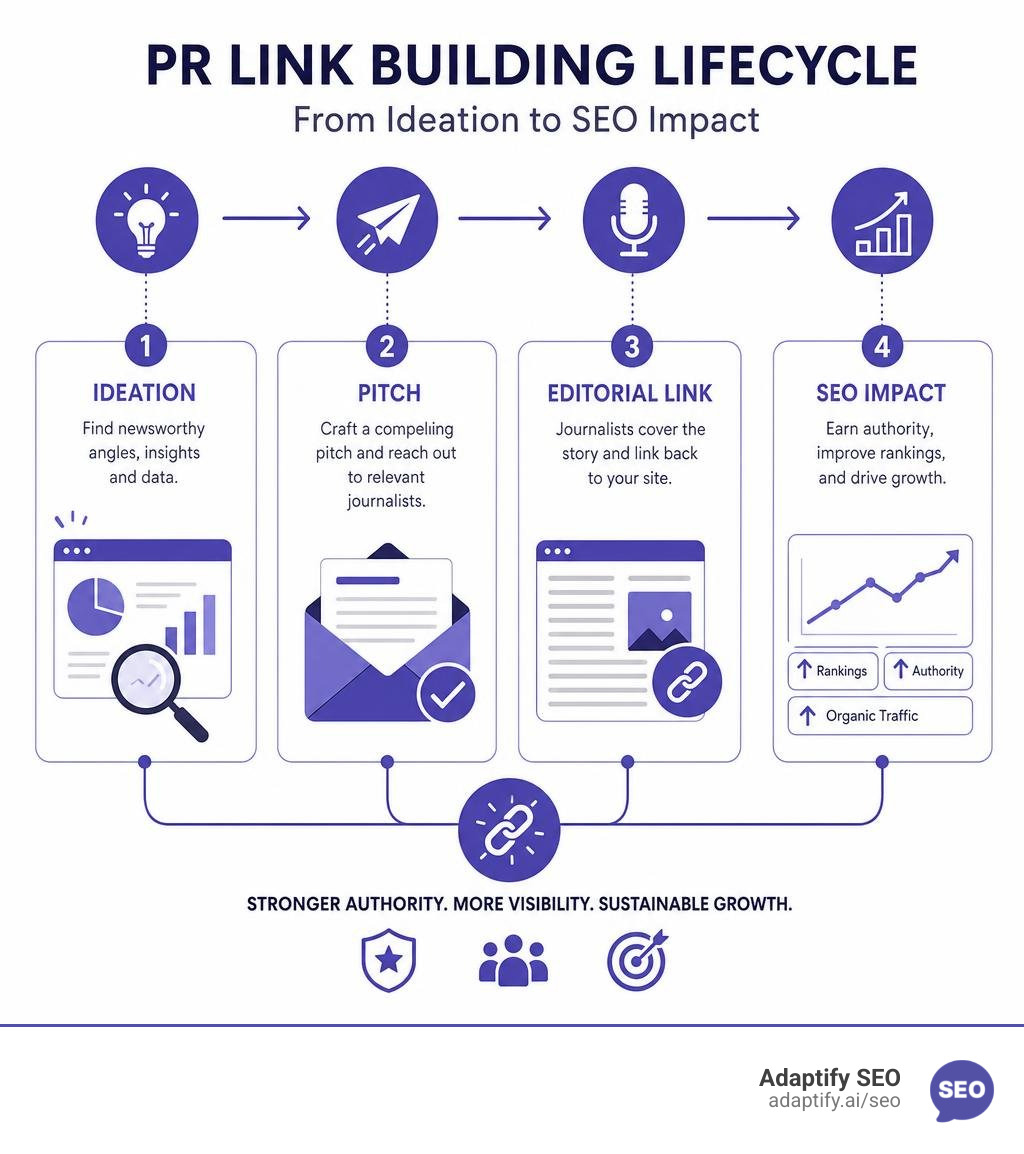
At its core, PR Link Building is a highly strategic offsite strategy that treats link acquisition not as a technical transaction, but as an editorial achievement. Instead of paying for directory placements or trading links with low-quality blogs, you earn mentions in reputable publications by offering something of real value: unique data, expert insights, or a compelling human-interest story.
Why does Google care so much about these links? The answer lies in how search engines evaluate authority. In the major search engine document leaks of 2024, it was confirmed that brand signals and overall entity authority are among the most critical ranking factors. Google does not look at backlinks in a vacuum; it looks at the credibility of the entity linking to you.
Furthermore, search engines utilize sophisticated systems to evaluate the quality of a source. Google uses internal metadata parameters, such as EncodedNewsAnchorData, to identify and give special weight to links originating from established, high-quality news outlets. When a major news site links to your page, search engines recognize it as an editorial vote of confidence.
If you want to understand how these dynamics play out in modern search algorithms, take a look at our deep dive on Digital PR Backlinks Uncovered – How to Win Google’s Heart. It explains exactly how search engines analyze editorial links to determine which sites deserve the top positions.
To truly appreciate the value of PR Link Building, we have to compare it to traditional SEO link-building tactics.
Traditional SEO link building relies heavily on direct outreach for guest posting, resource page link building, or purchasing niche edits. While these tactics can still help build foundational authority, they exist in a highly transactional ecosystem. You are reaching out to webmasters who often expect something in return, and the quality of the linking domains is usually moderate (typically ranging between DR 20 and DR 40).
In contrast, PR Link Building relies entirely on editorial decisions. You are pitching journalists, writers, and editors at national news sites, major business publications, and highly respected trade blogs. They do not link to you because you paid them or promised a link exchange; they link to you because your content adds genuine value to their readers.
| Feature | Traditional SEO Link Building | PR Link Building |
|---|---|---|
| Primary Focus | Acquiring backlink volume and anchor text match | Earning high-authority media coverage and brand visibility |
| Typical Domain Rating (DR) | DR 20–50 | DR 60–90+ |
| Tactics Used | Guest posting, niche edits, directory submissions | Data-driven studies, expert commentary, newsjacking |
| Acquisition Method | Transactional or cold outreach to webmasters | Relationship-building and pitching to journalists |
| Risk Profile | Moderate to High (vulnerable to search spam updates) | Extremely Low (100% white-hat and future-proof) |
| Secondary Benefits | Minimal referral traffic, low brand awareness | High referral traffic, brand credibility, AI search visibility |
If you are wondering which approach fits your current growth phase, check out our guide on Why Digital PR is Your Secret Weapon for Link Building Success. It outlines how to transition from basic outreach to a high-impact digital PR strategy.
When a journalist from a high-DR publication decides to write about your company or cite your research, they are sending an incredibly strong trust signal to search engine algorithms. In 2026, search algorithms are heavily focused on E-E-A-T (Experience, Expertise, Authoritativeness, and Trustworthiness), particularly for websites in YMYL (Your Money or Your Life) niches like finance, legal, and healthcare.
A single editorial backlink from a highly trusted media outlet carries more weight than hundreds of low-quality, automated backlinks. Why? Because the barrier to entry is so high. Anyone can buy a guest post on a low-tier blog, but you cannot buy an organic editorial feature in a leading national newspaper or top-tier industry journal.
These high-authority links raise your overall domain rating, which in turn acts as a rising tide that lifts all the content on your website. When your domain rating climbs from DR 30 to DR 60 through high-quality PR campaigns, your commercial landing pages and blog posts will naturally start ranking higher for competitive search terms.
To understand the long-term SEO benefits of this approach, read our strategic guide: Unlock Your SEO Potential with PR Link Building.
Earning high-quality PR links requires a shift in mindset. You cannot simply pitch your product or service and expect journalists to care. Instead, you need to create "linkable assets" — highly valuable, unique resources that writers naturally want to reference.

To build a sustainable pipeline of editorial links, you must create content that answers the questions journalists are actively trying to solve. For a step-by-step walkthrough on how to execute these campaigns, check out Unlock High-Quality PR Links: A Strategic Guide.
Let's look at the specific content formats and campaign types that consistently earn media coverage.
If there is one rule of thumb in digital PR, it is this: data is king. Over 90% of successful digital PR campaigns rely on data-led content or expert commentary. Journalists are constantly looking for credible data points to support the stories they are writing. If you can provide that data, you will earn the link.
Here are the most effective ways to build data-driven content:
To make your data studies as appealing as possible, always package them with high-quality visual aids, such as custom charts, interactive maps, or clean infographics. Journalists are visual storytellers; if you provide a ready-to-use graphic that summarizes your findings, they are far more likely to feature your campaign.
A successful PR Link Building strategy requires a careful balance between proactive campaigns and reactive newsjacking.
For example, if a new government regulation is announced affecting data privacy, a cybersecurity firm should immediately draft a 150-word expert commentary from their C-level executives explaining the practical implications for businesses. If you can get this commentary into a journalist's inbox within the first few hours of the news breaking, your chances of securing a high-DR backlink are incredibly high.
Creating a brilliant piece of content is only half the battle. To earn backlinks, you must get that content in front of the right writers. This is where strategic email outreach comes into play.
Mass-blasting generic press releases to purchased media lists is a recipe for failure. Modern PR outreach requires a highly targeted, relationship-first approach. You need to build curated media lists of journalists who specifically cover your beat, and write highly personalized pitches that show you understand their work.
If you want to master the art of email pitching, read our comprehensive guide on From Inbox to Impact: Boosting Backlinks with Strategic Email Outreach.
One of the most efficient ways to start earning high-authority PR links is by responding to active media queries. Journalists frequently use sourcing platforms to find expert quotes, data points, and case studies for articles they are actively writing.

The most popular platforms in 2026 include:
When using these platforms, speed and quality are everything. Responding within the first hour of a journalist query being published increases your placement rate by over 60%.
When drafting your response, avoid long-winded introductions or fluff. Lead with your most valuable quote or data point in the very first line, keep the entire response under 200 words, and clearly state the credentials of your spokesperson. Journalists are on tight deadlines; if your quote is ready to copy and paste directly into their article, you will win the placement.
While cold pitching can yield great results, the holy grail of PR Link Building is building long-term, mutually beneficial relationships with journalists. Cold outreach response rates typically average just 1% to 3%, whereas warm relationship outreach achieves response rates of 15% to 30%.
To build these relationships, focus on delivering value without immediately asking for anything in return. Engage with journalists on social media, share their articles, and offer yourself or your company's founders as helpful sources for future stories they might be researching.
Another highly effective tactic is monitoring unlinked brand mentions. Use media monitoring alerts to find websites that have mentioned your brand name but forgot to include a hyperlink. Reach out to the writer with a warm, polite email thanking them for the mention and suggesting that a link would help their readers easily find your website. Because they have already written about you favorably, the conversion rate for these emails is incredibly high.
To justify your investment in digital PR, you must track the metrics that connect your campaigns directly to business growth.
While traditional public relations often relies on vague metrics like "estimated reach" or "advertising value equivalency," digital PR allows for precise, data-driven tracking. Here are the core metrics you should monitor:
Unlike traditional link building where links can be placed relatively quickly, digital PR operates on editorial timelines. Initial placements typically begin appearing 2 to 6 weeks after you launch your outreach campaign. However, the true SEO impact — including indexation, domain authority growth, and improved search rankings — usually takes 3 to 6 months to fully materialize.
Yes, but with caveats. When a major news network syndicates an article across its local affiliates, you may see dozens of identical links appear in your backlink profile. Modern search engines are highly sophisticated at recognizing syndication networks. Usually, only the original source link or syndicated links that are indexable and "dofollow" will pass significant link equity. The primary value of syndication is the massive brand exposure and referral traffic it can generate.
Absolutely. You do not need a multi-million dollar budget to earn high-authority PR links. In fact, small businesses often have distinct advantages. You can leverage the specific, niche expertise of your founders, run highly targeted localized research campaigns, or pitch regional and industry-specific trade publications that national brands overlook.
In 2026, the intersection of SEO and brand building is more critical than ever. As search engines continue to prioritize trust, entity authority, and genuine editorial validation, PR Link Building has established itself as the ultimate offsite strategy for sustainable organic growth. By creating data-driven content, responding rapidly to media trends, and building real relationships with journalists, you can earn the high-authority backlinks that search engines love.
However, executing consistent, high-impact digital PR campaigns takes time, specialized skills, and continuous manual effort. This is where modern automation can transform your workflow.
At Adaptify SEO, we offer automated SEO services specifically designed to help marketing agencies and brands scale their offsite visibility. Our AI-driven platform streamlines everything from initial strategy formulation and content creation to identifying high-impact PR link building opportunities. By automating the tedious manual tasks of outreach and campaign management, we help you secure top-tier editorial links and build long-term search authority with maximum efficiency.

Stop being invisible: discover what the best local SEO strategies for small businesses are to dominate Google Maps, reviews, and AI search...
Master localized SEO to rank your local business in Google Maps and drive more in-store visits.

Master local retail SEO to drive foot traffic from Google with proven strategies for GBP, reviews, and AI search optimization.
Join 1,000+ agencies already delivering SEO and AI visibility from a single platform without increasing their headcount.Join 1,000+ agencies already delivering SEO and AI visibility from a single platform without increasing their headcount.