SEO improvement with AI: 11 Tools to Make Google Your Best Friend

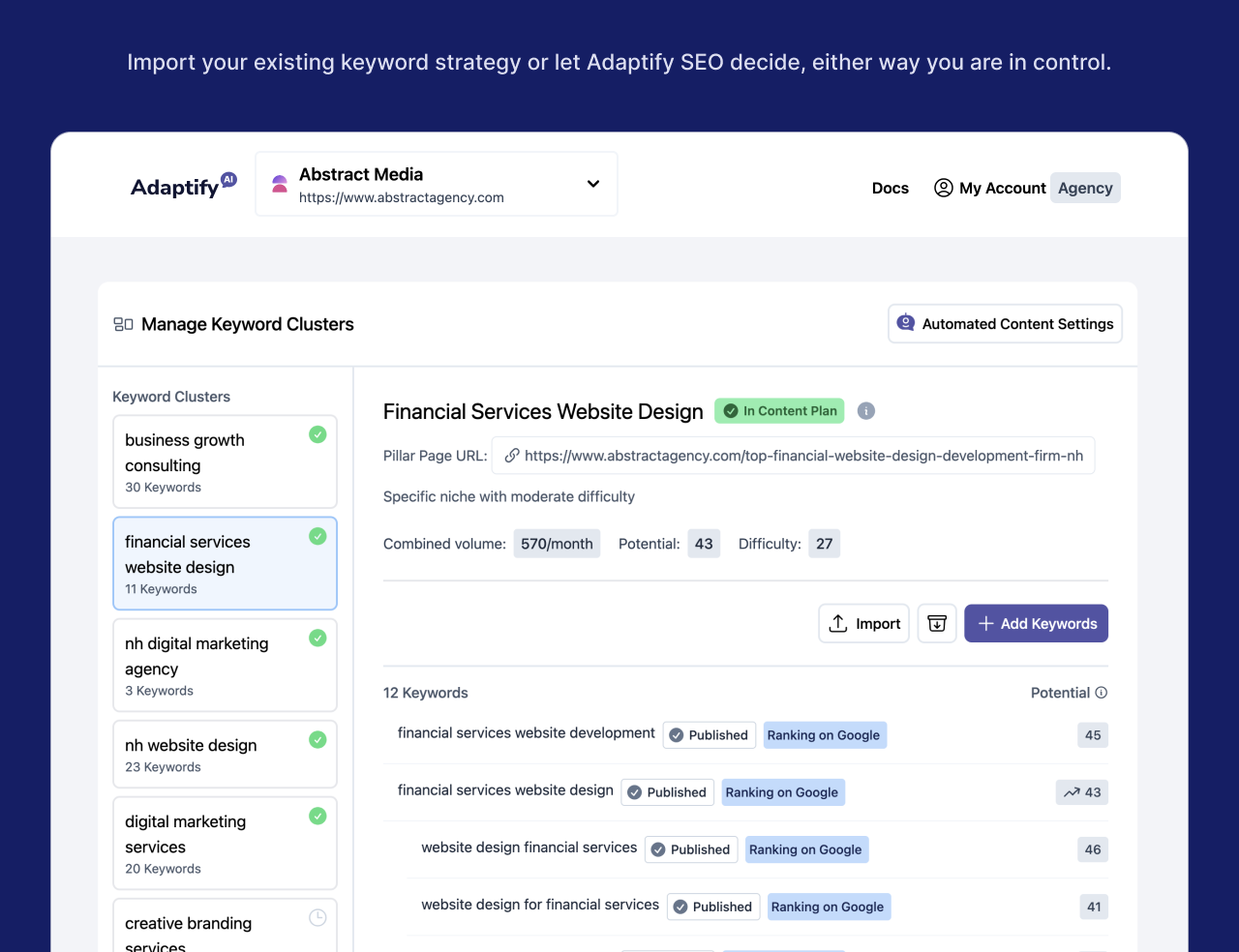

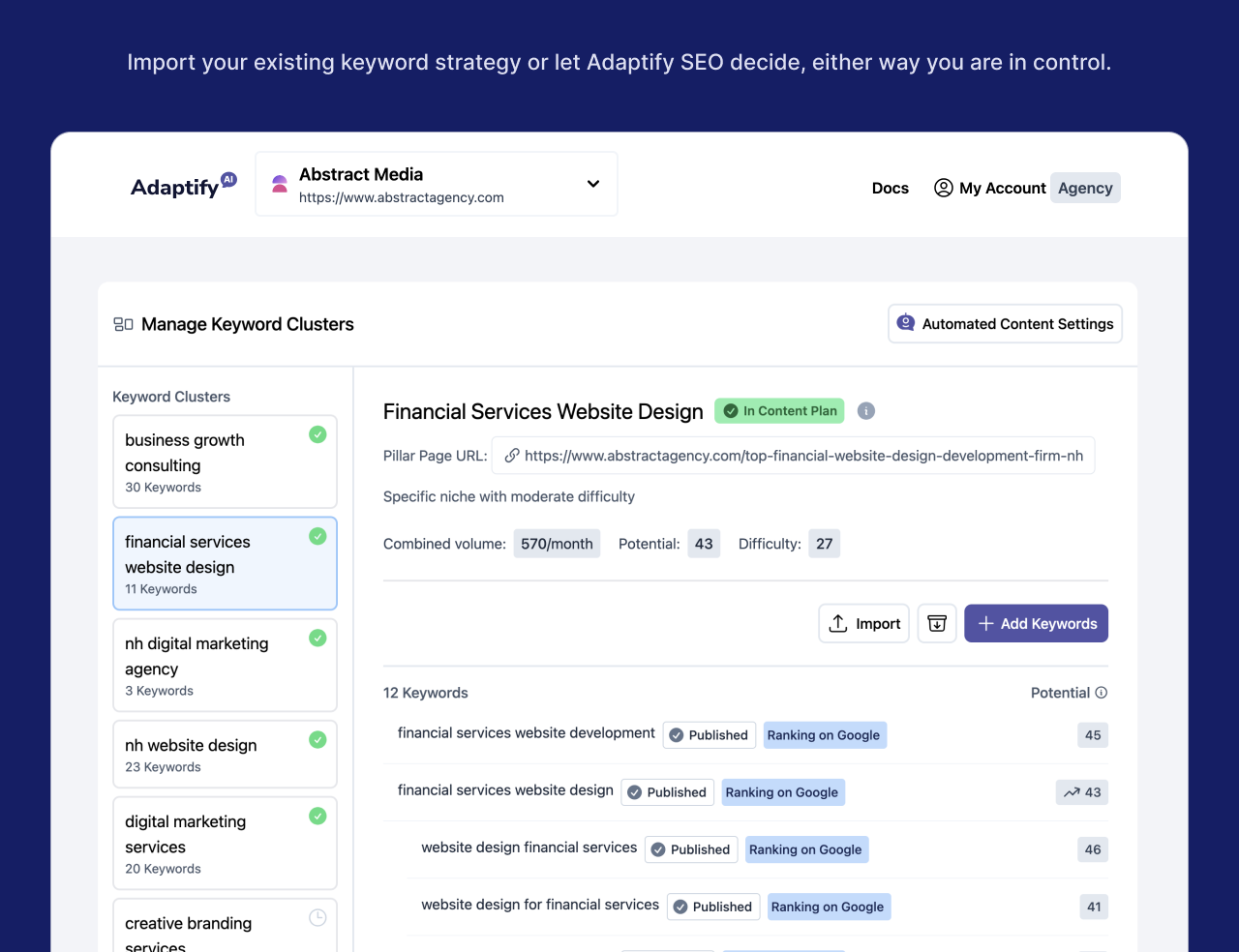
SEO improvement with AI is transforming how businesses rank on Google — and the fastest way to get started is to use AI tools across five core areas:
Google processes 8.5 billion searches every single day — that's 3 trillion queries every year. And yet, as many as 80% of website owners never update their SEO in the first 90 days after launch. That gap between search demand and optimization effort is exactly where AI gives you an edge.
The search landscape is also changing fast. ChatGPT alone receives 37.5 million search-like prompts daily. AI Overviews now appear across more than 100 countries. Over 65% of searches end without a single click. If you're running an agency and still doing most of your SEO work manually, you're fighting a battle with one hand tied behind your back.
This guide covers the tools, strategies, and workflows that actually move the needle — based on real-world testing, not hype.
I'm Hansjan Kamerling, product designer and marketing consultant at Adaptify AI, with hands-on experience building AI-powered products used by tens of thousands of users — including platforms where SEO improvement with AI was central to scaling organic growth. Read on to see which tools and tactics belong in your agency's stack right now.
When I first started in this industry, SEO was about matching keywords to pages. Today, Search Engine Optimization history shows we’ve moved from "strings" to "things." We aren't just optimizing for a search box anymore; we are optimizing for an ecosystem where "Googling" is now a verb and AI agents are the primary gatekeepers.
In 2026, the game has shifted toward Search Generative Experience (SGE) and AI Overviews. These AI-powered summaries provide instant answers at the top of the search results page. Research shows that 91% of URLs tracked in AI Overviews get "kicked out" or replaced at some point, and 96% of AI Overviews swap out domains frequently. This volatility means your strategy can't be static.
AI enhances traditional SEO by moving away from guesswork and toward predictive analytics. Instead of waiting three months to see if a keyword works, machine learning models can analyze SERP features and user behavior to predict which intent-labeled clusters will likely rank. This isn't just about faster writing; it's about deeper understanding. AI helps us decode user intent at a scale that was previously impossible for a human team to manage.

Choosing the right stack is the difference between scaling your agency and getting bogged down in "AI hallucinations." Here is a comparison of the heavy hitters I've tested for SEO improvement with AI:
| Tool | Best For | Key AI Feature |
|---|---|---|
| Semrush | All-in-one SEO | AI Search Optimizer & Keyword Strategy Builder |
| Surfer SEO | On-page optimization | AI Tracker for monitoring AI search visibility |
| Ahrefs | Backlinks & Competitors | AI-powered content grading and writing tools |
| ChatGPT | Research & Outlining | Custom GPTs for SEO audits and brief generation |
| Claude | Long-form content | Superior nuance and "human-like" writing tone |
| Indexly | Technical SEO | Automated indexing and technical issue tracking |
| SE Ranking | Rank tracking | AI Visibility tracker for LLM and AIO presence |
| Rankability | Content optimization | Real-time scoring for both organic and AI search |
| Ubersuggest | Small teams/Startups | Low-cost AI keyword and content suggestions |
| Search Atlas | Enterprise SEO | OTTO for automated technical and local SEO |
| Writesonic | Automation | AI agents for end-to-end content workflows |
Semrush remains the gold standard. With its recent acquisition by Adobe, I expect even faster rollouts of AI marketing features. Their "Keyword Strategy Builder" uses AI to turn a single seed keyword into a full-fledged topic cluster, saving me hours of manual spreadsheet work.
I’ve always loved Surfer for on-page work. Their new "AI Tracker" is a game-changer because it monitors how often your brand is cited in AI Overviews. It carries a 4.9/5 rating on Capterra for a reason—it makes complex data easy to act on.
While Ahrefs was slower to jump on the generative AI bandwagon, their research is top-tier. They recently published a study showing that AI-generated content does not hurt your Google rankings, provided it is helpful and intent-matched.
I use these as my "research assistants." Claude is particularly good at analyzing competitor gaps when you feed it SERP data. ChatGPT is my go-to for technical SEO scripts and schema generation.
One of the biggest frustrations in SEO is "Crawled - currently not indexed." Indexly solves this by automating the indexing process, often reducing the time it takes for new pages to appear in search from weeks to hours.
This tool offers a specific "AI Visibility" module that tracks how your brand performs across various LLMs. It’s essential for agencies that need to report on more than just "blue link" rankings.
Built by experts like Nathan Gotch, Rankability focuses on making content scannable for both humans and AI crawlers. I’ve seen it take a post from page 5 to #1 by simply fixing the semantic coverage.
If you’re on a budget, Ubersuggest’s lifetime deal is hard to beat. It provides solid AI prompts for metadata and basic content ideas.
Their OTTO tool is like having an automated SEO technician. It’s particularly strong for local SEO, helping businesses improve their map pack rankings through automated keyword integration.
Writesonic is built for speed. Their AI agents can handle end-to-end SEO automation, from research to the final draft, which is perfect for high-volume e-commerce sites.
While the tools above are great for specific tasks, Adaptify SEO provides a comprehensive, automated solution specifically for agencies. We streamline the entire process—from strategy formulation to PR link building—so you can focus on growing your business instead of managing 20 different tool subscriptions.
Creating Automated SEO content isn't about clicking "generate" and walking away. It’s about using AI to build a framework that humans then refine.
For metadata, I recommend using prompts that enforce strict character limits (60 for titles, 160 for descriptions). AI is excellent at generating 20 variations of a meta description in seconds, allowing you to pick the one with the highest "click-through" potential.
When scaling content, focus on E-E-A-T signals (Experience, Expertise, Authoritativeness, and Trustworthiness). AI can help you structure your content with proper subheadings and conversational tones, but you should always layer in original data, personal anecdotes, and verified expert bylines. This is what prevents your site from being flagged as "AI spam."
The days of targeting a single keyword are over. Now, we build topic clusters. You can learn how to use AI for keyword research by prompting tools to find "semantic gaps" between you and your top three competitors.
AI is particularly good at identifying long-tail keywords—those specific, 4+ word phrases that often have higher conversion rates. For example, instead of just "SEO tools," AI might find "best AI SEO tools for boutique marketing agencies in 2026." These niche terms are easier to rank for and bring in more qualified leads. When considering your budget, SEO pricing often reflects the depth of this research; automated tools like ours help keep these costs down while increasing accuracy.
Technical SEO is the foundation that allows AI crawlers to understand your site. A recent Vercel analysis on AI crawlers found that most major AI bots do not render JavaScript. If your site is JS-heavy, you might be invisible to the very models you're trying to influence.
To improve your technical SEO improvement with AI, follow these steps:
GPTBot or Google-Extended if you want to appear in AI summaries.I often get asked: Will SEO exist in 5 or 10 years? The answer is a resounding yes, but it won't look like it does today. We are entering the era of Generative Engine Optimization (GEO).
In this new landscape, brand authority is everything. McKinsey research on AI marketing shows that early adopters of generative AI are seeing a 10-20% revenue uplift. This isn't just because they are publishing more; it’s because they are using AI to personalize the user journey.
As zero-click searches continue to rise (currently over 65%), your goal shifts from getting a click to being the source of the answer. If ChatGPT or Google’s AI Overview cites your brand as the expert, you’ve won the "impression" even if you didn't get the "session." This builds massive brand equity over time.
We are also seeing a shift toward multimodal search—where people search using images (Visual Search) or their voice (Voice Search). AI is the only way to optimize for these conversational, non-text-based queries at scale.
Yes, it absolutely can. Google’s guidance is clear: they reward high-quality, helpful content regardless of how it was produced. The key is intent matching. If your AI content answers the user's question better than a human-written page, it will rank. However, "human-in-the-loop" editing is essential to ensure factual accuracy and a unique brand voice.
AI is not a "set it and forget it" solution. Its biggest limitations are:
Traditional metrics like "keyword rank" are becoming less relevant. Instead, look at:
The era of SEO improvement with AI isn't a threat—it's an opportunity for agencies to do better work, faster. By combining the raw power of AI tools with human expertise and brand building, you can turn search engines into your most reliable growth engine.
At Adaptify SEO, we believe the future belongs to those who automate the routine so they can master the strategic. Whether you're looking for SEO proposals that win clients or a system that handles your content and links on autopilot, the tools are ready. The only question is: are you?

Stop being invisible: discover what the best local SEO strategies for small businesses are to dominate Google Maps, reviews, and AI search...
Master localized SEO to rank your local business in Google Maps and drive more in-store visits.
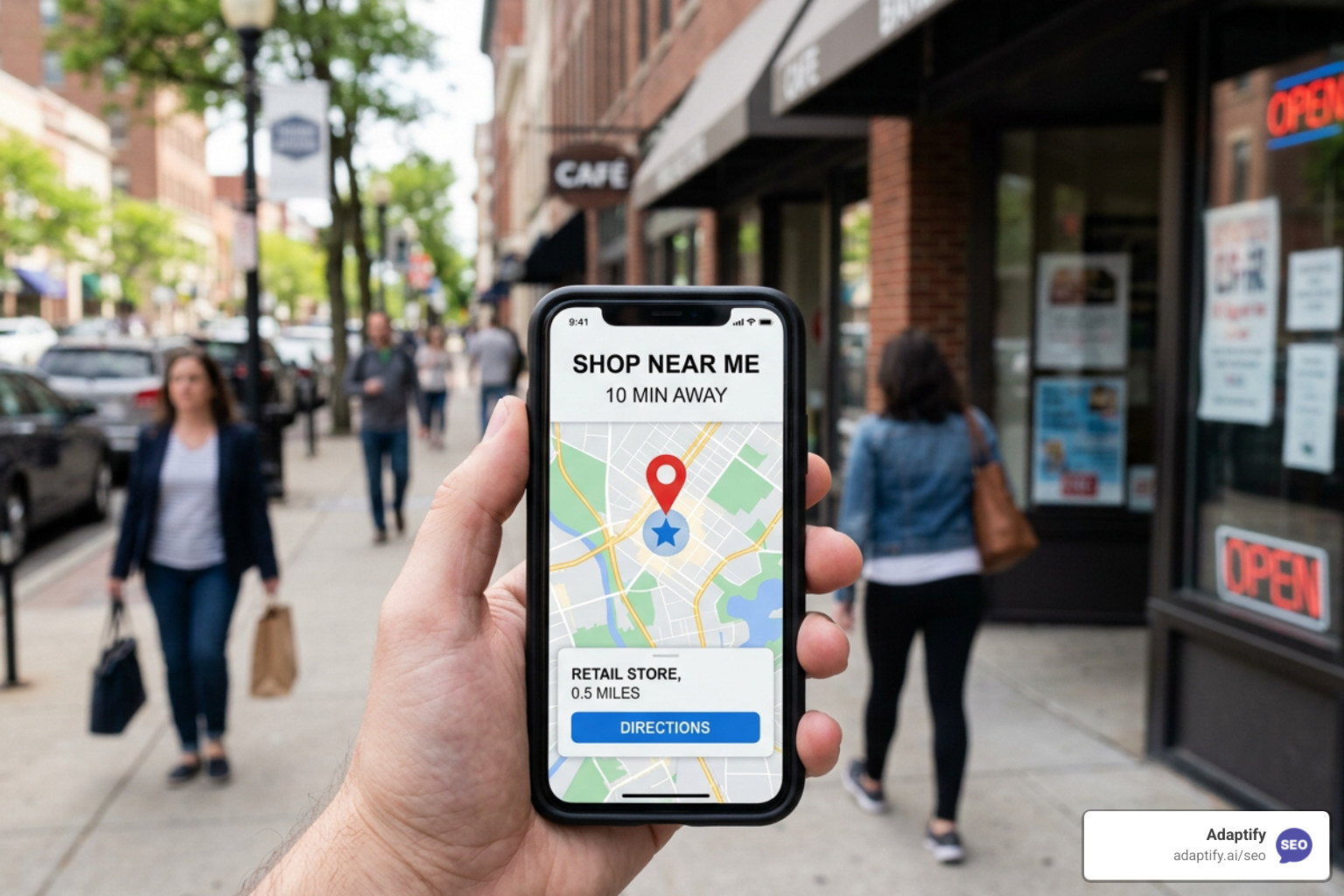
Master local retail SEO to drive foot traffic from Google with proven strategies for GBP, reviews, and AI search optimization.
Join 1,000+ agencies already delivering SEO and AI visibility from a single platform without increasing their headcount.Join 1,000+ agencies already delivering SEO and AI visibility from a single platform without increasing their headcount.