SEO Pricing Without the Panic: A Proposal Guide for Agencies




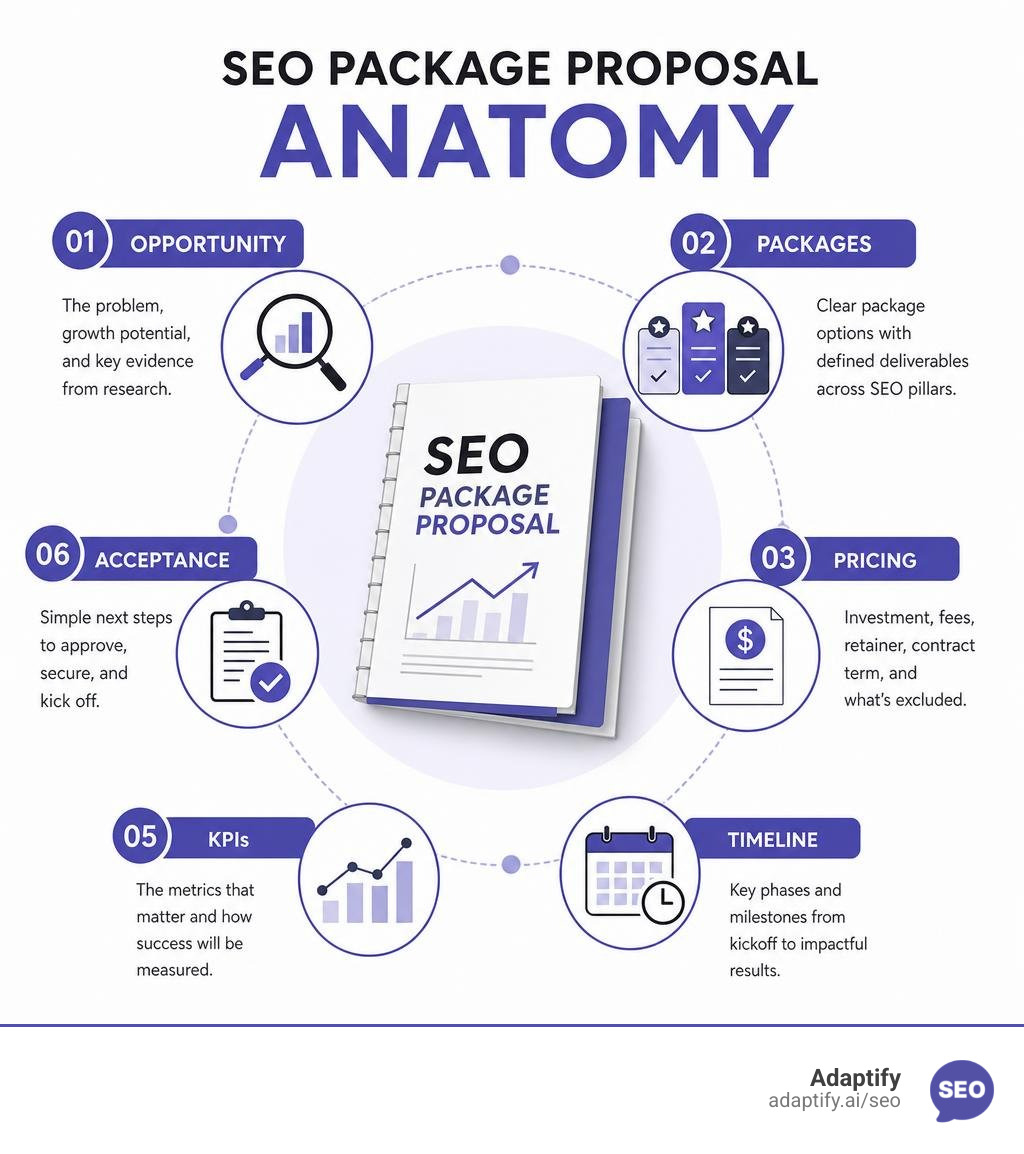
An SEO package proposal is a tailored sales document that shows a prospect what you will do, what it costs, when key work will happen, and how progress will be measured. To make it effective, lead with the client's opportunity, offer clear package choices, and define deliverables in countable terms.
A strong proposal should quickly answer:
This is more than a standard SEO proposal with a price at the end. A package proposal gives buyers structured options, while protecting your margin and reducing scope creep. It turns the decision from "Should we hire an SEO agency?" into "Which level of support fits our goals?"
Keep it focused. Data from millions of proposals suggests that roughly 11 pages across seven sections is a useful benchmark, though a warm lead with an agreed scope may need far less. The goal is not to explain every SEO detail. It is to make the value, work, timeline, and boundaries easy to understand.
I'm Luke Heinecke, CRO at Adaptify, with more than nine years in marketing and agency operations, including founding and exiting a performance marketing agency. I have seen how a clear SEO package proposal helps agencies sell confidently while building delivery systems that can scale.
When I ran my agency, custom scoping every single lead nearly ran my team into the ground. We would spend six unbillable hours building an artisanal scope of work, only to watch the prospect pick apart every line item or vanish entirely.
Moving to packaged retainers solves this problem. A structured package creates predictability for both your agency's pipeline and your client's budget. It harnesses buyer psychology by introducing the decoy effect: instead of forcing an all-or-nothing "Yes/No" decision, you invite the prospect to compare three clear tiers and decide how fast they want to grow.
Standardized service packages also lower perceived risk. Buyers rarely want to buy technical tasks like canonical tag adjustments; they want a predictable, risk-mitigated path to organic revenue. If you want to scale sustainably, check out our insights on agency growth strategies to build profitable service models.
A winning proposal is not an exhaustive technical manual; it is a decision-making tool. Most proposals lose deals before page two because they open with generic boilerplate about what digital marketing is. Your prospect already knows what marketing is—they want to know how you will fix their specific traffic bottleneck.
To keep your document clear, concise, and persuasive, structure your pitch into seven core sections:
For a deeper dive into streamlining your sales documents, read our no-fluff proposal playbook for closing better deals.
Nothing builds trust faster than presenting hard diagnostic findings on the very first page. Spending 60 to 90 minutes running a preliminary technical crawl to uncover real indexation blockers or crawl waste proves you have actually evaluated their site.
Proposals that include real audit data consistently convert at significantly higher rates because they turn abstract promises into concrete mathematical upside. If you want a proven format to uncover and showcase these diagnostic insights, you can utilize our SEO audit proposal structure to highlight quick wins immediately.
The quickest win you can present to a client is what I call "trapped traffic." These are high-commercial-intent keywords sitting in positions 8 through 14—the notorious page-two dead zone.

When pages rank on page two, they receive virtually zero clicks despite being inches away from real organic traffic. By highlighting competitor keyword gaps and showing the traffic leap that occurs when moving from position 11 to the top 3, you create an irresistible commercial business case.
Presenting pricing should never cause agency panic. When framed properly as a measurable investment tied to long-term enterprise value, price resistance drops. If you need structural inspiration for your documents, review our guide to essential proposal templates across various client sizes.
By offering three transparent tiers, you anchor the middle tier as the natural sweet spot while letting your highest tier serve as a high-value anchor:
| Tier | Focus Area | Monthly Deliverables | Target Profile | Monthly Retainer |
|---|---|---|---|---|
| Foundation | Technical Cleanup & Core Pages | 1 Content Piece, Basic Technical Maintenance, Monthly Reporting | Local businesses or early-stage sites | $3,500/mo |
| Growth (Recommended) | Content Scaling & Keyword Gaps | 4 Clustered Content Pieces, 2 Digital PR Backlinks, Bi-Weekly Sync | Growing mid-market brands seeking market share | $7,500/mo |
| Scale | Aggressive Category Domination | 8+ In-Depth Articles, 4+ Authority Backlinks, Full Technical Ops | Competitive verticals & enterprise websites | $14,500/mo |
If scaling deliverable production internally threatens your operational margins, leveraging white-label fulfillment solutions allows you to maintain elite service margins without burning out your internal staff.
One of the most profitable pricing models is the Kickoff Foundation + Recurring Retainer structure.
Instead of hiding the heavy upfront technical cleanup inside a monthly fee, charge a dedicated one-time foundation setup fee (e.g., $5,000 to $8,500) paired with a recurring monthly retainer. This protects your cash flow during the resource-heavy first 30 days and establishes a sustainable baseline for subsequent execution.
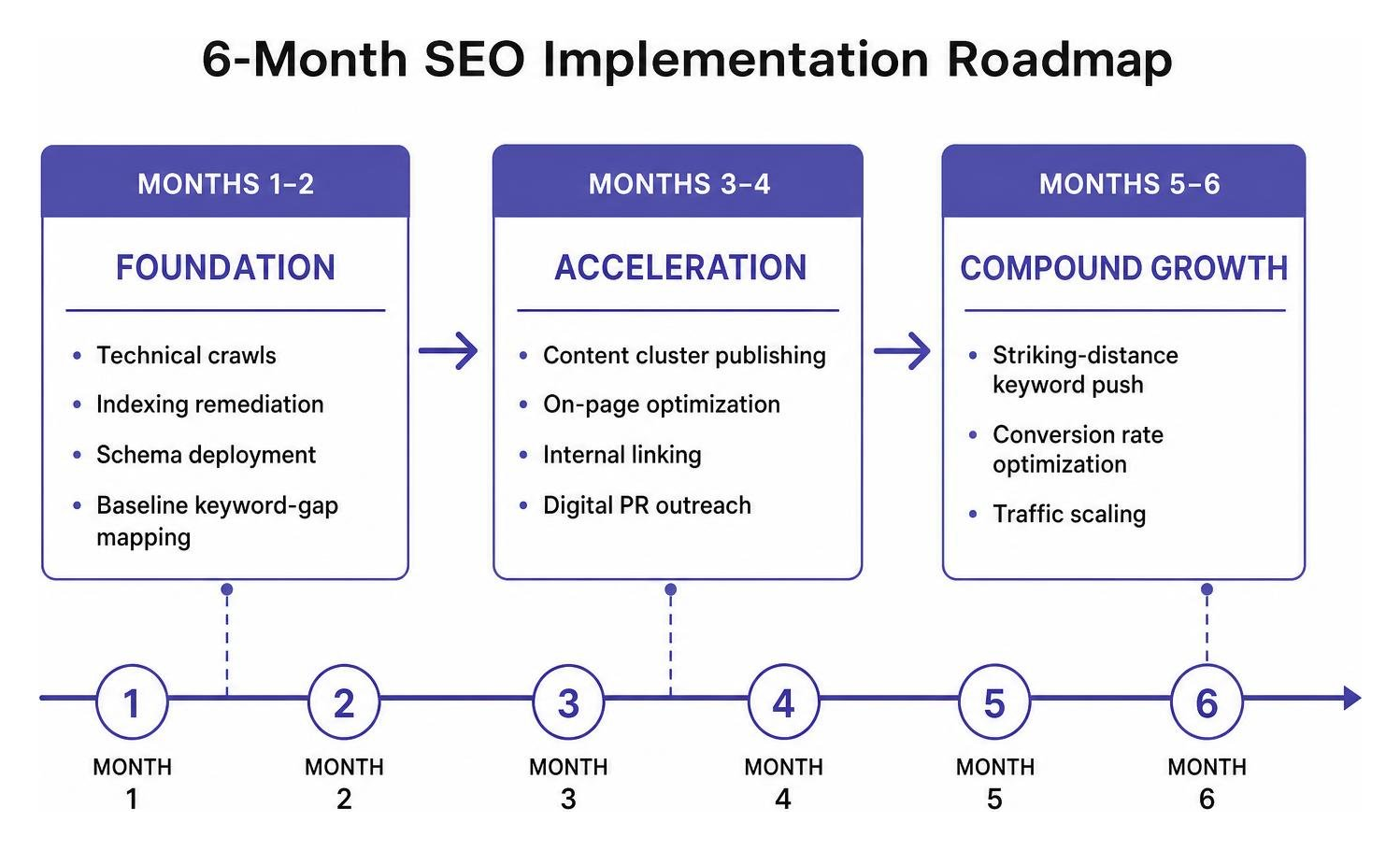
Setting accurate expectations early prevents friction later. Transparent agencies define exactly when results should begin compounding.
SEO compounds over time, and your proposal should visually reflect this reality:
Never guarantee position-one rankings in an SEO agreement. Search engine algorithms shift constantly, and making absolute guarantees damages your credibility with sophisticated buyers.
Instead, contractually commit to controllable leading indicators: deliverable completion rates, crawl efficiency, technical site health scores, indexation rates, and organic impression gains.
Even great packages lose deals if the execution fails on basic sales fundamentals.
Data from Proposify shows that 42.5% of proposals close within 24 hours when opened, and integrated online signatures speed up client approvals by 60%. Incorporating an embedded e-signature directly into your document—accompanied by a 3-minute video walkthrough—dramatically accelerates your closing cycle.
Between 8 and 12 pages is standard for net-new agency pitches. If you have already completed a detailed discovery session, a concise 3-to-4 page confirmation document is often enough.
Explicitly list exclusions directly underneath your pricing matrix. If a client requests custom development or extra assets, issue a separate statement of work.
Yes. Charging a nominal fee ($500 to $1,500) for paid discovery qualifies prospects immediately and filters out low-intent buyers before your team invests heavy manual research hours.
Packaging your agency's SEO services transforms your business from an unpredictable, custom-scoped consultancy into a scalable, highly profitable machine. When you replace vague task lists with structured packages, countable deliverables, and transparent multi-tier investments, you remove pricing anxiety for your prospects and your internal delivery team alike.
If manual content production, keyword research, and link acquisition are slowing down your fulfillment speed, consider how you can automate your agency's SEO delivery with Adaptify to execute elite campaigns at scale while protecting your margins.

Master SEO monitoring with key metrics and tools to track rankings, technical health, and organic growth for continuous performance optimi...

The Best Online Keyword Monitoring Tools for Real-Time Alerts - Learn about online keyword monitoring tool

Stop Flying Blind with These Top SEO Monitor Tools - Learn about seo monitor tools
Join 1,000+ agencies already delivering SEO and AI visibility from a single platform without increasing their headcount.Join 1,000+ agencies already delivering SEO and AI visibility from a single platform without increasing their headcount.