Going Local and Winning Big with the Best SEO Keywords




Local keywords are search terms people use when they want to find a business, service, or product near them. They can be as direct as "plumber in Chicago" or as simple as "coffee shop" — where Google fills in the location automatically based on where the searcher is sitting.
Here's a quick breakdown of what you need to know:
The opportunity is real. But most local businesses get the strategy wrong from day one — chasing broad, high-volume terms they can't realistically rank for, while ignoring the specific, high-intent phrases that actually convert.
This guide walks you through everything: how local keywords work, how to find the right ones, and how to turn them into rankings, traffic, and revenue.
I'm Luke Heinecke, Chief Revenue Officer at Adaptify, and I've spent over nine years in marketing and agency operations helping businesses cut through the noise with smarter local keyword strategies. In the sections ahead, I'll share the exact framework we use — so you can stop guessing and start winning local search.
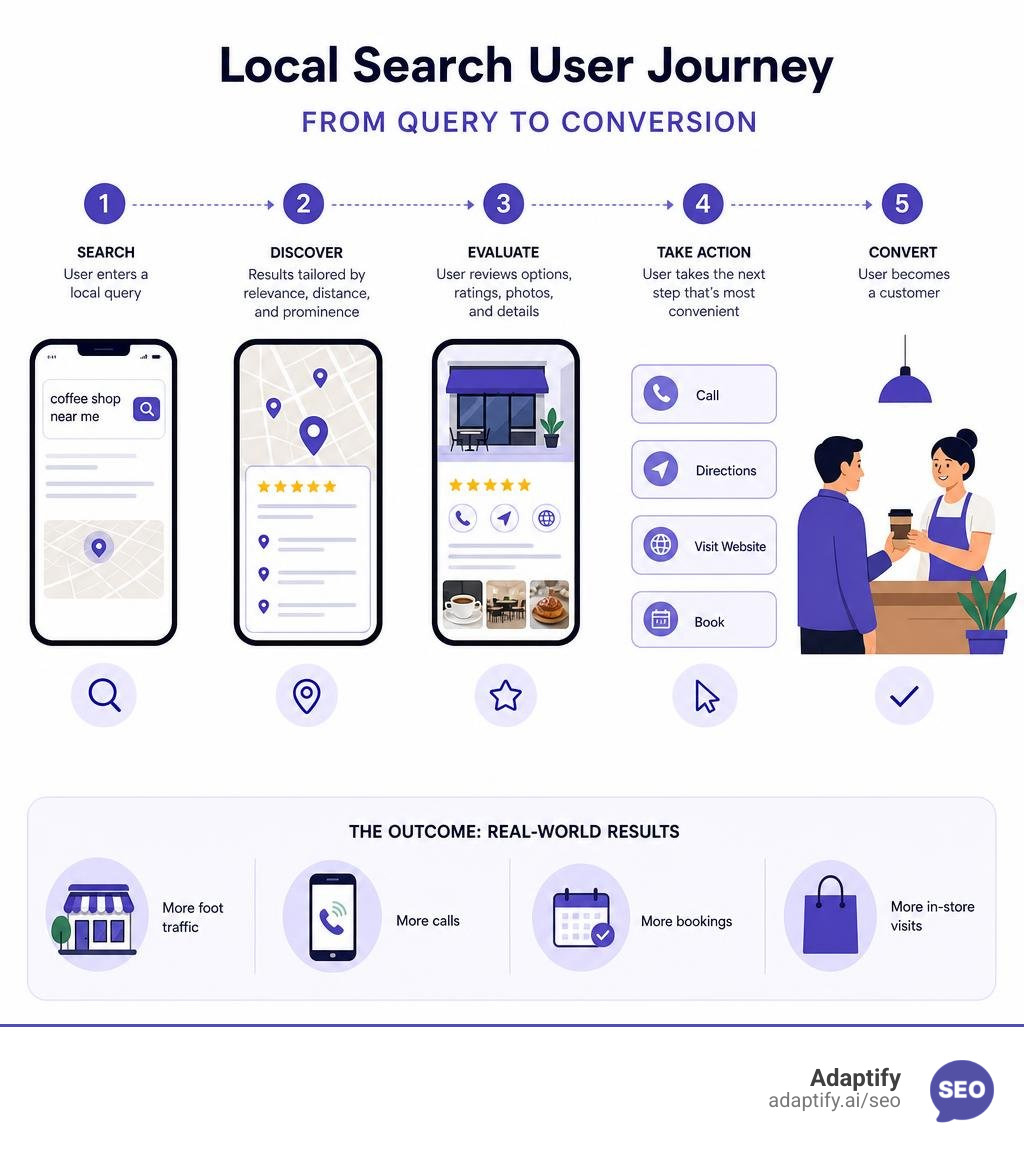
Understanding how search engines handle geography is the foundation of any local search campaign. Many business owners assume that ranking locally is simply a matter of tacking city names onto national keywords. In reality, modern search algorithms rely on sophisticated proximity signals and intent classification to serve hyper-relevant results.
When a customer searches with local search intent, they aren't looking for broad industry research. They need a quick, real-world solution. Whether it's an emergency pipe leak or a desire for artisanal coffee, search queries with localized intent carry significantly higher conversion rates than general informational searches.
Capturing these searches requires appearing in two distinct areas on Google: the Local Pack (the interactive map block showcasing three top local businesses) and standard organic rankings. When you optimize for the right terms, you position your business right where nearby customers are actively looking to make a purchase decision. For a complete look at building out your campaign, explore The Ultimate Guide to Local SEO Strategies.
Local search queries fall into two main categories: explicit and implicit.
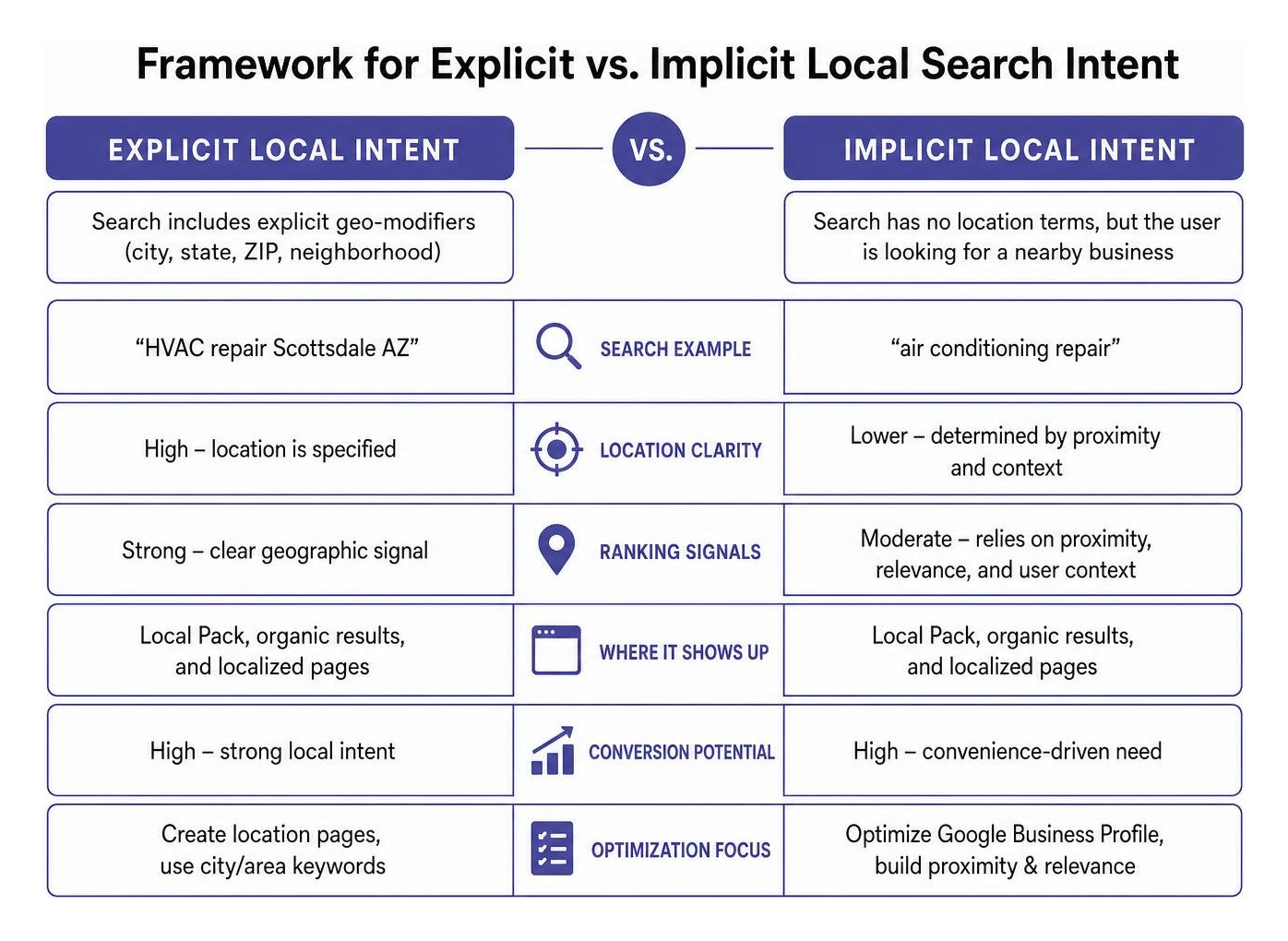
Here is how these two query types compare:
| Feature | Explicit Local Keywords | Implicit Local Keywords |
|---|---|---|
| Search Example | "HVAC repair Scottsdale AZ" | "air conditioning repair" |
| Geographic Signal | Direct text modifier in query | Physical GPS / IP proximity of searcher |
| Search Volume | Lower, but highly consistent | Higher national/regional reported volume |
| Primary SERP Driver | On-page content + local relevance | Proximity + Google Business Profile signals |
| Conversion Focus | Direct targeted service booking | Immediate, location-based customer need |
One of the most common mistakes I see local business owners make is forcing the phrase "near me" into their website content, page titles, and URLs.
Here is the truth: Google does not rely on on-page text to understand "near me" searches. Instead, search engines resolve "near me" queries by reading the user's real-time GPS coordinates, cell tower location, or IP address, and cross-referencing those signals with your Google Business Profile (GBP) address, review volume, and local citation signals.
Stuffing "near me" into your H1 headings looks spammy to users and provides zero algorithmic benefit. Focus instead on optimizing your physical address details, GBP categories, and neighborhood-level landing pages as highlighted in this guide to Going Hyperlocal The Ultimate Guide to Modern Local SEO Trends.

Executing a effective local keyword research strategy requires a clear, repeatable process. Rather than relying on guesswork, follow this practical, four-step workflow to identify and validate your best search opportunities.
Every successful research process begins with your real-world business data. Don't start in a keyword tool — start with your service catalog and customer interactions:
Once you have built your initial seed list, expand and validate it using reliable data sources:
That standard research tools routinely undercount local search volume, often displaying zero monthly searches for niche neighborhood terms that actually generate dozens of high-value calls each year.
Before assigning a keyword to a target page, always perform a quick live search engine results page (SERP) audit. Enter your keyword candidate into Google and note what appears:
Once you have compiled a list of hundreds of potential keyword variations, you must organize them into a clean, actionable hierarchy.
Not all keywords are created equal. Prioritize your list using commercial intent classification:
Avoid keyword cannibalization — the issue created when multiple pages on your site compete for the exact same query. Assign one primary target keyword cluster to each specific page:
/services/retaining-walls)./locations/cherry-creek). To master neighborhood-level optimization, check out Local SEO Help The Ultimate Guide to Dominating Your Neighborhood Search.Structure your URLs logically, using short, clean paths like domain.com/location/service-city.
For enterprises operating across multiple markets, avoid generating low-quality doorway pages where you simply swap city names on templated text. Search engines penalize thin, repetitive copy.
Instead, implement a robust Hub and Spoke structure:
Local search is evolving rapidly. Search engine updates and conversational AI tools have reshaped how customers discover local service businesses.
Google's AI Overviews now trigger on roughly 58% of question-based queries and 46% of multi-word search queries. Furthermore, while traditional Google searches average just 5 words, the average conversational search prompt spans nearly 350 words.
AI engines operate by taking a user's detailed query and fanning it out into synthetic sub-queries to retrieve concise answers. This shift makes strict exact-match keyword stuffing obsolete. Instead, winning visibility requires comprehensive topical authority and conversational context. Read more about this fundamental shift in Local SEO Is Dead Long Live GEO Boosting Local Visibility in AI.
To ensure your business is cited inside AI Overviews and conversational chat engines:
A single local landing page should focus on one primary "north star" keyword (e.g., "commercial roofing contractor Chicago") along with 3 to 5 supporting long-tail variations (e.g., "industrial roof repair Chicago," "flat roof replacement company"). Targeting dozens of unrelated terms on a single page dilutes search relevance.
Yes, absolutely. Keyword tools frequently undercount hyper-local search volume, often labeling long-tail terms as having 0 to 10 monthly searches. However, these highly specific queries carry intense commercial buying intent and often achieve conversion rates of 30% to 40%. A low-volume query like "emergency boiler repair Orchard Park NY" can easily drive thousands of dollars in direct revenue.
You should conduct a complete audit of your local keyword performance every 3 to 4 months. This allows sufficient time to gather ranking data in Google Search Console while identifying emerging seasonal search trends, new competitor service moves, or shifts in consumer phrasing.
Conducting effective local keyword research isn't a one-time setup task — it's an ongoing engine for revenue growth. By identifying real customer intent, mapping terms logically across your site architecture, and building topical depth for conversational AI search engines, you set your business up for sustainable local search dominance.
If managing local keyword tracking, landing page creation, and search updates manually feels overwhelming, automated platform workflows can help streamline your execution. Discover how to automate your localized strategy with The Local SEO AI Automation Playbook.
Ready to scale your local search rankings without the manual heavy lifting? Book a demo with Adaptify today and see how our automated SEO platform can drive real growth for your business.

Master SEO monitoring with key metrics and tools to track rankings, technical health, and organic growth for continuous performance optimi...

The Best Online Keyword Monitoring Tools for Real-Time Alerts - Learn about online keyword monitoring tool

Stop Flying Blind with These Top SEO Monitor Tools - Learn about seo monitor tools
Join 1,000+ agencies already delivering SEO and AI visibility from a single platform without increasing their headcount.Join 1,000+ agencies already delivering SEO and AI visibility from a single platform without increasing their headcount.