Big Sites, Bigger Buy-In: The Enterprise SEO Proposal Guide




To build a winning enterprise SEO proposal, agencies must deliver multi-stakeholder messaging tailored across executive, marketing, and engineering priorities, ground diagnostic audits in tangible pipeline revenue impact, and establish clear, phased 90-day roadmaps. Winning enterprise buy-in requires demonstrating commercial return on investment, mitigating technical risk across complex tech stacks, and providing executive clarity before detailing granular tactical execution.
Pitching a mom-and-pop shop usually means convincing one person who owns the business, manages the budget, and occasionally resets the Wi-Fi router. Pitching an enterprise brand is an entirely different game. Enterprise deals involve buying committees of 5 to 8 stakeholders, each with their own KPIs, professional anxieties, and veto power.
| Feature | SMB SEO Proposal | Enterprise SEO Proposal |
|---|---|---|
| Audience | Single business owner | 5–8 committee members (C-Suite, IT, Legal, Procurement) |
| Core Metric Focus | Keyword rankings & local traffic | Organic-attributed pipeline, CAC reduction, ARR |
| Technical Scope | Basic metadata & plugin fixes | Architecture, rendering, indexation ceilings, headless CMS |
| Governance | Informal / direct sign-off | Formal SLAs, MSA/SOW approval, security reviews |
| Roadmap Horizon | Month-to-month checklists | Phased 90-day milestones aligned with engineering sprints |
Navigating this matrix means your proposal cannot simply be a list of SEO deliverables. If you want to master the underlying structure, following The No-Fluff SEO Proposal Playbook for Winning Better Clients will help you cut through the administrative noise.
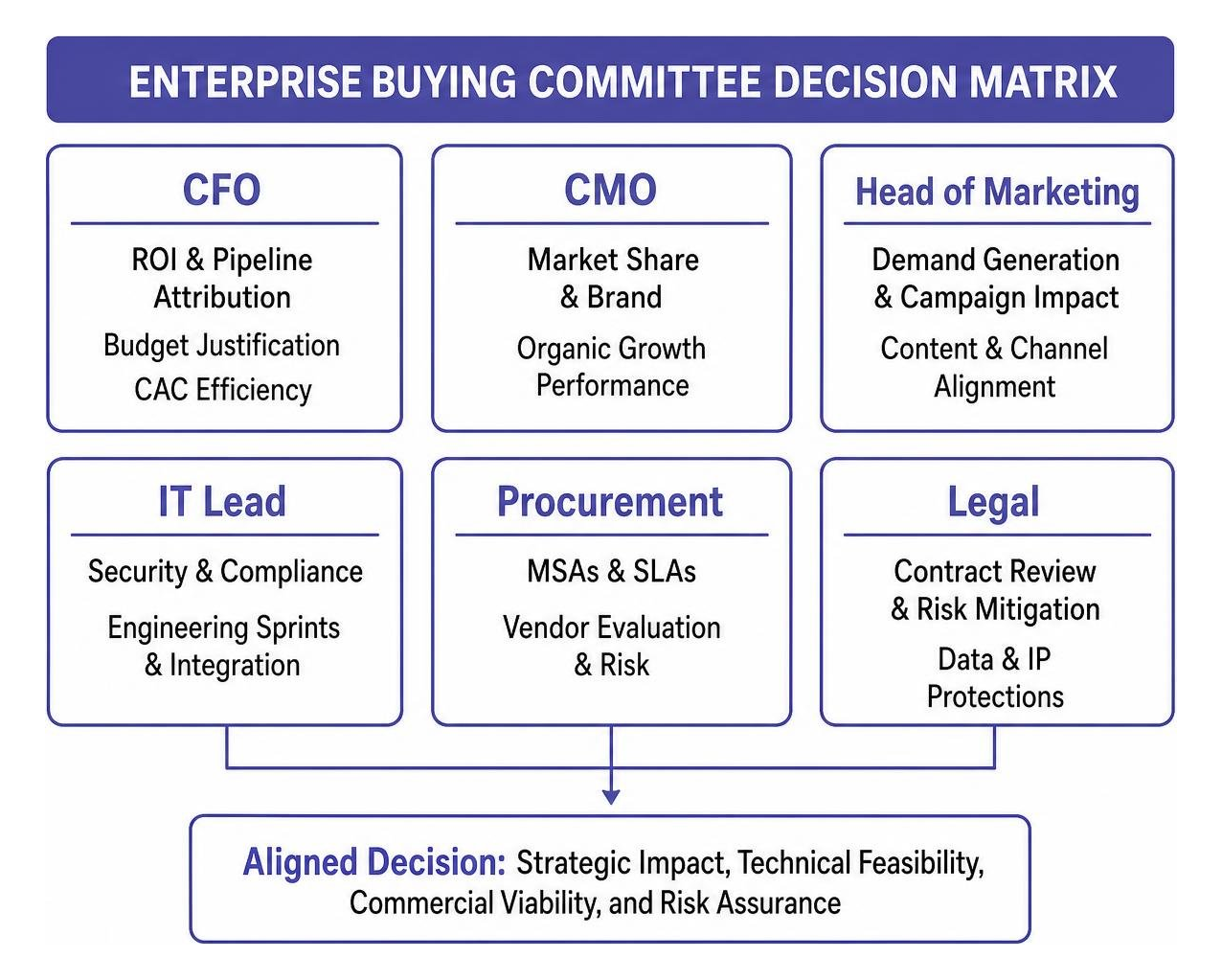
Each stakeholder reads your proposal through a distinct lens, evaluating how your program impacts their departmental roadmaps and performance metrics:
Your document must address these priorities in parallel. Show the CMO how you outrank key competitors, reassure the IT Director with clean code recommendations that respect existing deployment pipelines, and prove financial viability to the CFO with measurable forecasting models.
Agency teams often assume that pitching a massive enterprise brand requires a massive document. In reality, exhaustive 40-page PDFs create cognitive overload and stall procurement cycles. Data shows that proposals with tight document structures win more often: proposal length benchmarks show that proposals of six pages or less have a 66% higher acceptance rate.
Interactive, web-based proposals allow executive stakeholders to quickly skim financial and strategic summaries while allowing technical teams to expand sections on crawl architecture, rendering pipelines, and schema validation without cluttering the primary narrative.
An enterprise audit shouldn't just be an automated export of 10,000 broken image links or missing meta descriptions. It must highlight crawl equity limitations, internal linking bottlenecks, JavaScript hydration snags, and the critical distinction between direct commercial competitors and organic search competitors (such as publisher networks capturing high-intent search volume). To build credibility, ground your findings in standard technical crawl frameworks.
The executive summary is the most critical piece of the proposal because it is often the only section the entire buying committee reads. Write this section last so that it synthesizes every dimension of the pitch into an impactful, high-level strategic overview.
It should synthesize technical baseline findings, quantify market share gaps, and show projected organic pipeline gains. Backing up these strategic points with proven data, similar to the approaches highlighted in our Proof in the Pudding: SEO Agency Case Studies That Actually Delivered review, builds immediate confidence across the C-suite.
Enterprise organizations do not have time for generic task lists or unfocused site hygiene chores. Win enterprise deals by organizing your technical findings directly around commercial impact:
Quantifying the "cost of inaction" accelerates pipeline velocity. For instance, demonstrating that a brand loses $40,000 per month in organic traffic value to competitors creates immediate urgency across the entire buying committee. Sizing this opportunity proves the value of claiming search territory and turns organic search from a perceived operational expense into an indispensable revenue driver.
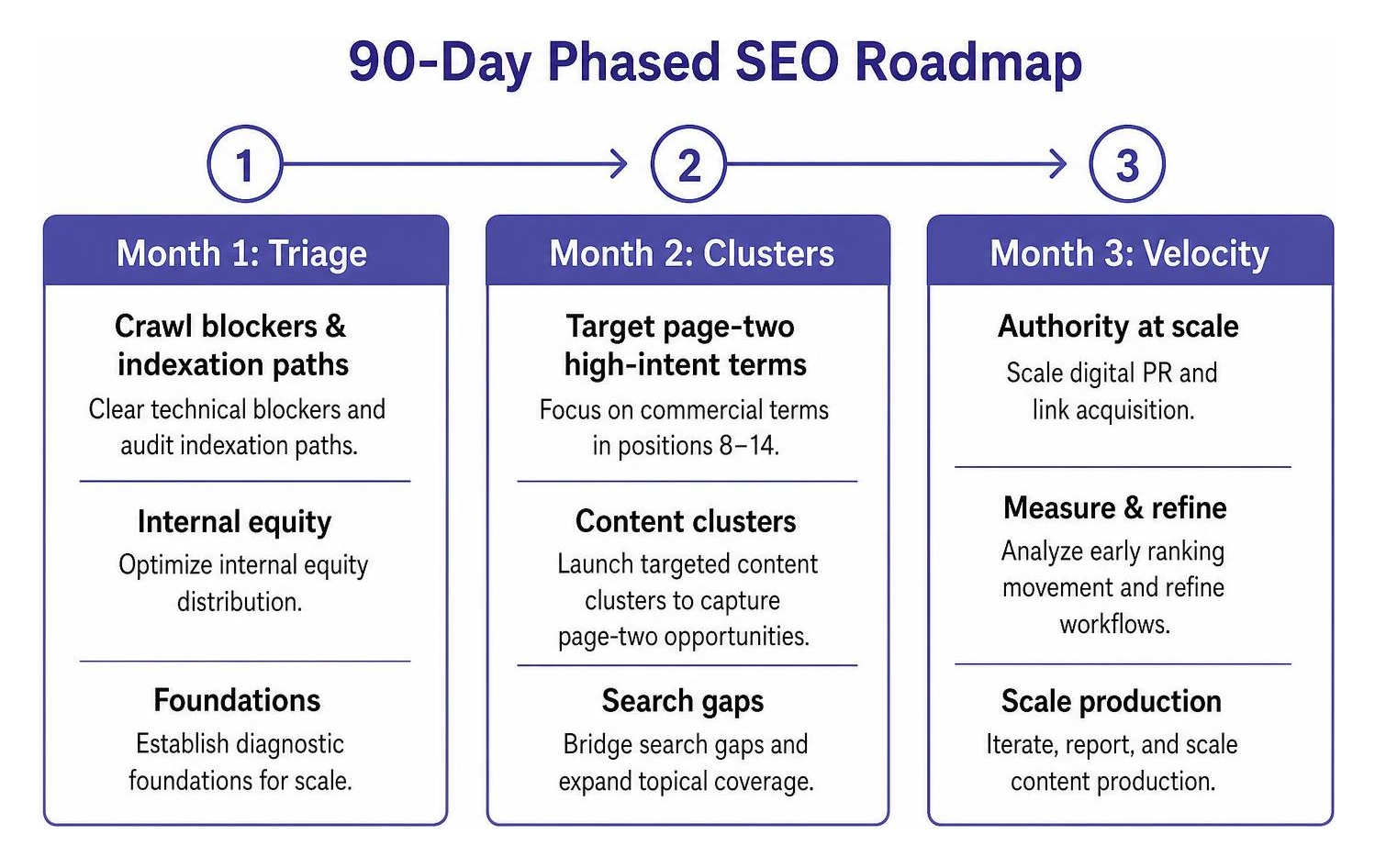
To build confidence across the client team, structure your plan into clear monthly blocks that integrate seamlessly into their operational rhythm:
Enterprise marketing leads require clear, continuous visibility into campaign performance. Outline your operational cadence clearly:
Agencies scaling this reporting cadence can explore Beyond the Basics: Everything You Need to Know About SEO Reporting Systems and deploy Automated SEO Reporting: The Secret Weapon for Agencies to keep stakeholders informed without wasting hours on manual decks.
Enterprise contracts typically use structured multi-tier monthly retainers, hybrid models (a foundational onboarding audit fee plus an ongoing retainer), or market-specific allocations based on business units and regional domains.
Ensure the proposal outlines the governance framework with strict clarity:
Never email an enterprise proposal cold without context. A live video walkthrough allows you to guide stakeholders through the strategy and address objections directly. In fact, agency teams frequently report a 20% increase in close rates simply by conducting live proposal walkthroughs instead of sending static PDFs.
Pairing interactive digital proposals with real-time viewer tracking lets you see which slides executive decision-makers review most before your follow-up call, giving you critical leverage during final negotiations.
Avoid these common missteps during the sales cycle:
Enterprise proposals address multi-stakeholder buying committees, custom development tech stacks, corporate procurement requirements, and revenue-based attribution models rather than basic local listings and surface-level keyword reports.
Quantify opportunity by calculating organic traffic value, competitive market share loss, and pipeline revenue potential tied directly to improving commercial page-two rankings.
Search engine algorithms and competitive environments shift continuously. Sophisticated enterprise buyers recognize that ranking guarantees are unrealistic; they value strategic roadmaps, rigorous execution, and transparent leading indicators instead.
Winning large accounts requires moving past generic service menus and delivering an enterprise SEO proposal that connects organic search directly to business growth. By tailoring your message to executive, marketing, and technical stakeholders, grounding your scope in diagnostic data, and outlining a dependable 90-day roadmap, you can consistently turn complex pitches into signed partnerships.
If you are looking to scale your agency's fulfillment and power your strategic delivery, discover how our automated SEO tools streamline organic execution across every client engagement.

Master SEO monitoring with key metrics and tools to track rankings, technical health, and organic growth for continuous performance optimi...

The Best Online Keyword Monitoring Tools for Real-Time Alerts - Learn about online keyword monitoring tool

Stop Flying Blind with These Top SEO Monitor Tools - Learn about seo monitor tools
Join 1,000+ agencies already delivering SEO and AI visibility from a single platform without increasing their headcount.Join 1,000+ agencies already delivering SEO and AI visibility from a single platform without increasing their headcount.