The Ultimate Guide to AI Visibility Tools for the 2025 US Market




The best GEO tools for AI search visibility in 2026 are no longer a nice-to-have — they're the difference between your brand being recommended by ChatGPT, Perplexity, and Google AI Overviews, or being completely invisible to millions of potential customers.
Here's a quick look at the top GEO tools worth evaluating right now:
| Tool | Best For | Starting Price |
|---|---|---|
| Profound | Enterprise AI analytics | $499/month |
| Evertune | Product narrative control | Custom pricing |
| OptimizeGEO | Full-funnel AI visibility | Custom pricing |
| Otterly AI | Affordable prompt tracking | $29/month |
| Writesonic GEO | AI-optimized content creation | $199/month |
| Peec AI | Real-time visibility alerts | €89/month |
| AthenaHQ | Mid-market growth teams | $49/month |
| GEO Optimizer | Open-source technical audits | Free (MIT) |
Search has fundamentally changed. When someone asks an AI assistant for a product recommendation or a solution to a problem, that AI doesn't return ten blue links. It picks two or three sources and presents them as the answer. If your brand isn't one of those sources, you don't exist in that moment.
The numbers make this hard to ignore. 89% of B2B buyers now use AI platforms like ChatGPT for research. Brands in the top 25% by web mentions receive roughly 169 citations in Google AI Overviews — about 10 times more than average. And yet, 63% of companies still aren't dedicating any time, budget, or staff to Generative Engine Optimization (GEO).
That gap is the opportunity — but only for those who move quickly and with the right tools.
Traditional SEO metrics simply don't capture what's happening in AI-driven search. Keyword rankings don't tell you whether ChatGPT mentions your brand. Domain authority doesn't predict whether Perplexity cites your content. A new category of tools has emerged specifically to track, measure, and improve your visibility inside AI-generated answers — and this guide compares the best of them.
I'm Hansjan Kamerling, product designer and marketing consultant at Adaptify AI, with experience building products across fintech, SaaS, and growth-stage startups — including platforms with custom-trained AI models used by over 40,000 users. I've spent considerable time researching and testing the best GEO tools for AI search visibility in 2026, and what follows is a practical, no-fluff comparison designed to help agency owners and marketing teams make a confident decision.
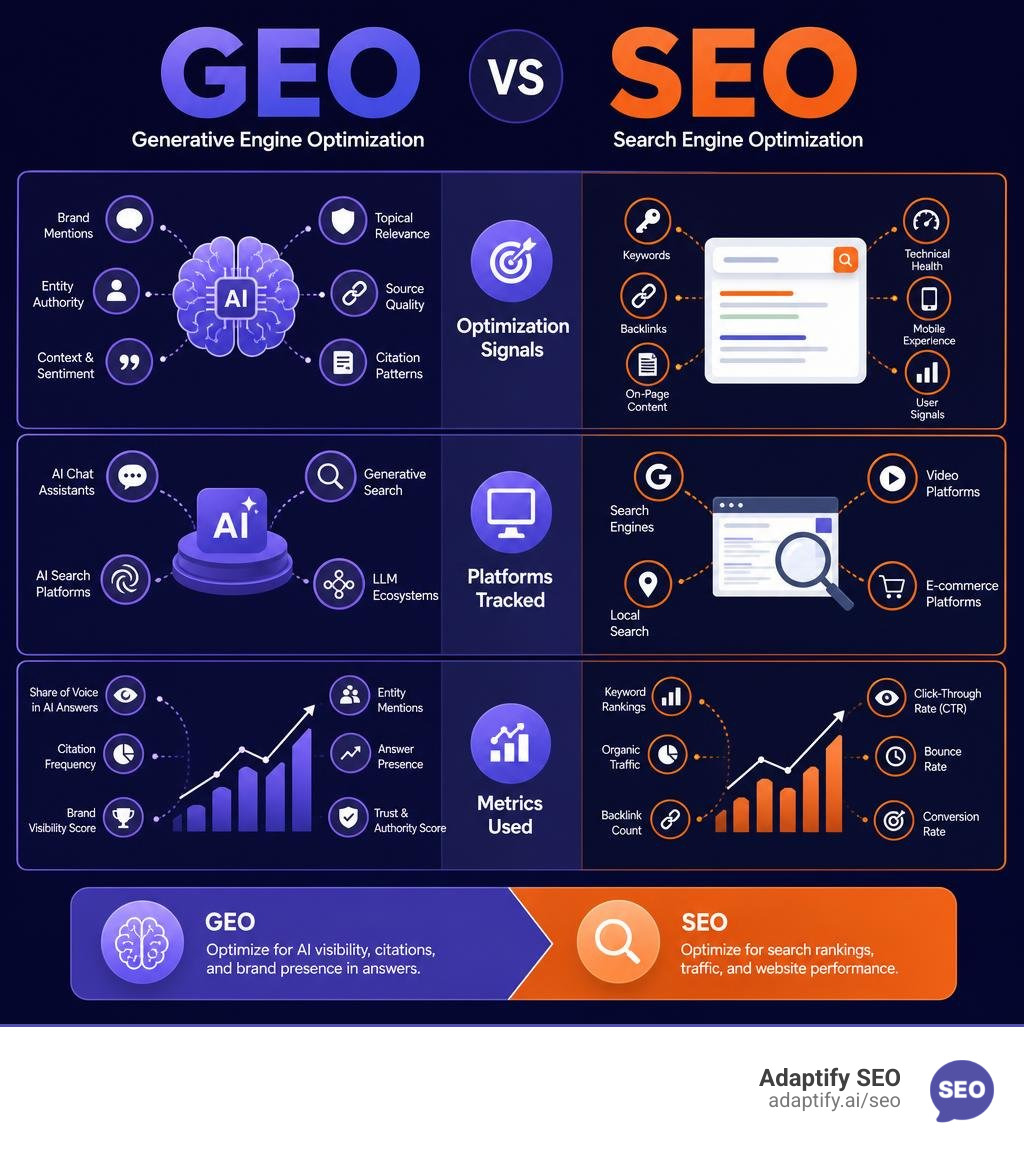
Choosing the right tool to measure and grow your brand's presence inside LLMs (Large Language Models) requires looking past traditional search engine parameters. Instead of focusing on search volume and backlink quantities, we must evaluate platforms based on how effectively they track AI visibility, Share of Voice (SoV), entity authority, brand mentions, and citation patterns.
To understand why traditional SEO tools leave you blind in the AI age, we have to look at how generative engines select and synthesize information. AI search operates on two primary gates:
AI engines prioritize multi-source verification and entity authority over keyword density. They build a "Source Stack"—a hierarchy of trust where verified databases and highly active community forums (like Reddit, which saw a 450% increase in citations inside AI overviews in just three months) sit at the top.
If you want a complete breakdown of these mechanics, check out our Beginner's Guide to Geo AI SEO.
Despite this clear shift, only 9% of marketing resources are currently dedicated to GEO. If you feel slightly out of depth here, you are in good company: only 1 in 3 marketers feel they understand GEO well, compared to 72% who feel confident in traditional SEO.
By optimizing your technical infrastructure and content structure for machine readability, you can boost your brand's AI search visibility by almost 40%. The era of local map-packs is shifting rapidly too; you can read more about this transition in Local SEO is Dead, Long Live Geo: Boosting Local Visibility in AI.
When auditing tools for your marketing stack, look for these advanced capabilities:
llms.txt files (the robots.txt of the AI era) and rich JSON-LD schema templates. Proper schema markup can lift LLM data extraction accuracy from a meager 16% to 54%.Trying to track these complex, dynamic variables by manually typing prompts into ChatGPT is a recipe for madness. To understand why, read our guide on Professional Tools for Geo: Why Manual Tracking is a Losing Game.
Let's explore the leading commercial platforms dominating the market.
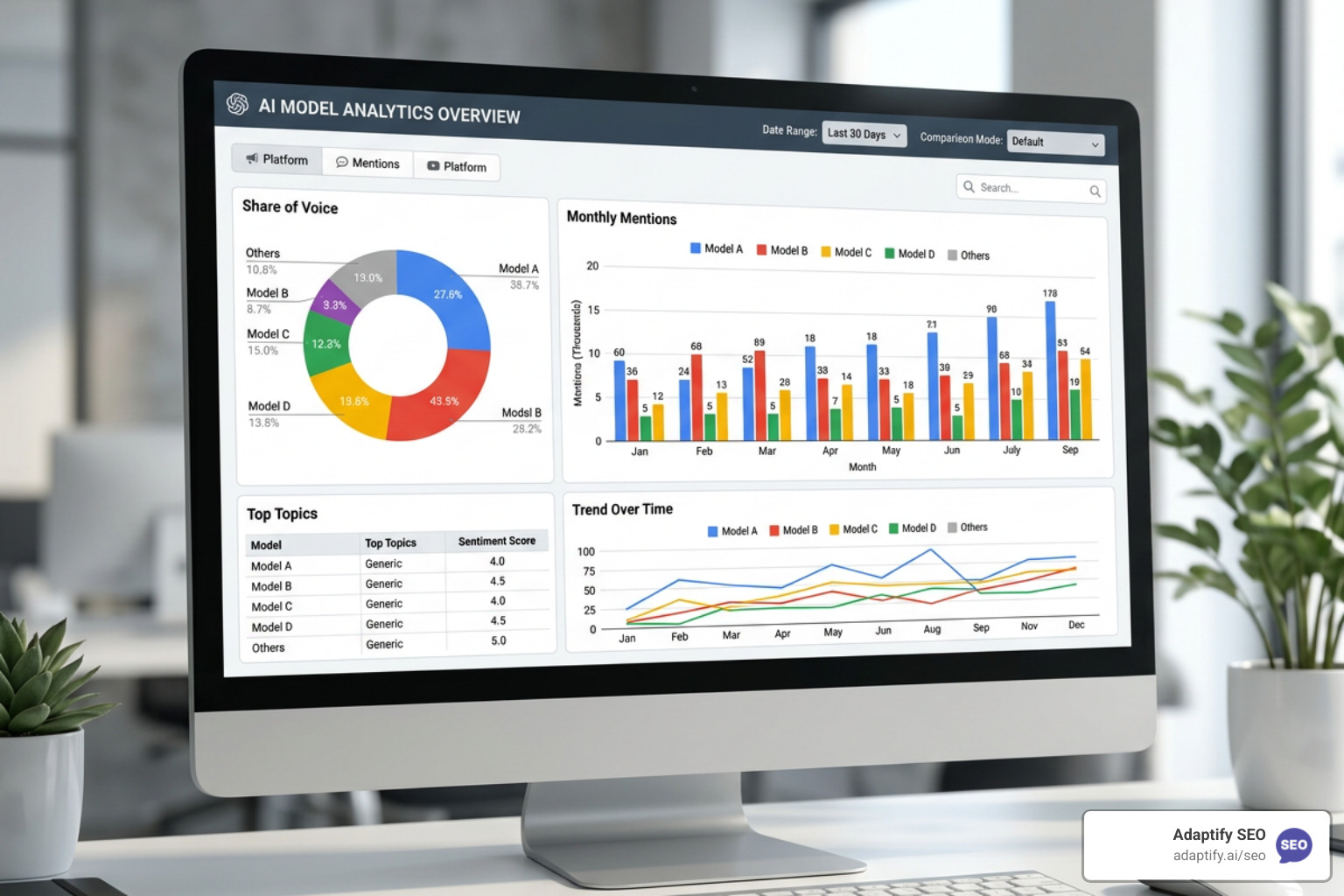
Profound is widely regarded as a heavy hitter for enterprise-level analytics. It offers deep access to massive prompt datasets (over 261 million globally) and tracks how products are recommended during complex AI shopping journeys.
Evertune excels at product narrative control and brand awareness mapping. It uses a demographically weighted panel of 25 million users to measure real-world consumer experiences alongside direct API model testing.
OptimizeGEO is a comprehensive platform built to monitor ChatGPT, Gemini, Perplexity, Claude, Copilot, and Google AI Overviews. It includes an "Accuracy Score" feature that fact-checks AI responses against your official brand documentation to catch hallucinations.
For mid-market teams, Otterly AI offers highly practical, cost-effective prompt-specific tracking starting at just $29/month. Writesonic’s GEO Suite ($199–$499/month) is highly execution-focused, featuring built-in content optimization workflows that generate AI-citable articles and FAQs.
For a deeper analysis of how these tools perform side-by-side, check out our review of The Best AI-Powered Geo SEO Platforms for 2026.
| Feature | Profound | Evertune | OptimizeGEO | Otterly AI | Writesonic GEO |
|---|---|---|---|---|---|
| Target Audience | Enterprise | Mid-to-Enterprise | Mid-to-Enterprise | SMBs / Startups | Content Teams |
| Direct API Tracking | Yes | Yes | Yes | No (Scraped) | Partial |
| Sentiment Analysis | Yes | Yes | Yes | Basic | No |
| llms.txt Generation | No | Yes | Yes | No | Yes |
| Workflow Execution | No | No | Yes (Agents) | No | Yes |
If you have developer resources or manage a technical SEO team, you don't necessarily have to start with expensive enterprise software. Excellent open-source toolkits exist to audit your infrastructure.

geo-optimizer-skill): A brilliant MIT-licensed CLI tool built for Claude Code and terminal environments. It runs comprehensive audits on your site's AI-readiness, scores you from 0 to 100, and checks if actual AI engines are citing your domain. You can even integrate it into your CI/CD pipeline to fail website builds if your AI-readiness score drops below a certain threshold.geo-lint (@ijonis/geo-lint): This is an agent-first open-source linter. It contains 36 dedicated GEO rules that scan your markdown or HTML files for "weak lead sentences," low citation density, or missing tables (AI engines cite structured tables far more often than raw prose).madeburo/GEO-AI): A zero-dependency TypeScript engine designed to generate dynamic llms.txt and llms-full.txt files directly from your CMS (like Strapi, WordPress, or Shopify) while managing AI crawler access and rate-limiting bots.Using these tools to secure your site's technical foundation is highly recommended. To get started, read our Expert Tips for Improving Your Geo Score.
Measuring the return on investment for GEO requires a shift in mindset. Because generative search often results in "zero-click" sessions where the user gets their answer without visiting your site, traditional click-through rates (CTR) won't tell the whole story.
Instead, you must track:
With 41% of companies planning to increase their GEO budgets, establishing a clear baseline now is critical. Learn how to set up your tracking metrics with our guide: Stop Guessing and Start Benchmarking Your AI Search Performance.
Navigating the transition from traditional search engines to generative AI models can feel overwhelming, especially for busy marketing agencies managing dozens of client accounts.
That is where Adaptify.ai comes in. We offer a fully automated SEO and GEO solution built specifically for agencies. Instead of wasting hours manually analyzing citation patterns or rewriting blog posts, our platform automates the entire process:
By combining technical optimization with automated execution, we help you secure your brand's place in the future of search. Discover how we can scale your agency's workflows by reading The New Frontier: Integrating AI and Geo for Business Growth or explore our Adaptify AI Visibility Features to start optimizing your digital footprint today.

Stop being invisible: discover what the best local SEO strategies for small businesses are to dominate Google Maps, reviews, and AI search...
Master localized SEO to rank your local business in Google Maps and drive more in-store visits.

Master local retail SEO to drive foot traffic from Google with proven strategies for GBP, reviews, and AI search optimization.
Join 1,000+ agencies already delivering SEO and AI visibility from a single platform without increasing their headcount.Join 1,000+ agencies already delivering SEO and AI visibility from a single platform without increasing their headcount.