Stop Guessing Your Rankings: How to Use a SERPs Tracking Tool

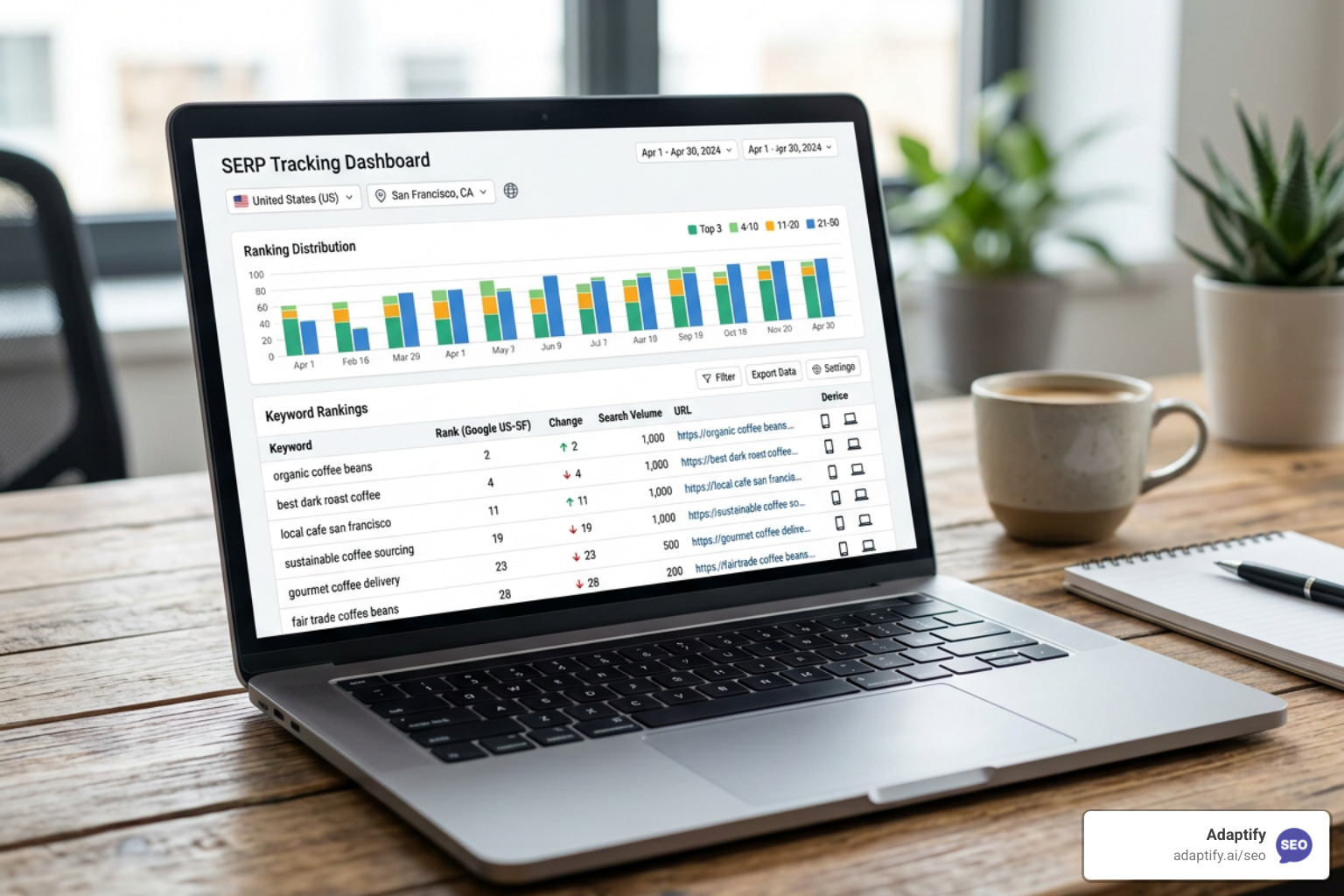

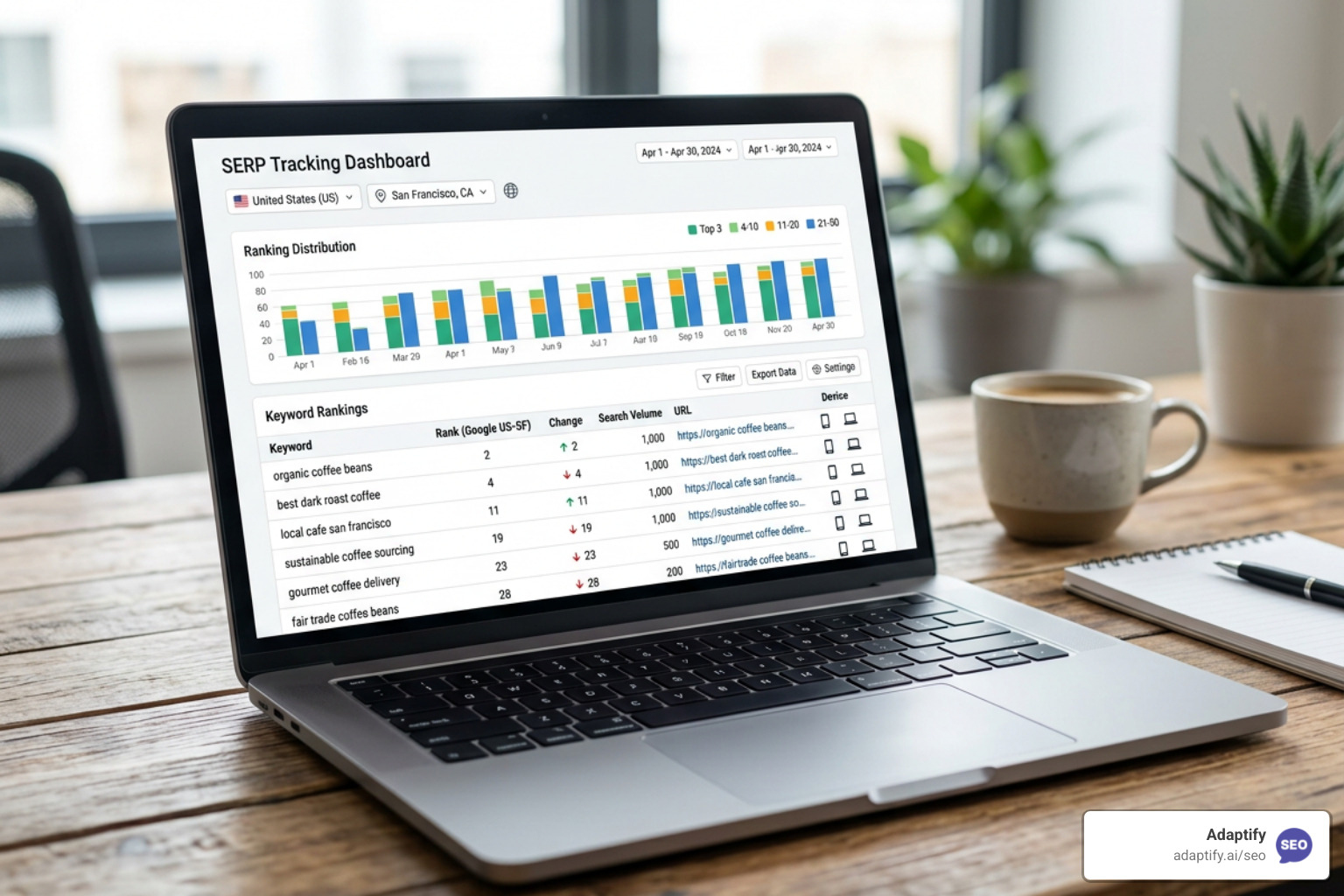
A serps tracking tool is software that automatically monitors where your website ranks in search engine results pages for a set of target keywords — across locations, devices, and search engines — without you having to check manually.
Here's what a SERP tracking tool does at a glance:
If you've ever typed a keyword into Google and counted down to find your client's listing, you already know the problem. It's slow. It's inaccurate. And Google personalizes results based on your location, search history, and device — so what you see isn't what your client's customers see.
For agencies managing multiple clients across dozens of keyword sets, manual checking isn't just inefficient. It's actively misleading.
The scale of the problem is real: Google holds around 87% of the global search market, and roughly half of all web traffic comes from mobile devices. That means you're not tracking one search landscape — you're tracking many, all at once.
I'm Hansjan Kamerling, a product designer and marketing consultant at Adaptify AI who has worked with SaaS platforms, data analytics tools, and growth-stage startups on making complex data — including serps tracking tool outputs — simple and actionable for teams. In that work, I've seen how the right tracking setup can transform guesswork into a repeatable growth system.
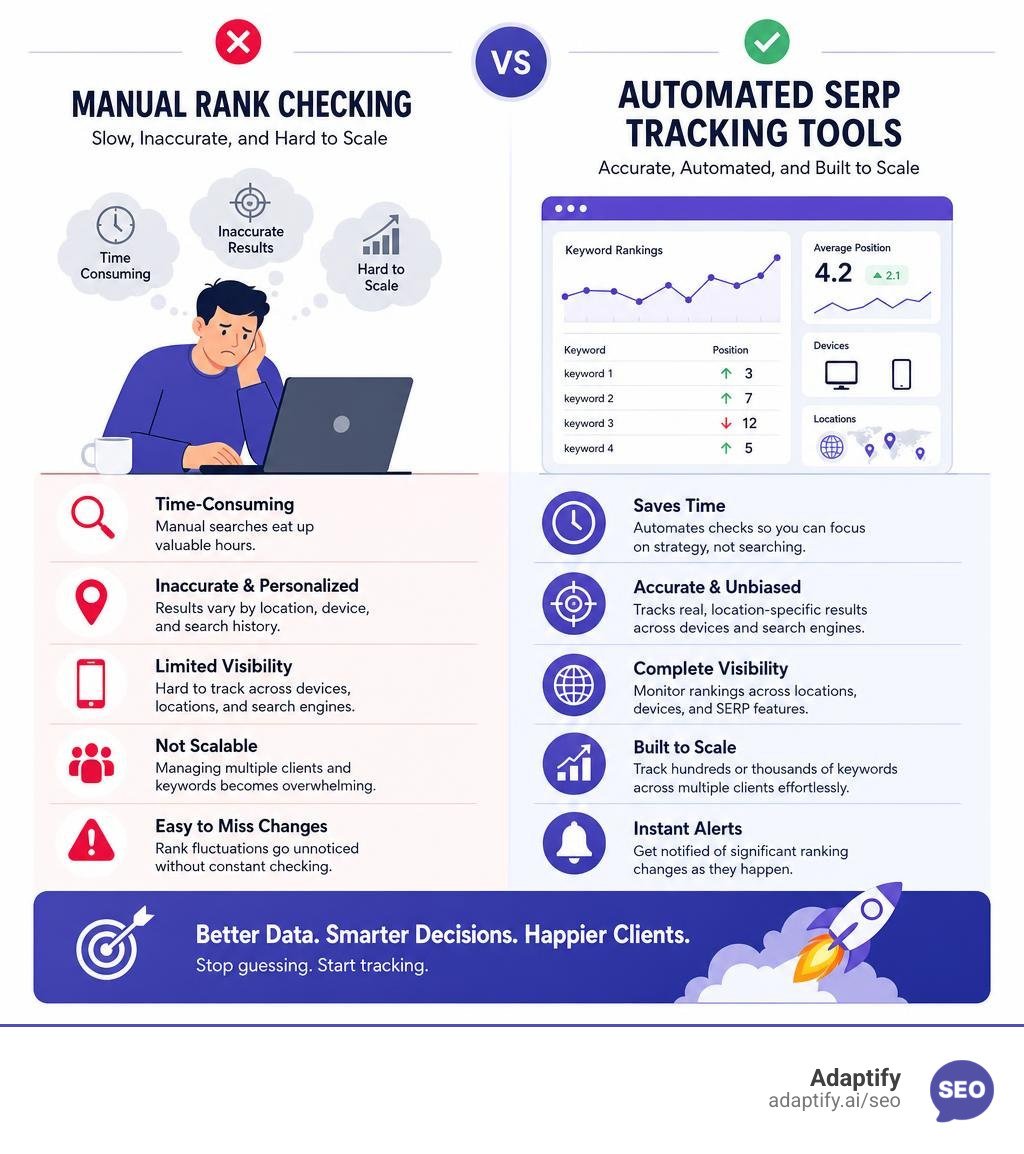
Let's be completely honest: the days of relying on manual Google searches to report rankings to your clients are long gone. Search engines have evolved into highly complex, personalized, and localized ecosystems.
When you perform a manual search, Google uses your search history, active Google account, browser cookies, and physical IP address to tailor the results. This personalization means your "Position 3" ranking might actually be "Position 8" for a user sitting just two zip codes away.
Furthermore, Google has strict scraping restrictions. If you try to check hundreds of keywords manually or with cheap, unpolished scripts, you will quickly run into CAPTCHAs and blocked IPs.
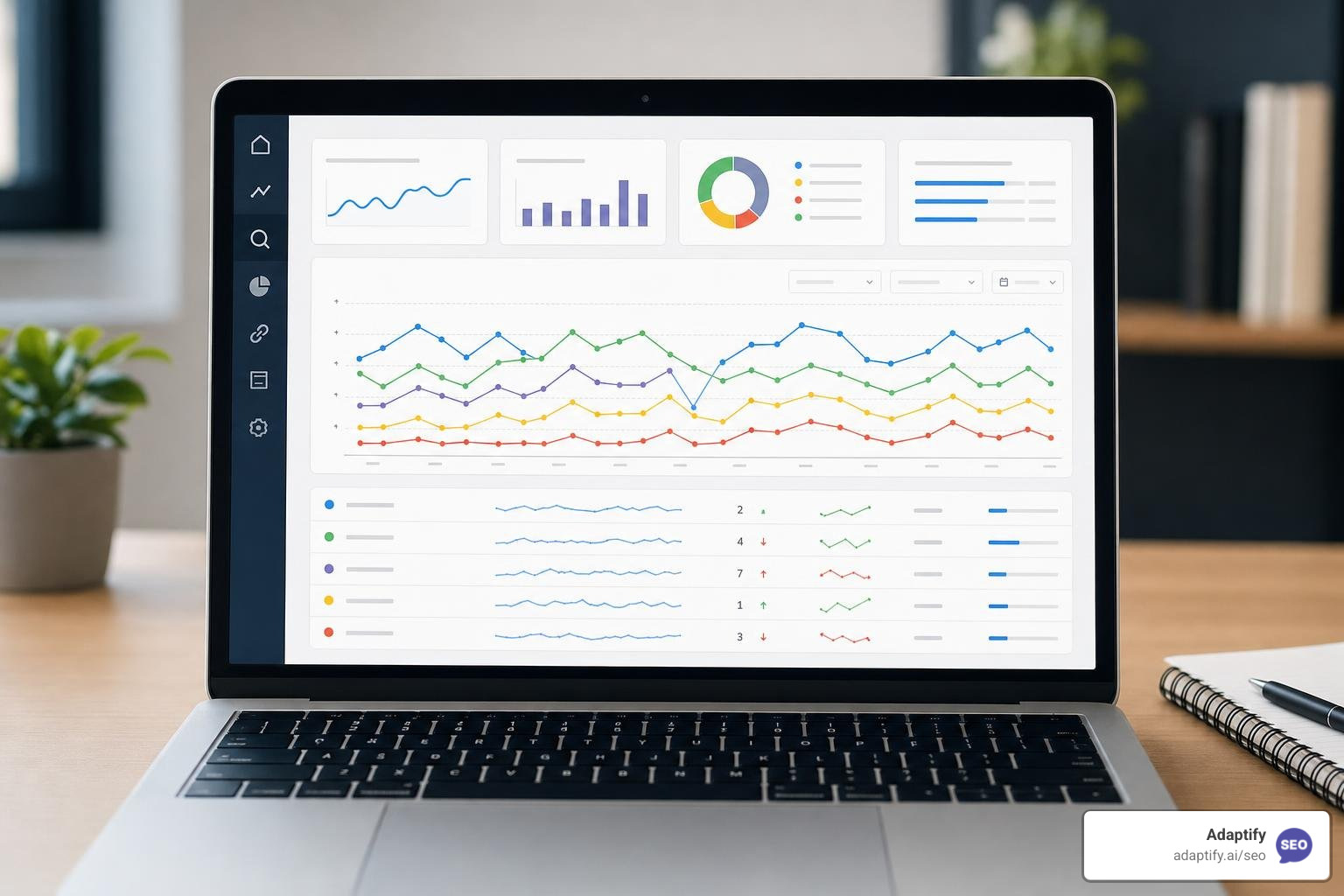
Automated tracking solves this by querying search engines through clean, proxy-supported systems that simulate unbiased, real-world searches. This is why automated tracking is crucial for maintaining reporting integrity. If you want to dive deeper into why transitioning to automated systems is non-negotiable for growing brands, read our guide on Stop Guessing and Start Tracking with SEO Ranking Monitoring.
By switching to a modern serps tracking tool, your agency can:
To master this transition and make sure you are tracking like a seasoned professional, check out our insights on Climbing Google's Ladder – Tracking Your Keyword Rankings Like a Pro.
Not all tracking software is built equal. When you are looking to invest in a serps tracking tool, you should evaluate options based on these six foundational pillars:
For a comprehensive breakdown of advanced monitoring features, you can explore the SERP Analyzer & Monitoring Platform | SERPs.io .
In the early days of SEO, rank tracking was simple: you were either at Position 1, Position 5, or off the first page. Today, search engine results pages are packed with rich interactive elements.
If your client ranks Position 1 organically, but Google places an AI Overview, a Local Pack, three sponsored ads, and a "People Also Ask" (PAA) block above them, your client is effectively pushed below the fold.
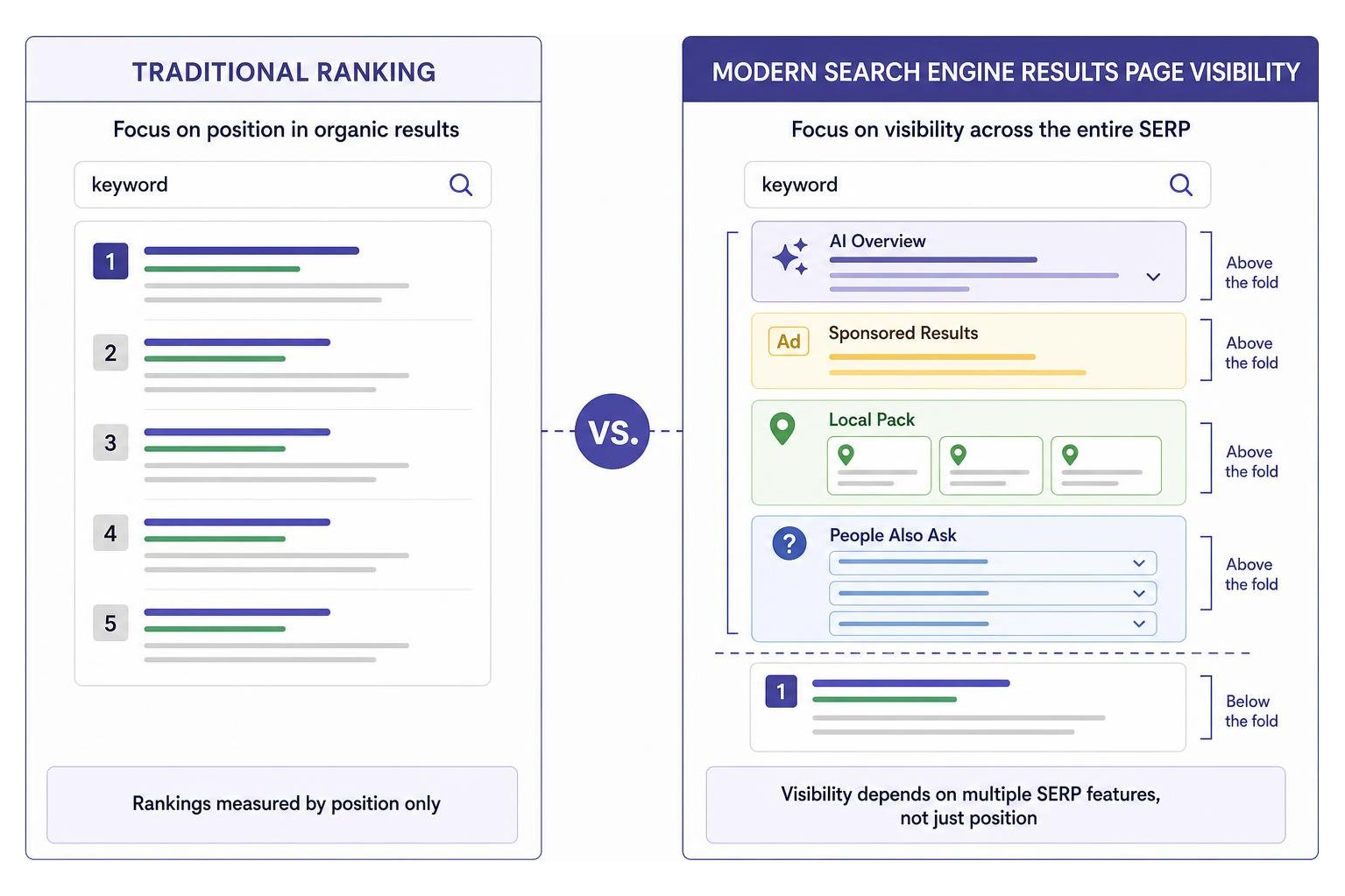
This is why modern SEOs focus on visibility tracking rather than raw position lists. A robust tracker monitors your share of voice across various SERP features:
If you want to understand how to turn these complex SERP features into a cohesive ranking strategy, take a look at Tracking Triumph: How to Monitor Your Keyword Rankings.
Search is undergoing its most radical transformation in decades. Users are no longer just clicking blue links; they are asking conversational questions to AI engines.
Modern serps tracking tool setups must adapt to track AI citations and conversational search visibility. If your brand is cited in a ChatGPT response, a Claude query, a Perplexity answer, or a Google AI Overview, that is highly valuable real estate.
Tools like SERPs.io and specialized AI trackers now calculate an AI Visibility Score (ranging from 0 to 100). They monitor how often your brand is mentioned across Gemini, Grok, and other LLMs. If you are optimizing for these platforms, tracking these citations is just as critical as tracking your traditional Google organic positions.
To help you find the perfect match for your agency or in-house team, let's compare some of the top-performing SERP trackers on the market:
| Tool | Starting Price | Best For | Key Strength |
|---|---|---|---|
| AccuRanker | $129/mo | Large Agencies | On-demand refreshes & speed |
| SERPWoo | $49.95/mo | Niche Marketers | Deep SERP analysis & historical monitoring |
| Pro Rank Tracker | $13.50/mo | Small Teams | Amazon tracking & white-label reports |
| SE Ranking | $65/mo | All-in-One Users | Keyword clustering & core SEO tools |
| Wincher | $49/mo | Beginners | Simplicity & clean user interface |
| Nightwatch | $39/mo | Local SEOs | Visual dashboards & map tracking |
| FreeSERP | Free / $20 one-time | Solo SEOs & Startups | Unmatched affordability & zero-expiry checks |
If you run campaigns for local service businesses or global e-commerce brands, national-level tracking is essentially useless. You need to segment your data based on where the searches are actually happening.

With over half of all web traffic coming from mobile devices, Google uses mobile-first indexing. Mobile SERPs look drastically different from desktop SERPs, often prioritizing local maps and shorter, punchier featured snippets. Your tracker must monitor both to ensure you aren't losing mobile visibility.
For local businesses, a ranking drop of two blocks can mean the difference between a ringing phone and silence. Advanced trackers use GeoGrid tracking to visualize rankings across specific map points or zip codes. For a deep dive into hyper-localized tracking strategies, read our guide on Local Rank Tracking: The Secret Sauce for Hyperlocal Visibility.
If you are still trying to track local clients manually, you are fighting a losing battle. Find out why in Professional Tools for GEO: Why Manual Tracking Is a Losing Game.
A serps tracking tool shouldn't just be a scoreboard; it should be an engine for growth. Here is how I recommend using your ranking data to drive strategy:
To set up your workspace for automated, hands-off reporting that alerts you to these changes instantly, follow our step-by-step framework in How to Set Up Automated SEO Monitoring for Success.
As search engines continue to integrate AI, local maps, and complex rich snippets, keeping up manually is impossible. The agencies that win are those that automate their tracking workflows so they can spend their time on what actually matters: strategy, content, and growth.
At Adaptify, we take this a step further. We don't just help you track your search presence; we automate your entire SEO execution. From reverse-engineering keyword strategies to generating high-quality, search-intent-aligned content and building high-authority PR backlinks, Adaptify acts as an automated SEO team for busy agencies.
If you want to build a search strategy that stands the test of time and algorithm updates, check out our guide on Future-Proof Your Rankings: A Guide to Scalable SEO Tools.
Ready to stop guessing and start scaling? Explore Adaptify’s automated SEO platform or schedule a live demo with our team today.

Stop being invisible: discover what the best local SEO strategies for small businesses are to dominate Google Maps, reviews, and AI search...

Master localized SEO to rank your local business in Google Maps and drive more in-store visits.

Master local retail SEO to drive foot traffic from Google with proven strategies for GBP, reviews, and AI search optimization.
Join 1,000+ agencies already delivering SEO and AI visibility from a single platform without increasing their headcount.Join 1,000+ agencies already delivering SEO and AI visibility from a single platform without increasing their headcount.